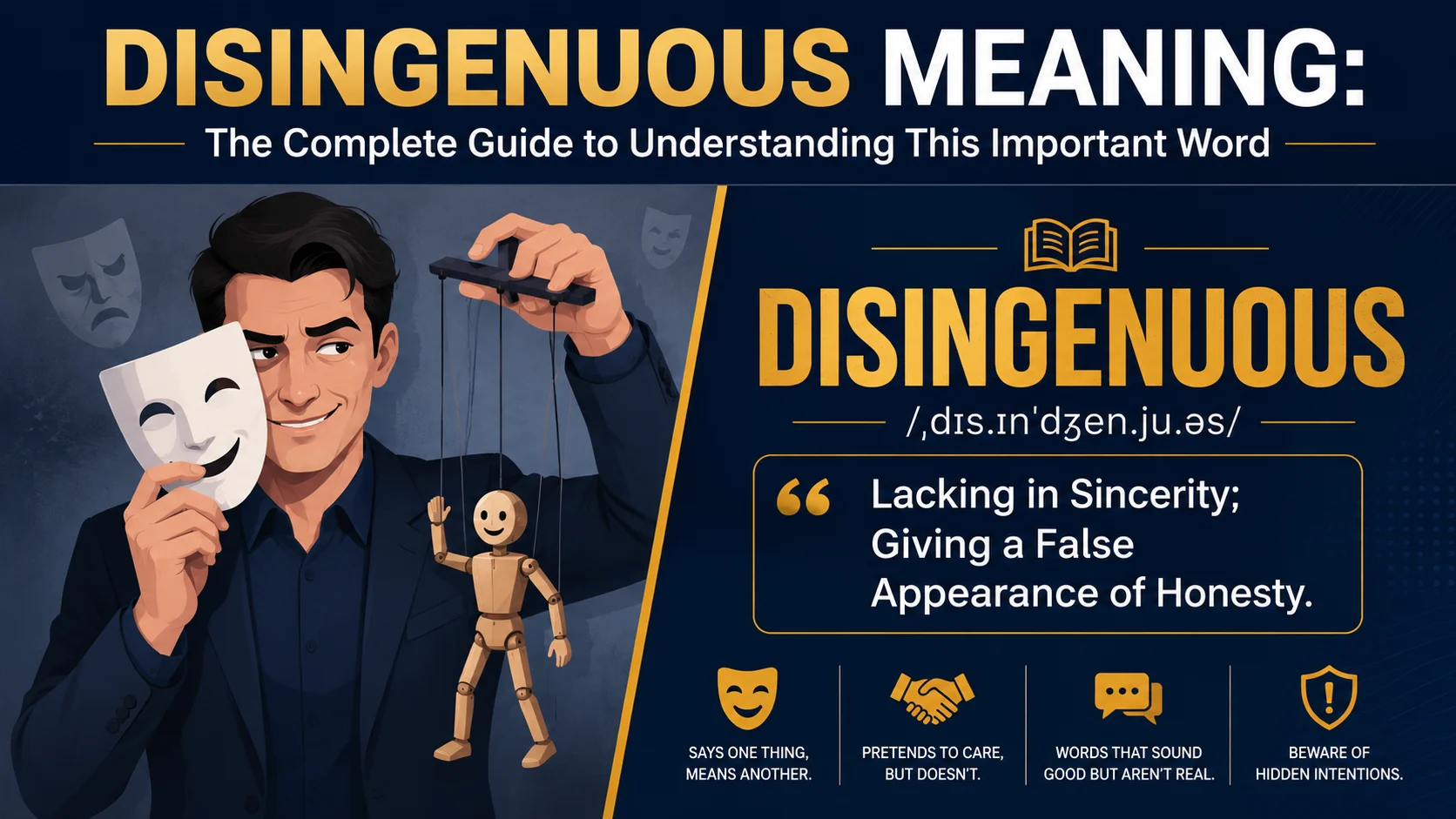
Disingenuous is an adjective that describes someone who is not being completely honest or sincere, often by pretending to be less informed or more innocent than they truly are. It refers to a calculated lack of frankness, where a person gives a false appearance of honesty while concealing an ulterior motive.
Have you ever had a conversation with someone who seemed to be asking innocent questions, but you felt they already knew the answers? Or perhaps you have encountered a politician who appeared honest but you suspected they were hiding something? That feeling you experienced is the essence of the word disingenuous.
Understanding the disingenuous meaning is important because it helps you recognize when people are not being completely straightforward with you. It is a word that pops up in news articles, political commentary, and everyday conversations about trust and honesty. Knowing what it means and how to use it can make you a more perceptive communicator.
The challenge with disingenuous is that it is often confused with similar words like “ingenuous” and “ingenious.” People also sometimes misuse it to mean simply “naive,” which is incorrect. This confusion can make people hesitant to use the word correctly.
This article clears up the confusion around disingenuous once and for all. You will learn its definition, see real examples, and discover how to use it correctly. By the end, you will confidently understand and use this powerful word. Good vocabulary depends on knowing these subtle distinctions.
The main takeaway is that disingenuous describes behavior that is insincere, dishonest, or lacking in candor. It involves giving a false impression of being honest or innocent while actually having hidden motives. It is the opposite of ingenuous, which means innocent and straightforward. The word comes from Latin roots meaning “not freeborn” or “not noble,” and it has been used in English since the 17th century.
Definitions and Explanations
What Does “Disingenuous” Mean?
The disingenuous meaning centers on the idea of insincerity and calculated dishonesty. According to Merriam-Webster, it means “lacking in candor” and “giving a false appearance of simple frankness . The dictionary defines it as “lacking in frankness, candor, or sincerity; falsely or hypocritically ingenuous; insincere” .
A disingenuous person is not simply lying outright. Instead, they are often pretending to be more innocent, ignorant, or honest than they really are. They might ask “innocent” questions that are actually designed to trap you or lead you to a specific conclusion. They might express concern that is actually self-serving .
The word describes things like:
- Speech or behavior that gives a false appearance of honesty
- A person who seems sincere but is actually pretending to be open and candid
- Remarks that contain a hint of truth but are delivered with intent to deceive
- Questions asked in “bad faith” to exhaust or manipulate someone
| Aspect | Description |
| Part of speech | Adjective |
| Definition | Lacking in candor; insincere; giving a false appearance of frankness |
| Pronunciation | /ˌdɪs.ɪnˈdʒen.ju.əs/ |
| Synonyms | Insincere, hypocritical, deceptive, calculating, dishonest |
| Antonyms | Sincere, honest, frank, straightforward, genuine |
The Etymology of Disingenuous
Understanding where disingenuous comes from helps you remember its meaning. The word entered English around 1645-1655 . It is formed by combining the negative prefix dis- with the word ingenuous .
Ingenuous comes from the Latin word ingenuus, which originally meant “native” or “freeborn.” In ancient Rome, this distinguished free-born citizens from slaves. Over time, ingenuous came to mean “noble and honorable,” and eventually “showing childlike innocence” or “lacking guile .
When English speakers added the negative prefix dis- to ingenuous, they created disingenuous, meaning “guileful” or “deceitful” . It literally means “not innocent” or “not honest.
| Word Part | Meaning |
| dis- | “not” or “opposite of” |
| ingenuous | “honest,” “innocent,” “freeborn” |
| -ous | “having the quality of” |
Disingenuous vs. Ingenuous: The Crucial Difference
A key to understanding the disingenuous meaning is knowing its relationship to ingenuous. These words are opposites.
Ingenuous means “innocent or trusting . It describes someone who is open, honest, and straightforward. An ingenuous person does not hide their feelings or motives. They are naive in a charming way.
Disingenuous means “insincere, hypocritical, devious or dishonest . It describes someone who pretends to be ingenuous but is actually calculating and deceptive.
For example, a child might give an ingenuous smile—innocent and genuine. A politician might give a disingenuous smile—seeming sincere but actually hiding something.
| Term | Meaning | Example |
| Ingenuous | Innocent, trusting, straightforward | “The toddler broke into an ingenuous grin.” |
| Disingenuous | Insincere, hypocritical, deceitful | “Lee tried to appear innocent, but I recognized her disingenuous tricks.” |
Disingenuous vs. Ingenious: Another Common Confusion
People often confuse disingenuous with ingenious, but these words are entirely different.
Ingenious refers to cleverness or inventiveness . An ingenious person is smart and creative. An ingenious solution is clever and effective.
Disingenuous refers to insincerity or dishonesty. It has nothing to do with being clever, though a disingenuous person might use their cleverness to deceive.
For example, “Craig is so ingenious that he can build toys from scraps” . This describes cleverness, not dishonesty. “Her excuse was rather disingenuous” . This describes insincerity, not cleverness.
Advantages and Disadvantages
Advantages of Using “Disingenuous”
Precision in description: Using disingenuous allows you to describe a specific type of dishonesty—one that involves pretending to be sincere or innocent. It captures a nuance that simpler words like “dishonest” or “insincere” might miss.
Powerful criticism: Calling someone or something disingenuous is a strong criticism. It suggests that the person is not just lying, but is manipulating the situation by pretending to be something they are not.
Understanding manipulation: Recognizing disingenuous behavior helps you identify when someone is trying to manipulate you. This is especially useful in politics, business, and personal relationships.
Formal vocabulary: Disingenuous is a formal word that can add sophistication to your writing. It is appropriate for academic, professional, and literary contexts.
Potential Disadvantages
Misunderstanding: Some people may not understand the word. In casual conversation, simpler alternatives like “insincere” or “hypocritical” might be more appropriate.
Strong negative connotation: Disingenuous is a strong accusation. Using it carelessly can offend people or create conflict.
Confusion with similar words: The word is often confused with “ingenuous” and “ingenious.” Using it incorrectly can undermine your credibility.
Common misuse: According to the American Heritage Dictionary, 87 percent of their Usage Panel disapproved of using disingenuous to mean “naive . This is a common error to avoid.
Real-World Examples
Examples of Disingenuous in Sentences
1: Political context
“Her recent expressions of concern about the community center closing are disingenuous at best because she stands to benefit financially when the property is redeveloped” .
2: Apologies
“His apology seemed disingenuous, given that he repeated the same mistake the very next day” .
3: Questions
“He asked disingenuous questions designed to make his opponent look foolish” .
4: Professional context
“The lawyer’s disingenuous argument misled the jury” .
5: Public statements
“I should be disingenuous if I pretended not to be aware of the issue” .
Famous Contexts
Political commentary: Ayoub Khan claimed there was a “deliberate disingenuous move by many to make this a matter of banning Jews” .
Cultural criticism: Roger’s indignation over gentrification isn’t enough, however, to motivate him to meet a deadline on what he now considers a disingenuous, assigned piece .
Government transparency: Doing so, in fact, “would expose as disingenuous the government’s public explanations for moving to unseal” .
Sealioning: A Modern Example of Disingenuous Behavior
The internet term “sealioning” provides a perfect modern example of disingenuous behavior. As media critic Anita Sarkeesian explained, “Sealioning is when an uninvited stranger pops into your conversation and peppers you with unsolicited and insincere questions. The sealion politely demands evidence for even the most mundane or self-evident statements and insists that you justify your opinions until he’s satisfied—which he never is, since he’s asking questions in bad faith” .
This behavior is a textbook example of being disingenuous—appearing polite and innocent while actually trying to exhaust and frustrate the other person.
Regional and Global Usage
Global English
Disingenuous is a standard English word used across all English-speaking regions. Its meaning is consistent and widely understood. There is no significant regional variation in its definition or usage .
Formal vs. Informal Usage
Disingenuous is primarily a formal word. It appears in academic writing, political commentary, news articles, and professional contexts. In casual conversation, people often use simpler alternatives like “insincere,” “hypocritical,” or “dishonest.”
Translations
The word has equivalents in many languages :
| Language | Translation |
| Spanish | Fingido, falso, poco sincero |
| French | Fourbe, malhonnête |
| German | Unaufrichtig, heuchlerisch |
| Hindi | कपटपूर्ण (kapatapurna) |
| Urdu | بے اخلاص (be ikhlāṣ) |
| Arabic | غير مخلص (ghayr mukhliṣ) |
Common Mistakes
Mistake 1: Confusing Disingenuous with Ingenuous
The most common error is confusing disingenuous with ingenuous. Remember, they are opposites. Ingenuous means innocent and honest. Disingenuous means insincere and dishonest .
Correction: Use ingenuous for innocence and straightforwardness. Use disingenuous for insincerity and deception.
Mistake 2: Using Disingenuous to Mean “Naive”
A common error is using disingenuous to mean “naive” or “uninformed.” According to the American Heritage Dictionary Usage Panel, 87 percent disapproved of this usage . For example, “the disingenuous tourist who falls prey to stereotypical con artists” is considered incorrect .
Correction: Use disingenuous to mean insincere or calculating. If you mean naive or uninformed, use ingenuous, naive, or gullible.
Mistake 3: Confusing Disingenuous with Ingenious
Ingenious means clever and inventive. Disingenuous means insincere and dishonest . They are completely different words.
Correction: Use ingenious for cleverness. Use disingenuous for insincerity.
Mistake 4: Misspelling the Word
Disingenuous is often misspelled. Common errors include “disingenious,” “disengenuous,” and “disingenous.” The correct spelling is d-i-s-i-n-g-e-n-u-o-u-s.
Correction: Practice the spelling. Remember the pattern: dis + ingenuous.
Exercises
Exercise 1: Fill in the Blank
Choose the correct word: disingenuous, ingenuous, or ingenious.
- “Her _________ smile seemed innocent, but I knew she was hiding something.”
- “The toddler gave an _________ grin when she saw the puppy.”
- “He came up with an _________ solution to the problem.”
- “His excuse was rather _________.”
Exercise 2: Identify the Meaning
Determine what is being described in each context.
- “A politician who pretends to be honest but has hidden motives.”
- “A child who is open and honest without any guile.”
- “A clever and creative solution to a problem.”
Exercise 3: Choose the Correct Form
Select the correct word to complete each sentence.
- His apology was _________; he clearly did not mean it.” (Disingenuous/Ingenuous)
- “She gave an _________ answer, but I could tell she was lying.” (disingenuous/ingenuous)
- “The _________ child told the truth without hesitation.” (disingenuous/ingenuous)
Answer Key
Exercise 1 Answers:
- Disingenuous (pretending innocence)
- Ingenuous (innocent and honest)
- Ingenious (clever)
- Disingenuous (insincere)
Answers of Exercise 2:
- Disingenuous (insincere behavior)
- Ingenuous (innocent and honest)
- Ingenious (clever)
Exercise 3 Answers:
- Disingenuous (insincere)
- disingenuous (insincere)
- ingenuous (innocent and honest)
Related Concepts and Comparisons
Disingenuous vs. Insincere
| Term | Meaning | Nuance |
| Disingenuous | Pretending to be honest or innocent | Implies a calculated deception |
| Insincere | Not genuine or honest | Broader, less specific |
Hypocritical vs. Disingenuous
| Term | Meaning | Nuance |
| Disingenuous | Insincere, pretending to be honest | Focus on deception in the moment |
| Hypocritical | Pretending to have virtues one does not have | Focus on contradiction between words and actions |
Disingenuous vs. Deceitful
| Term | Meaning | Nuance |
| Disingenuous | Giving false appearance of honesty | Often involves pretending ignorance |
| Deceitful | Intentionally misleading | Broader, more direct dishonesty |
FAQs
What does disingenuous mean in simple terms?
Disingenuous means insincere or dishonest, especially when someone pretends to be more innocent or honest than they really are. It is behavior that gives a false appearance of sincerity.
What is the difference between disingenuous and ingenuous?
Ingenuous means innocent, honest, and straightforward. Disingenuous means insincere, dishonest, and pretending to be ingenuous. They are opposites .
What is the difference between disingenuous and ingenious?
Ingenious means clever and inventive. Disingenuous means insincere and dishonest. They are completely different words .
How do you pronounce disingenuous?
Disingenuous is pronounced /ˌdɪs.ɪnˈdʒen.ju.əs/. The stress falls on the third syllable (“jen”).
Is disingenuous a negative word?
Yes, disingenuous is a negative word. It describes behavior that is insincere, dishonest, or deceptive. Calling someone disingenuous is a strong criticism.
What are some synonyms for disingenuous?
Common synonyms include insincere, hypocritical, deceptive, dishonest, calculating, and dishonest .
What are some antonyms for disingenuous?
Common antonyms include sincere, honest, frank, straightforward, and genuine .
Can you use disingenuous in a sentence?
Yes. For example, “Her recent expressions of concern are self-serving and disingenuous” . Or, “The lawyer’s disingenuous argument misled the jury” .
What is the origin of the word disingenuous?
Disingenuous comes from the Latin ingenuus, meaning “freeborn” or “honest.” The prefix dis- means “not” . It entered English in the 17th century .
Is it wrong to use disingenuous to mean naive?
Yes, this is considered an error by careful writers. According to the American Heritage Dictionary Usage Panel, 87 percent disapproved of using disingenuous to mean naive .
Conclusion
This guide has explored the meaning and usage of the word disingenuous. It is an adjective that describes insincere behavior, especially when someone pretends to be more honest or innocent than they truly are. It is the opposite of ingenuous, which means innocent and straightforward. Understanding the disingenuous meaning helps you recognize when people are not being completely honest with you.
The best practical advice is to use disingenuous when you want to describe calculated insincerity—behavior that gives a false appearance of honesty while hiding ulterior motives. Be careful not to confuse it with ingenuous (innocent) or ingenious (clever). Avoid using it to mean “naive,” which is considered incorrect by most usage experts. Good vocabulary depends on understanding these subtle distinctions, and now you have the knowledge to use this important word correctly.







4 thoughts on “Disingenuous Meaning| Definition, Examples and Usage Guide”