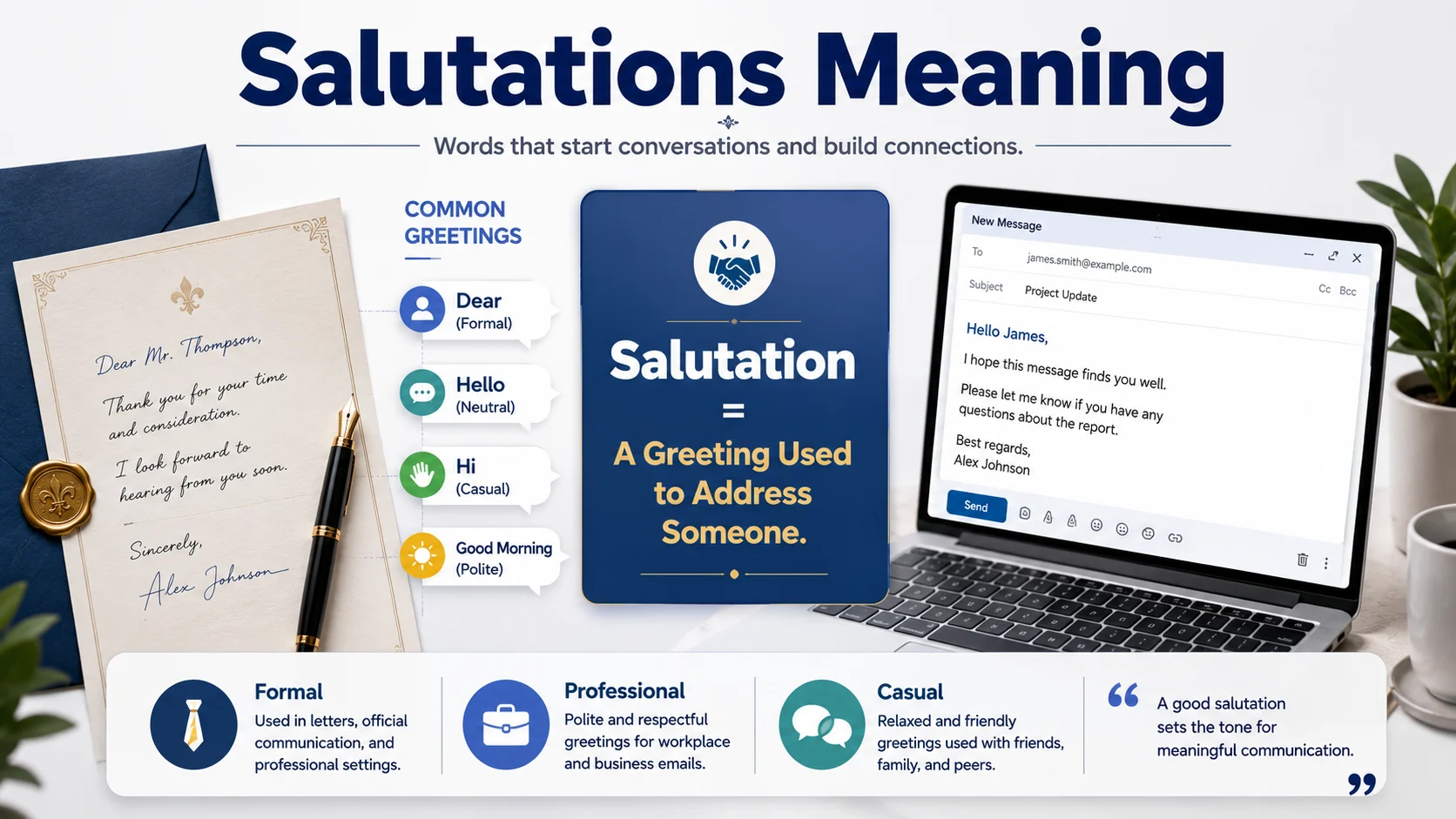
Salutations are greetings used when addressing someone. They commonly appear at the beginning of letters, emails, speeches, and conversations. Examples include “Hello,” “Hi,” “Dear,” “Good morning,” and “Greetings.” A salutation can communicate respect, friendliness, professionalism, or familiarity.
Salutations meaning refers to greetings or expressions used when addressing another person or group. You can use a salutation in everyday conversation, formal correspondence, business emails, letters, invitations, and speeches.
The word can describe both spoken and written greetings. However, it appears particularly often in discussions about letters and email etiquette. For example, “Dear Dr. Smith,” is a formal salutation, while “Hi Sarah,” creates a more relaxed tone.
Choosing the right greeting matters because your opening words establish the tone of your communication. Therefore, understanding salutations can help you sound respectful, professional, friendly, or appropriately casual.
Quick Answer
| Element | Explanation |
|---|---|
| Meaning | A greeting used when addressing someone |
| Singular | Salutation |
| Plural | Salutations |
| Formal example | “Dear Mr. Williams,” |
| Casual example | “Hi Alex,” |
| Professional example | “Dear Hiring Manager,” |
| Group example | “Hello everyone,” |
| Main purpose | To open a conversation, letter, email, speech, or message |
| Tone | Can be formal, neutral, friendly, or casual |
What Does Salutations Meaning Refer To?
The basic salutations meaning is greetings or words used to acknowledge and address someone.
The singular form is salutation.
The plural form is salutations.
For example:
“Please begin your letter with a suitable salutation.”
This means the writer should start the letter with an appropriate greeting.
Simple Definition
A salutation is essentially an opening greeting.
It can appear as:
- Hi
- Hello
- Dear
- Greetings
- Good morning
- Good afternoon
- Good evening
- Dear Sir or Madam
- Hello everyone
The appropriate choice depends on the situation.
Salutation vs. Greeting
The words salutation and greeting are closely related.
However, they are not always used in exactly the same way.
| Word | General Meaning | Typical Context |
|---|---|---|
| Salutation | A greeting used to address someone | Letters, emails, formal communication |
| Greeting | Any expression of welcome or acknowledgment | Conversation, cards, messages, correspondence |
| Opening | The beginning of a communication | Broader writing context |
Therefore, every salutation is a greeting, but not every greeting functions specifically as a salutation.
Origin and History of the Word Salutation
The word salutation comes from Latin roots associated with greeting, wishing health, or expressing goodwill.
The Latin verb salutare means to greet or salute. It connects with salus, a Latin word associated with health, safety, and well-being.
Over time, related forms entered European languages.
English adopted salutation as a term for an act or expression of greeting.
Historical Use
Historically, people often followed strict conventions when addressing others.
Social rank, occupation, age, and relationship could influence the appropriate greeting.
For example, formal correspondence might use titles such as:
- Mr.
- Mrs.
- Miss
- Dr.
- Professor
- Reverend
- Sir
- Madam
Modern communication has become more flexible. Nevertheless, formal salutations remain important in many professional and institutional settings.
Types of Salutations
Salutations generally fall into several categories.
Formal Salutations
Formal salutations show respect and professionalism.
Common examples include:
- Dear Mr. Johnson,
- Dear Ms. Carter,
- Dear Dr. Williams,
- Dear Professor Brown,
- Dear Hiring Manager,
- Dear Members of the Committee,
- Dear Sir or Madam,
These greetings work well in professional correspondence.
Informal Salutations
Informal salutations suit friends, relatives, and familiar acquaintances.
Examples include:
- Hi John,
- Hello Sarah,
- Hey Mike,
- Hi everyone,
- Hey there,
The relationship between the participants determines whether an informal greeting feels appropriate.
Neutral Salutations
Neutral greetings sit between formal and casual language.
Examples include:
- Hello,
- Hello John,
- Greetings,
- Good morning,
- Good afternoon,
These options work well when you want to remain polite without sounding overly formal.
Professional Salutations
Professional communication requires particular attention to tone.
Examples include:
Dear Hiring Manager,
Dear Admissions Committee,
Dear Customer Service Team,
Dear Professor Lee,
These options establish professionalism from the beginning.
Common Salutations and What They Communicate
| Salutation | Formality | Typical Use |
|---|---|---|
| Dear Mr. Smith | Formal | Business letters |
| Dear Ms. Smith | Formal | Professional correspondence |
| Dear Dr. Smith | Formal | Academic or professional communication |
| Dear Hiring Manager | Formal | Job applications |
| Hello | Neutral | Emails and conversations |
| Hello Sarah | Neutral | Professional or personal |
| Hi Sarah | Casual/Neutral | Everyday messages |
| Hey Sarah | Casual | Friends and familiar contacts |
| Greetings | Formal/Neutral | Announcements and formal writing |
| Good morning | Polite | Workplace or face-to-face communication |
| Good afternoon | Polite | Workplace or formal settings |
| Good evening | Polite | Evening conversations or events |
How to Choose the Right Salutation
Selecting a salutation becomes easier when you consider three factors:
- Who are you addressing?
- Why are you contacting them?
- How formal should your message sound?
Consider Your Relationship
A close friend does not usually need:
Dear Mr. Johnson,
Instead, you might write:
Hey John!
Conversely, a professional contact may require:
Dear Mr. Johnson,
Consider the Setting
A job application requires a different opening from a text message.
For example:
Job application:
Dear Hiring Manager,
Message to a friend:
Hey!
Consequently, the same greeting will not work equally well in every context.
Consider Your Audience
A group message requires a plural or collective greeting.
For example:
Hello everyone,
or:
Dear Team,
A single person’s name would not make sense if you are addressing an entire group.
Salutations in Emails
Email etiquette makes salutations particularly important.
The first line of your email immediately establishes your relationship with the recipient.
Formal Email
For an unfamiliar professional contact:
Dear Ms. Anderson,
This option is respectful and conventional.
Professional but Friendly Email
If you already know the recipient:
Hi James,
This sounds professional without feeling stiff.
Casual Work Email
Among close colleagues:
Hey team,
may be perfectly appropriate.
However, company culture matters. Some workplaces prefer formal communication even among familiar colleagues.
Formal Email Salutations
When writing a formal email, consider these options.
When You Know the Name
Use the person’s appropriate title and surname when the setting calls for formality.
Dear Dr. Miller,
When You Know the Role but Not the Name
Use the person’s professional role.
Dear Hiring Manager,
Dear Admissions Officer,
Dear Customer Service Manager,
When Addressing a Committee
Use:
Dear Selection Committee,
or:
Dear Members of the Committee,
When Addressing a Department
You can write:
Dear Marketing Team,
or:
Dear Human Resources Team,
These greetings identify the intended audience clearly.
What Salutation Should You Use When You Don’t Know Someone’s Name?
This situation occurs frequently in professional writing.
Instead of using an outdated generic greeting, consider identifying the recipient’s role.
For example:
Dear Hiring Manager,
Dear Admissions Team,
Dear Recruitment Team,
Dear Customer Support Team,
Dear Editor,
These options are often more specific than:
To Whom It May Concern
Is “To Whom It May Concern” Still Appropriate?
It can be appropriate in certain formal documents.
However, it often sounds impersonal.
Whenever possible, identify the recipient by name or role.
For example:
Less personal:
To Whom It May Concern,
More targeted:
Dear Human Resources Manager,
Specificity usually creates a stronger opening.
Salutations in Business Communication
Business communication often requires a balance between professionalism and approachability.
Formal Business Letter
Dear Mr. Thompson,
Professional Email
Hello Maria,
Established Professional Relationship
Hi David,
Internal Team Communication
Hi Team,
Informal Workplace
Hey everyone,
The best choice depends on company culture and the relationship between colleagues.
Salutations in Letters
Traditional letters often follow a predictable structure.
A typical formal letter includes:
- sender information
- date
- recipient information
- salutation
- body
- closing
- signature
For example:
Dear Ms. Parker,
The body then begins below the salutation.
Personal Letters
Personal letters can use warmer greetings.
Examples include:
- Dear Mom,
- Dear Grandma,
- Dear Alex,
- My dear friend,
- Hello Sarah,
The relationship determines the appropriate level of warmth.
Salutations in Academic Writing
Academic communication often requires respectful and professional greetings.
Examples include:
Dear Professor Williams,
Dear Dr. Patel,
Dear Admissions Committee,
Dear Faculty Members,
Students should generally avoid overly casual openings when contacting professors or administrators.
For example, “Hey prof!” may sound too informal unless the professor has explicitly established that communication style.
Salutations in Job Applications
Job applications require particular care.
The salutation creates an immediate impression.
Strong Options
Dear Hiring Manager,
Dear Recruitment Team,
Dear [Specific Name],
If you can identify the relevant hiring manager, using their name can make the application more personal.
Avoid Overly Casual Openings
Avoid:
Hey!
Hi there!
What’s up?
These greetings do not usually fit a formal application.
Salutations in Cover Letters
A cover letter should normally use a professional greeting.
For example:
Dear Hiring Manager,
Or, if the recipient is known:
Dear Ms. Rodriguez,
A professional salutation supports the overall tone of the application.
Furthermore, it demonstrates attention to detail.
Salutations in Speeches
The word salutation does not apply only to letters.
Speakers can also begin with a greeting.
For example:
Good morning, everyone.
Distinguished guests, colleagues, and friends,
Ladies and gentlemen,
Welcome, everyone.
These opening expressions acknowledge the audience before the speaker begins the main content.
Why Speech Salutations Matter
A speech salutation helps:
- acknowledge the audience
- establish rapport
- create a respectful tone
- introduce the event
- transition into the main topic
Therefore, choosing an appropriate opening can strengthen a presentation.
Salutations in Invitations
Invitations may use formal or informal greetings depending on the event.
Formal Invitation
Dear Mr. and Mrs. Wilson,
Wedding Invitation
Traditional wedding invitations may use names and formal wording rather than conversational greetings.
Casual Invitation
For a birthday or informal gathering:
Hi everyone!
or:
Hey friends!
The occasion determines the appropriate style.
Salutations in Text Messages
Text messaging usually requires less formal language.
Common options include:
- Hi
- Hey
- Hello
- Hey there
- Hi! How are you?
- Good morning!
Among friends, the salutation may disappear completely.
For example:
You free tonight?
The message starts directly with the purpose.
Nevertheless, a greeting can make an unexpected message feel friendlier.
Salutations and Tone
A salutation can change how the rest of a message feels.
Compare these examples:
Dear James,
Hi James,
Hey James,
James,
They all address the same person.
However, each creates a slightly different impression.
| Greeting | Likely Impression |
|---|---|
| Dear James | Formal, respectful |
| Hello James | Neutral, polite |
| Hi James | Friendly, professional |
| Hey James | Casual, familiar |
| James | Direct, potentially abrupt |
Tone depends on more than the words alone. Punctuation, relationship, subject matter, and previous communication also influence interpretation.
Five Real Life Conversation Examples
Example 1: Professional Email
Employee: Dear Ms. Carter,
Employee: I am writing to follow up on our meeting yesterday.
Here, the formal salutation suits a professional relationship.
Example 2: Friendly Email
Alex: Hi Jordan,
Alex: Hope you’re doing well. Are you available this weekend?
The greeting is friendly without being overly casual.
Example 3: Text Message
Sam: Hey Chris!
Chris: Hey! What’s up?
This interaction uses an informal salutation.
Example 4: Group Email
Manager: Hello everyone,
Manager: Thank you for joining today’s meeting.
The salutation addresses the entire group.
Example 5: Academic Email
Student: Dear Professor Williams,
Student: I wanted to ask about the assignment deadline.
The respectful greeting fits the student-professor relationship.
Common Salutation Mistakes
Using an Overly Casual Greeting
Writing:
Hey!!!
to an unfamiliar executive may create the wrong impression.
Using Excessive Formality
Conversely:
Esteemed Sir,
may sound unnecessarily old-fashioned in an ordinary business email.
Misspelling the Recipient’s Name
A spelling mistake in the salutation can undermine an otherwise polished message.
Therefore, double-check names before sending important correspondence.
Using the Wrong Title
Avoid guessing someone’s title when you do not know it.
For example, do not assume someone uses “Mrs.” when “Ms.” would be more appropriate.
Ignoring Cultural Expectations
Different cultures and organizations have different conventions.
Consequently, research or follow established communication norms when writing to international recipients.
Salutation vs. Complimentary Close
A salutation begins a message.
A complimentary close ends it.
For example:
Dear Ms. Johnson,
Thank you for your time.
Sincerely,
Alex Brown
Here, “Dear Ms. Johnson” is the salutation.
“Sincerely” is the complimentary close.
Common Pairs
| Salutation | Possible Closing |
|---|---|
| Dear Mr. Smith | Sincerely |
| Dear Hiring Manager | Kind regards |
| Hello Sarah | Best |
| Hi John | Thanks |
| Dear Professor Lee | Best regards |
The opening and closing should generally match in formality.
Salutations vs. Greetings
These terms overlap, but their usage can differ.
A greeting is a broad expression of acknowledgment.
A salutation specifically refers to an address or greeting, particularly at the beginning of written communication.
For example:
“Good morning!”
is a greeting.
In a formal email:
“Dear Professor Smith,”
functions specifically as the salutation.
Therefore, salutation is often the more precise term when discussing correspondence.
Formal vs. Informal Salutations
| Situation | Recommended Salutation |
|---|---|
| Job application | Dear Hiring Manager |
| Professor | Dear Professor [Last Name] |
| Doctor | Dear Dr. [Last Name] |
| New business contact | Dear Mr./Ms. [Last Name] |
| Known colleague | Hi [First Name] |
| Close colleague | Hey [First Name] |
| Friend | Hi/Hey [First Name] |
| Large group | Hello everyone |
| Committee | Dear Members of the Committee |
| Customer service | Hello Customer Service Team |
Are Salutations Always Necessary?
No.
In casual digital communication, people often begin immediately with their message.
For example:
Can you send me the file?
This is perfectly normal in some contexts.
However, a greeting can make the message feel more courteous.
For example:
Hi Sarah, can you send me the file?
The second version feels warmer.
In formal communication, a salutation is generally expected.
Modern Changes in Salutation Etiquette
Digital communication has changed how people greet one another.
Traditional letters often required formal structures.
Emails introduced greater flexibility.
Messaging apps made greetings even more conversational.
As a result, modern users move between:
Dear Mr. Smith,
Hello Mr. Smith,
Hi John,
Hey John,
depending on the relationship.
Furthermore, workplace culture has become more informal in many industries.
Nevertheless, professional judgment remains important.
Frequently Asked Questions
What is the simple meaning of salutations?
Salutations are greetings used when addressing someone. They commonly appear at the beginning of letters, emails, speeches, and other communications.
Is “hello” a salutation?
Yes. Hello can function as a salutation when it opens a conversation, email, letter, or other communication.
Is “Dear” a salutation?
Yes. Dear is one of the most common salutations in formal and personal correspondence.
What is the difference between salutation and greeting?
A greeting is a broad term for an expression of acknowledgment or welcome. A salutation is often a specific greeting used to address someone, particularly at the beginning of written communication.
What is a formal salutation?
A formal salutation is a respectful opening such as “Dear Ms. Johnson,” “Dear Dr. Smith,” or “Dear Hiring Manager.”
What salutation should I use in a professional email?
Use a greeting that matches your relationship with the recipient. “Dear [Name]” works well for formal situations, while “Hi [First Name]” is suitable for many established professional relationships.
What salutation should I use if I don’t know the person’s name?
Use their role or department when possible. Examples include “Dear Hiring Manager,” “Dear Admissions Team,” and “Dear Customer Service Team.”
Can “Hey” be a professional salutation?
Sometimes. Many modern workplaces use “Hey” casually. However, “Hi” or “Hello” is safer when you are uncertain about the organization’s communication style.
What is the opposite of a salutation?
There is no exact opposite. However, a complimentary close or sign-off appears at the end of a letter or email rather than at the beginning.
Are salutations used only in written communication?
No. Salutations can also appear in speeches, presentations, ceremonies, and spoken interactions. However, the term is especially common when discussing correspondence.
Conclusion
Salutations meaning centers on the simple idea of greeting or addressing someone. The word commonly appears when discussing letters, emails, speeches, professional communication, and other forms of direct communication.
A salutation can be as formal as “Dear Dr. Smith” or as casual as “Hey Alex.” Therefore, the best choice depends on the audience, relationship, purpose, and setting.
Formal situations generally benefit from respectful greetings. Job applications, academic emails, business letters, and official correspondence often use “Dear” followed by a person’s name or professional role. Meanwhile, everyday communication usually favors “Hi,” “Hello,” or “Hey.”
Context matters just as much as the greeting itself. A phrase that sounds friendly between close colleagues may seem too casual when addressed to a senior executive. Conversely, an extremely formal greeting may feel unnecessarily distant in a relaxed workplace.
Ultimately, effective salutations help establish the tone before the main message begins. By choosing a greeting that matches the situation, you can communicate respect, warmth, professionalism, or familiarity from the very first words.