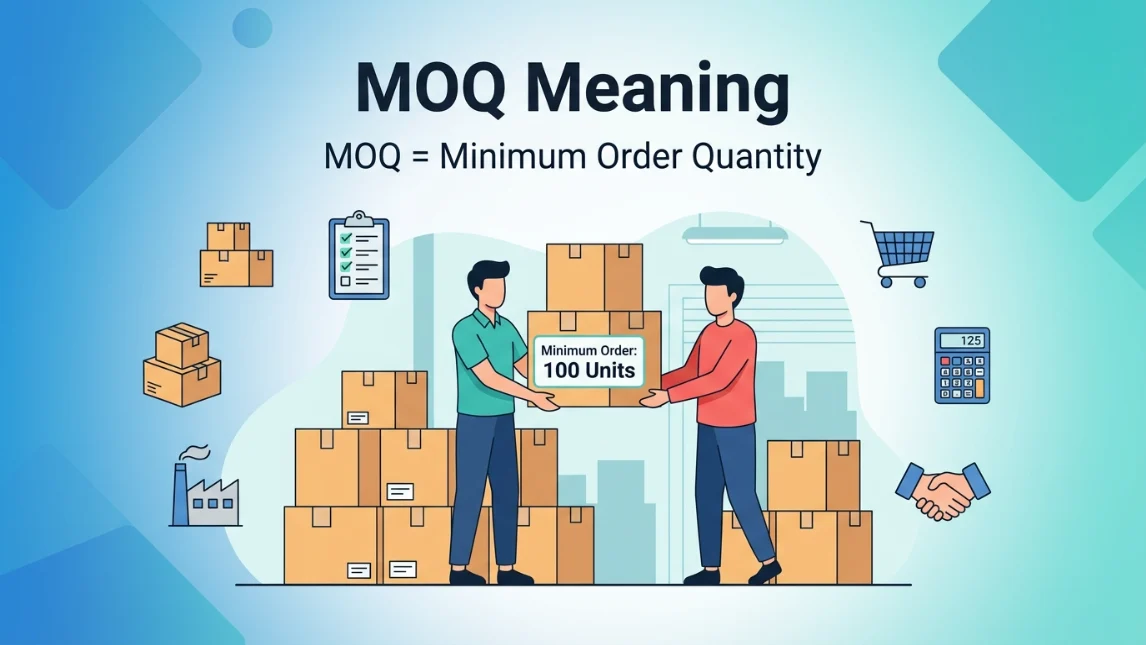
The acronym MOQ stands for Minimum Order Quantity, representing the absolute smallest number of units or total dollar amount a supplier agrees to produce or sell in a single order. Suppliers set this threshold to cover baseline production costs, raw materials, and labor overhead while ensuring profitable operations.
The moq meaning defines the minimum volume of inventory or goods that a manufacturer, wholesaler, or supplier requires a buyer to purchase at one time. Understanding commercial supply chain terms proves essential when launching e commerce stores, sourcing wholesale products, or negotiating supplier contracts globally. Furthermore, learning these operational acronyms helps entrepreneurs prevent cash flow strain, optimize warehouse space, and establish strong trade relationships across platforms like Alibaba, ThomasNet, and Shopify.
moq Meaning Quick Summary
| Context | What MOQ Means | Common Platform | Example Sentence | Tone / Vibe |
| Manufacturing & Sourcing | Minimum Order Quantity | Alibaba, ThomasNet | “The supplier has a 500 unit MOQ for custom packaging.” | Professional, Negotiable |
| E-Commerce Wholesale | Lowest Purchase Threshold | Faire, Handshake | “We hit their dollar MOQ by ordering multiple product SKUs.” | Commercial, Direct |
| Retail & Dropshipping | Minimum Order Requirement | AliExpress, Shopify | “Looking for low MOQ suppliers to test new inventory lines.” | Strategic, Budget Focused |
| Supply Chain Operations | Baseline Production Unit | Freight, B2B Portals | “High MOQ terms reduce per unit production overhead.” | Technical, Operational |
What Does moq Meaning Stand For?
When business founders ask about the moq meaning, they are exploring a fundamental economic safeguard used by suppliers to guarantee baseline profitability. In global manufacturing and trade, suppliers invest significant capital into setting up machinery, purchasing raw materials, and allocating factory labor before fulfilling any order batch.
| Primary Interpretation | Business Context | Typical Operational Scenario |
| Unit Based MOQ | Physical item count | A factory requiring a minimum purchase of 1000 apparel units |
| Dollar Based MOQ | Minimum expenditure | A distributor requiring a minimum spending total of $500 per order |
| Tiered MOQ | Volume based pricing | Higher order volumes unlocking lower cost per unit tiers |
Historically, minimum order quantities emerged during early industrialization when mass assembly lines required continuous volume to justify operation setup expenses. Consequently, suppliers established minimum order thresholds so small orders would not generate financial losses. Today, electronic commerce and digital procurement platforms utilize automated order minimum systems to regulate global trade flows between factories and online retailers.
Contextual Dynamics & Nuances of the Term
Understanding supply chain terms requires evaluating how manufacturers determine order limits and how buyers manage capital constraints.
1. High Volume Manufacturing Dynamics
Factories operating heavy machinery prefer high minimum order numbers. For instance, running a plastic injection mold requires thousands of dollars in machinery calibration and raw plastic preparation. Therefore, factories mandate large order volumes to spread fixed setup expenses evenly across every individual unit produced.
2. Cash Flow and Working Capital Management
For emerging businesses, high order requirements represent a major financial hurdle. Purchasing large quantities ties up valuable working capital in physical inventory that might sit unsold in a warehouse. Consequently, smart founders negotiate staggered production schedules or smaller trial runs to protect liquidity.
3. High Unit MOQ vs Low Dollar Minimums
Suppliers typically structure order requirements around unit counts or monetary totals. Unit based requirements apply heavily to customized products where manufacturing tooling changes for each client. Conversely, dollar based thresholds usually apply to distributors selling pre stocked, off the shelf inventory across various product lines.
Real-Life Conversation Examples Using the Term
To master how this business jargon functions naturally, review these five realistic email and chat scripts illustrating everyday commercial sourcing scenarios.
1: Inquiring About Custom Manufacturing
Purchasing Manager: Hello! We love your stainless steel water bottle designs.
Supplier Representative: Thank you for reaching out! We offer full custom branding for all corporate orders.
Purchasing Manager: What is your MOQ for custom laser engraved logos?
Supplier Representative: Our standard unit requirement is 500 pieces per colorway to cover machine setup costs.
2: Negotiating Lower Initial Volume
E-Commerce Founder: We want to test your organic skincare line in our store.
Distributor Sales: That sounds great! Our standard order minimum is $2000 for new wholesale accounts.
E-Commerce Founder: Can we start with a smaller $1000 test order to verify customer demand first?
Distributor Sales: I can approve a $1000 trial order if you cover the expedited shipping costs.
3: Discussing Tiered Volume Pricing
Sourcing Specialist: Can you provide pricing for your canvas tote bags?
Factory Agent: Certainly. The price is $5 per bag at our 1000 unit baseline requirement.
Sourcing Specialist: How much does the price drop if we double our initial order volume?
Factory Agent: Reaching a 2000 unit order lowers the unit price to $3.50 per bag.
4: Clarifying Packaging Restrictions
Brand Owner: We need custom printed boxes for our subscription service launch.
Packaging Rep: We can handle full color exterior printing with custom inserts.
Brand Owner: Is the packaging MOQ calculated per design or for the total combined order?
Factory Agent: The requirement applies per artwork file because we must set up distinct printing plates for each design.
5: Sourcing via B2B Digital Platforms
Buyer: Hi, I saw your product listing on Alibaba and want to place a sample order.
Vendor: Welcome! We can send individual sample units before you commit to the full production run.
Buyer: Perfect, what is the unit price for samples versus the bulk order requirement?
Vendor: Samples cost $20 each, but bulk units drop to $4 when you meet our 250 unit order requirement.
Platform-Specific Breakdown
Sourcing platforms operate under different business models, leading to varied minimum order expectations across the global market.
How It Is Used on Snapchat and TikTok
While consumer social media platforms do not host manufacturing negotiations directly, creators use these platforms to discuss brand building and sourcing logistics.
- E-Commerce Education Clips: Entrepreneurs post short tutorials explaining how to negotiate production minimums with overseas factories.
- Behind the Scenes Videos: Small business owners film unboxing videos showing their first factory production runs and sharing inventory costs.
The Role of Order Requirements on B2B Platforms
B2B directories like Alibaba, ThomasNet, and Global Sources integrate clear order minimums directly into product search filters.
- Product Directory Tags: Sellers state their order thresholds on product cards, allowing buyers to filter out high volume suppliers immediately.
- RFQs (Request for Quotation): Buyers post specific order requirements, prompting factories to submit custom bids matching those target quantities.
Instagram and Texting Dynamics
On messaging apps like WhatsApp and WeChat, direct communications between brand managers and factory representatives revolve around production terms.
- Supplier WhatsApp Chats: Founders negotiate price points and production terms directly with factory sales representatives in real time.
- Instagram Wholesale Inquiries: Boutique brands use direct messaging to ask independent makers about their wholesale order thresholds.
Alternative Meanings & NLP Variations of the Phrase
While minimum order quantity remains the standard commercial definition, related business terms expand the operational vocabulary:
| Related Acronym / Term | Full Definition / Scope | Supply Chain Context |
| MOV (Minimum Order Value) | Total financial dollar threshold | Distributor and wholesale sales accounts |
| EOQ (Economic Order Quantity) | Ideal order size for lowest total cost | Internal warehouse inventory management |
| MPQ (Minimum Package Quantity) | Smallest pre packaged master carton | Shipping, freight, and pallet loading |
| MOQ (Medical / Specialized) | Minimum Operating Quantity | Specialized hospital or lab supply usage |
- Minimum Order Value (MOV): Focuses strictly on the total monetary cost of an order rather than physical item counts, giving buyers flexibility across product lines.
- Minimum Package Quantity (MPQ): Refers to the fixed number of items packed inside a single factory master carton to prevent opening sealed boxes.
- Economic Order Quantity (EOQ): An internal inventory calculation that helps companies balance ordering frequency against warehouse holding expenses.
Misinterpretations: When NOT to Use the Term
Using supply chain acronyms incorrectly during commercial conversations can harm your credibility with experienced suppliers.
Avoid Using When Requesting Individual Product Samples
Do not confuse production order minimums with sample evaluation orders. When requesting a single prototype to inspect quality, ask specifically for a “sample unit” rather than asking to fulfill an order threshold.
Avoid Confusing Unit Requirements with Master Packaging Counts
Do not confuse order minimums with master carton packaging counts. A factory might have a production requirement of 1000 items, but package them inside master cartons containing an MPQ of 50 units each.
How to Respond in Chat Comfortably
When a factory sales representative presents an order requirement that exceeds your budget, responding professionally opens doors for negotiation.
1. Requesting a Tiered Trial Order
If a supplier presents a high initial volume requirement, ask for a smaller introductory run:
- “We appreciate the details. Can we place a 250 unit trial run to test market response before committing to the full 1000 unit volume?”
- “Is there flexibility on the initial order threshold if we agree to pay a slightly higher per unit cost?”
2. Combining Product Variations
If you want to offer multiple colors or sizes without multiplying your inventory costs, ask to aggregate order volumes:
- “Can we split the 500 unit requirement across two color variants, or does the requirement apply to each color individually?”
- “Does your dollar threshold allow us to combine different SKUs from your catalog to meet the total requirement?”
FAQs
What is the primary moq meaning in e commerce sourcing?
The primary definition is Minimum Order Quantity, which specifies the lowest number of units a manufacturer or wholesaler agrees to sell per order.
Why do manufacturers enforce order minimums?
Factories enforce order minimums to cover machine calibration costs, raw material purchases, and labor overhead, ensuring every production run remains profitable.
Can you negotiate order thresholds with overseas suppliers?
Yes, buyers frequently negotiate lower order limits by offering to pay a slightly higher per unit price or by starting with a smaller test batch.
What is the difference between MOQ and MOV?
MOQ refers to the minimum number of physical units required, whereas MOV (Minimum Order Value) refers to the minimum dollar amount spent per order.
Does a sample request count toward order requirements?
No, suppliers usually provide individual samples separately so buyers can evaluate product quality before placing a full production order.
How does order volume affect the price per unit?
Higher order volumes lower the price per unit because the factory spreads fixed setup and tooling costs across more items.
What does low MOQ mean on sourcing websites?
Low order minimums mean the vendor accepts small purchase quantities, making them ideal for small businesses, startups, and product testing.
What is the difference between unit and dollar order requirements?
Unit requirements specify exact item quantities for specific items, while dollar minimums allow buyers to mix different items to reach a spend target.
How do small businesses manage high supplier requirements?
Small businesses manage high requirements by joining buying groups, using inventory financing, sourcing from wholesale distributors, or negotiating trial runs.
What does MPQ stand for in shipping logistics?
MPQ stands for Minimum Package Quantity, representing the fixed number of units packed inside a single factory master carton.
Conclusion
The moq meaning highlights how commercial suppliers balance operational setup expenses with global distribution needs. Whether you are sourcing custom apparel, launching a private label beauty line, or negotiating wholesale orders on Alibaba, understanding minimum order thresholds enables smarter financial planning. By learning how to negotiate volume tiers and manage working capital effectively, growing businesses can scale inventory operations with confidence.