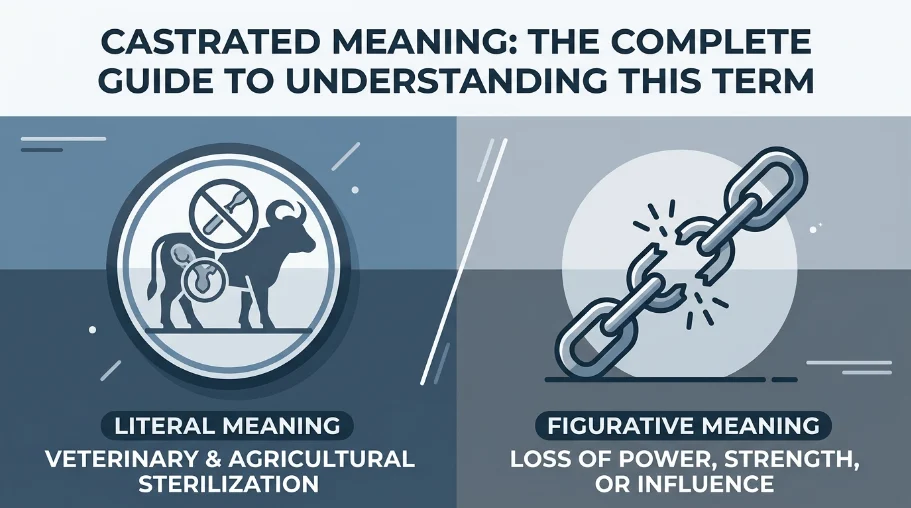
Castrated is the past tense of the verb castrate, which means to remove the testicles of a male animal or human . It can also be used metaphorically to describe something that has been weakened or deprived of power . The noun form is castration, and the term applies to both literal surgical procedures and figurative uses .
Have you ever come across the word castrated and wondered exactly what it means? This term appears in medical, agricultural, and even metaphorical contexts. Understanding its meaning is essential for clear communication across these different fields.
The challenge with castrated is its multiple meanings. In its most literal sense, it refers to a surgical procedure on male animals or humans . However, it also has figurative uses, such as describing something that has been weakened or deprived of power . This dual meaning can create confusion if you are not familiar with the context.
This article clears up the confusion around castrated once and for all. You will learn its definitions, see real examples from different fields, and discover how to interpret the term correctly based on context. By the end, you will confidently understand and use this word in any situation.
Key Takeaway
The main takeaway is that castrated has both literal and figurative meanings . Literally, it refers to the surgical removal of testicles in males. Figuratively, it describes something that has been weakened, deprived of power, or rendered ineffective. The term is used in agriculture, medicine, and metaphorical language across all English-speaking regions.
Definitions and Explanations
What Does “Castrated” Mean?
The castrated meaning is most directly defined as “deprived of the testes; emasculated. It is the past tense and past participle of the verb castrate, which means to remove the testicles of a male animal or human .
In veterinary and agricultural contexts, castration is a common procedure performed on male animals to control breeding, improve temperament, and enhance meat quality. For example, a castrated male horse is called a gelding, and a castrated male cow is called a steer.
| Feature | Description |
| Part of speech | Verb (past tense/past participle) |
| Literal meaning | To remove the testicles of a male animal or human |
| Figurative meaning | To weaken, deprive of power, or render ineffective |
| Noun form | Castration |
| Related adjective | Eunuch (for humans) |
| Pronunciation | /ˈkæs.treɪ.tɪd/ |
The Figurative Meaning of Castrated
Beyond its literal definition, castrated has a powerful figurative meaning. It can describe something that has been weakened, deprived of power, or made less effective.
For example, a “castrated” bill in politics is one that has been significantly altered or weakened. A “castrated” performance might be one that lacks energy or passion. This figurative use extends the core idea of removal or deprivation to non-physical contexts.
The Etymology of Castrated
The word castrated has a long history. It comes from the Latin word castratus, the past participle of castrare, meaning “to castrate” . This Latin word is thought to be related to the Sanskrit castram, meaning “knife .
The word entered the English language in the 1530s. Its first recorded use was by William Turner, an English physician and naturalist. The noun form, castration, entered the language slightly later, in the 1550s.
Related Terms
| Term | Meaning |
| Gelding | A castrated male horse |
| Steer | A castrated male cow |
| Wether | A castrated male sheep |
| Barrow | A castrated male pig |
| Eunuch | A castrated male human |
| Emasculate | To deprive of strength or vigor |
Advantages and Disadvantages
Advantages of Castration in Animals
| Advantage | Explanation |
| Population control | Prevents unwanted breeding and overpopulation |
| Improved temperament | Reduces aggression and makes animals easier to handle |
| Better meat quality | Improves tenderness and flavor in livestock |
| Health benefits | Reduces risk of certain diseases, such as testicular cancer |
Disadvantages of Castration in Animals
| Disadvantage | Explanation |
| Ethical concerns | Some view it as a form of unnecessary animal cruelty |
| Pain and stress | Causes physical pain and psychological stress if not properly managed |
| Hormonal changes | Can affect growth rates and metabolism |
| Potential complications | Risk of infection or other surgical complications |
Figurative Use: Advantages and Disadvantages
| Aspect | Explanation |
| Advantages | Can be a powerful way to describe weakness or ineffectiveness |
| Disadvantages | Can be offensive or insensitive if used carelessly |
Real-World Examples
Examples of “Castrated” in Literal Contexts
Example 1: Animal Agriculture
“The farmer castrated the young bull to make it more docile and improve the quality of its meat.”Example 2: Veterinary Medicine
“The veterinarian castrated the male dog to prevent unwanted breeding.”Example 3: Historical Context
“In ancient times, prisoners of war were sometimes castrated and sold as eunuchs.”Example 4: Animal Terminology
“After the procedure, the male horse became a gelding and was easier to train.”Examples of “Castrated” in Figurative Contexts
Example 1: Politics
“The senator claimed the new bill was a castrated version of the original proposal, stripped of all its meaningful provisions.”Example 2: Art and Performance
“The film adaptation felt castrated compared to the director’s original vision.”Example 3: Business
“The CEO feared the merger would castrate the company’s innovative culture.”Example 4: Everyday Language
“His argument was castrated by the opposing lawyer’s counter-evidence.”Common Phrases with “Castrated”
Phrase Meaning “Castrated version” A weakened or diluted version of something “Politically castrated” Deprived of political power or influence “Metaphorically castrated” Figuratively weakened or deprived of power
Regional and Global Usage
Global English
The castrated meaning is consistent across all English-speaking regions. Whether in the United States, the United Kingdom, Canada, or Australia, the literal definition is the same. The figurative use is also understood globally.
| Region | Literal Meaning | Figurative Meaning |
| United States | Removal of testicles | Weakened or deprived of power |
| United Kingdom | Removal of testicles | Weakened or deprived of power |
| Canada | Removal of testicles | Weakened or deprived of power |
| Australia | Removal of testicles | Weakened or deprived of power |
Formal vs. Informal Usage
Castrated is primarily used in formal or technical contexts. It is common in veterinary medicine, agriculture, and historical discussions. In informal conversation, people often use synonyms like “fixed” or “neutered” for animals.
| Context | Preferred Term |
| Formal/Technical | Castrated |
| Informal/Casual | Fixed, neutered, altered |
| Figurative | Weakened, stripped, gutted |
Common Mistakes
Mistake 1: Using “Castrated” for Female Animals
Some people use castrated for female animals. The correct term for females is spayed, which involves the removal of the ovaries and uterus.
Correction: Use castrated for males and spayed for females.
Mistake 2: Confusing “Castrated” with “Neutered”
Neutered is a gender-neutral term that can refer to the sterilization of both male and female animals. Castrated specifically refers to males.
Correction: Use castrated for males only. Use neutered for either gender.
Mistake 3: Using “Castrated” Too Casually
The word castrated can be offensive or insensitive when used carelessly in figurative contexts.
Correction: Use castrated carefully in figurative language. Consider whether a milder synonym like “weakened” or “stripped” would be more appropriate.
Mistake 4: Mispronunciation
Some people mispronounce castrated. The correct pronunciation is /ˈkæs.treɪ.tɪd/ with three syllables.
Correction: Practice the pronunciation. Say it as “CAS-tray-ted,” not “CAS-trat-ed.”
Exercises
Exercise 1: Fill in the Blank
Choose the correct word to complete each sentence.
- “The veterinarian __________ the male dog to prevent breeding.”
- “The farmer turned the young bull into a __________ by having it castrated.”
- “The politician called the bill a __________ version of the original.”
Exercise 2: Identify the Meaning
Determine whether “castrated” is used literally or figuratively in each sentence.
- “The surgeon castrated the patient as part of the treatment.”
- “The committee’s proposal was castrated by the board.”
- “The rancher castrated the male calves.”
Answer Key
Exercise 1 Answers:
Exercise 2 Answers:
- Literal (surgical procedure)
- Figurative (weakened, deprived of power)
- Literal (agricultural procedure)
Related Concepts and Comparisons
Castrated vs. Neutered
Term Gender Meaning Castrated Male Removal of testicles Neutered Male or Female Sterilization of either gender Spayed Female Removal of ovaries and uterus Castrated vs. Emasculated
Term Meaning Usage Castrated Literal removal of testicles Medical, agricultural Emasculated Figurative weakening Literary, metaphorical Castrated vs. Altered
Term Meaning Usage Castrated Specific removal of testicles Formal Altered General sterilization Casual Animal Terminology
Species Castrated Male Term Horse Gelding Cow Steer Sheep Wether Pig Barrow Goat Wether Chicken Capon
FAQs
What does castrated mean?
Castrated means having had the testicles removed. It is used literally for male animals and humans, and figuratively to describe something weakened or deprived of power.
Is castrated the same as neutered?
Not exactly. Neutered is a gender-neutral term for sterilization. Castrated specifically refers to males and the removal of testicles.
What is a castrated male horse called?
A castrated male horse is called a gelding.
What is a castrated male cow called?
A castrated male cow is called a steer.
What is a castrated male human called?
A castrated male human is called a eunuch.
Can castrated be used figuratively?
Yes, castrated can be used figuratively to describe something that has been weakened, stripped of power, or rendered ineffective.
How do you pronounce castrated?
Castrated is pronounced “CAS-tray-ted” (/ˈkæs.treɪ.tɪd/).
What is the noun form of castrated?
The noun form is castration.
Is castrating animals ethical?
The ethics of castrating animals are debated. Supporters cite population control, health benefits, and improved temperament. Critics raise concerns about animal welfare.
What is the difference between castrated and spayed?
Castrated applies to males (removal of testicles). Spayed applies to females (removal of ovaries and uterus).
Conclusion
This guide has explored the meaning and usage of the word castrated. It has both literal and figurative meanings . Literally, it refers to the removal of testicles in male animals or humans . Figuratively, it describes something that has been weakened, stripped of power, or rendered ineffective . Understanding these meanings is essential for clear communication in medical, agricultural, and metaphorical contexts.
The best practical advice is to consider your audience and context carefully. In formal or technical writing, castrated is the correct term for describing the surgical removal of testicles. In casual conversation, synonyms like “neutered” or “fixed” may be more appropriate. When using castrated figuratively, be aware of its potential to offend and consider whether a milder synonym would be more suitable.
Good communication depends on using the right word in the right context. Now you have the knowledge to use castrated correctly in any situation.










7 thoughts on “Castrated Meaning |The Complete Guide to Understanding This Term”