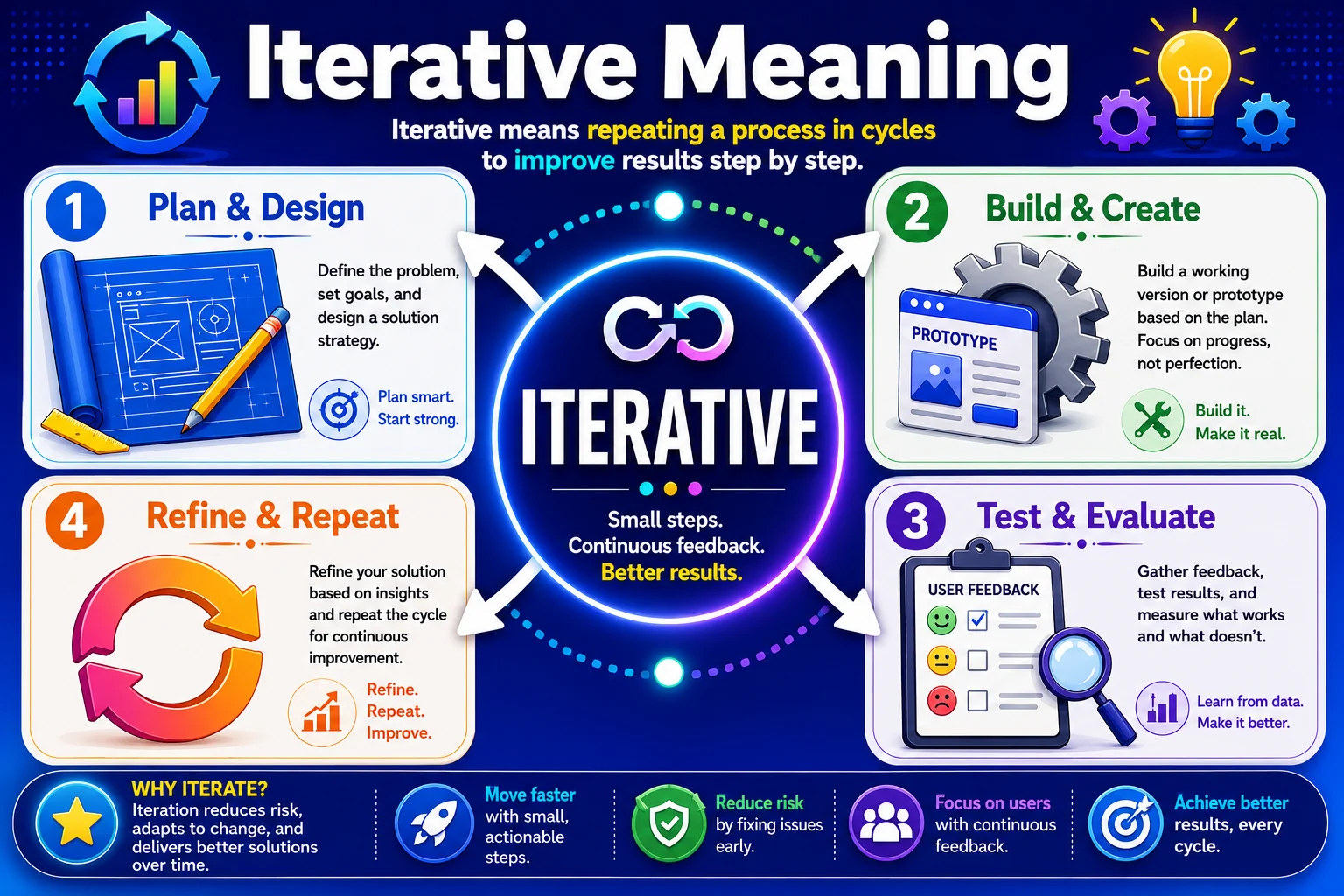
Iterative refers to a process that involves repeating a cycle of steps to refine, improve, or make progress toward a goal over time. Rather than attempting to complete a project in a single pass, an iterative approach builds upon successive versions, known as iterations, using feedback and testing to continuously enhance the final result.
Understanding the complete iterative meaning helps you navigate project management frameworks, software development workflows, scientific methodologies, and creative processes. Furthermore, this essential concept underpins modern operational strategies in tech startups, design studios, and Fortune 500 companies alike. Consequently, when people search for this phrase, they usually want to uncover how iterative models differ from traditional approaches, why modern teams prioritize them, or how to apply them to everyday problem-solving.
Additionally, fast-paced industries rely heavily on adaptability, continuous feedback, and rapid prototyping. For example, software teams use iterative Agile sprints to release incremental updates based on user feedback. Similarly, content creators and designers iterate on drafts to polish their work continuously. Therefore, grasping every dimension of the definition elevates your professional toolkit and enhances your project execution strategies.
Quick Answer Box
| Aspect | Details |
| Primary Meaning | Involving repetition of a process to achieve continuous refinement |
| Context | Agile software development, project management, design, science |
| Primary Uses | Prototyping, sprint planning, user testing, continuous feedback |
| Example | The design team took an iterative approach, releasing three draft versions |
| Tone | Methodical, adaptable, progressive, analytical, structured |
What Does Iterative Meaning Represent in Science and History?
To understand the core iterative meaning, one must examine its mathematical and linguistic roots. Historically, the word stems from the Latin iterativus, which derives from iterare, meaning to repeat or to do again (rooted in iter, meaning way or journey). In mathematics and computer science, iteration described the repetition of a sequence of operations to approach a desired solution or numerical value.
Furthermore, early computing pioneers integrated iterative algorithms into software architecture. Instead of expecting complex systems to function perfectly on the first try, programmers wrote loops and feedback cycles that repeatedly calculated and refined output values until reaching an acceptable threshold of accuracy.
Moreover, the management landscape shifted in the late twentieth century with the rise of Agile methodologies. Moving away from rigid, linear models like Waterfall, organizations embraced iterative development. Consequently, breaking large initiatives into smaller, manageable cycles became the gold standard for innovation and risk reduction across industries.
Contextual Dynamics & Nuances of the Term
However, the practical application of the concept varies depending on your field, team structure, and project goals.
1. Software Development & Agile Management
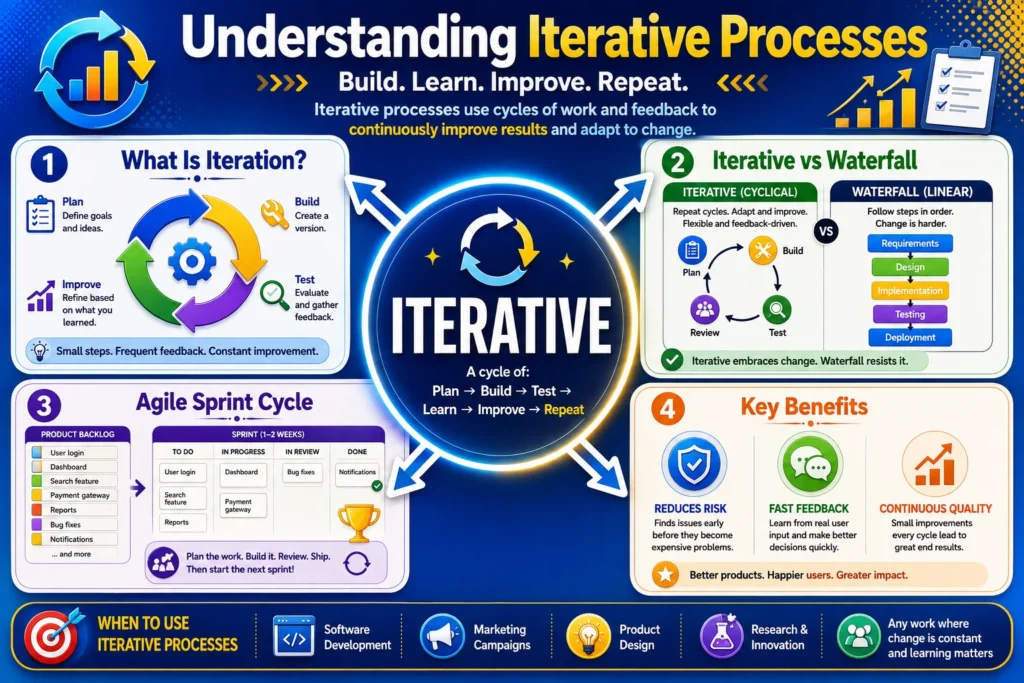
In tech, an iterative process breaks product development into short cycles called “sprints.” Each sprint includes planning, designing, building, testing, and reviewing a specific feature set.
- Incremental Delivery: Releasing working functional pieces rather than waiting for a complete final product.
- Feedback Loops: Incorporating user data and bug reports into the very next development cycle.
- Risk Reduction: Catching design flaws early in small prototypes before committing massive resources.
2. Design Thinking & UX/UI
Similarly, user experience (UX) designers rely on iterative design. Designers build low-fidelity wireframes, test them with actual users, gather observations, and iterate on the interface until the experience feels intuitive.
3. Scientific Method & Academic Research
In scientific research, hypothesis testing is inherently iterative. Researchers run experiments, analyze data, refine their hypotheses based on outcomes, and conduct further testing to deepen understanding.
Real-Life Conversation Examples Using Iterative Meaning Concepts
Indeed, understanding conversational contexts helps you use the term naturally across project meetings and casual discussions. Below are five real-life messaging scenarios that show how people use the word across different settings.
1. Planning a Product Launch
Alex: Hey Sarah! Are we expecting to launch the full app platform by the end of this month?
Sarah: Not quite! We’re taking an iterative approach so we can release a basic version first and collect user feedback.
Alex: That makes sense!
Sarah: Exactly! Consequently, we can add extra features in subsequent updates without delaying the core launch.
2. Reviewing Web Design Wireframes
Jordan: The homepage mockups look good, but some navigation menus feel a bit confusing.
Taylor: Indeed, I agree! Let’s schedule an iterative review cycle so we can test two alternative layouts with users.
Jordan: That sounds brilliant! Furthermore, user testing will show us exactly which version performs best.
Taylor: Deal, because small refinements lead to a much better final product!
3. Refining Corporate Strategy
Maya: The quarterly marketing plan feels a bit broad right now.
Chloe: Actually, leadership suggested an iterative testing strategy where we run smaller campaigns first.
Maya: Oh, that explains why we’re starting with small budget tests on two platforms!
Chloe: Naturally, testing small iterations keeps our ad spending efficient!
4. Drafting Content or Reports
Liam: Is your research report ready for final publication tomorrow?
Emma: However, don’t publish it just yet! I want to run one more iterative editing pass to polish the section transitions.
Liam: Good catch. Consequently, I will hold off on formatting until you finish the pass.
Emma: Trust me, because careful editing makes a huge difference in clarity!
5. Clarifying Methodology Terms
Noah: What’s the main difference between an iterative process and a linear process?
Sophia: Meanwhile, a linear process follows a strict straight line from start to finish, whereas an iterative process repeats feedback loops to make continuous improvements.
Noah: Is one better than the other?
Sophia: Yes! In fact, iterative models work best when project requirements change or evolve over time.
Platform-Specific Breakdown
Additionally, professional networks and productivity channels discuss project workflows through distinct digital tools and collaboration platforms. Consequently, analyzing how teams discuss the topic across platforms reveals how modern projects run.
How It Is Used on LinkedIn and Project Management Blogs
For instance, project managers and Agile coaches on LinkedIn share frameworks for structuring effective sprint cycles. Furthermore, discussions frequently center on balancing rapid iterations with quality assurance.
- Agile Frameworks: Specifically, coaches post diagrams comparing Scrum sprints, Kanban boards, and Waterfall timelines.
- Continuous Integration: Similarly, tech leaders discuss automated deployment pipelines that allow software updates to roll out continuously.
- Lessons Learned: Meanwhile, leaders share case studies showing how iterative pivoting saved failing projects.
The Role of Jira, Trello, and Product Forums
On the other hand, product management platforms like Jira or Trello are designed around iterative workflows. Teams organize tasks into backlogs, sprints, and review columns to track continuous progress visually.
In fact, teams use sprint retrospectives at the end of each cycle to evaluate performance. Consequently, team members refine both the product and their internal working habits simultaneously.
- Sprint Boards: Visual columns tracking tasks from “To Do” to “In Progress” and “Done.”
- Retrospective Notes: Team feedback discussions on what went well and what needs adjustment in the next cycle.
- Bug Tracking: In addition, assigning user-reported issues directly to the next development iteration.
- Version Tagging: Finally, labeling software releases (e.g., v1.1, v1.2) to mark each completed cycle.
Alternative Meanings & NLP Variations of the Phrase
Additionally, search engines use Natural Language Processing (NLP) to connect related methodology terms, engineering concepts, and project management keywords. Therefore, understanding the broader lexical web surrounding the topic helps clarify how AI engines categorize the phrase.
Lexical Entities and Synonyms
To fully grasp the iterative meaning in modern English, consider these primary semantic variations and contextual synonyms:
- Cyclical: Specifically, occurring in cycles or recurring intervals.
- Repetitive: Namely, involving repetition (though iteration implies repetition aimed at improvement).
- Incremental: For example, increasing or adding on step by step over time.
- Recursive: Similarly, a process that applies its own output as the input for the next step.
- Evolutionary: In contrast, developing gradually through successive stages of adaptation.
- Agile: Furthermore, a project approach characterized by flexibility, short work cycles, and frequent refinement.
Misinterpretations: When NOT to Misuse the Term
Because the term represents a structured methodology, confusing it with aimless repetition or sloppy planning can lead to misunderstandings. However, understanding clear boundaries ensures effective communication.
1. Confusing Iteration with Aimless Guesswork
However, the most common mistake occurs when people confuse iterative development with random trial and error. True iteration is structured: each cycle begins with a clear hypothesis, incorporates deliberate testing, measures concrete feedback, and implements targeted changes.
2. Treating “Iterative” as an Excuse for Incomplete Work
Similarly, team members sometimes use the word to justify delivering poor-quality or half-finished work. While an iteration may contain fewer features than the final vision, the delivered components should still meet high standards of functionality and quality.
3. Conflating “Iterative” with “Incremental”
In addition, while people often use them together, they represent distinct concepts. Incremental development means adding new pieces step-by-step (like building a house room by room). Iterative development means refining the whole picture through repeated passes (like sketching, outlining, and painting a canvas).
| Approach | Primary Focus | Structural Character |
| Iterative | Refinement & Feedback | Repeating cycles to improve quality and fit |
| Incremental | Step-by-Step Addition | Adding functional components piece by piece |
| Waterfall (Linear) | Single Sequential Pass | Complete planning followed by fixed execution |
| Trial & Error | Unstructured Experiment | Random attempts without systematic feedback |
How to Respond in Chat Comfortably
Furthermore, when a colleague or manager suggests an iterative approach in text messages or project chats, responding constructively keeps the workflow moving forward. Below are tailored guidelines for replying depending on the context.
If a Manager Proposes an Iterative Plan
When your project lead suggests breaking a big launch into iterative phases, show support and confirm key milestones.
- Option 1: “That sounds like a great strategy! However, let’s make sure we define clear feedback goals for version one!”
- Option 2: “I love that approach! For example, which features are we prioritizing for the first cycle?”
- Option 3: “Indeed, building this iteratively will help us catch any issues early before full deployment!”
If Someone Requests Feedback on a Draft
If a teammate sends an early draft or prototype for review, acknowledge its current stage and offer constructive, cycle-focused feedback.
- Option 1: “Great starting point! Because it’s an early iteration, I’ll focus my notes on the high-level structure first.”
- Option 2: “This looks really promising for cycle one! Polishing these two sections will make the next version shine.”
- Option 3: “Awesome draft! I’ll leave my notes in the document so you can incorporate them into the next pass!”
FAQs
What is the primary iterative meaning in business and technology?
In business and technology, the primary iterative meaning refers to a process where a product, project, or strategy is developed, tested, and refined through repeating cycles of improvement based on feedback and data.
What is an example of an iterative process?
An everyday example is software updates. A team releases Version 1.0 of an app, gathers user bug reports and reviews, fixes issues and adds features in Version 1.1, and repeats this cycle continuously.
What is the difference between iterative and agile?
Agile is an overall project management philosophy centered on flexibility, collaboration, and adaptability. Iterative is the specific technique used within Agile where work is broken down into repeating cycles (sprints).
What are the main steps in an iterative cycle?
A typical iterative cycle includes five main steps: Planning, Designing/Building, Testing, Reviewing/Evaluating, and Incorporating Feedback into the next cycle.
Why do companies prefer iterative development over Waterfall?
Companies prefer iterative approaches because they reduce risk, allow teams to adapt to market changes quickly, lower upfront costs, and deliver functional value to users much faster.
Can personal goals or habits be iterative?
Yes! Setting a goal, tracking daily progress, evaluating what works, and adjusting your routine every week is an iterative approach to self-improvement.
What does “iterative design” mean in UX/UI?
Iterative design in UX/UI refers to repeatedly building, testing, and refining user interfaces based on user behavior data, usability testing, and feedback to ensure intuitive navigation.
Is “iterative” a positive attribute in project management?
Yes, being iterative indicates adaptability, a commitment to quality through testing, and a willingness to learn from feedback rather than sticking rigidly to an outdated plan.
What is the mathematical meaning of iterative?
In mathematics, an iterative method is a mathematical procedure that uses an initial guess to generate a sequence of improving approximate solutions for a class of problems.
How does iteration help reduce project risk?
Iteration reduces risk by testing small, functional versions early. If a flaw or wrong assumption exists, the team discovers it quickly before spending massive time and budget on a full build.
Conclusion
Ultimately, modern problem-solving continuously thrives when grounded in flexibility, learning, and continuous refinement. The evolution of the term demonstrates how an ancient mathematical concept successfully transformed into the primary framework for global technology, product design, and business strategy. Today, whether you encounter the word in a sprint planning meeting, during a software update, or while editing a document draft, its core message remains consistent: progress comes from building, learning, and refining step by step.
Additionally, collaborative software tools and project management methodologies keep feedback loops accessible for teams worldwide. Therefore, by understanding every dimension of the definition, you can effortlessly navigate project discussions, implement continuous improvement models, and execute ideas with total confidence.

Andrew Morris is a writer at Meaninga.com who specializes in word meanings, slang, idioms and modern language trends. He creates clear, accurate and easy to understand content for everyday readers.