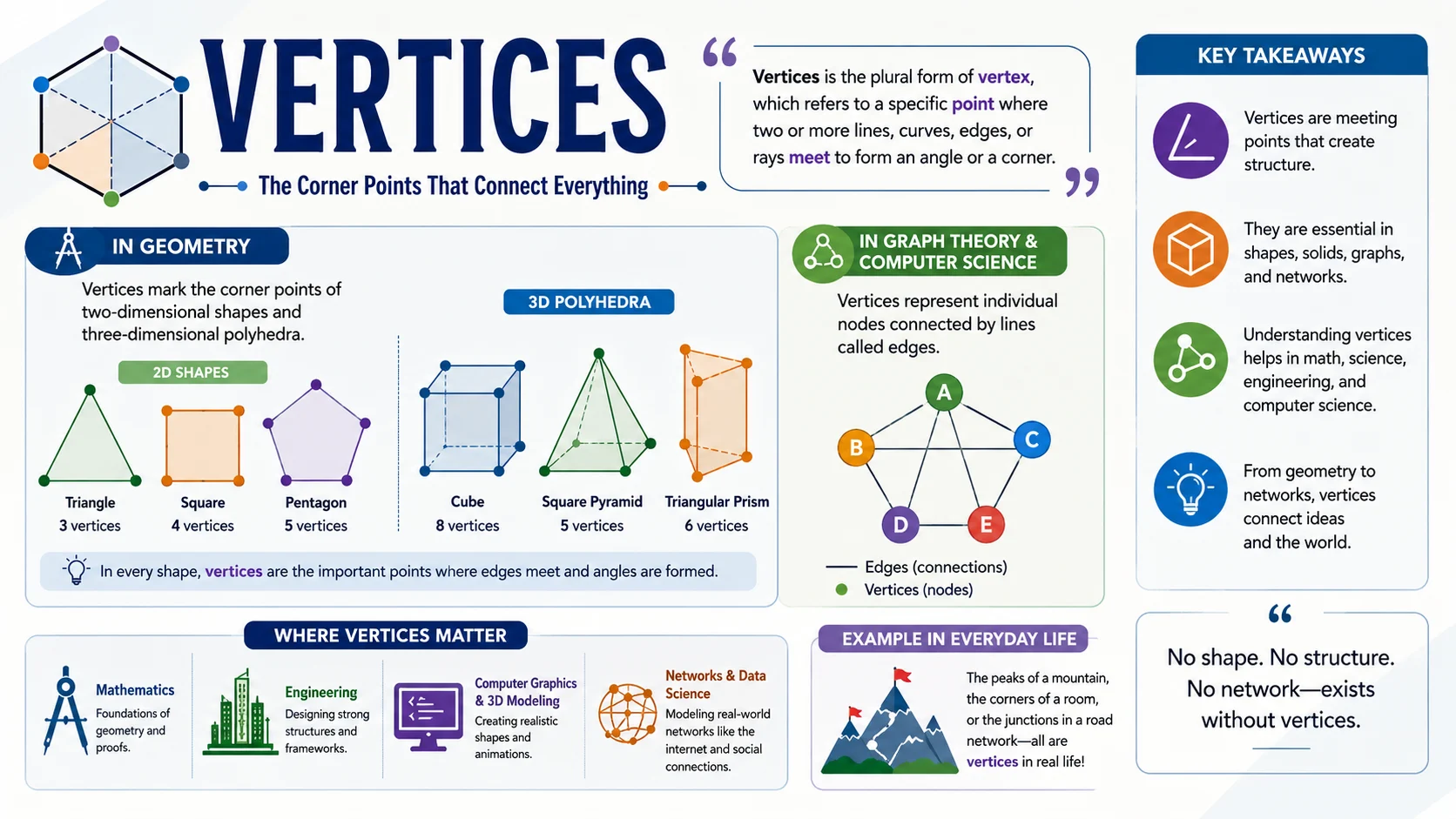
Vertices is the plural form of vertex, which refers to a specific point where two or more lines, curves, edges, or rays meet to form an angle or a corner. In geometry, vertices mark the corner points of two-dimensional shapes and three-dimensional polyhedra. In graph theory and computer science, vertices represent individual nodes connected by lines called edges.
Understanding the complete vertices meaning helps you excel in mathematics, master computer graphics, navigate network analysis, and build advanced 3D models. Furthermore, this essential term connects basic elementary geometry with complex spatial algorithms and computer programming structures. Consequently, when people search for this phrase, they usually want to uncover how to identify a vertex, how to calculate the number of vertices on a shape, or how the definition changes between algebra, geometry, and computer science.
Additionally, digital industries rely heavily on vertices to build virtual environments and 3D computer graphics. For example, modern video games and animation software render entire characters, landscapes, and buildings using interconnected polygons defined by thousands or millions of vertices. Similarly, data analysts use graph theory vertices to map out social media networks, transportation routes, and logistics supply chains. Therefore, mastering every dimension of the definition enriches your technical vocabulary and deepens your mathematical problem-solving skills.
Quick Answer Box
| Aspect | Details |
| Singular Form | Vertex (Plural: Vertices) |
| Etymology Origin | From Latin vertex (“highest point,” “peak,” or “whirlpool,” from vertere meaning to turn) |
| Core Geometric Meaning | The precise corner point where two or more line segments meet |
| Primary Fields | Geometry, algebra, graph theory, 3D computer graphics, network analysis |
| Pronunciation | “VER-tuh-seez” |
What Does Vertices Meaning Represent in Geometry and Mathematics?
To understand the core vertices meaning, one must explore how the concept functions across various mathematical disciplines.
1. Vertices in Two-Dimensional (2D) Shapes
In plane geometry, a vertex is the corner point where two straight lines or edges intersect to form an interior angle.
- Triangles: Every triangle has 3 vertices where its three sides intersect.
- Quadrilaterals: Squares, rectangles, and parallelograms each feature 4 vertices.
- Polygons: An n-sided polygon always contains exactly n vertices. For instance, an octagon has 8 sides and 8 vertices.
2. Vertices in Three-Dimensional (3D) Solids
In solid geometry, a vertex is the sharp point or corner where three or more flat faces or straight edges meet.
- Cube: A standard cube features 8 vertices, 6 square faces, and 12 straight edges.
- Pyramid: A square-based pyramid possesses 5 vertices (4 at the base plus 1 top apex).
- Tetrahedron: A triangular pyramid contains 4 vertices.
“In geometry, if edges form the framework and faces form the skin, vertices serve as the anchor points holding the entire structure together.”
3. Euler’s Characteristic Formula for Polyhedra
For any simple convex three-dimensional polyhedron, the number of vertices ($V$), faces ($F$), and edges ($E$) always satisfies Euler’s famous formula:
V – E + F = 2
For example, on a cube with 6 faces (F = 6) and 12 edges (E = 12):
V – 12 + 6 = 2 \implies V = 8
Thus, Euler’s formula allows you to calculate the exact number of vertices instantly without counting them manually.
Vertices Across Specialized Contexts
However, the application of vertices extends far beyond basic shape measurement. Different technical disciplines use the term to describe critical structural nodes.
1. Algebra and Parabolas (The Vertex of a Curve)
In algebra, the vertex of a parabola represents the single absolute turning point of the quadratic function y = ax^2 + bx + c.
- Maximum or Minimum: It marks either the highest peak (if the parabola opens downward) or the lowest trough (if the parabola opens upward).
- Axis of Symmetry: The vertical line passing through the parabola’s vertex divides the curve into two identical mirror images.
2. Graph Theory and Computer Networks
In computer science and discrete mathematics, a graph consists of a set of vertices (also called nodes or points) connected by edges (lines or links).
- Social Networks: Each user account acts as a vertex, while a “friendship” or “follow” forms an edge connecting two vertices.
- GPS Navigation: Cities or intersections function as vertices, while roads represent the connecting edges.
3. 3D Computer Graphics and Animation
In digital art and animation software (such as Blender or Maya), 3D objects consist of “polygon meshes.”
- Wireframe Geometry: Artists manipulate individual vertices in 3D space along the X, Y, and Z axes to sculpt digital models.
- Vertex Shaders: Graphics processing units (GPUs) calculate the precise spatial position, lighting, and movement of millions of vertices every second to display smooth 3D graphics on screen.
How Vertices Compare to Edges, Faces, and Nodes
Understanding how vertices relate to other geometric terms prevents confusion during complex calculations:
| Term | Geometry Definition | Graph Theory Equivalent | Everyday Analogy |
| Vertex (Vertices) | A corner point where edges meet | Node / Point | The plastic corner joint on a frame |
| Edge | A straight line segment connecting two vertices | Link / Line | The wooden stick or wire connecting corners |
| Face | A flat surface bounded by edges | Region | The cardboard panel filling the side |
| Apex | The highest vertex opposite a base (e.g., pyramid top) | Root Node | The peak of a tent |
Real-Life Conversation Examples
Reviewing everyday academic, programming, and design dialogue shows how people use the term across various settings.
1. Studying Geometry at School
Leo: I am trying to remember how many vertices a triangular prism has.
Maya: Just count the corners! It has two triangular ends with 3 vertices each, making 6 vertices in total.
Leo: That makes it so much easier to visualize!
2. Working on 3D Animation Software
Alex: Why is my 3D character model lagging so much during playback?
Jordan: Your polygon count is way too high. The mesh contains over two million vertices!
Alex: I see. I will optimize the geometry and reduce the vertex count so it renders smoothly.
3. Analyzing Network Security Data
Elena: How is the algorithm mapping our corporate cloud network?
Sam: It treats every server as a vertex and every active data connection as an edge. That way, we can quickly identify isolated nodes.
Key Rules for Counting and Identifying Vertices
Whether solving math homework, writing code, or building structural models, keep these simple guidelines in mind:
- Look for Sharp Intersection Points: A vertex must be a distinct point where straight edges or curves meet to form a corner.
- Curved Shapes Have No Vertices: Smooth round shapes like spheres, cylinders, and circles have zero vertices because they lack intersecting straight edges or sharp corners.
- A Cone Has One Vertex (Apex): A cone features a circular base transitioning up to a single top point, often called its vertex or apex.
- Mind the Singular vs. Plural: Use vertex when referencing one single point and vertices when referring to two or more points. (Avoid incorrect terms like “vertexes”).
FAQs
What is the primary meaning of vertices?
Vertices is the plural form of vertex. It refers to the corner points where two or More line segments, edges, or curves meet in shapes, angles, or mathematical graphs.
What is the difference between a vertex and vertices?
Vertex is the singular noun referring to one single corner point. Vertices is the plural noun referring to multiple corner points.
How many vertices does a cube have?
A standard cube has 8 vertices, along with 6 flat square faces and 12 straight edges.
Does a circle have any vertices?
No. A circle consists of a continuous curved line with no straight edges or intersecting lines, meaning it has 0 vertices.
Does a sphere have vertices?
No. A sphere is a completely smooth three-dimensional surface with no edges or corners, so it has 0 vertices.
How do you find the vertices of a 3D shape?
You can count the sharp corner points where three or more edges intersect. Alternatively, if you know the number of faces ($F$) and edges ($E$), you can use Euler’s formula: $V = E – F + 2$.
What is a vertex in algebra?
In algebra, a vertex is the maximum or minimum turning point on a parabolic curve defined by a quadratic equation.
How do you pronounce “vertices”?
It is pronounced VER-tuh-seez (or /ˈvɜːr.tɪ.siːz/).
What is a vertex in computer graphics?
In 3D computer graphics, a vertex is a spatial coordinate point (defined by X, Y, and Z positions) that connects with other vertices to form triangular or polygonal meshes.
What is the difference between an edge and a vertex?
A vertex is an individual zero-dimensional point (a corner), whereas an edge is a one-dimensional line segment connecting two vertices together.
Conclusion
Ultimately, whether encountered in a high school geometry test, an algebra textbook, a 3D animation workspace, or a computer network diagram, understanding the vertices meaning reveals a fundamental building block of spatial awareness. The evolution of the concept from ancient Latin origins to modern digital computing shows how mathematics structures our understanding of shapes and connectivity. By recognizing how vertices define form and structure, you can solve mathematical problems with absolute confidence and appreciate the architecture of the digital world.










24 thoughts on “Vertices Meaning| The Ultimate Guide and Semantic Meaning For 2026”