The prior meaning refers to something coming before in time, order, importance, or rank. Consequently, it describes previous events, earlier agreements, or existing commitments that occurred before a specific moment.
What Does Prior Mean? A Complete Overview
Understanding the true prior meaning is essential for anyone reading legal contracts, business schedules, or formal academic texts. Language carries specific weight, and formal adjectives frequently clarify precise timelines. Consequently, encountering this word in legal documents or official notices can feel rigid at first. Furthermore, grasping its exact definition helps you manage daily schedules accurately and understand formal documents with complete confidence.
In general terms, the word functions as an adjective or noun describing an earlier event, condition, or obligation. When an event occurs prior to another, it happens earlier on the timeline. Conversely, a future or subsequent event represents the opposite state. Therefore, establishing a clear sequence allows legal authorities and business leaders to organize priorities effectively.
The term originated from the Latin word prior, which means “former,” “previous,” or “first.” Historically, medieval religious orders used the word as a title for a monastic officer ranking directly below an abbot. Consequently, as formal English developed, the word expanded into an adjective describing previous conditions and a legal noun referring to earlier criminal records.
Quick Answer Guide
| Context | Primary Meaning | Primary Usage | Example Sentence | Tone & Style |
| Time & Order | Existing or happening earlier in time | Daily Scheduling, Formal Writing | “She had a prior commitment tonight.” | Formal, Direct |
| Legal / Criminal | A previous criminal conviction | Courtroom Proceedings, Police Reports | “The suspect had no prior records.” | Legal, Objective |
| Monastic / Religious | A senior officer in a monastery | Religious History, Monastic Orders | “The prior managed the daily monastery duties.” | Historical, Formal |
| Business & Contracts | Existing agreements before a new deal | Corporate Contracts, NDAs | “This deal requires prior written consent.” | Corporate, Binding |
What Does Prior Mean in Legal and Business Settings?
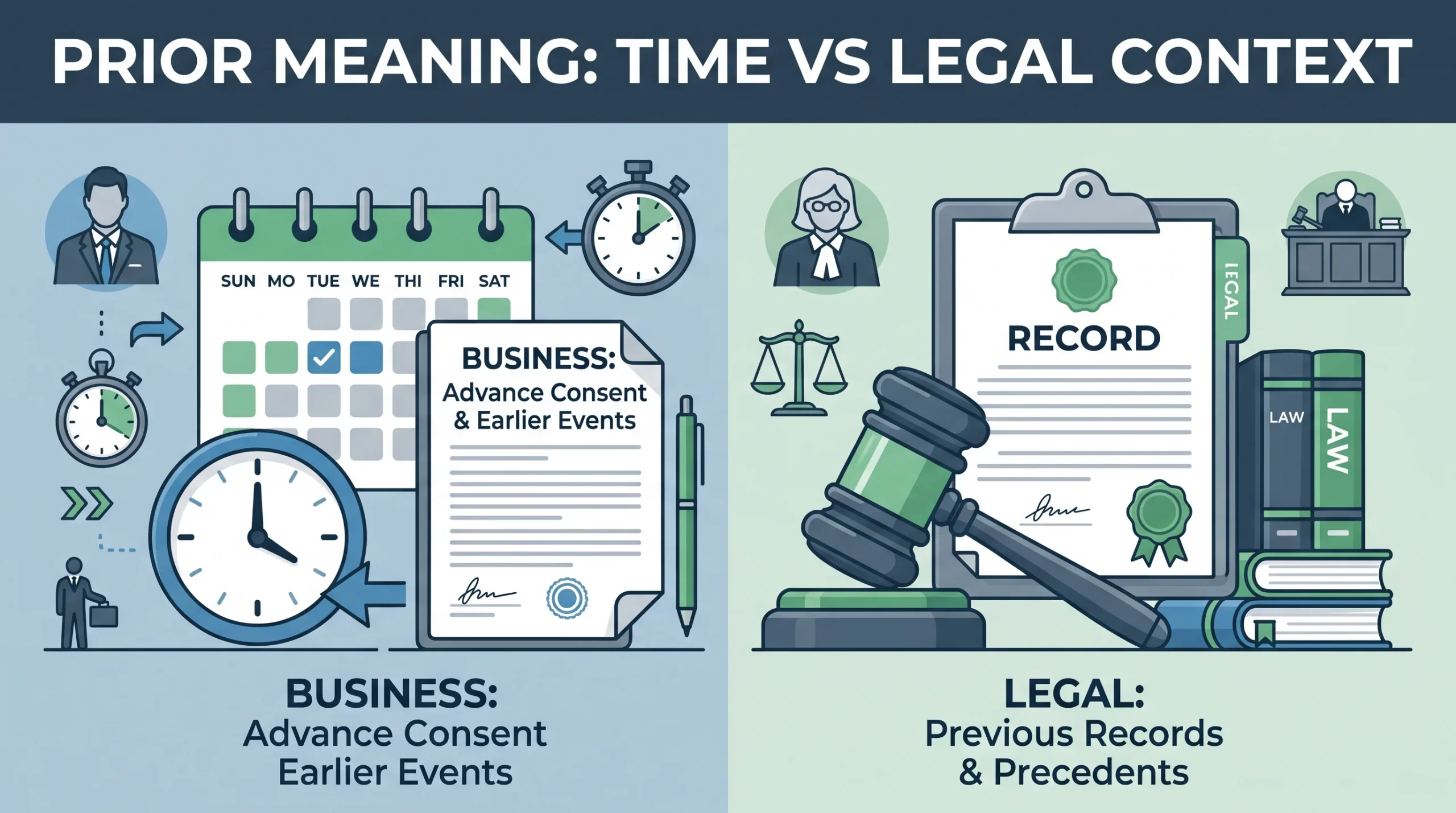
When people research the prior meaning within contracts or legal hearings, the primary answer involves established precedents and earlier conditions. In corporate law, agreements often mandate “prior notice” or “prior written consent” before a party makes changes. Consequently, taking action without earlier approval violates the contract terms.
Furthermore, legal systems use the word as a plural noun to reference a defendant’s criminal history. Because past convictions influence trial sentencing, courts examine these earlier records carefully. Therefore, defense attorneys and prosecutors evaluate past offenses during bail hearings and trial proceedings.
For example, if a business partner wants to sign a new vendor deal, the master agreement might require prior written authorization from the board. However, if the partner signs the contract without getting earlier consent, the contract may face immediate cancellation.
- Prior Approval: Permission that an individual must obtain before taking an action.
- Prior Notice: An advance warning or notification given before an event occurs.
- Priors (Legal Noun): Previous criminal convictions recorded on a person’s legal file.
Contextual Dynamics & Nuances of the Term
Understanding the term requires evaluating the surrounding situation. The word carries distinct operational weight depending on where the scenario unfolds.
- Corporate Scheduling & HR: Identifies earlier obligations that prevent taking on new tasks.
- Legal Contracts & NDAs: Establishes conditions that must be fulfilled beforehand.
- Courtrooms & Law Enforcement: Reviews past criminal behavior to determine appropriate sentencing.
- Religious Architecture & History: Refers to the physical residence or office of a monastery leader.
The Business Perspective: Preconditions and Consent
In corporate operations, establishing earlier consent protects organizations from unauthorized decisions. Consequently, management structures rely heavily on advance notices.
- Prior Authorization: Insurance companies require advance medical approval before covering complex procedures.
- Prior Knowledge: Demonstrates that a party already possessed information before signing a non-disclosure agreement.
- Prior Engagement: Politely declines invitations due to previously scheduled appointments.
The Legal Perspective: Precedent and Criminal History
To fully grasp the word, you must analyze how courts handle past events. Furthermore, judges evaluate earlier actions to ensure fair legal outcomes.
- Prior Restraint: A controversial government action that suppresses speech or publication before it occurs.
- Prior Offenses: Earlier violations that increase penalties for repeated unlawful behavior.
Real-Life Conversation Examples Using Prior
Reviewing real-life exchanges helps illustrate how the term functions across different everyday scenarios.
1: Declining an Invitation Politely
- Colleague A: “Are you joining the team dinner this Thursday?”
- Colleague B: “Unfortunately, I have a prior commitment that evening.”
- Colleague A: “No worries, we will catch you at the next event!”
2: Business Contract Discussion
- Manager A: “Can we modify the software features next week?”
- Manager B: “We must get prior written approval from the client first.”
- Manager A: “I will send the official request form today.”
3: Medical Insurance Query
- Patient: “Why hasn’t the pharmacy filled my prescription yet?”
- Pharmacist: “Your insurance provider requires prior authorization for this medicine.”
- Patient: “I will call my doctor’s office to submit the form.”
4: Courtroom Legal Exchange
- Judge: “Does the defendant have any priors on record?”
- Prosecutor: “No, your honor, this is a first-time offense.”
- Judge: “We will take that into account during sentencing.”
5: Everyday Scheduling Update
- Friend A: “Why didn’t you answer my call earlier?”
- Friend B: “I was in a meeting that ran late without prior notice.”
- Friend A: “Understood, hope the rest of your day goes smoothly!”
Platform-Specific Breakdown
Different professional spaces utilize the term in distinct ways.
- Legal Tech & Contract Apps: Platforms like DocuSign highlight phrases like “requires prior signature” to ensure valid execution.
- Healthcare Portals: Medical apps track prior authorization requests to inform patients about coverage status.
- Scheduling Tools: Apps like Calendly block out times based on prior calendar entries.
- News & Crime Outlets: Crime reporting platforms use the plural noun form to list a suspect’s previous charges.
How It Is Used in Business and Healthcare
On business platforms, systems display notifications like “Action blocked: prior approval needed.” Consequently, this workflow prevents unauthorized changes to secure files.
In healthcare administrative software, staff track insurance approvals clearly. Furthermore, clinics notify patients whenever a procedure requires earlier carrier review.
Alternative Meanings & NLP Variations of the Phrase
While earlier time and legal history dominate search queries, related linguistic variations exist across formal English.
- Priorly (Adverb): An archaic or informal variation meaning previously or beforehand.
- Priority (Noun): A related concept describing something given higher importance or precedence.
- Priory (Noun): A monastery or religious house governed by a prior or prioress.
- Prioritize (Verb): The active process of arranging items or tasks in order of importance.
Misinterpretations: When NOT to Use Prior
Using formal terms in casual settings can sound unnatural or create unnecessary stiffness in friendly conversations.
| Setting | Context | Appropriateness Level | Recommended Alternative |
| Casual Texting | Everyday chat with friends | Unnatural | Before / Earlier |
| Legal Contracts | Formal agreements & NDAs | Highly Appropriate | Prior / Preceding |
| Medical Claims | Insurance authorization | Highly Appropriate | Prior authorization |
| Academic Writing | Research papers & essays | Highly Appropriate | Prior to / Previous |
Avoid Overly Casual or Incorrect Contexts
Never confuse the target term with simple informal time markers when speaking casually. Telling a close friend that you ate dinner “prior to coming over” sounds overly formal. Consequently, reserve the phrase for professional, written, or official contexts.
Furthermore, avoid using the plural form “priors” outside of law enforcement or legal contexts. Likewise, referring to someone’s personal past mistakes as “priors” in casual conversation can sound harsh or accusatory.
How to Respond in Discussion Comfortably
When someone uses the term in a corporate, medical, or legal discussion, responding naturally is simple once you recognize their intent.
- Declining Invitations: If a colleague says “I have a prior engagement,” respond politely (“Thanks for letting me know, enjoy your evening!”).
- Business Requests: If an manager notes “This needs prior approval,” confirm the protocol (“I will submit the authorization paperwork immediately.”).
- Legal & Insurance Updates: If a clinic mentions “We are waiting on prior authorization,” ask for timeline details (“How long does the review process usually take?”).
FAQs
What does prior meaning in simple terms?
In simple terms, it means existing or happening earlier in time, order, or importance.
What is the difference between prior and previous?
Both words mean coming before. However, prior often implies a formal relationship, necessity, or requirement, whereas previous simply refers to time sequence.
What does prior to mean?
The phrase “prior to” is a formal preposition that simply means before. For example, “prior to the meeting” means “before the meeting.
What does priors mean in criminal law?
In criminal law, “priors” is informal legal shorthand referring to an individual’s previous criminal convictions or court charges.
What is prior authorization in healthcare?
Prior authorization is a requirement by health insurance plans where doctors must get approval before providing certain medical treatments or medications.
What is a synonym for prior?
Common synonyms include previous, earlier, preceding, former, and antecedent.
What is the opposite of prior?
Common antonyms include subsequent, later, following, future, and succeeding.
How do you pronounce prior?
You pronounce it as “PRY-er.”
What is a priory in religious history?
A priory is a monastery or religious house directed by a prior or prioress.
Can prior be used as a noun?
Yes, as a singular noun it refers to a religious leader, and as a plural noun (“priors”) it refers to previous criminal convictions.
Conclusion
Language provides essential precision for organizing time, legal requirements, and formal duties. Understanding the full prior meaning allows you to navigate business contracts, medical requirements, and scheduling with complete confidence. Whether you are reviewing contract clauses or declining an invitation politely, recognizing this fundamental word ensures you communicate clearly across every environment.