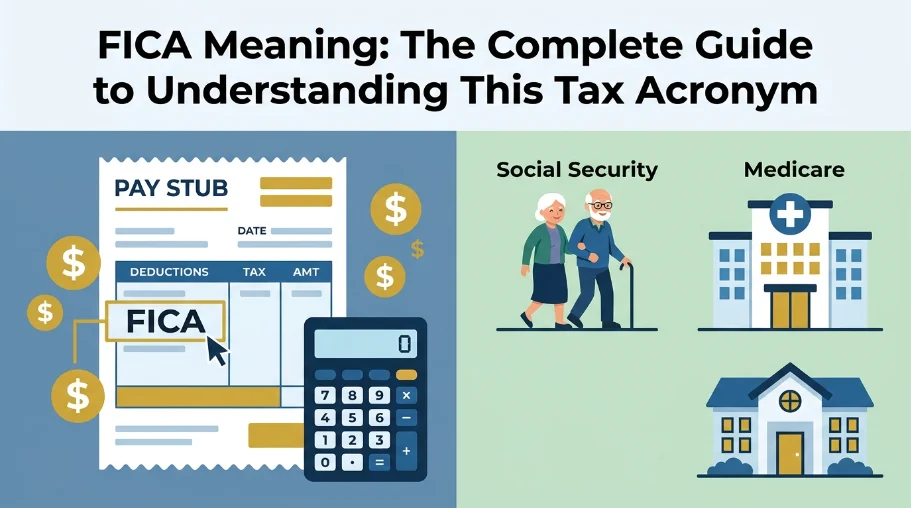
FICA stands for the Federal Insurance Contributions Act, a U.S. law that requires employers to withhold payroll taxes from employee wages to fund Social Security and Medicare programs . Both employees and employers contribute matching amounts, with the total FICA tax rate being 15.3% of wages (7.65% each) .
Have you ever looked at your pay stub and wondered what the deduction labeled “FICA” really means? This small acronym represents a significant portion of your paycheck, but many people do not fully understand what it is or where their money goes. Understanding the FICA meaning is essential for every working American.
The confusion around FICA is widespread. Many people mistake it for income tax or assume it is just another government deduction. The truth is that FICA serves a specific purpose: it funds the Social Security and Medicare programs that provide benefits to retirees, people with disabilities, and survivors of deceased workers . Knowing what you are paying for helps you appreciate the value of these programs.
This article clears up the confusion around FICA once and for all. You will learn what FICA stands for, how it works, who pays it, and why it matters. By the end, you will confidently understand the FICA meaning and how it affects your finances. Good financial literacy depends on knowing these important details.
Key Takeaway
The main takeaway is that FICA is the federal payroll tax that funds Social Security and Medicare . It consists of two parts: Social Security tax (6.2% each from employee and employer, up to a wage cap) and Medicare tax (1.45% each from employee and employer, with no wage cap) . Self-employed individuals pay both halves themselves through self-employment tax .
Definitions and Explanations
What Does FICA Stand For?
FICA stands for the Federal Insurance Contributions Act . This is a U.S. federal law that requires employers to withhold payroll taxes from employee wages and contribute matching amounts .
The name comes from the fact that the taxes help fund federal insurance programs:
- Social Security (retirement, disability, and survivor benefits)
- Medicare (health insurance for people 65 and older and certain younger people with disabilities)
How FICA Works
FICA taxes work through a shared contribution system. Both employees and employers contribute equally to fund Social Security and Medicare . The employer withholds the employee’s share from each paycheck and then adds an equal matching amount .
| Tax Component | Employee Pays | Employer Pays | Wage Limit (2026) |
| Social Security | 6.2% | 6.2% | $184,500 |
| Medicare | 1.45% | 1.45% | No limit |
| Additional Medicare | 0.9% | 0% | Above $200,000 (single) |
The Two Components of FICA
Social Security Tax (OASDI)
This tax funds the Old-Age, Survivors, and Disability Insurance program . It provides:
- Monthly retirement income for workers starting at age 62 or later
- Disability income for workers who become unable to work
- Survivor benefits for spouses and dependents of deceased workers
The Social Security tax applies only up to a yearly wage base limit. For 2026, this limit is $184,500 . Once an employee’s earnings exceed this amount, no additional Social Security tax is withheld for the year .
Medicare Tax (Hospital Insurance)
This tax funds Medicare Part A, which covers hospital care, skilled nursing, and hospice . Unlike Social Security, there is no wage cap for Medicare tax. All wages are subject to the 1.45% tax .
High earners pay an additional 0.9% Medicare surtax on wages above certain thresholds :
- $200,000 for single filers
- $250,000 for married couples filing jointly
- $125,000 for married individuals filing separately
FICA vs. Federal Income Tax
Many people confuse FICA with federal income tax, but they are different .
| Feature | FICA | Federal Income Tax |
| Purpose | Funds Social Security and Medicare | Funds general government operations |
| Rate | Fixed percentage (7.65% employee share) | Progressive (10% to 37%) |
| Employer Match | Yes, employers match employee contributions | No, only employees pay |
| Deductions | Cannot be reduced by deductions or credits | Can be reduced by deductions and credits |
What FICA Pays For
The money collected through FICA taxes goes directly to two trust funds managed by the federal government:
- Social Security Trust Fund: Provides retirement, disability, and survivor benefits
- Medicare Trust Fund: Provides hospital insurance for people 65 and older and certain younger people with disabilities
These programs are not funded through general income tax revenue. Instead, they rely on the payroll taxes collected through FICA .
Advantages and Disadvantages
Advantages of FICA
Provides essential social safety net: FICA funds Social Security and Medicare, which provide crucial support to millions of Americans. Without these programs, many retirees, people with disabilities, and survivors would struggle financially.
Predictable contributions: FICA is a fixed percentage of wages, making it easy for employees and employers to budget for payroll taxes .
Employer matching: The employer’s matching contribution effectively doubles the amount going into the system, increasing the funding available for benefits .
Portable benefits: Social Security and Medicare benefits follow workers throughout their careers. You do not lose your contributions when you change jobs.
Disadvantages of FICA
Regressive tax structure: FICA only applies to wages up to the Social Security wage base limit. Higher-income earners pay a smaller percentage of their total income in FICA taxes .
Lack of investment choice: Unlike retirement savings accounts, FICA contributions go into government trust funds. Individuals cannot choose how their money is invested .
Future uncertainty: Concerns about the long-term solvency of Social Security and Medicare raise questions about whether current workers will receive full benefits .
Real-World Examples
Example 1: Employee FICA Calculation
For an employee earning $60,000 per year in 2026, FICA contributions would be:
| Tax Component | Employee Share | Employer Share |
| Social Security (6.2% of $60,000) | $3,720 | $3,720 |
| Medicare (1.45% of $60,000) | $870 | $870 |
| Total FICA | $4,590 | $4,590 |
| Combined FICA | $9,180 |
Example 2: High-Earner FICA Calculation
For an employee earning $200,000 per year in 2026:
| Tax Component | Employee Share | Employer Share |
| Social Security (6.2% of $184,500) | $11,439 | $11,439 |
| Medicare (1.45% of $200,000) | $2,900 | $2,900 |
| Additional Medicare (0.9% of $0, if single) | $0 | $0 |
| Total FICA | $14,339 | $14,339 |
| Combined FICA | $28,678 |
Example 3: How FICA Appears on Your Pay Stub
On most pay stubs, FICA appears as separate line items :
- Social Security (may be labeled “SS,” “SS Tax,” “OASDI,” or “FICA-SS”)
- Medicare (may be labeled “Med,” “Medicare,” or “Fed MED/EE”)
- Some employers combine them under a single “FICA” line
Example 4: Self-Employed FICA
Self-employed individuals do not have employers to match their FICA contributions. Instead, they pay self-employment tax under the Self-Employment Contributions Act (SECA) . This tax covers both the employee and employer portions of FICA, totaling 15.3% of net self-employment earnings .
For 2026, the self-employment tax calculation is:
- Social Security: 12.4% on profits up to $184,500
- Medicare: 2.9% on all profits
- Additional Medicare: 0.9% on profits above $200,000 (single filers)
Self-employed individuals can deduct the employer-equivalent portion of self-employment tax as a business expense on their tax returns .
Regional and Global Usage
FICA is a U.S.-specific term and does not apply to other countries. However, many countries have similar payroll tax systems to fund social insurance programs .
U.S. FICA Tax Compliance
FICA applies to all wages earned by employees working in the United States . Employers are required to:
- Withhold the employee’s share from each paycheck
- Contribute an equal matching amount
- File quarterly reports using Form 941
- Remit payments to the IRS
Exemptions from FICA
Some workers are exempt from FICA taxes:
- Nonresident aliens: Foreign nationals in F-1 or J-1 status with nonresident alien tax status are exempt on employment wages
- Student workers: Students who meet minimum credit hour enrollment requirements are exempt for on-campus employment
- Some government employees participate in alternative retirement systems
Common Mistakes
Mistake 1: Confusing FICA with Federal Income Tax
Many people assume FICA is part of their income tax. This is incorrect. FICA is a separate payroll tax that funds specific programs .
Correction: Understand that FICA and income tax are distinct. FICA is a fixed percentage of wages for Social Security and Medicare. Income tax is a progressive tax based on total income .
Mistake 2: Believing Employers Pay All FICA
Some employees think employers pay the full FICA tax. In reality, the cost is split equally between employee and employer .
Correction: Remember that you pay half (7.65%) of FICA through payroll deductions, and your employer pays the other half .
Mistake 3: Not Understanding the Social Security Wage Limit
People often overestimate how much they will pay in Social Security taxes. Social Security tax applies only to earnings up to the annual wage base limit .
Correction: For 2026, Social Security tax applies to earnings up to $184,500. Income above this amount is not subject to Social Security tax .
Mistake 4: Assuming FICA Will Fund Their Personal Retirement Account
FICA does not create a personal savings account. Contributions go into trust funds that pay benefits to current retirees .
Correction: FICA taxes support the current Social Security and Medicare systems. Your benefits are based on your work history and earnings record, not your individual contributions.
Exercises
Exercise 1: Calculate FICA Withholding
Calculate the FICA tax (employee share) for an employee earning $75,000 annually in 2026.
- Social Security: 6.2% of _____ = _____
- Medicare: 1.45% of _____ = _____
- Total FICA employee share = _____
Exercise 2: Identify FICA Components
Match each FICA component to its description.
| Component | Description |
| Social Security | Fund retirement, disability, and survivor benefits |
| Medicare | Fund hospital insurance |
| Additional Medicare | 0.9% surtax on high earners |
Exercise 3: Determine Eligibility
Determine whether each worker is subject to FICA.
- A full-time employee earning $50,000 annually
- A self-employed consultant earning $80,000 annually
- An F-1 visa student working on-campus
- A retiree receiving Social Security benefits
Answer Key
Exercise 1 Answers:
- Social Security: 6.2% of $75,000 = **$4,650**
- Medicare: 1.45% of $75,000 = **$1,087.50**
- Total FICA employee share = $5,737.50
Exercise 2 Answers:
- Social Security: Fund retirement, disability, and survivor benefits
- Medicare: Fund hospital insurance
- Additional Medicare: 0.9% surtax on high earners
Exercise 3 Answers:
- Yes – Subject to FICA withholding
- Yes – Must pay self-employment tax (equivalent of FICA)
- No – Nonresident alien students are exempt on employment wages
- No – Benefits are not wages subject to FICA
Related Concepts and Comparisons
FICA vs. Self-Employment Tax
| Feature | FICA | Self-Employment Tax (SECA) |
| Who Pays | Employees and employers | Self-employed individuals |
| Total Rate | 7.65% each (employee + employer) | 15.3% total |
| Social Security | 6.2% each | 12.4% total |
| Medicare | 1.45% each | 2.9% total |
| Deduction | Not deductible | Half of self-employment tax is deductible |
FICA vs. FUTA
| Feature | FICA | FUTA |
| Stands For | Federal Insurance Contributions Act | Federal Unemployment Tax Act |
| Purpose | Fund Social Security and Medicare | Fund unemployment benefits |
| Paid By | Employee and employer | Employer only |
| Rate | 7.65% each (employee + employer) | 6% (employer) |
FAQs
What does FICA stand for?
FICA stands for the Federal Insurance Contributions Act . It is the federal law that requires payroll taxes to be withheld from employee wages to fund Social Security and Medicare.
What is FICA tax?
FICA tax is the payroll tax that funds Social Security and Medicare programs . It is automatically withheld from employee paychecks, with employers contributing matching amounts .
How much is FICA tax?
The total FICA tax rate is 15.3% of wages. Employees pay 7.65% (6.2% for Social Security plus 1.45% for Medicare). Employers match this with another 7.65% .
What is the FICA tax rate for 2026?
For 2026, the FICA tax rate is 7.65% for employees (6.2% Social Security + 1.45% Medicare) and 7.65% for employers . The Social Security wage base limit is $184,500 .
Is FICA tax the same as federal income tax?
No, FICA and federal income tax are different . FICA is a fixed percentage payroll tax that funds Social Security and Medicare . Federal income tax is a progressive tax that funds general government operations .
Why is FICA on my paycheck?
FICA is on your paycheck because your employer is required by law to withhold Social Security and Medicare taxes from your wages . These taxes fund the benefits you may receive in retirement or if you become disabled.
Who pays FICA taxes?
Both employees and employers pay FICA taxes . Employees pay 7.65% of their wages, and employers match this amount . Self-employed individuals pay both halves through self-employment tax .
What does FICA pay for?
FICA taxes fund Social Security and Medicare programs . Social Security provides retirement, disability, and survivor benefits. Medicare provides health insurance for people 65 and older and certain younger people with disabilities .
What is the Social Security wage base limit?
The Social Security wage base limit is the maximum earnings subject to Social Security tax. For 2026, the limit is $184,500 . Earnings above this amount are not subject to Social Security tax .
Do I get my FICA contributions back?
FICA contributions do not work like a personal savings account. They go into trust funds that pay benefits to current retirees . However, your work history and earnings record determine your eligibility for Social Security and Medicare benefits.
What is the Additional Medicare Tax?
The Additional Medicare Tax is a 0.9% surtax that applies to high earners . It applies to wages above $200,000 for single filers, $250,000 for married couples filing jointly, and $125,000 for married individuals filing separately . This tax is only paid by employees, not employers .
How do self-employed people pay FICA?
Self-employed individuals pay self-employment tax under the Self-Employment Contributions Act (SECA) . This tax covers both the employee and employer portions of FICA, totaling 15.3% of net earnings .
Conclusion
This guide has explored the FICA meaning and its importance in the U.S. payroll tax system. FICA stands for the Federal Insurance Contributions Act . It funds Social Security and Medicare through payroll taxes paid by both employees and employers . Understanding what FICA is and how it works helps you make sense of your paycheck and appreciate the benefits these programs provide.
The best practical advice is to understand that FICA is not optional and cannot be avoided. However, it is an investment in your future. The Social Security and Medicare benefits you earn through FICA contributions provide financial security during retirement, disability or times of need. Financial literacy starts with understanding the taxes you pay and what you receive in return. Now you have the knowledge to understand FICA and its role in your financial life.











17 thoughts on “FICA Meaning | The Complete Guide to Understanding This Tax Acronym For 2026”