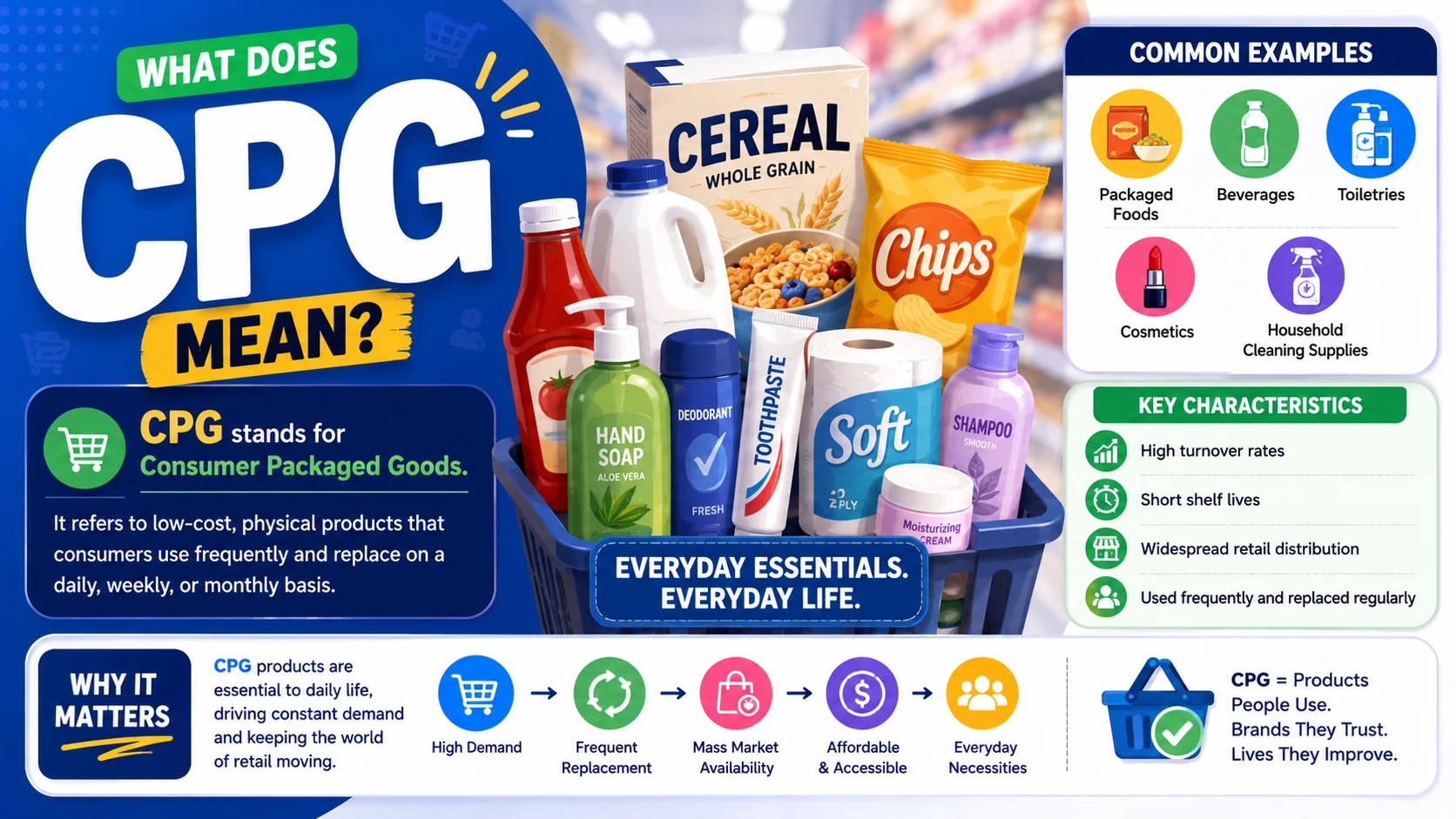
CPG stands for Consumer Packaged Goods. It refers to low-cost, physical products that consumers use frequently and replace on a daily, weekly, or monthly basis. Common examples include packaged foods, beverages, toiletries, cosmetics, and household cleaning supplies. CPG products feature high turnover rates, short shelf lives, and widespread retail distribution.
Understanding the complete CPG meaning helps you navigate corporate supply chains, retail marketing, stock market investments, and modern consumer habits. Furthermore, because the consumer packaged goods sector represents one of the largest segments of the global economy, grasping its core dynamics is essential for business professionals and entrepreneurs alike. Consequently, when people search for this term, they usually want to uncover what products fall under the CPG umbrella, how CPG differs from durable goods, or how modern direct-to-consumer (DTC) trends are transforming the industry.
Additionally, retail brands and grocery stores rely heavily on CPG manufacturers to maintain consistent inventory and drive high sales volumes. For example, multinational corporations invest billions in shelf-space positioning and digital marketing to capture market share. Similarly, e-commerce platforms have reshaped how shoppers buy everyday essentials online. Therefore, mastering every dimension of the definition elevates your commercial literacy and deepens your understanding of retail economics.
Quick Answer Box
| Aspect | Details |
| Full Term | Consumer Packaged Goods |
| Primary Meaning | Everyday physical items bought frequently and consumed quickly |
| Key Categories | Food & beverages, beauty products, household cleaners, personal care |
| Industry Traits | High volume, low profit margins per item, rapid inventory turnover |
| Key Difference from Durables | Consumed quickly rather than lasting for years (e.g., milk vs. refrigerator) |
What Does CPG Meaning Represent in Business and Retail?
To understand the core CPG meaning, one must examine how products move from manufacturing plants to retail shelves and consumer homes.
1. High Turnover and Short Lifespans
Unlike major purchase items that last for years, CPG items are designed for immediate or short-term consumption. Because consumers use these products daily, the demand remains relatively steady regardless of minor economic fluctuations.
- FMCG Comparison: CPG is often used interchangeably with FMCG (Fast-Moving Consumer Goods), particularly in international markets outside North America.
2. Supply Chain and Retail Placement
Because individual CPG items carry low profit margins, manufacturers achieve profitability through immense sales volume.
“In the CPG industry, success isn’t built on single large transactions, it’s built on winning daily habits and brand loyalty.”
Furthermore, physical placement in retail stores, such as eye-level shelf space or checkout line displays, plays a critical role in driving impulse purchases and brand recognition.
Major Categories of CPG Products
The CPG market encompasses a vast array of everyday household items, organized into several primary categories:
[Food & Beverage] -> Cereals, snacks, sodas, coffee, canned goods
[Personal Care]  -> Toothpaste, shampoo, soap, deodorant, skincare
[Household Goods]-> Detergent, paper towels, trash bags, dish soap
[Baby Care]      -> Diapers, baby wipes, infant formula
CPG vs. Durable Goods: A Quick Comparison
Understanding how CPG products differ from durable goods clarifies key economic and manufacturing distinctions:
| Feature | Consumer Packaged Goods (CPG) | Durable Goods |
| Lifespan | Used immediately or within days/months | Built to last 3+ years |
| Purchase Frequency | Frequent (weekly, monthly) | Infrequent (every few years) |
| Price Point | Relatively low cost per unit | High capital investment |
| Consumer Demand | Stable, inelastic demand | Cyclical, tied to economic conditions |
| Examples | Bread, shampoo, laundry soap | Automobiles, washing machines, laptops |
Real-Life Conversation Examples
Reviewing everyday business and retail dialogue shows how professionals use the term across various settings.
1. Discussing Marketing Strategy at a Brand Agency
Alex: Our agency just landed a new account with a major beverage manufacturer.
Sarah: That’s fantastic! Is it a traditional retail campaign or digital DTC outreach?
Alex: A mix of both! CPG brands are investing heavily in social media ads to drive in-store sales.
2. Planning Supply Chain Operations
Jordan: We need to optimize our inventory logistics for the upcoming holiday season.
Taylor: Agreed. Because CPG turnover spikes in Q4, maintaining warehouse stock is crucial.
Jordan: Exactly, we can’t afford out-of-stock notices on core grocery lines.
3. Evaluating Investment Opportunities
Maya: Are you looking to add defensive stocks to your portfolio this quarter?
Chloe: Yes, I’m analyzing a few established CPG companies, their steady consumer demand offers great stability.
Key Trends Transforming the CPG Industry
Modern technology and changing consumer preferences continue to reshape the CPG landscape:
- Direct-to-Consumer (DTC) E-Commerce: Digital brands bypass traditional retail stores by shipping subscription boxes (e.g., razors, vitamins, meal kits) directly to consumer doorsteps.
- Sustainability and Eco-Friendly Packaging: Consumers increasingly demand recyclable materials, reduced plastic waste, and ethically sourced ingredients.
- Private-Label Competition: Store brands (such as Kirkland Signature or Great Value) compete directly with national CPG brands by offering lower prices.
- Data-Driven Personalization: Brands leverage customer purchase data to tailor rewards programs, targeted ads, and custom product formulations.
FAQs
What is the primary CPG meaning in retail?
In retail, CPG stands for Consumer Packaged Goods, referring to low-cost products that consumers purchase frequently and replace quickly, such as food, beverages, and personal care items.
What is the difference between CPG and FMCG?
CPG (Consumer Packaged Goods) and FMCG (Fast-Moving Consumer Goods) are essentially synonymous. CPG is the preferred term in North America, while FMCG is more widely used in Europe and Asia.
What are common examples of CPG items?
Common examples include packaged snacks, bottled water, toothpaste, dish soap, cereal, paper towels, shampoo, and pet food.
Are electronics considered CPG?
No. Electronics like smartphones, televisions, and computers are classified as durable goods or consumer electronics because they last for several years and require higher capital investment.
Why is the CPG industry considered economically defensive?
The CPG sector is defensive because people continue buying essential goods like food, soap, and toilet paper even during economic downturns or recessions.
What is a CPG brand?
A CPG brand is a company or product line that manufactures and markets packaged items directly to end consumers, either through retail stores or online channels.
How do CPG companies make a profit?
Because individual CPG profit margins are relatively small, companies generate revenue through massive sales volume, widespread retail distribution, and high customer retention.
What does DTC mean in the CPG industry?
DTC stands for Direct-to-Consumer, a business model where CPG companies sell products directly to buyers through their own websites rather than third-party retailers.
Is pet food considered a CPG product?
Yes! Pet food, treats, and pet care supplies are major, fast-growing categories within the overall CPG sector.
What are private-label CPG goods?
Private-label CPG goods are store-brand products manufactured by a third party but sold under a specific retailer’s name (e.g., Target’s Favorite Day or Trader Joe’s items).
Conclusion
Ultimately, whether managing retail logistics, launching a digital brand, or investing in stock markets, understanding the CPG meaning equips you with essential business insight. The evolution of consumer packaged goods, from traditional grocery aisles to modern digital subscription boxes, highlights how essential items adapt to changing consumer habits. By recognizing the mechanics of turnover, brand loyalty, and distribution, you can navigate the modern retail market with confidence.

Andrew Morris is a writer at Meaninga.com who specializes in word meanings, slang, idioms and modern language trends. He creates clear, accurate and easy to understand content for everyday readers.