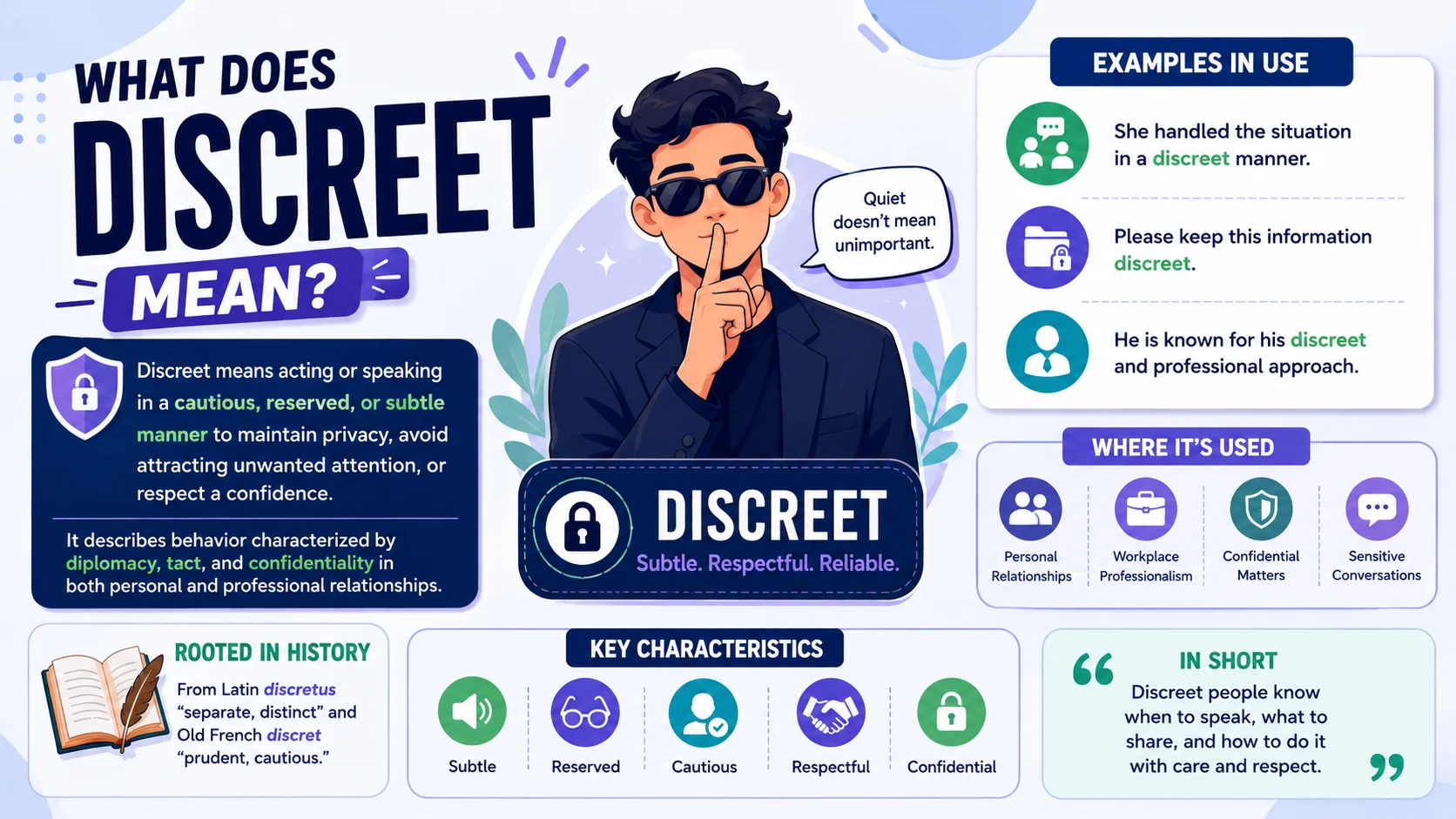
Discreet means acting or speaking in a cautious, reserved, or subtle manner to maintain privacy, avoid attracting unwanted attention, or respect a confidence. Rooted in Latin and French, it describes behavior characterized by diplomacy, tact, and confidentiality in both personal and professional relationships.
Understanding the complete discreet meaning helps you communicate with tact, navigate sensitive professional environments, and maintain privacy in personal relationships. Furthermore, because this term is frequently confused with its homophone discrete, mastering its definition, spelling, and proper context ensures your writing remains clear and polished. Consequently, when people search for this word, they usually want to uncover how to use it correctly in sentences, understand its legal and workplace nuances, or learn how it differs from similar vocabulary.
Additionally, modern communication environments prioritize individuals who can handle confidential information and navigate delicate social situations with care. For example, human resource managers must remain discreet when handling sensitive employee matters. Similarly, financial advisors and legal professionals rely on discretion to build trust with high-profile clients. Therefore, grasping every dimension of the definition elevates your professional literacy and sharpens your everyday communication skills.
Quick Answer Box
| Aspect | Details |
|---|---|
| Primary Meaning | Cautious, subtle, tactful, keeping secrets, avoiding unwanted attention |
| Primary Contexts | Professional communications, personal privacy, diplomacy, sensitive services |
| Common Confusion | Often confused with discrete (which means separate, distinct, or detached) |
| Mnemonic Trick | The “ee”s in discreet keep secrets ee-nsider (hidden inside together) |
| Tone | Tactful, reserved, diplomatic, professional, quiet |
What Does Discreet Meaning Represent in Language and History?
To understand the core discreet meaning, one must trace its historical evolution and linguistic development across Western culture.
1. Etymology and Historical Roots
Historically, the term entered Middle English through the Old French word discret, which originated from the Latin discretus, meaning “separated” or “distinguished.” In early usage, being discreet meant possessing good judgment, discernment, and the wisdom to separate right actions from wrong ones. Over time, the word evolved to focus specifically on exercising good judgment by remaining quiet, subtle, and respectful of sensitive matters.
2. The Modern Concept of Discretion
In contemporary society, discretion is widely recognized as a crucial social and executive skill.
“Being discreet isn’t about hiding the truth, it’s about knowing when, where, and how to speak so that trust is never compromised.”
Furthermore, modern organizations value discreet professionals because they protect sensitive data, prevent unnecessary workplace drama, and foster a secure environment for business negotiations.
Contextual Dynamics & Nuances of the Term
However, the specific application of being discreet shifts depending on the industry, social environment, or personal setting.
1. In Workplace & Executive Settings
In executive offices and corporate management, being discreet means keeping internal deliberations, compensation details, and client data strictly private.
- Confidentiality: HR personnel and personal assistants handle personal records without broadcasting details to colleagues.
- Diplomacy: Managers deliver constructive feedback privately rather than criticizing employees in front of the team.
2. In Personal Relationships & Social Life
In social circles, a discreet friend is someone who respects your secrets, listens without gossiping, and supports you quietly.
- Privacy Protection: Avoiding posting sensitive photos or personal details of friends on social media without permission.
- Tactful Advice: Offering gentle, private guidance when a friend faces a delicate situation.
3. In Commerce & Customer Support
Many businesses offer “discreet shipping” or “discreet billing” to protect customer privacy.
- Unmarked Packaging: Delivering packages in plain brown boxes without prominent branding or product names on the outside label.
- Private Billing: Listing neutral company names on credit card statements to preserve buyer privacy.
Discreet vs. Discrete: The Critical Difference
Understanding how discreet differs from its homophone discrete is one of the most important vocabulary distinctions in the English language:
| Word | Primary Meaning | Example Sentence |
|---|---|---|
| Discreet | Cautious, subtle, keeping secrets, quiet | “She was discreet about her private life.” |
| Discrete | Separate, distinct, detached, individual | “The project consists of three discrete phases.” |
Discreet = EE's are hidden together inside (Secretive)
Discrete = T separates the two E's (Separate)
Real-Life Conversation Examples
Reviewing everyday workplace and social dialogue shows how people use the term across various settings.
1. Discussing a Sensitive Promotion
Alex: Did you hear that Marcus might be stepping into the VP role next month?
Sarah: Yes, but please keep it discreet until the executive team makes an official announcement!
Alex: Absolutely, my lips are sealed.
2. Planning a Surprise Event
Jordan: We need to buy a gift for Taylor’s retirement party without her noticing.
Taylor: Let’s collect the contributions discreetly via direct messaging rather than in open meetings.
Jordan: Good plan! That way it stays a complete surprise.
3. Evaluating Professional Services
Maya: I need to hire a financial consultant to review our restructuring plan.
Chloe: I recommend hiring Elena, she is extremely skilled and completely discreet with client information.
Maya: Perfect, that’s exactly what we need for this project.
How to Be More Discreet in Everyday Communication
Developing greater discretion helps strengthen trust and improves professional relationships:
- Pause Before Speaking: Ask yourself whether sharing a piece of information is necessary, helpful, or respectful to others.
- Choose Private Channels: Discuss personal performance or sensitive issues in one-on-one meetings rather than group chats.
- Respect Confidences: If someone shares personal details with you in faith, never pass that information along as workplace gossip.
- Mind Your Digital Footprint: Avoid tagging people or sharing location details online without checking if they are comfortable with it.
- Focus on Tactful Language: Frame feedback constructively and quietly, avoiding overly dramatic declarations.
FAQs
What is the primary discreet meaning in English?
The primary meaning of discreet is acting or speaking in a subtle, cautious, or quiet way to keep secrets, avoid attracting unwanted attention, or protect privacy.
What is the difference between “discreet” and “discrete”?
Discreet” means subtle, private, or tactful, whereas “discrete” means separate, distinct, or composed of distinct parts.
What does “discreet packaging” mean when shopping online?
Discreet packaging means shipping an order in plain boxes or envelopes without product descriptions, logo branding, or revealing labels on the exterior.
Can a person be called discreet?
Yes! Calling a person discreet means they are trustworthy, tactful, respectful of privacy, and good at keeping confidential information safe.
What is an example of being discreet at work?
An example is discussing an employee’s salary or performance review in a private meeting room behind closed doors rather than over email or in open areas.
What is the noun form of discreet?
The noun form of discreet is discretion, which refers to the quality of behaving in a subtle, cautious, and trustworthy manner.
Is “discreet” a positive or negative trait?
In almost all context, being discreet is viewed as a highly positive trait associated with professionalism, maturity, trust, and diplomacy.
How do I remember how to spell “discreet”?
A helpful trick is to remember that in discreet, the two “e”s are hidden together inside the word, keeping secrets safe. In discrete, the “t” separates the “e”s.
What are common synonyms for discreet?
Common synonyms include tactful, diplomatic, subtle, cautious, understated, confidential, prudent, and guarded.
What is the antonym of discreet?
The primary antonyms for discreet include indiscreet, rash, brash, boastful, loud, flashy, careless, and ostentatious.
Conclusion
Ultimately, whether managing confidential corporate records, protecting client privacy, or maintaining personal friendships, understanding the discreet meaning empowers you to communicate with skill and care. The evolution of the word demonstrates how discernment developed into a cornerstone of modern professionalism and trust. By choosing your words carefully and knowing when to remain subtle, you build stronger relationships, safeguard privacy, and project lasting authority.