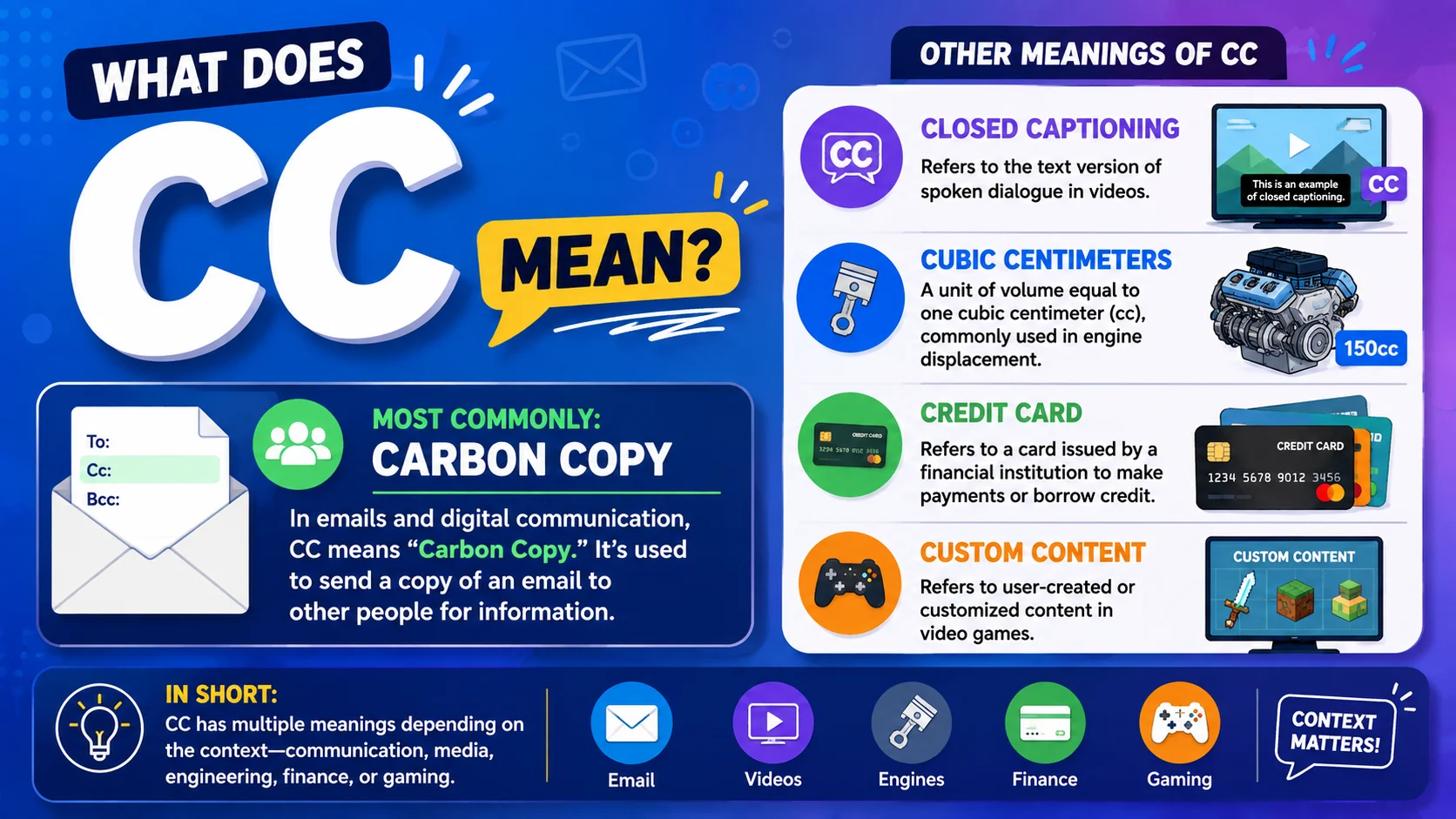
CC most commonly stands for “Carbon Copy” in digital communication and email, referring to sending a copy of an email to secondary recipients for informational purposes. However, depending on the context, CC can also stand for Closed Captioning in video media, Cubic Centimeters in engine displacement, Credit Card in finance, or Custom Content in gaming.
Understanding the complete CC meaning helps you write professional emails, navigate digital video settings, evaluate vehicle engine specifications, and participate in online gaming communities. Furthermore, because CC is one of the most versatile two-letter acronyms in the English language, its precise meaning depends entirely on the industry or medium where it appears. Consequently, when people search for this term, they usually want to uncover what CC stands for in email, how it differs from BCC, or what it means in specialized fields like media, automotive engineering, and financial transactions.
Additionally, workplace communication relies heavily on proper email etiquette, making the distinction between primary recipients and CC recipients critical for team productivity. Similarly, streaming platforms and content creators use CC tags to improve video accessibility for global audiences. Therefore, grasping every dimension of the definition elevates your communication literacy and prevents common professional missteps.
Quick Answer Box
| Context | What CC Stands For | Primary Function / Meaning |
| Email / Workplace | Carbon Copy | Sends a copy of an email to keep someone informed |
| Video & Media | Closed Captioning | Displays text on screen for audio/dialogue accessibility |
| Automotive & Science | Cubic Centimeters (cm3) | Measures engine displacement or liquid volume |
| Finance & Commerce | Credit Card | Refers to a physical or digital payment card |
| Gaming & Sims | Custom Content | User-created mods, clothing, or objects |
| Real Estate / Business | Covenants & Conditions | Legal rules governing property usage or business agreements |
What Does CC Meaning Represent Across Primary Industries?
To understand the core CC meaning, one must explore how different fields adopt and apply this versatile abbreviation.
1. In Email & Digital Communication (Carbon Copy)
Historically, the term originates from physical carbon paper, which was placed between sheets of paper on a typewriter to create a duplicate copy of a document simultaneously.
In modern email clients (like Gmail or Outlook), the CC field allows you to send a copy of your message to individuals who are not the main addressees but need to stay informed about the conversation.
- Primary Recipient (“To”): The person expected to respond or take action.
- Secondary Recipient (“CC”): A person included for awareness or visibility (no direct action required).
To: Project Coordinator (Action required)
CC: Department Manager (Keeping informed)
BCC: HR Department (Private documentation)
2. In Video, TV & Streaming (Closed Captioning)
In video media and broadcasting, CC stands for Closed Captioning. Unlike standard subtitles, closed captions display spoken dialogue alongside crucial background sound cues (such as [phone ringing] or [upbeat music playing]) to assist deaf or hard-of-hearing viewers, as well as users watching videos on mute.
3. In Automotive Engineering & Measurement (Cubic Centimeters)
In mechanical engineering and vehicle specifications, CC stands for Cubic Centimeters—a unit of volume used to measure engine displacement.
- Engine Capacity: A 150cc motor scooter has an engine cylinder volume of 150 cubic centimeters, whereas a 2,000cc automobile engine (often labeled as 2.0 Liters) holds significantly higher air-fuel volume and output capacity.
4. In Finance & Banking (Credit Card)
In online shopping checkout forms, financial applications, and banking apps, CC is a universal shorthand for Credit Card (often paired with CVV for security validation).
5. In Gaming & Digital Design (Custom Content)
In life-simulation games (such as The Sims) and open-world gaming communities, CC refers to Custom Content. These are fan-made, downloadable assets such as custom clothing, hairstyles, furniture, or textures created by third-party designers to expand gameplay customization.
How CC Differs from BCC in Email
Understanding the distinction between CC and BCC is crucial for maintaining professional digital etiquette and protecting recipient privacy:
| Feature | CC (Carbon Copy) | BCC (Blind Carbon Copy) |
| Recipient Visibility | Visible to all email recipients | Hidden from all other recipients |
| Primary Use Case | Keeping team members in the loop publicly | Protecting privacy or discreetly looping in someone |
| Reply All Exposure | Included if anyone clicks “Reply All” | Safe from receiving future “Reply All” threads |
| Etiquette Risk | Clutters inboxes if overused | Can feel secretive if used inappropriately |
Real-Life Conversation Examples
Reviewing everyday dialogue shows how professionals and consumers use CC across different settings.
1. Sending a Project Update at Work
Alex: I just finished the Q3 marketing proposal draft.
Sarah: Great! Email it directly to the client and make sure to CC the project manager so she stays updated.
Alex: Will do! I’ll send it over right away.
2. Watching a Foreign Film or Video
Jordan: I can’t hear the dialogue very well over the background noise.
Taylor: Just click the CC button on the bottom corner of the screen to turn on closed captions!
Jordan: Perfect, that makes it much easier to follow along.
3. Shopping for a Motorcycle
Sam: Are you looking at the 250cc bike or the 600cc sportbike?
Chris: Definitely the 250cc, it’s much better for a beginner rider!
Essential Rules for Using Email CC Correctly
Mastering email CC etiquette prevents inbox overload and maintains clear professional boundaries:
- Use CC for FYIs Only: Only CC people who genuinely need to stay informed about the topic. Avoid CCing colleagues on minor routine tasks.
- Do Not Over-CC Executives: Avoid looping in high-level management unless explicitly requested or when confirming major project milestones.
- Use “Reply All” Sparingly: When responding to a CCed thread, consider whether everyone needs to read your reply or if a direct message to the sender is sufficient.
- Transition to BCC for Bulk Emails: If sending an email to a large list of external clients, use BCC instead of CC to protect everyone’s private email address.
FAQs
What is the primary CC meaning in email?
In email, CC stands for “Carbon Copy.” It allows you to send a copy of an email to secondary recipients who need to stay informed without being the primary addressee.
What is the difference between CC and BCC?
CC (Carbon Copy) reveals all recipient email addresses to everyone on the thread, whereas BCC (Blind Carbon Copy) hides the BCCed recipients’ addresses from other readers.
What does CC mean on TikTok, YouTube, or Netflix?
On video platforms, CC stands for Closed Captioning, which displays on-screen text representing dialogue and audio descriptions for accessibility.
What does CC mean in engine size (e.g., 125cc)?
In engine specs, CC stands for cubic centimeters, measuring the total volume swept by the engine’s pistons (engine displacement).
What does CC stand for in banking and payments?
In banking and e-commerce forms, CC stands for Credit Card.
What does CC mean in gaming (like The Sims)?
In gaming communities, CC stands for Custom Content—user-created modifications, clothes, hair, or items downloaded to customize gameplay.
What does CC mean in real estate or property law?
In real estate and property management, CC frequently stands for Covenants and Conditions (often paired with Restrictions as CC&Rs).
Should I reply to people in the CC line?
You should only include CCed recipients in your reply if your response provides vital information that affects their work or role in the discussion.
What does CC mean in creative licensing (CC License)?
In digital media and publishing, CC stands for Creative Commons—a public copyright license that allows creators to share their work for public use under specified conditions.
Is CCing someone considered passive-aggressive?
Including someone’s supervisor or manager on a CC line during a disagreement can be perceived as passive-aggressive. Always use CC transparently and constructively.
Conclusion
Ultimately, whether you are managing an email inbox, enabling closed captions on a video, evaluating a vehicle engine, or shopping online, understanding the CC meaning allows you to communicate with precision. The evolution of this simple two-letter abbreviation, from physical typewriter carbon paper to modern digital accessibility and gaming culture, highlights how language adapts across technology and industry. By applying proper context and etiquette, you can navigate any professional or technical conversation with ease.