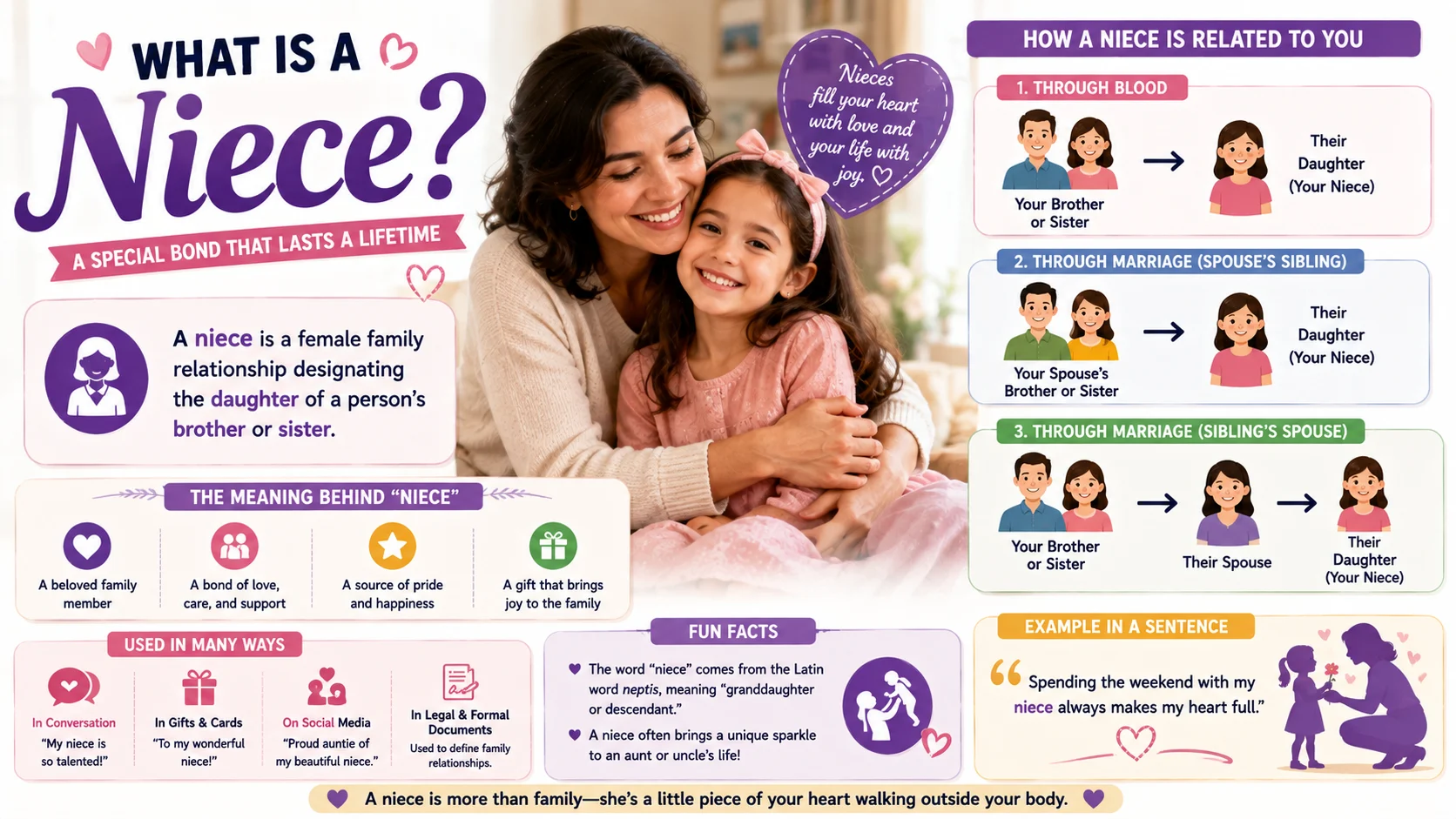
A niece is a female family relationship designating the daughter of a person’s brother or sister. Additionally, a person can have a niece through marriage, which refers to the daughter of one’s spouse’s sibling, or the daughter of one’s sibling’s spouse.
Understanding the complete niece meaning helps you navigate family trees, clarify genealogical relationships, write family wills or legal documents, and express social connections accurately. Furthermore, this fundamental kinship term bridges immediate family structures with extended relatives across generations. Consequently, when people search for this phrase, they usually want to uncover the precise definition, how the term differs from nephew or cousin, how step and half relationships work, or where the word originates historically.
Additionally, various cultures and legal frameworks define extended family roles with subtle distinctions. For example, in many traditional family gatherings, nieces represent the younger generation that connects siblings across adulthood. Similarly, legal inheritance laws categorize nieces under collateral relatives when establishing heirs. Therefore, mastering every dimension of the definition enriches your vocabulary and deepens your understanding of family dynamics.
Quick Answer Box
| Aspect | Details |
| Primary Meaning | The daughter of one’s brother, sister, or spouse’s sibling |
| Etymology Origin | From Old French nece, tracing back to Latin neptis (granddaughter or niece) |
| Male Equivalent | Nephew (the son of one’s sibling) |
| Reciprocal Relationship | You are her Aunt or Uncle |
| Common Variations | Niece-in-law, stepniece, half-niece, grandniece (great-niece) |
What Does Niece Meaning Represent in History and Family Structure?
To understand the core niece meaning, one must look at how language organizes kinship and traces biological and social family ties.
1. Etymology and Linguistic Origins
Historically, the word entered Middle English through the Old French term nece, which directly evolved from the Latin word neptis. In classical Latin, neptis originally meant “granddaughter,” but over time, its scope expanded throughout European languages to include the daughter of a brother or sister.
2. The Reciprocal Kinship Dynamic
Kinship terms function in pairs. If a young female is your niece, your relationship to her depends entirely on your gender:
- If you are female, you are her aunt.
- If you are male, you are her uncle.
- If you are non-binary, gender-neutral terms such as pibling (parent’s sibling) or auncle are sometimes used informally.
“A niece connects past sibling bonds to future family stories, carrying shared roots into the next generation.”
Contextual Dynamics and Variations of the Term
However, family relationships expand beyond basic biological ties. The exact application of niece depends on marriage, blended families, and generational depth.
1. Biological Niece vs. Niece-in-Law
- Biological Niece: The daughter born to your full brother or sister.
- Niece-in-Law: The daughter of your spouse’s brother or sister, or the female spouse of your nephew.
2. Blended Families: Stepniece and Half-Niece
- Half-Niece: The daughter of your half-brother or half-sister (a sibling with whom you share only one biological parent).
- Stepniece: The daughter of your stepsibling, or the stepdaughter of your biological sibling.
3. Generational Variations: Grandniece vs. Great-Niece
When your niece has children, your relationship to her daughter moves down one generation:
- Grandniece (or Great-Niece): The daughter of your niece or nephew. To her, you are a great-aunt or great-uncle.
How Niece Compares to Similar Family Terms
Understanding how niece compares to other relative terms prevents confusion when building family trees:
| Relation Term | Primary Definition | Key Distinction vs. Niece |
| Niece | Daughter of your sibling | Specific female second-generation relative |
| Nephew | Son of your sibling | Male equivalent of a niece |
| Cousin | Child of your aunt or uncle | Same generation as you, sharing grandparents rather than parents |
| Nibling | Gender-neutral term for a sibling’s child | Inclusive term encompassing both nieces and nephews |
Real-Life Conversation Examples
Reviewing everyday social and family dialogue shows how people use the term across various settings.
1. Celebrating Family Milestones
Mark: Are you traveling out of town this coming weekend?
Diana: Yes! My niece is graduating from college, so the whole family is getting together to celebrate.
Mark: That is wonderful! How old is she now?
Diana: She is 22. It feels like just yesterday I was holding her as a baby!
2. Clarifying Family Connections
Carlos: Is Maya your cousin or your sister?
Elena: Neither! She is actually my niece. She is my older brother David’s eldest daughter.
3. Shopping for Holidays
Rachel: I am trying to figure out what gift to buy for my stepniece.
Sam: How long has she been part of the family?
Rachel: Ever since my brother married her mother five years ago! She loves art supplies, so I think a sketchbook set would be perfect.
Key Rules for Using the Term Accurately
Whether completing a legal form, creating a family chart, or writing a personal story, keep these simple guidelines in mind:
- Gender Specificity: Use niece exclusively for female relatives. For males, use nephew.
- Spelling Tip: Remember the classic grammar rule “i before e except after c” when writing niece (N-I-E-C-E).
- Gender-Neutral Option: If referring to siblings’ children without specifying gender, use the modern collective noun nibling (similar to “sibling”).
- Legal and Estate Definitions: In legal wills, specifying “nieces and nephews” covers your siblings’ children, but explicitly state whether you include nieces-in-law or stepnieces to prevent ambiguity.
FAQs
What is the primary meaning of “niece”?
A niece is the daughter of your brother, sister, or spouse’s sibling.
What is the difference between a niece and a nephew?
A niece is a female child of your sibling, while a nephew is a male child of your sibling.
What is the gender-neutral word for niece and nephew?
The gender-neutral term is nibling, which combines “niece/nephew” with “sibling.”
Is my sister’s daughter my cousin or my niece?
Your sister’s daughter is your niece. You are her aunt or uncle.
What do I call my niece’s daughter?
Your niece’s daughter is your grandniece (also commonly called your great-niece).
What is a niece-in-law?
A niece-in-law is either the daughter of your spouse’s sibling or the wife/partner of your nephew.
How do you pronounce “niece”?
It is pronounced NEES (rhyming with words like piece, fleece, and peace).
What is the difference between a great-niece and a grandniece?
There is no functional difference! Both terms refer to the daughter of your niece or nephew. Genealogy experts often prefer “grandniece” to match “granddaughter.”
Is my husband’s niece considered my niece?
Yes! Socially and informally, your spouse’s niece is treated as your niece. Formally or legally, she can be referred to as your niece-in-law.
What is the plural form of niece?
The plural form is nieces (pronounced NEES-ez).
Conclusion
Ultimately, whether mentioned during a holiday gathering, included in a genealogical tree, or written into a legal document, understanding the niece meaning reveals a crucial familial connection defined by generational continuity and personal affection. The evolution of the term from its Latin origins to modern family usage shows how language structures our closest human bonds. By recognizing the precise boundaries and variations of the word, you can communicate your family relationships with absolute clarity.

Andrew Morris is a writer at Meaninga.com who specializes in word meanings, slang, idioms and modern language trends. He creates clear, accurate and easy to understand content for everyday readers.