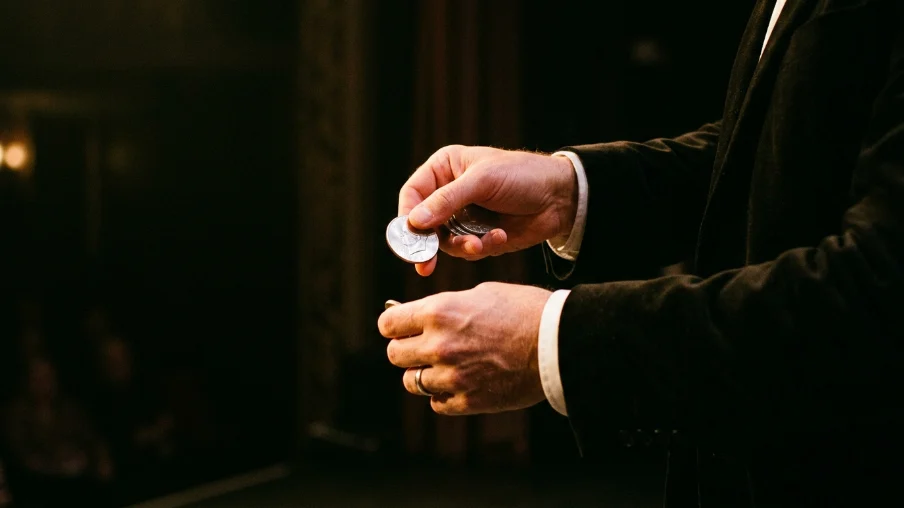
Legerdemain (pronounced lej-er-duh-mayn) is a sophisticated English noun that refers to skillful use of one’s hands to perform magic tricks (sleight of hand) or, more broadly, clever deception and trickery in non-physical contexts like business, politics, and everyday life.
| Aspect | Details |
|---|---|
| Part of Speech | Noun (uncountable) |
| Pronunciation (US) | /ˌlɛdʒ.ər.dəˈmeɪn/ |
| Pronunciation (UK) | /ˌledʒ.ə.dəˈmeɪn/ |
| Literal Meaning | Sleight of hand; manual dexterity in magic tricks |
| Figurative Meaning | Deceitful cleverness; trickery; artful deception |
| Primary Use | Formal, literary, and descriptive contexts |
Have you ever watched a magician make a coin disappear and wondered how they did it? That’s legerdemain in its purest form. But this fascinating word goes far beyond the stage it’s also used to describe the subtle, sometimes deceptive cleverness people use in finance, politics, law, and even everyday conversations.
In this comprehensive guide, you’ll learn exactly what legerdemain means, where it comes from, how to use it correctly in sentences, and why this 600-year-old word is still relevant today. Whether you’re a writer looking to expand your vocabulary, a student preparing for an exam, or simply curious about unusual English words, this guide covers everything you need to know.
Quick Answer Box
| Question | Answer |
|---|---|
| What does legerdemain mean? | Legerdemain means sleight of hand (magic tricks) or skillful deception and trickery in a figurative sense. |
| Where does the word come from? | From Middle French léger de main, meaning “light of hand”. |
| How do you pronounce it? | lej-er-duh-mayn (US) or ledj-uh-duh-mayn (UK). |
| Is it positive or negative? | Neutral when describing magic; negative when used figuratively to mean deception or trickery. |
| What are common synonyms? | Sleight of hand, prestidigitation, trickery, deception, artifice, chicanery. |
What Does Legerdemain Mean?
At its core, legerdemain has two distinct but related meanings:
Literal Meaning: Sleight of Hand
In the literal sense, legerdemain refers to the manual dexterity and fine motor skills used by magicians and performers to create illusions. When a magician pulls a rabbit from a hat, makes a card disappear, or performs a coin trick, they are demonstrating legerdemain.
“The magician’s legerdemain left the audience in awe as he made the coin vanish into thin air.”
Figurative Meaning: Trickery and Deception
More commonly in modern usage, legerdemain is used figuratively to describe any kind of clever deception, manipulation, or trickery especially in contexts where someone uses intelligence or cunning to mislead others.
“The company used financial legerdemain to hide its true losses from investors.”
This figurative usage appears frequently in discussions about:
- Finance – accounting tricks, creative bookkeeping
- Politics – legislative maneuvers, rhetorical misdirection
- Law – legal loopholes, semantic arguments
- Business – strategic deception, marketing manipulation
Full Definition of Legerdemain
Let’s break down the complete definition across multiple authoritative sources:
Dictionary Definitions
Key Characteristics
- Involves skill – whether physical (magic) or intellectual (deception)
- Creates illusion – makes something seem different from reality
- Often involves misdirection – directing attention away from the trick
- Can be neutral or negative – depends on context and intent
Origin and Etymology of Legerdemain
Understanding where legerdemain comes from helps illuminate its meaning:
French Origins
The word entered English in the early 15th century (around 1400–1450) from Middle French.
The French phrase was léger de main, which literally translates to “light of hand”.
- Léger – “light” (in weight), from Latin levis “light”
- De – “of”
- Main – “hand,” from Latin manus “hand”
Evolution of Meaning
Originally, legerdemain simply meant “conjuring tricks” or “sleight of hand”. Over time, English speakers expanded its use to include figurative trickery and deception any situation where someone uses cleverness to mislead others.
Related Words
The same French root léger (“light”) gives us:
Context and Usage of Legerdemain
When to Use Legerdemain
Legerdemain is a formal or literary word. You’re more likely to encounter it in:
- News articles (especially financial and political journalism)
- Literature and fiction
- Academic writing
- Sophisticated conversation
Formality Level
| Context | Appropriateness |
|---|---|
| Formal writing | ✅ Highly appropriate |
| News media | ✅ Common |
| Academic papers | ✅ Appropriate |
| Casual conversation | ⚠️ May sound pretentious |
| Texting/Social media | ❌ Rarely used |
Parts of Speech
- Noun (primary) : “His legerdemain was impressive.”
- Adjective (rare) : “legerdemain tricks”
- Noun form : “legerdemainist” – one who performs legerdemain
Real-Life Examples of Legerdemain in Sentences
Literal Usage (Magic)
- “The street performer’s legerdemain with playing cards drew a large crowd.”
- “With practiced legerdemain, he switched the rings without anyone noticing.”
- “Her legerdemain was unmatched by any other magician in the competition.”
- “A common trick of legerdemain is to produce a rabbit from an apparently empty hat.”
Figurative Usage (Deception)
- “The CFO’s financial legerdemain concealed millions in losses from shareholders.”
- “His political legerdemain led to the downfall of the opposition leader.”
- “Landrieu defends at least some of this semantic legerdemain.”
- “This kind of legal legerdemain is one of the most damaging legacies of the takeover binge.”
- “The corrupt businessman used accounting legerdemain to fool the auditors.”
- “Accounts of the penuriousness of life on such an income invariably involve financial legerdemain.”
Platform-Specific Meaning of Legerdemain
In Literature
Authors use legerdemain to describe both literal magic and metaphorical trickery. John Steinbeck, for example, wrote: “His right hand practiced legerdemain” in The Pearl.
In Financial Journalism
Financial legerdemain is a common phrase referring to:
In Political Commentary
Political legerdemain describes:
- Legislative maneuvering
- Rhetorical misdirection
- Semantic arguments
- Strategic deception
In Legal Contexts
Legal legerdemain refers to:
- Using loopholes
- Technical arguments
- Procedural manipulation
- Semantic trickery
Alternative Meanings and Related Terms
Synonyms
| Synonym | Nuance |
|---|---|
| Sleight of hand | Most direct synonym; focuses on manual dexterity |
| Prestidigitation | Fancy term for magic tricks |
| Trickery | Broader; any form of deception |
| Deception | General term for misleading others |
| Artifice | Clever or cunning devices |
| Chicanery | Trickery, especially in legal/political contexts |
| Hocus-pocus | Informal; meaningless trickery |
| Conjuration | Magic or supernatural trickery |
Antonyms
| Antonym | Meaning |
|---|---|
| Honesty | Truthfulness, sincerity |
| Transparency | Openness, clarity |
| Straightforwardness | Directness, simplicity |
| Truthfulness | Accuracy, honesty |
| Candor | Frankness, openness |
Related Terms
- Legerdemainist – a performer of legerdemain
- Illusion – something that deceives the senses
- Misdirection – diverting attention to conceal a trick
How to Respond When Someone Uses Legerdemain
In Conversation
If someone uses “legerdemain” in conversation, here are appropriate responses:
Scenario 1: Literal usage (magic)
“That’s an impressive word for a magic trick! Are you a magician?”
Scenario 2: Figurative usage (deception)
“So you’re saying they used clever trickery to hide what they were really doing?”
Scenario 3: You didn’t understand
“I’m not familiar with that word does it mean something like sleight of hand?
How to Use It Yourself
In formal writing:
“The administration’s fiscal legerdemain has obscured the true state of the national debt.”
In professional settings:
“We need to be careful about any financial legerdemain that could raise red flags with auditors.”
In casual conversation (use sparingly):
“He used some real legerdemain to get out of that meeting.”
Misinterpretations of Legerdemain
Common Mistakes
| Mistake | Correction |
|---|---|
| Confusing with “legitimate” | Legerdemain has nothing to do with legality or legitimacy |
| Thinking it means “large” or “grand | It comes from “light,” not “large” |
| Using it as a verb | It’s a noun, not a verb |
| Misspelling as “legerdemane” | Correct spelling: legerdemain |
Words Often Confused with Legerdemain
- Leger line – a music notation term (different meaning)
- Legacy – something handed down (unrelated)
- Legend – a story or myth (unrelated)
When NOT to Use Legerdemain
Avoid legerdemain in these contexts:
| Context | Reason |
|---|---|
| Casual texting | Too formal; sounds pretentious |
| Everyday conversation | Most people won’t know it |
| Writing for a general audience | Use simpler alternatives |
| Positive contexts | Figuratively, it has negative connotations |
| Describing honest skill | Implies deception |
Better Alternatives for Casual Contexts
| Instead of | Use |
|---|---|
| “His legerdemain was impressive.” | “His magic trick was impressive.” |
| “Financial legerdemain” | “Creative accounting” or “number manipulation” |
| “Political legerdemain” | “Political maneuvering” or “deception” |
Usage Tips for Mastering Legerdemain
1. Remember the “Light Hand” Origin
The word literally means “light of hand”. Think of a magician’s nimble fingers this visual helps cement the meaning.
2. Distinguish Literal vs. Figurative
- Literal = magic tricks, sleight of hand
- Figurative = deception, trickery, clever manipulation
3. Use in Formal Contexts
Save legerdemain for:
- Essays and academic writing
- Professional articles
- Literary works
- Sophisticated conversation
4. Pair with Strong Verbs
Common collocations:
- perform legerdemain
- use legerdemain
- demonstrate legerdemain
- employ legerdemain
5. Know the Tone
When used figuratively, legerdemain has a negative connotation it implies dishonesty or manipulation. Use it carefully.
Conversation Examples
Example 1: At a Magic Show
Alex: “Did you see how he made that card disappear? I’ve never seen anything like it!”
Sam: “That’s classic legerdemain. He’s been practicing sleight of hand for years.”
Alex: “Legerdemain that’s a fancy word for a magic trick, huh?”
Sam: “Exactly. It literally means ‘light of hand’ in French.
Example 2: In a Business Meeting
Manager: “Our competitor’s financial reports look too good to be true.”
Analyst: “I agree. I suspect there’s some accounting legerdemain happening.”
Manager: “Meaning they’re hiding losses with creative bookkeeping?”
Analyst: “Precisely. We should dig deeper before making any decisions.”
Example 3: Political Debate
Journalist: “The senator managed to avoid answering the question entirely.”
Pundit: “That’s political legerdemain at its finest. He redirected attention without actually saying anything.”
Journalist: “So he used rhetorical trickery to dodge the issue?”
Pundit: “Exactly. It’s a classic move.”
Example 4: Everyday Conversation
Jordan: “How did you convince your boss to let you work from home?”
Taylor: “A little legerdemain with the schedule I showed him how it would save the company money.”
Jordan: “So you manipulated the numbers?”
Taylor: “Let’s call it ‘strategic presentation.'”
Example 5: Legal Context
Lawyer: “The defense is using legal legerdemain to delay the trial.”
Client: “What do you mean?”
Lawyer: “They’re filing endless procedural motions to run out the clock. It’s a common tactic.”
Edge Cases and Nuances
Can Legerdemain Be Positive?
In its literal sense (magic), legerdemain is neutral it simply describes a skill. However, in its figurative sense, it is almost always negative because it implies deception.
Positive use (rare):
“Her legerdemain with the paintbrush created stunning illusions on canvas.”
Negative use (common):
“His financial legerdemain defrauded investors of millions.”
Legerdemain vs. Sleight of Hand
While often used interchangeably, there’s a subtle difference:
| Term | Focus |
|---|---|
| Sleight of hand | Specifically manual dexterity and trickery |
| Legerdemain | Broader; includes figurative deception |
“Sleight of hand” is the older term (from Old Norse), while “legerdemain” is the French borrowing that became popular in the 15th century.
Legerdemain in Different English Varieties
| Variety | Usage |
|---|---|
| American English | Common in formal writing; pronounced lej-er-duh-mayn |
| British English | Same meaning; pronunciation slightly different |
| Australian English | Used similarly to British English |
Frequently Asked Questions
1. What is the simple meaning of legerdemain?
Legerdemain simply means sleight of hand (magic tricks) or clever deception and trickery. It comes from the French phrase meaning “light of hand.
2. How do you pronounce legerdemain?
In American English, it’s pronounced lej-er-duh-mayn (/ˌlɛdʒ.ər.dəˈmeɪn/). In British English, it’s ledj-uh-duh-mayn (/ˌledʒ.ə.dəˈmeɪn/).
3. Is legerdemain a negative word?
It depends on context. When describing magic tricks, it’s neutral. When used figuratively to mean deception or trickery, it has a negative connotation.
4. What is another word for legerdemain?
Common synonyms include sleight of hand, prestidigitation, trickery, deception, artifice, and chicanery.
5. Where does the word legerdemain come from?
It comes from Middle French léger de main, meaning “light of hand”. It entered English in the early 15th century.
6. Can legerdemain be used as a verb?
No, legerdemain is a noun. You cannot “legerdemain” something. Use it as a noun: “He performed legerdemain.”
7. What is financial legerdemain?
Financial legerdemain refers to clever, often deceptive accounting practices used to hide losses, inflate profits, or avoid taxes.
8. Is legerdemain the same as magic?
Not exactly. Magic is the broader category of performance art. Legerdemain specifically refers to the manual dexterity and sleight-of-hand techniques used in magic tricks.
9. What is the opposite of legerdemain?
Antonyms include honesty, transparency, straightforwardness, and truthfulness.
10. Is legerdemain a common word?
No, legerdemain is a rare or formal word. You’re more likely to encounter it in literature, news articles, and academic writing than in everyday conversation.
11. How can I remember the meaning of legerdemain?
Think of “light hand” – a magician’s nimble, light fingers performing tricks. The word literally means “light of hand” in French.
12. What is a legerdemainist?
A legerdemainist is a performer who specializes in legerdemain essentially, a magician who focuses on sleight of hand.
13. Can legerdemain be used in a positive way?
Rarely. In its literal sense (magic), it’s neutral. But figuratively, it almost always implies deception or trickery, which is negative.
14. What’s the difference between legerdemain and prestidigitation?
They are synonyms. Both refer to sleight of hand and magic tricks. Prestidigitation comes from Latin/French roots meaning “quick-fingered.
15. Why do people use legerdemain in politics?
Political legerdemain refers to rhetorical tricks, misdirection, and strategic deception used to manipulate public opinion or avoid answering difficult questions.
Conclusion
Legerdemain is a fascinating word with a rich 600-year history. Whether you encounter it in a novel, a news article about financial scandals, or a conversation about politics, you now know exactly what it means:
- Literally: sleight of hand; magic tricks performed with manual dexterity
- Figuratively: clever deception, trickery, or manipulation
- Origin: from French léger de main = “light of hand”
- Tone: formal; neutral when literal, negative when figurative
Use this word confidently in formal writing, but consider simpler alternatives in casual conversation. And remember next time you see a magician perform an amazing trick, you can impress your friends by calling it legerdemain.

Andrew Morris is a writer at Meaninga.com who specializes in word meanings, slang, idioms and modern language trends. He creates clear, accurate and easy to understand content for everyday readers.





3 thoughts on “Legerdemain Meaning | Definition, Origin and Complete Usage Guide For 2026”