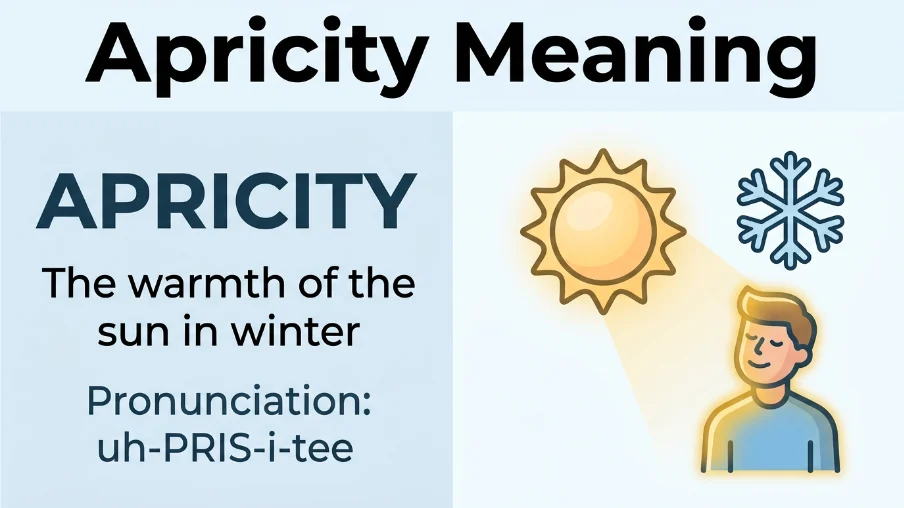
Apricity (pronounced uh-PRIS-i-tee) is a rare and beautiful noun that means the warmth of the sun in winter. It describes that pleasant, gentle feeling of sunlight on your skin on a cold day when the air around you remains chilly. The word comes from the Latin apricus, meaning “warmed by the sun”.
Have you ever stepped outside on a frosty winter morning and felt the sun’s rays gently warming your face? That simple, pleasant sensation has a name. It is called apricity. This rare and poetic word captures a feeling that many people experience but struggle to describe.
The word apricity is a hidden gem in the English language. It was coined in 1623 by lexicographer Henry Cockeram for his dictionary The English Dictionary; or, An Interpreter of Hard English Words . Despite its charming meaning, the word never gained widespread use and is considered rare or even obsolete by some dictionaries . However, language enthusiasts have rediscovered it in recent years. People appreciate its ability to describe a specific and pleasant winter sensation that no other English word captures as well .
This article explores the full meaning of apricity. You will learn its definition, pronunciation, origin, and how to use it in sentences. By the end, you will have a beautiful new word to add to your vocabulary. Good writing often uses precise and evocative words, and apricity fits that description perfectly.
Key Takeaway
The main takeaway is that apricity means the warmth of the sun in winter. It is a noun that describes the pleasant sensation of feeling sunlight on your skin during cold weather. The word has Latin origins and was first recorded in English in 1623. While considered rare or obsolete, it has experienced a revival among language lovers who appreciate its specific and poetic meaning. Knowing this word allows you to describe a common winter experience with precision and beauty.
Definition and Explanation
What Is the Meaning of Apricity?
Apricity is a noun. Its primary and most accepted definition is the warmth of the sun in winter . It is not about the intense heat of a summer afternoon. Instead, it refers to the gentle, pleasant warmth you feel from the sun’s rays when the air around you is still cold. It is that moment when you tilt your head back, close your eyes, and feel the sun’s caress on a chilly day.
The word goes beyond just temperature. It captures a specific and comforting feeling. It is the contrast between the cold air and the warm sunlight that makes the experience so noticeable and pleasant . It is a moment of comfort and hope in the middle of winter .
| Feature | Description |
| Part of speech | Noun |
| Primary meaning | The warmth of the sun in winter |
| Pronunciation | uh-PRIS-i-tee |
| Origin | Latin apricus (“warmed by the sun”) |
| Synonyms | Sunniness, warmth, basking |
Pronunciation Guide
Pronouncing apricity correctly is straightforward. The word has four syllables and the stress falls on the second syllable.
- UK Pronunciation: /əˈprɪs.ə.ti/
- US Pronunciation: /əˈprɪs.ə.t̬i/
- Phonetic Spelling: uh-PRIS-i-tee
Here is a breakdown to help you say it:
- uh: as in “above”
- PRIS: rhymes with “this” (with a short “i” sound)
- i: as in “happy”
- tee: as in “tea”
The Etymology and Origin of Apricity
The story of apricity begins in Latin. It comes from the Latin words apricitas, meaning “sunniness,” and apricus, meaning “warmed by the sun” or “having lots of sunshine” . The Latin verb apricari means “to bask in the sun .
The word entered the English language in 1623. The English lexicographer Henry Cockeram recorded or possibly invented it for his dictionary, The English Dictionary; or, An Interpreter of Hard English Words . It was part of his effort to define difficult words. Despite its lovely meaning, the word never caught on and remained rare. The Oxford English Dictionary even marks it as obsolete, with its only known use being in the early 1600s .
However, the word has been revived in recent years. Language enthusiasts and word lovers appreciate its ability to capture a very specific, pleasant feeling that many people experience but cannot easily name . This makes it a valuable addition to a writer’s or speaker’s vocabulary.
The Verb and Adjective Forms
While apricity is a noun, there are related words that you might find useful.
- Apricate (verb): This means to bask in the sun or to expose oneself to sunlight . It is the action of enjoying the apricity. For example, “She went outside to apricate in the winter sun.”
- Apricious / Apricous (adjective): This means warmed by the sun or having the quality of sunshine . It describes something that is sunny or sun-warmed. For example, “The apricious bench was a perfect spot to sit.”
Real-World Examples
Seeing apricity used in sentences helps you understand how to use it naturally.
Examples in Context
- “Despite the frosty morning, Sarah enjoyed the apricity as she sat on a park bench, basking in the weak winter sunlight that provided a comforting warmth against the crisp air” .
- “I sat on the porch to enjoy the apricity while the snow sat on the grass” .
- “As he stood in the sunshine, apricity began to cover him like a wool sweater” .
- “The apricity of the January afternoon made us want to stay outside longer” .
- “She enjoyed the apricity as she sat by the window with a book” .
Historical Usage
The word has appeared in print, even if rarely. One interesting example comes from an 1856 source:
- “These humicubations, the nocturnal irrorations, and the dankishness of the atmosphere, generated by a want of apricity, were extremely febrifacient” .
This old-fashioned sentence shows the word’s age and literary context.
How to Use Apricity in Your Writing
| Context | Example | Purpose |
| Descriptive writing | “The apricity of the winter sun called us outdoors.” | To create a poetic and precise image. |
| Journal entry | “Today’s apricity was a small moment of comfort.” | To describe a personal feeling. |
| Creative writing | “She felt the apricity on her face and smiled.” | To evoke a specific sensory experience. |
| Everyday conversation | “I’m just going to enjoy the apricity for a moment.” | To use a beautiful and unusual word. |
Related Concepts and Comparisons
Understanding apricity also involves knowing its synonyms and related concepts.
Synonyms and Similar Words
While no word is a perfect synonym for apricity, several words capture parts of its meaning.
| Word | Meaning | Similarity to Apricity |
| Sunniness | The state of being full of sunlight | Describes the sunlight, not the feeling. |
| Warmth | A moderate degree of heat | Describes heat in general, not specifically winter sun. |
| Basking | To lie in warmth or light for enjoyment | Describes the action, not the feeling itself. |
Apricity vs. Other Winter Words
Apricity is one of many words for winter experiences. However, it is unique in its focus on the warm feeling of the sun.
| Word | Meaning | Connection to Apricity |
| Hibernation | The state of being inactive during winter | Opposite; apricity encourages activity. |
| Frost | A covering of ice crystals | Apricity melts frost. |
| Hygge | A cozy, comfortable feeling | Both are about winter comfort, but apricity is more specific. |
Common Mistakes
When using apricity, there are a few common mistakes to avoid.
Mistake 1: Thinking It Is Not a Real Word
Some people might think apricity is a made-up or internet slang word. It is not. It is a legitimate English word with a long history, dating back to 1623. It is listed in dictionaries like the Oxford English Dictionary and the Cambridge Dictionary .
Mistake 2: Mispronouncing It
A common error is to stress the wrong syllable. The correct pronunciation is “uh-PRIS-i-tee,” with the stress on the second syllable. Do not pronounce it as “A-pri-city” or “ap-ri-city.”
Correction: The word has four syllables: uh-PRIS-i-tee. Practice saying it aloud .
Mistake 3: Using It to Mean Summer Heat
Apricity is specifically the warmth of the winter sun. It does not mean the intense heat of summer. Using it to describe a hot summer day would be incorrect. It is the contrast with the cold air that makes the feeling special.
Correction: Reserve apricity for cold days when the sun provides a gentle warmth .
| Mistake | Incorrect | Correct |
| Pronouncing wrong | A-pri-city | uh-PRIS-i-tee |
| Using for summer heat | “The apricity of July was intense.” | “The apricity of January was welcome.” |
| Thinking it’s slang | It’s not in the dictionary. | It is a real word from 1623 . |
Exercises
Test your understanding of apricity with these exercises.
Exercise 1: Fill in the Blank
Choose the correct word to complete each sentence.
- The _________ of the winter sun was a welcome relief.
- She enjoyed the _________ as she sat by the window with a book.
- Despite the frost, we felt the warmth of the _________.
- The word _________ comes from the Latin word apricus.
Exercise 2: True or False
- Apricity means the heat of the summer sun.
- The word was first recorded in the 1600s.
- Apricity is a noun.
- It is pronounced “uh-PRIS-i-tee.”
Exercise 3: Write a Sentence
Write your own sentence using the word apricity. Try to describe a personal experience of feeling the winter sun.
Answer Key
Exercise 1 Answers:
- Apricity
- Apricity
- Apricity
- Apricity
Exercise 2 Answers:
- False (It means the warmth of the winter sun.)
- True (It was recorded in 1623.)
- True (It is a noun.)
- True (The stress is on the second syllable.)
Exercise 3 (Example):
“As I walked through the park on that cold December day, I paused to feel the apricity on my face.”
FAQs
What does apricity mean?
Apricity means the warmth of the sun in winter. It is the pleasant, gentle feeling of sunlight on your skin when the air around you is still cold .
How do you pronounce apricity?
Apricity is pronounced “uh-PRIS-i-tee.” The stress is on the second syllable .
Is apricity a real word?
Yes, apricity is a real word. It was first recorded in English in 1623 in a dictionary by Henry Cockeram . It appears in the Oxford English Dictionary and other dictionaries .
What is the origin of the word apricity?
Apricity comes from the Latin word apricus, which means “warmed by the sun” or “having lots of sunshine . It is also related to the Latin verb apricari, meaning “to bask in the sun” .
Is apricity an obsolete word?
The Oxford English Dictionary marks apricity as obsolete, with its only known use being in the early 1600s . However, it has been revived in recent years by language enthusiasts and is recognized by modern dictionaries like Cambridge .
What is the verb form of apricity?
The verb form related to apricity is apricate, which means to bask in the sun. The adjective form is apricious or apricous, meaning warmed by the sun .
Can apricity be used metaphorically?
Yes, some sources suggest apricity can be used metaphorically to describe a feeling of comfort, hope, or kindness that provides relief during cold or difficult emotional periods .
What are some synonyms for apricity?
Synonyms for apricity include sunniness, warmth, and basking. Other descriptive phrases include “winter sun-glow” and “the sun’s embrace” .
How can I use apricity in a sentence?
You can use apricity to describe the feeling of winter sun. For example: “Despite the frosty morning, Sarah enjoyed the apricity as she sat on a park bench” .
When was the word apricity first used?
The word apricity was first recorded in 1623 when Henry Cockeram included it in his dictionary, The English Dictionary; or, An Interpreter of Hard English Words .
Conclusion
This guide has explored the beautiful and rare word apricity. It is a noun that means the warmth of the sun in winter. The word has a rich history, originating from the Latin apricus and first recorded in English in 1623 . It is a forgotten or rare word, but it has been rediscovered by language lovers who appreciate its specific and evocative meaning .
The best practical advice is to start using apricity in your writing and conversations. It is a perfect word for describing a common winter experience that many people enjoy but struggle to name. Use it in a journal entry, a poem, or even a text message to a friend. A beautiful word like apricity deserves to be used and appreciated. Good writing is about using the right word for the right moment, and apricity is a wonderful addition to any vocabulary.











5 thoughts on “Apricity Meaning | The Beautiful Word for Winter Sunshine For 2026”