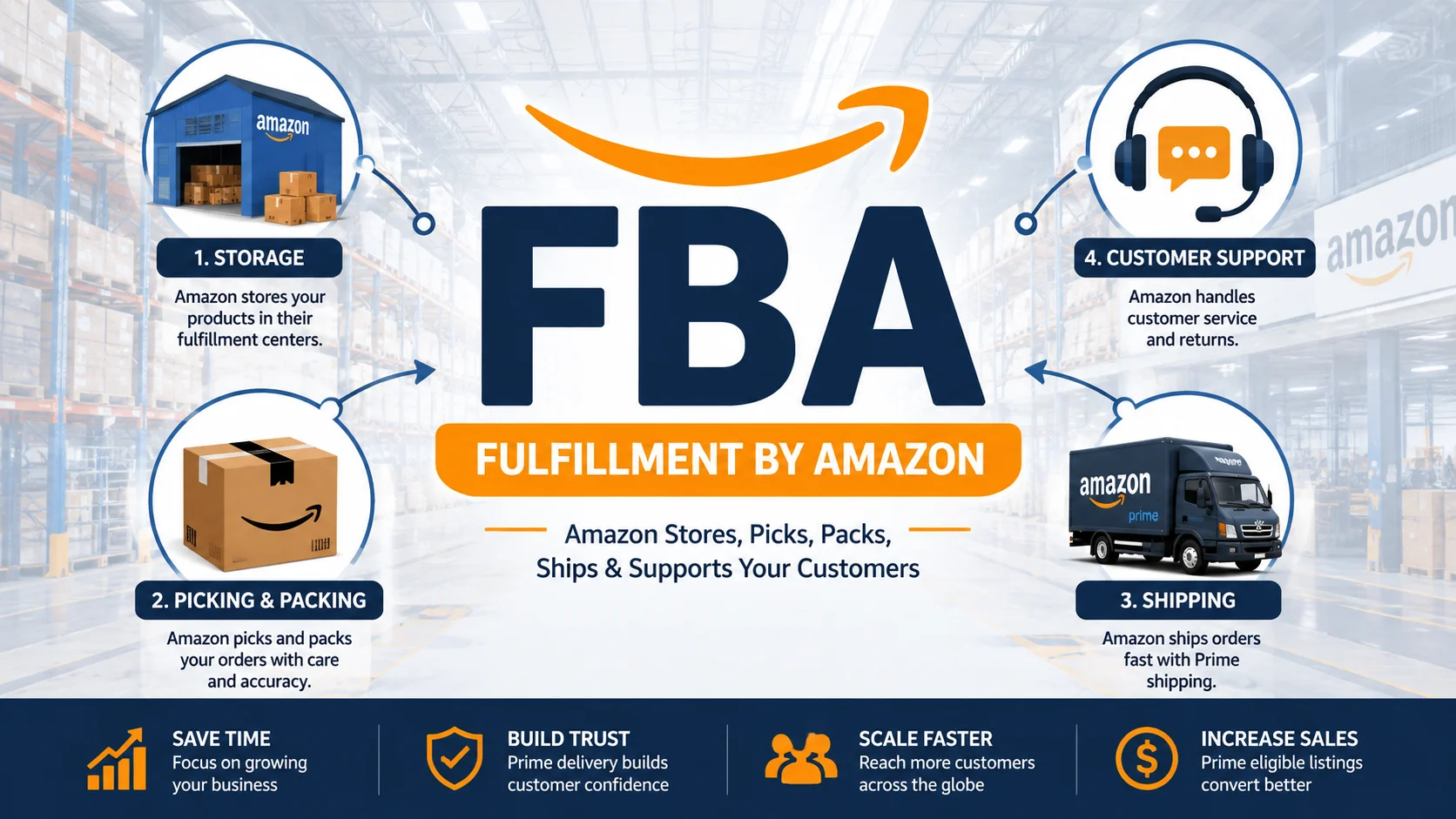
FBA stands for Fulfillment by Amazon. It is a service where Amazon stores, packs, and ships products for sellers, and also handles customer service and returns. Using FBA allows sellers to offer Prime shipping and scale their business without managing their own logistics.
Have you ever ordered something on Amazon and received it the next day? That fast shipping is often thanks to FBA. If you are thinking about selling products online, you have probably seen this acronym everywhere. But what does FBA actually mean, and why is it so important?
FBA stands for Fulfillment by Amazon. It is a program where Amazon takes care of the entire shipping process for sellers. Instead of storing products in your garage or renting a warehouse, you send your inventory to Amazon’s fulfillment centers. When a customer places an order, Amazon picks, packs, and ships the product. They also handle customer service and returns.
This service changes the game for small businesses. It allows anyone to sell products online without building a complex logistics operation. You can focus on finding great products and marketing them while Amazon handles the heavy lifting. However, FBA comes with costs and rules that you need to understand.
This article explains everything you need to know about FBA. You will learn how it works, the advantages and disadvantages, and how to decide if it is right for your business. By the end, you will have a clear understanding of this powerful selling tool.
Key Takeaway
FBA meaning is straightforward: Fulfillment by Amazon is a service that lets sellers outsource order fulfillment to Amazon. Sellers send their products to Amazon’s warehouses. Amazon then handles storage, packing, shipping, customer service, and returns for those products . Products enrolled in FBA automatically qualify for Amazon Prime, which boosts visibility and conversion rates .
Definition and Explanation
What Is FBA?
Fulfillment by Amazon (FBA) is a service provided by Amazon for third-party sellers . It allows sellers to store their products in Amazon’s fulfillment centers. Amazon takes over the entire fulfillment process when a customer places an order .
Here is a breakdown of what FBA includes :
- Storage: Amazon stores your inventory in their warehouses.
- Picking: Amazon workers select your product from the warehouse shelf.
- Packing: Amazon packs the product securely.
- Shipping: Amazon ships the product to the customer.
- Customer Service: Amazon handles customer inquiries about the order.
- Returns: Amazon processes returns and refunds.
When you use FBA, your products become Prime-eligible . This means customers with Amazon Prime can get free two-day shipping on your items. The Prime badge can significantly increase your conversion rates .
How Does Amazon FBA Work?
The FBA process follows a clear workflow. Understanding this helps you plan your business operations .
1. Inventory Preparation
You prepare your products according to Amazon’s requirements. This includes proper packaging and labeling. Each unit needs an FNSKU barcode, which is Amazon’s internal identifier for your product .
2. Inbound Shipping
You create a shipment plan in Seller Central. Amazon tells you where to send your products. You ship your inventory to the assigned fulfillment center or centers .
3. Storage and Inventory Management
Amazon receives and catalogs your inventory. You can monitor your stock levels through Seller Central. Amazon uses an Inventory Performance Index (IPI) to track how efficiently you manage your inventory .
4. Order Fulfillment
When a customer orders your product, Amazon’s team picks, packs, and ships the item. They use Amazon-branded packaging and their own carrier network .
5. Returns and Customer Service
Amazon handles all customer inquiries, returns, and refunds for FBA orders. Returned items are inspected and either returned to sellable inventory or disposed of based on condition .
A Simple Analogy
Think of FBA like a consignment shop, but for online sales. You bring your products to a large, trusted store. They display your items, handle the checkout, and manage all the customer interactions. You just keep the store supplied with products. In return, you pay them a fee for their services.
Advantages and Disadvantages
Like any business decision, FBA has pros and cons. Understanding both sides helps you make an informed choice .
Advantages of Using FBA
Prime Eligibility and Increased Visibility
FBA products are eligible for Amazon Prime. This offers customers free two-day shipping. Prime-eligible listings also rank better in search results, improving your reach and visibility .
Time Savings
FBA frees up your time to focus on other aspects of your business. You do not need to worry about packing orders, managing shipping, or handling customer service. This allows you to concentrate on product sourcing, marketing, and business growth .
Trust and Credibility
Amazon has established standard operating procedures. Customers trust the Amazon brand and shopping experience. This trust spills over to your brand, enhancing your credibility .
Scalability
FBA scales with your business. You can make 10, a hundred, or a thousand sales, and FBA handles the logistics. You will not need to hire more staff, rent a bigger warehouse, or renegotiate terms with couriers .
Improved Customer Experience
FBA provides faster delivery and consistent customer service. This can lead to higher customer satisfaction and more repeat business .
Lower Shipping Costs
Amazon claims that shipping costs with FBA are 70% less than comparable premium options offered by other major US carriers .
Disadvantages of Using FBA
Costs Can Be High
FBA fees can eat into your profit margins. You will pay storage fees and fulfillment fees. During peak seasons, storage fees increase substantially . Careful inventory planning is essential to avoid these costs.
Less Control
Once your inventory is in Amazon’s warehouses, you have less control over it. The packaging is standardized Amazon packaging. You cannot customize the customer experience in the same way you could if you fulfilled orders yourself .
Storage Fees for Slow-Moving Products
FBA charges monthly storage fees. For products that do not sell quickly, these fees can add up. Long-term storage fees apply to items that stay in the warehouse for over 181 days .
Complex Rules and Requirements
Amazon has strict packaging, labeling, and shipping requirements. Failing to meet these can result in extra fees or your products being rejected .
Fees Can Change
Amazon can change its fee structure at any time. A change in fees can significantly impact your profit margins .
| Aspect | FBA | FBM (Fulfillment by Merchant) |
| Prime Eligibility | Yes | Possible with Seller Fulfilled Prime |
| Storage | Amazon handles it | You handle it |
| Shipping | Amazon handles it | You handle it |
| Customer Service | Amazon handles it | You handle it |
| Cost | Fees for storage and fulfillment | Cost of storage, shipping, and staff |
| Control | Less control | Full control |
| Best For | Small, fast-moving products | Large, heavy, or slow-moving products |
Real-World Examples
These examples show how businesses use FBA in different contexts.
FBA in Action
A Small Business Owner
Sarah designs her own line of children’s toys. She makes the toys in her small workshop. Instead of renting a warehouse or packing orders herself, she uses FBA. She sends her inventory to Amazon. When a customer buys a toy, Amazon picks, packs, and ships it. Sarah focuses on designing new toys and marketing her brand. She also uses Amazon’s customer service team to handle questions.
A Food Vendor
A company sells gourmet coffee beans. They decide to use FBA to reach more customers. They send their coffee to Amazon’s fulfillment centers. Customers see the Prime badge and trust the fast shipping. Amazon handles all the logistics. The coffee company focuses on sourcing high-quality beans and creating a strong brand.
Using FBA with Other Programs
You can combine FBA with other Amazon programs . For example, you can use Amazon Warehousing and Distribution (AWD) for bulk storage. AWD stores your items for less and automatically replenishes your FBA inventory. You can also use Multi-Channel Fulfillment (MCF) to fulfill orders from your own website using FBA inventory .
Regional and Global Usage
FBA is available in many countries around the world. The core concept is the same, but there are regional differences.
FBA in the United States
Amazon has over 100 fulfillment centers in the United States . Sellers can place their goods closer to the final delivery address. This lowers ground shipping costs and transit time. Amazon FBA in the US is a mature and highly developed service.
FBA in the United Kingdom
The UK has a similar FBA program. Sellers can send inventory to UK fulfillment centers. This allows them to offer Prime shipping to UK customers.
FBA in the UAE
Amazon FBA in the UAE allows sellers to reach a massive customer base in the region . In September 2024, Amazon UAE received more than 32 million visitors. FBA helps sellers simplify their operations and deliver a first-class experience to customers .
FBA in Canada, Mexico, and Brazil
You can use Remote Fulfillment with FBA to sell to customers in Canada, Mexico, and Brazil. You can use your US FBA inventory. There is no need to send inventory to those countries. Eligible products are automatically listed with Prime shipping .
Common Mistakes
Understanding common mistakes can help you avoid them when starting with FBA.
Mistake 1: Not Calculating Fees Properly
Many new sellers underestimate FBA fees. They do not account for storage fees, fulfillment fees, and other costs. This can lead to negative profit margins.
Correction: Use the FBA Revenue Calculator in Seller Central. This tool helps you estimate your costs and potential profit before you commit inventory .
Mistake 2: Overstocking Inventory
Sending too much inventory to Amazon can be costly. You will pay high storage fees, and if the product does not sell, you may incur long-term storage fees.
Correction: Optimize your inventory levels. Send enough stock to meet demand, but do not overstock. Use replenishment alerts in the FBA dashboard .
Mistake 3: Ignoring Product Restrictions
Amazon has restrictions on certain products. There are laws, product restrictions in general, and restrictions specific to FBA . Sending restricted products can result in your inventory being destroyed and your account being penalized.
Correction: Always review Amazon’s product restrictions before listing a product. Make sure your products are eligible for FBA.
Mistake 4: Poor Packaging and Labeling
Amazon has strict packaging and labeling requirements. Failing to meet these can result in extra fees or your products being rejected .
Correction: Follow Amazon’s FBA packaging, prep, and labeling guidelines. Ensure each unit has an FNSKU barcode.
Exercises
Test your knowledge with these exercises.
Exercise 1: Fill in the Blank
Complete each sentence with the correct term.
- FBA stands for _________ by _________.
- With FBA, Amazon handles _________, _________, _________, _________, and _________.
- Products enrolled in FBA are eligible for _________, which offers customers free two-day shipping.
- Amazon charges _________ fees and _________ fees for FBA.
- Using FBA allows sellers to focus on _________ and _________.
Exercise 2: Scenario Questions
Answer the following questions based on the information in this guide.
- Sarah sells handmade candles. She wants to reach more customers but does not have space to store large quantities. Should she use FBA or FBM? Why?
- John sells custom-made furniture. His products are large and heavy. Should he use FBA or FBM? Why?
- Maria sells small, fast-moving electronics accessories. She wants to scale her business quickly. Should she use FBA or FBM? Why?
Answer Key
Exercise 1 Answers:
- Fulfillment by Amazon
- storage, picking, packing, shipping, customer service (and returns)
- Amazon Prime
- storage and fulfillment
- product sourcing and marketing (or business growth)
Exercise 2 Answers:
- FBA. Sarah does not have storage space. FBA would handle storage and shipping for her .
- FBM. FBA storage fees for large items can be very high. John would have more control and lower costs with FBM .
- FBA. Small, fast-moving products are ideal for FBA. The Prime badge will help her conversion rates, and FBA will scale with her business .
Related Concepts and Comparisons
Understanding related concepts helps clarify the FBA meaning and its place in the e-commerce ecosystem.
FBA vs. FBM
FBA and FBM are the two main fulfillment methods on Amazon . FBA stands for Fulfillment by Amazon. FBM stands for Fulfilled by Merchant.
- FBA: Amazon handles storage, packing, shipping, customer service, and returns .
- FBM: The seller handles storage, packing, shipping, customer service, and returns .
FBA is often better for small, fast-moving products . FBM is often better for large, heavy, or slow-moving products . Many successful sellers use both methods on a per-product basis .
Other Fulfillment Options
Amazon offers several other fulfillment options :
- Amazon Warehousing and Distribution (AWD): A bulk storage program. You can store your items for less and have them automatically replenished into the FBA network .
- Seller Fulfilled Prime: You fulfill orders yourself but get the Prime badge on your listings .
- Multi-Channel Fulfillment (MCF): Use your FBA inventory to fulfill orders from other sales channels, like your own website .
- Remote Fulfillment with FBA: Use your US FBA inventory to sell to customers in Canada, Mexico, and Brazil .
Amazon FBA vs. Dropshipping
FBA and dropshipping are different business models. In dropshipping, you do not hold any inventory. The supplier ships directly to the customer. In FBA, you hold inventory at Amazon’s warehouses. You are responsible for purchasing the products and sending them to Amazon.
FAQs
What does FBA stand for?
FBA stands for Fulfillment by Amazon. It is a service where Amazon stores, packs, and ships products for sellers. Amazon also handles customer service and returns for FBA orders.
What is the FBA meaning in simple terms?
FBA meaning is a program where you send your products to Amazon, and they handle the rest. They store, pack, and ship your items when they sell. They also deal with customer questions and returns.
How do I start selling with Amazon FBA?
First, register for an Amazon Professional selling account. Next, register for FBA in Seller Central. Then, list your products and assign them to FBA. Finally, prepare your products, label them, and send them to Amazon’s fulfillment centers using the Send to Amazon workflow .
Is FBA worth it for small businesses?
FBA can be worth it for many small businesses. It helps you reach more customers with Prime shipping and saves you time on logistics . However, you need to understand the fees to ensure your profit margins remain healthy .
How much does Amazon FBA cost?
FBA costs include storage fees and fulfillment fees . Storage fees are charged monthly based on the space your products occupy. Fulfillment fees are charged per unit based on size and weight. Additional fees may apply for long-term storage and other services .
What are the disadvantages of Amazon FBA?
The main disadvantages are high costs, less control over packaging and customer experience, and fees for slow-moving inventory . You also have to follow Amazon’s strict packaging and labeling rules .
What is the difference between FBA and FBM?
FBA stands for Fulfillment by Amazon. FBM stands for Fulfilled by Merchant . With FBA, Amazon handles the entire fulfillment process. With FBM, you are responsible for storage, packing, shipping, and customer service .
What types of products are best for FBA?
Small, lightweight, and fast-moving products are best for FBA . These products have lower storage fees and high turnover. Products that are large, heavy, or slow-moving may be better suited for FBM .
How long does Amazon store inventory with FBA?
Amazon stores your inventory as long as you pay the storage fees. Fees are charged monthly. Long-term storage fees apply to items that remain in the warehouse for over 181 days .
Does Amazon FBA handle returns?
Yes, Amazon handles all customer service and returns for FBA orders . When a customer returns a product, Amazon processes the return and refunds the customer. Returned items are inspected and either returned to sellable inventory or disposed of based on condition .
Conclusion
This guide has explained the meaning of FBA and its importance for online sellers. FBA stands for Fulfillment by Amazon. It is a service that allows sellers to outsource the entire order fulfillment process to Amazon. Amazon stores your inventory, picks and packs orders, and ships them to customers. Amazon also handles customer service and returns.
FBA offers several advantages. It allows your products to be Prime-eligible, which boosts visibility and conversion rates. It frees up your time to focus on other aspects of your business. It also helps you scale your business without building a complex logistics operation .
However, FBA comes with significant costs. You need to factor in storage fees and fulfillment fees. You also have less control over the customer experience. To succeed with FBA, you need to carefully manage your inventory and monitor your costs .
The best practical advice is to use the FBA Revenue Calculator to understand your costs. Consider starting with a small test shipment. Over time, you can expand your FBA operations. For many sellers, FBA is a powerful tool that can help grow their business.











2 thoughts on “FBA Meaning | What Is Fulfillment by Amazon? Complete Guide For 2026”