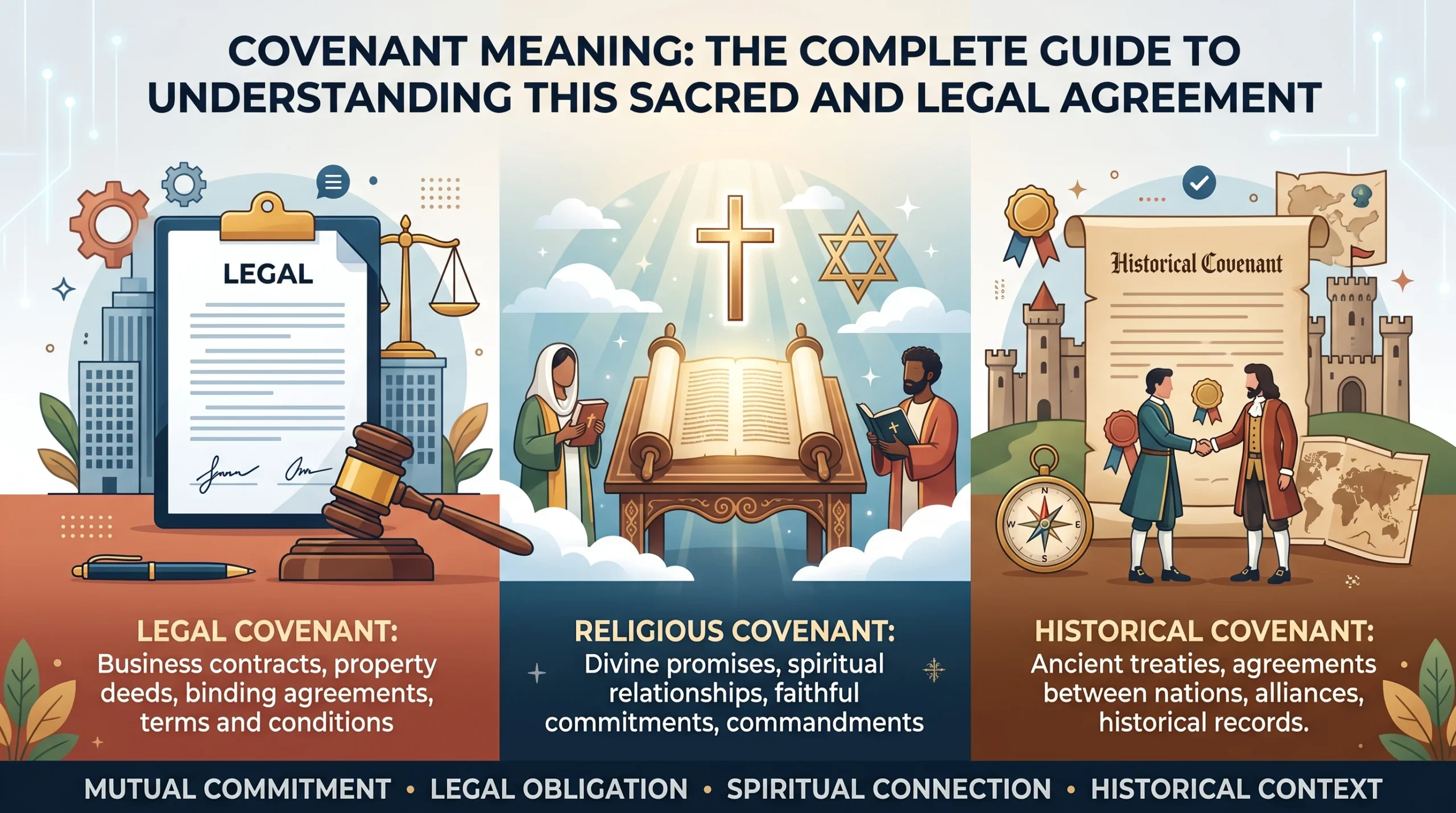
A covenant is a formal, binding agreement or promise between two or more parties, often involving mutual commitments and obligations . In religious contexts, it refers to a sacred agreement between God and humanity . Unlike ordinary contracts, covenants carry a sense of solemnity and moral or spiritual weight .
Have you ever encountered the word covenant and wondered what it truly means? This powerful word appears everywhere, from legal documents to sacred scriptures, from property deeds to international treaties. Its meaning can seem mysterious because it bridges the worlds of law and faith.
Understanding the covenant meaning is essential for several reasons. You might encounter it in a real estate contract, a church service, or even a history book. It is a word that carries weight and seriousness. Knowing what it means helps you understand the commitments you are making, whether they are with other people or with a higher power.
The challenge with covenant is its many layers of meaning. In the legal world, it is a specific type of enforceable promise . In the religious world, it describes a sacred bond between God and people . It is also used to describe major historical agreements. This guide will help you navigate these different meanings. By the end, you will understand what a covenant is, how it differs from a simple contract, and why this ancient idea is still relevant today.
The main takeaway is that a covenant is more than just a contract. It is a formal, solemn, and binding agreement that carries significant weight . A covenant can be a legal agreement between people, a sacred promise between God and humanity, or a fundamental national compact . Its defining feature is a deep, mutual commitment that creates an enduring bond.
Definitions and Explanations
What Does “Covenant” Mean?
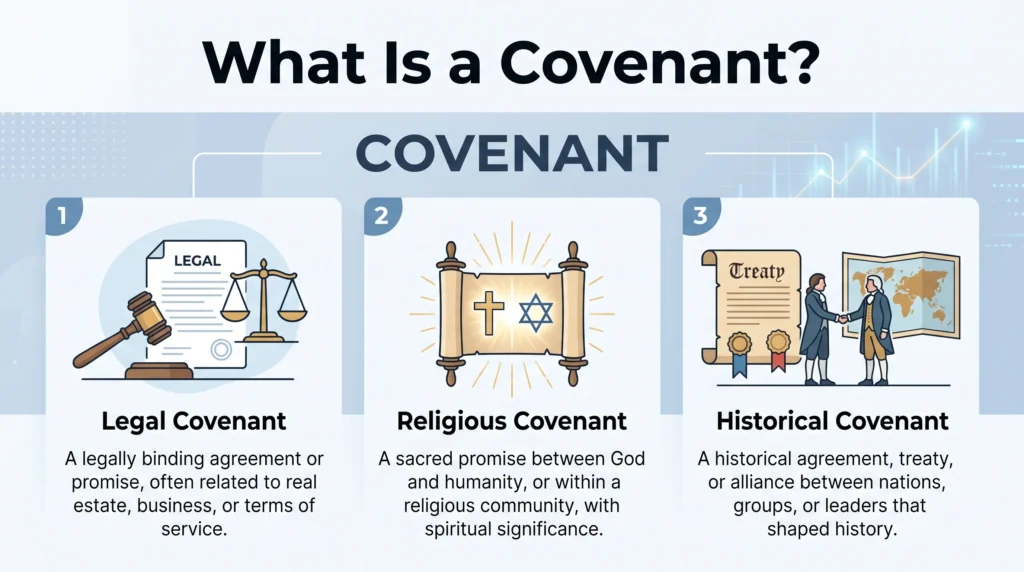
The covenant meaning centers on the idea of a formal and solemn agreement. It is a promise that is meant to be binding . In general terms, a covenant is an agreement between two or more parties to do or not do something . The word comes from the Latin convenire, which means “to come together” or “to agree .
This word is used in several distinct but related contexts. Understanding these contexts is the key to understanding the word as a whole.
The Different Faces of a Covenant
| Context | Meaning | Example |
| Legal | A formal, written promise or agreement recognized by law . In property law, it often restricts land use . | “The restrictive covenant prevents building over 30 feet tall.” |
| Religious | A sacred agreement between God and His people . These covenants set out the terms of the relationship. | “The covenant between God and Abraham.” |
| Historical & Political | A binding agreement between nations or groups, often used to form a political body . | “The Solemn League and Covenant” in Scottish history. |
Covenant vs. Contract: What’s the Difference?
One of the most important distinctions is between a covenant and a contract . While both are agreements, they are not the same. A contract is a private, business-like exchange. It is often about a specific, one-time transaction. A covenant is different.
| Feature | Contract | Covenant |
| Nature | Private, transactional, and often purely legal . | Public, constitutional, and carries moral or spiritual weight . |
| Focus | Exchange of goods or services for consideration. | Mutual commitment and obligation that creates a relationship . |
| Formality | Can be informal or formal. | Traditionally a very formal and solemn promise . |
| Enforcement | Enforced by law if there is a breach. | Binding by law and/or by a higher moral or spiritual authority. |
Historically, under common law, the presence of a seal distinguished a covenant from an ordinary contract and signified an unusual level of solemnity. This distinction shows that the law treated a covenant as a more serious and weighty promise than a typical contract.
The Legal Covenant
In modern law, a covenant retains its status as a formal promise. Property law often uses covenants as “restrictive covenants” that limit how a person can use a piece of land. These covenants “run with the land,” meaning they remain binding on future owners.
In a finance context, a covenant is also known as an “undertaking” . It is a promise a borrower makes to a lender, like a promise to pay a regular sum of money . The party giving the covenant is sometimes called the “covenantor” .
The Religious Covenant
The religious covenant meaning is profound. In the Old Testament, the Hebrew word for covenant, berith, comes from a root meaning “to cut,” referring to the ritual practice of cutting animals in half during a covenant ceremony.
Several major covenants are described in the Bible:
- The Covenant with Abraham: God promises Abraham that he will be the father of a great nation and that his descendants will possess the land of Canaan .
- The Covenant at Sinai: God gives the law to Moses, establishing a formal agreement with the people of Israel .
- The New Covenant: In the New Testament, this refers to the new relationship with God established through the death of Jesus . As one writer explains, “a testament is of no force while the testator liveth” .
The Blood of the Covenant
The Bible explains that a covenant was often inaugurated with blood . This was a sign of the covenant’s seriousness. The passage from Hebrews 9 explains that “without the shedding of blood there is no forgiveness” , linking the covenant to the act of sacrifice and atonement.
Advantages and Disadvantages
Advantages of Covenants
- Creates Strong, Enduring Bonds: Covenants build lasting relationships based on trust and mutual obligation. They aim to connect people on a deeper level than a simple transaction.
- Provide Stability and Certainty: Legal covenants, especially in property law, create a stable framework for land use and help communities maintain a consistent character.
- Establishes Moral and Spiritual Obligations: Religious covenants provide a clear framework for how people should live and relate to God, offering guidance and a sense of purpose.
Disadvantages of Covenants
- Strict covenants can sometimes enforce unfair rules and oppress people. In the past, people also used restrictive covenants to discriminate against certain groups.
- Inflexibility: Covenants are meant to be binding, which can make them difficult to change or adapt to new circumstances.
- Legal Complexity: Covenants, especially property covenants, can be legally complex and difficult to enforce or interpret.
Real-World Examples
Examples of Legal Covenants
Example 1: Property Covenant
A homeowner signs a restrictive covenant agreeing not to build a structure taller than a certain height .
Example 2: Financial Covenant
A company enters into a finance agreement. It promises (covenants) to maintain a certain debt-to-equity ratio .
Example 3: Lease Covenant
A tenant in a rental agreement promises to pay the rent on time and not to sublet the property without permission .
Examples of Religious Covenants
1: God’s Covenant with Noah
God makes a covenant with Noah that he will never again destroy the world by flood, signified by the rainbow .
2: God’s Covenant with Abraham
God promises Abraham that his descendants will be as numerous as the stars and that they will inherit the Promised Land .
3: The New Covenant
Jesus, at the Last Supper, speaks of the “new covenant in my blood,” establishing a new relationship with his followers .
Examples of Historical Covenants
1: The National Covenant (Scotland)
In 1638, Scottish Presbyterians signed a covenant to defend their religion against the king’s interference .
2: The Solemn League and Covenant
A 1643 agreement between the English Parliament and Scottish Covenanters to preserve the reformed religion in Scotland .
3: International Covenant on Civil and Political Rights
A major United Nations treaty committing its parties to respect the civil and political rights of individuals .
Examples in Sentences
| Context | Sentence |
| Legal | “The landlord and tenant signed a covenant outlining the terms of the lease.” |
| Religious | “The Old Testament describes the covenant between God and the Israelites.” |
| Historical | “The Solemn League and Covenant was a significant political document.” |
| Financial | “The charity benefits from regular financial covenants.” |
Regional and Global Usage
Global English
The word covenant is a standard English word used globally. Its meaning is consistent across all English-speaking regions, though it appears more frequently in legal and religious contexts.
Legal Usage
In legal contexts, covenants are used in property and finance law around the world. They are particularly common in common law systems, which originated in England.
Religious Usage
The term is used in the Jewish and Christian traditions. It is also a concept in Islam, though the term “covenant” is more strongly associated with the Bible and Christian theology.
Common Mistakes
Mistake 1: Using “Covenant” and “Contract” Interchangeably
This is the most common error. People often use the terms as if they mean the same thing. However, a covenant is more formal and solemn and creates a deeper commitment .
Correction: Use “contract” for a commercial exchange. Use “covenant” for a sacred or profoundly serious promise.
Mistake 2: Assuming All Religious Covenants Are the Same
Another mistake is treating all covenants in the Bible as if they have the same conditions. The covenant with Abraham (based on faith) is different from the covenant at Sinai (based on law) .
Correction: Understand that “covenant” is a broad concept that covers many different types of divine agreements.
Mistake 3: Thinking Covenants Are Obsolete
Some believe that covenants are only old-fashioned ideas from the past. However, they are still very much in use in modern law, finance, and international agreements.
Correction: Remember that property and financial covenants remain important legal tools today.
Exercises
Exercise 1: Fill in the Blank
Choose the correct word: covenant, contract, or treaty.
- “The _________ between God and Abraham is a central theme in the Bible.”
- “A restrictive _________ on the land prevents the owner from building another house.”
- “The two nations signed a _________ to promote peace and trade.”
Exercise 2: Identify the Meaning
Determine what type of covenant is being described in each sentence.
- “The charity depends on regular covenants from its supporters.”
- “The story of Moses and the Ten Commandments describes the _________.”
- “The home owner’s association uses covenants to maintain the neighborhood’s appearance.”
Exercise 3: True or False
- A covenant and a contract are the same thing.
- Covenants were often sealed with a ritual involving blood in the ancient world.
- Covenants are only found in religious texts.
Answer Key
Answers of Exercise 1:
- Covenant (religious context)
- Covenant (property law context)
- Treaty (international agreement)
Exercise 2 Answers:
- Financial Covenant (regular payment promise)
- Religious Covenant (Mosaic covenant)
- Property Covenant (restrictive covenant)
Exercise 3 Answers:
- False (Covenant and contract are different)
- True (Genesis 15 describes this ritual)
- False (Covenants are used in law, finance, and property)
Related Concepts and Comparisons
Covenant vs. Testament
The New Testament is a collection of Christian writings. The word “testament” is a translation of the Greek word diatheke, which is the same word used for “covenant” . A testament also refers to a “last will and testament,” a legally binding document that takes effect after death.
Covenant vs. Oath
An oath is a solemn promise. A covenant is a broader agreement that can be confirmed by an oath . God is often said to confirm his covenant with an oath.
Covenant vs. Compact
A compact is a formal agreement between parties. It is often used interchangeably with covenant, especially in political contexts . Both carry a sense of mutual obligation, though covenant has a more religious or sacred connotation .
FAQs
What is the simple definition of covenant?
A covenant is a formal, binding agreement between two or more parties . It is a serious promise that carries weight and creates an obligation.
What does covenant mean in the Bible?
In the Bible, a covenant is a sacred agreement between God and His people . God makes promises and gives instructions, and the people commit to following them . The relationship is sealed with a sign, such as the rainbow or circumcision.
What is the difference between a covenant and a contract?
A covenant is a solemn and often sacred agreement based on mutual commitment and relationship. A contract is a legal agreement focused on a specific exchange of goods or services .
What does a restrictive covenant mean?
A restrictive covenant is a legal agreement that limits how a piece of land can be used . For example, it might prevent building certain types of structures or using the land for specific businesses.
What is a financial covenant?
A financial covenant is a promise a borrower makes to a lender . It is often a promise to maintain a certain financial health, such as keeping a minimum level of income or assets.
Why is a covenant important?
Covenants are important because they create strong and binding relationships, whether between people, between nations, or between humanity and God. They provide structure, stability, and a sense of mutual obligation.
What is the covenant of works?
The covenant of works refers to a theological concept describing the agreement God made with Adam in the Garden of Eden . Adam was promised life in return for perfect obedience to God’s command.
Is a covenant legally enforceable?
Yes, in law, a covenant is a legally enforceable agreement . If you sign a covenant, you are bound by its terms. Covenants in property law “run with the land” and remain binding even if the property is sold.
Is the New Testament a covenant?
Yes, the word “testament” in the New Testament is a translation of the Greek word for “covenant” . The New Testament describes the “New Covenant” established through the life, death, and resurrection of Jesus.
How do you use covenant in a sentence?
You can say: “The religious community reaffirmed their covenant with God through prayer and service.” You can also use it in a legal context: “The buyer agreed to all the covenants in the property deed.”
Conclusion
This guide has explored the rich and layered meaning of the word covenant. It is far more than a simple agreement. It is a formal, solemn, and binding commitment that can exist in the realms of law, religion, and history . A covenant creates a bond of mutual obligation. It differs from a standard contract in its weight, seriousness, and often sacred character .
The best practical advice is to understand the context. When you encounter the word covenant, think about whether it is being used in a legal, religious, or historical setting. This will help you interpret its specific meaning. If you are entering into a covenant, be aware of its profound implications. It is a serious commitment that is meant to last. Now you have the knowledge to understand this powerful and enduring concept in any context.