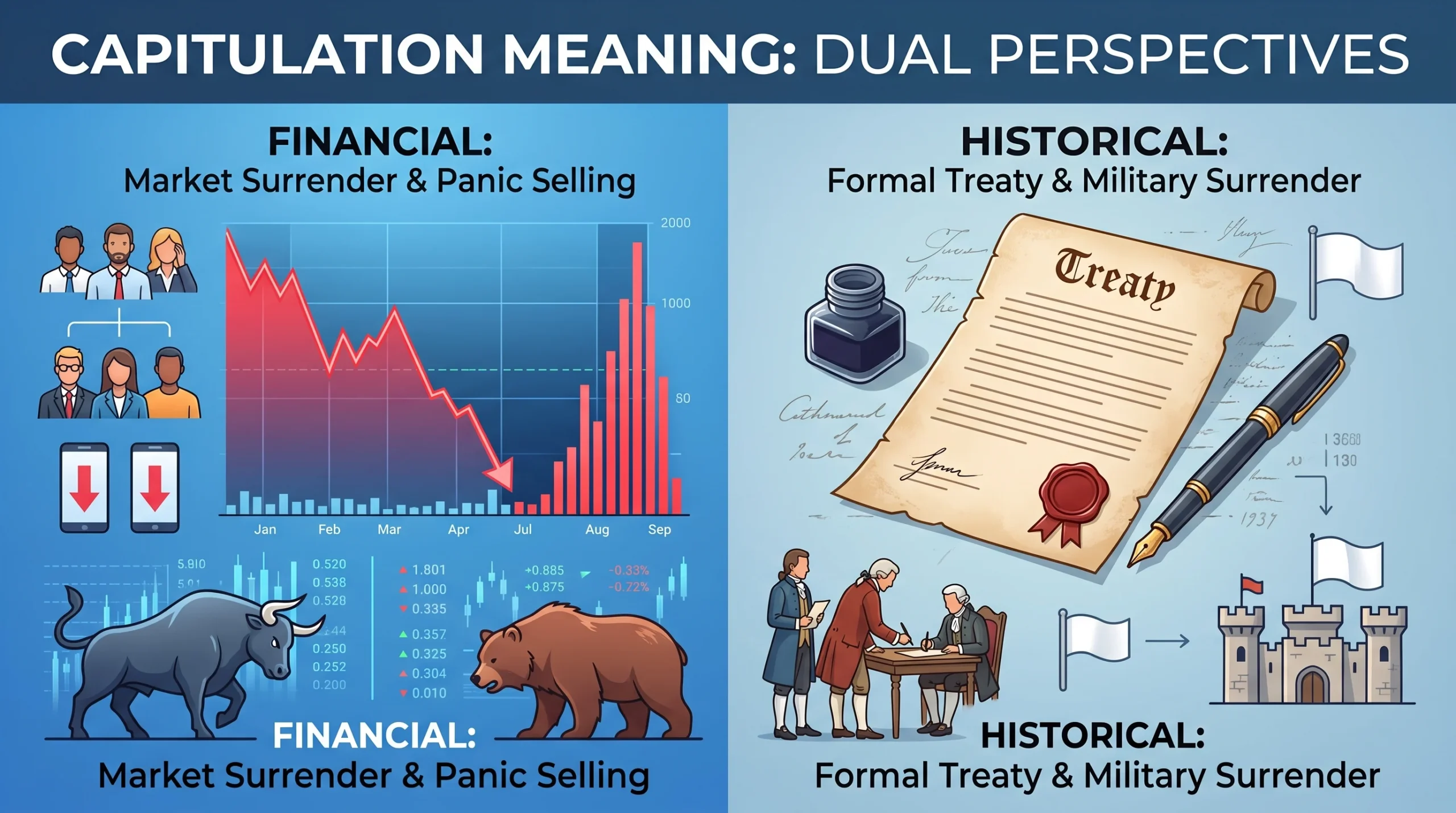
The capitulation meaning refers to the act of surrendering, yielding, or giving up under agreed-upon terms. In finance, it describes panic selling when investors give up hope; in military history, it denotes formal surrender.
What Does Capitulation Mean? A Complete Overview
Understanding the true capitulation meaning is essential for anyone navigating financial markets, historical analysis, or everyday negotiations. Language holds deep nuance, and complex words frequently adapt across different fields to describe significant turning points. Consequently, encountering this term in market news or historical texts can feel intimidating at first. Furthermore, grasping its precise definition helps you analyze economic shifts accurately and interpret human behavior under pressure.
In general terms, the word describes an act of giving up or yielding to an opponent, demand, or overwhelming force. When an individual or group capitulates, they abandon their resistance after struggling against pressure. Conversely, staying resilient represents the opposite of this action. Therefore, declaring a state of surrender marks the total end of a prolonged conflict or argument.
The term originated from the Late Latin word capitulare, which means to draw up articles or conditions. Historically, commanders drafted formal articles of agreement when negotiating a military surrender. Consequently, as centuries passed and global trade evolved, financial analysts adopted the term to describe the moment investors collectively surrender to market pressure.
Quick Answer Guide
| Context | Primary Meaning | Primary Usage | Example Sentence | Tone & Style |
| Finance / Investing | En masse panic selling | Crypto, Stock Markets, Trading | “Massive volume signaled total market capitulation.” | Analytical, Economic |
| Everyday Life | Giving in to pressure or demands | Negotiations, Debates, Conflicts | “The board reached capitulation after public backlash.” | Formal, Descriptive |
| Military & History | Treaty-based formal surrender | Historical Texts, Military Warfare | “The general signed the act of capitulation.” | Historical, Official |
| Psychology | Giving up resistance to an idea | Behavioral Analysis, Therapy | “His capitulation to despair delayed his recovery.” | Clinical, Reflective |
What Does Capitulation Mean in Finance and Investing?
When investors research the capitulation meaning within stock or crypto trading, the primary answer involves psychological surrender. Market participants experience intense fear during a prolonged market crash. Consequently, investors sell their assets en masse at steep losses to avoid further financial pain.
Furthermore, financial analysts view this extreme selling event as a critical market indicator. Because panic drives the final remaining holders to exit their positions, selling pressure completely exhausts itself. Therefore, market bottoms often form immediately after a wave of total surrender occurs.
For example, if a major stock index drops steadily for months, retail traders eventually lose all optimism and sell their shares at rock bottom prices. This dramatic surge in trading volume marks the final phase of the decline.
- Mass Panic Selling: Investors liquidate their holdings without regard to asset valuation.
- Surge in Trading Volume: A sudden spike in market volume indicates widespread panic exits.
- Potential Market Bottom: The exhaustion of sellers frequently creates a sharp price reversal.
Contextual Dynamics & Nuances of the Term
Understanding the term requires evaluating the surrounding environment. The word carries distinct emotional and structural weight depending on where the situation unfolds.
- Stock & Crypto Markets: Triggers intense market volatility and signals potential economic bottoms.
- Political Negotiations: Reflects a complete surrender of bargaining power to an opposing party.
- Historical Warfare: Marks the formal end of armed conflicts through structured legal treaties.
- Personal Disputes: Indicates that one party has conceded their position entirely.
The Financial Perspective: Exhaustion and Reversal
In trading circles, surrender is not always viewed negatively by observers. Instead, institutional investors actively hunt for signs of panic.
- Seller Exhaustion: Once every fearful investor sells, no sellers remain to push prices lower.
- Institutional Buying: Smart money investors step in to purchase discounted assets from panicking sellers.
- VIX Volatility Spikes: Financial fear indices reach historic highs during these market events.
The Historical and Military Perspective
To fully grasp the word, you must analyze its original historical roots. Military leaders used formal agreements to establish surrender terms without total annihilation.
- Articles of Surrender: Military commanders negotiated specific conditions regarding prisoners and weapons.
- Diplomatic Treaties: Nations signed legal documents to formally yield territory or military sovereignty.
Real-Life Conversation Examples Using Capitulation
Reviewing real life exchanges helps illustrate how the term functions across different everyday scenarios.
1: Financial Market Analysis
- Trader A: “Are you buying this recent tech stock dip?”
- Trader B: “Not yet, I am waiting for total capitulation and a volume spike.”
- Trader A: “Good strategy, the panic hasn’t fully cleared out the weak hands.”
2: Corporate Negotiation
- Executive A: “Did the labor union agree to the new contract terms?”
- Executive B: “Yes, the sudden management shift forced their complete capitulation.”
- Executive A: “That resolves our scheduling deadlock for the upcoming year.”
3: History Lecture Discussion
- Student 1: “Why did the fortress surrender so quickly during the siege?”
- Student 2: “The lack of fresh water caused an immediate capitulation.”
- Student 1: “That makes sense, they had zero resources left to fight.”
4: Everyday Argument
- Friend A: “Did Mark ever convince you to go camping in the rain?”
- Friend B: “My complete capitulation happened after he bought me dinner.”
- Friend A: “Haha, everyone has a price!”
5: Sports Commentary
- Commentator 1: “The visiting team lost their three goal lead in the final ten minutes.”
- Commentator 2: “It was a total defensive capitulation under heavy pressure.”
- Commentator 1: “Their head coach looks completely stunned on the sideline.”
Platform-Specific Breakdown
Different professional platforms embrace the term in distinct ways.
- Bloomberg & CNBC: Financial news outlets frequently use the word during market sell-offs to describe trader sentiment.
- Academic History Journals: Scholars adopt the term when documenting military surrenders and diplomatic concessions.
- Twitter / X (Crypto Community): Crypto traders type the term to announce the end of bear markets or brutal price slumps.
- Corporate Boardrooms: Executives use the word to summarize successful acquisitions or rival concessions.
How It Is Used on Financial Media and Academic Research
On financial television, anchors broadcast phrases like “Has the crypto market reached total capitulation?” This hook promises viewers an analysis of whether a bear market has finally reached its floor.
In academic research, historical documents describe formal acts of surrender. Researchers analyze how treaties altered national borders after armies capitulated under heavy siege.
Alternative Meanings & NLP Variations of the Phrase
While financial panic and military surrender dominate search queries, related linguistic variations exist across formal English.
- Capitulate (Verb): The active verb describing the process of surrendering or yielding.
- Capitulator (Noun): The individual or institution that surrenders under pressure.
- Capitulatory (Adjective): Expressing or relating to an act of surrender.
- Recapitulate (Related Verb): A distinct word meaning to summarize or restate main points.
Misinterpretations: When NOT to Use Capitulation
Using formal vocabulary in the wrong environment can create awkward moments or make simple statements overly dramatic.
| Setting | Context | Appropriateness Level | Recommended Alternative |
| Casual Texting | Everyday chat | Unnatural | Giving in / Yielding |
| Financial Analysis | Market reports | Highly Appropriate | Capitulation / Panic selling |
| Corporate Strategy | Executive reviews | Highly Appropriate | Concession / Surrender |
| Academic History | Research papers | Highly Appropriate | Capitulation / Treaty surrender |
Avoid Overly Casual or Incorrect Contexts
Never confuse the target term with “recapitulate.” Writing “Let me capitulate the main points of our meeting” to a business colleague is incorrect. In that scenario, you should use “recap” or “summarize.”
Furthermore, refrain from using heavy academic terms for minor personal choices. Telling a friend that eating pizza was a “total capitulation” sounds overly dramatic in casual conversation.
How to Respond in Discussion Comfortably
When someone uses the term in an academic or market discussion, responding naturally is simple once you recognize their intent.
- Market Discussions: If an analyst says “The stock market is near capitulation,” respond with strategic interest (“Are you tracking the volume indicators for a reversal?”).
- Debates & Negotiations: If a colleague mentions “The client reached capitulation,” accept the update smoothly (“That gives us a clear path to finalize the contract.”).
- Historical Debates: If a professor discusses “The general’s capitulation,” engage with factual context (“Was that decision driven by troop shortages?”).
FAQs
What does capitulation meaning in the stock market?
In the stock market, it refers to a wave of panic selling where investors surrender their positions at steep losses, often marking a market bottom.
Is capitulation a positive or negative sign in trading?
It feels negative while occurring due to severe price drops. However, technical analysts often view it as a bullish signal that a bear market is ending.
What is the difference between capitulate and recapitulate?
Capitulate means to surrender or give up. Recapitulate means to summarize or restate key points.
What is the origin of the word capitulation?
The word comes from the Late Latin capitulare, meaning to draw up articles of agreement for a formal surrender.
Can capitulation happen in crypto markets?
Yes, crypto markets experience severe market surrender events where retail investors sell holdings during steep crashes.
What is a synonym for capitulation?
Common synonyms include surrender, yielding, concession, acquiescence, and submission.
What is the opposite of capitulation?
Common antonyms include resistance, defiance, persistence, endurance, and holding.
How do you pronounce capitulation?
You pronounce it as “kuh-pich-uh-LAY-shun.”
What causes market capitulation?
Sustained economic fear, negative news cycles, margin calls, and cascading stop-loss orders cause investors to panic sell.
Can capitulation apply to personal relationships?
Yes, it describes a scenario where one person completely yields their argument or position to another after prolonged debate.
Conclusion
Language evolves to provide precise clarity for human behavior under extreme pressure. Understanding the full capitulation meaning allows you to navigate financial news, historical events, and complex negotiations with confidence. Whether you are analyzing stock market bottom signals or reading historical treaties, recognizing this key concept ensures you comprehend critical turning points across every domain.