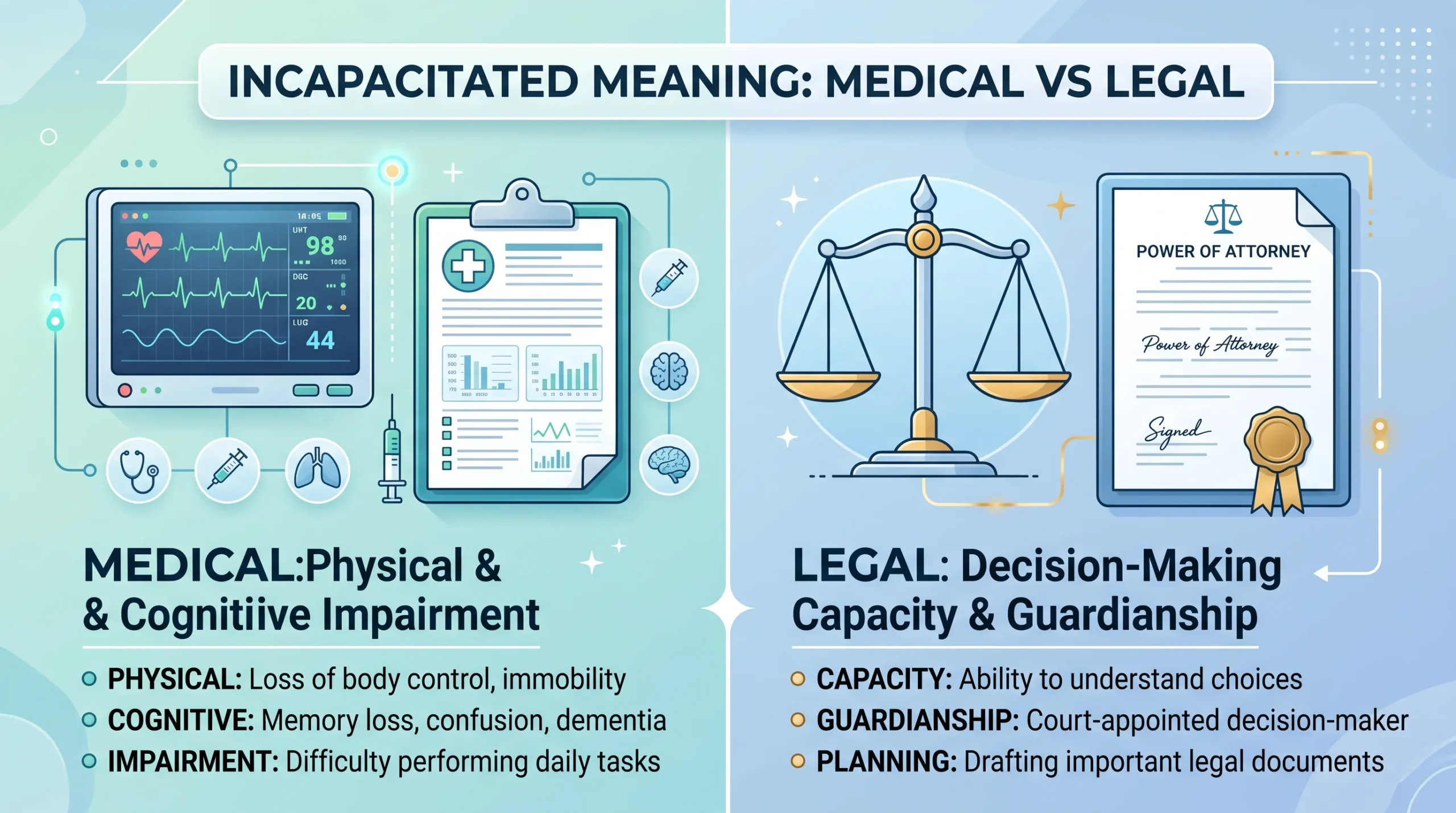
The incapacitated meaning describes a state of being deprived of strength, ability, or legal capacity. Consequently, an incapacitated person cannot function normally, make informed decisions, or perform daily physical or mental tasks due to injury, illness, or disability.
What Does Incapacitated Mean? A Complete Overview
Understanding the true incapacitated meaning is essential for anyone navigating legal documents, medical situations, or daily news. Language carries specific weight, and formal terms frequently convey critical real-world conditions. Consequently, encountering this word in legal contracts or hospital reports can feel overwhelming at first. Furthermore, grasping its precise definition helps you make informed choices during emergencies and handle family planning or insurance matters with confidence.
In general terms, the word describes a condition where an individual loses the physical or mental capacity to act. When someone becomes incapacitated, they cannot carry out standard tasks or manage personal responsibilities. Conversely, being fully functional represents the opposite state. Therefore, recognizing this condition allows medical professionals and legal authorities to step in with necessary care or legal support.
The term originated from the Latin prefix in- (meaning “not”) combined with capacitas (meaning “capability” or “holding capacity”). Historically, courts and physicians used the word to describe individuals stripped of their operational abilities. Consequently, as modern healthcare systems and probate law developed, the term became a standardized legal and medical classification across the globe.
Quick Answer Guide
| Context | Primary Meaning | Primary Usage | Example Sentence | Tone & Style |
| Medical / Physical | Unable to function due to injury or illness | Emergency Rooms, Clinical Notes, Rehab | “The driver was incapacitated by the collision.” | Clinical, Objective |
| Legal / Estate | Lacking mental capacity to make decisions | Wills, Power of Attorney, Guardianship | “The court declared the patient legally incapacitated.” | Formal, Legally Binding |
| Workplace / HR | Temporarily or permanently unable to work | Disability Claims, Workers’ Comp | “Sick leave applies when an employee is incapacitated.” | Corporate, Administrative |
| Military & Law | Neutralized or rendered unable to fight | Defense Reports, Law Enforcement | “The suspect was quickly incapacitated by officers.” | Tactical, Direct |
What Does Incapacitated Mean in Legal and Medical Settings?
When people research the incapacitated meaning within legal or medical contexts, the primary answer involves an inability to self-govern. In medical care, a patient becomes incapacitated when severe trauma, illness, or anesthesia prevents them from communicating or functioning. Consequently, doctors must rely on designated family members or healthcare proxies to guide care decisions.
Furthermore, legal systems define the term through specific competency standards. Because an incapacitated individual cannot comprehend legal consequences, courts restrict them from signing binding contracts, updating wills, or managing finances. Therefore, families often establish a Power of Attorney ahead of time to prepare for potential incapacity.
For example, if an older people develops advanced dementia, a probate court may formally evaluate their cognitive health. However, if the court finds them legally incapacitated, a appointed guardian steps in to manage their personal affairs and medical care safely.
- Physical Incapacitation: Severe physical trauma or illness prevents a person from moving or performing basic daily tasks.
- Mental Incapacitation: Cognitive impairment or unconsciousness strips a person of the ability to reason, communicate, or consent.
- Legal Incapacitation: A formal court ruling determines that an individual can no longer manage their legal, financial, or personal decisions.
Contextual Dynamics & Nuances of the Term
Understanding the term requires evaluating the surrounding situation. The word carries distinct operational and legal weight depending on where the scenario unfolds.
- Hospitals & Trauma Centers: Guides immediate consent protocols and emergency proxy decisions.
- Courts & Estate Planning: Triggers guardianship proceedings and activates financial powers of attorney.
- Insurance & Disability Claims: Determines eligibility for short-term or long-term disability payouts.
- Defense & Public Safety: Describes neutralizing a threat without implying permanent harm.
The Medical Perspective: Recovery and Impairment
In clinical settings, incapacitation can prove temporary or permanent depending on the underlying diagnosis. Consequently, medical teams constantly re-evaluate patient functionality.
- Temporary Incapacitation: Surgeries, severe intoxication, or reversible trauma render a patient temporarily unable to act.
- Permanent Incapacitation: Progressive neurological diseases or irreversible brain damage create a lasting state of impairment.
- Consent Protocols: Emergency care proceeds under implied consent when an incapacitated patient cannot speak.
The Legal Perspective: Protecting Individual Rights
To fully grasp the word, you must analyze how courts balance protection with personal liberty. Furthermore, declaring someone legally incapacitated requires rigorous evidence to prevent abuse.
- Judicial Evaluation: Judges examine medical evaluations before stripping an individual of decision-making rights.
- Power of Attorney Activation: Legal documents specify exact medical conditions required to trigger a proxy’s authority.
Real-Life Conversation Examples Using Incapacitated
Reviewing real-life exchanges helps illustrate how the term functions across different everyday scenarios.
1: Estate Planning Consultation
- Client: “What happens to my bank accounts if I get into a severe accident?”
- Attorney: “If you become incapacitated, your designated Power of Attorney steps in to manage payments.”
- Client: “That gives me peace of mind, let’s draft those papers today.”
2: Hospital Emergency Update
- Doctor: “The patient suffered a severe concussion during the fall.”
- Family Member: “Can she sign her own medical release forms right now?”
- Doctor: “No, she is currently incapacitated, so we need the primary healthcare proxy to sign.”
3: HR Disability Claim
- Employee: “How long does short-term disability coverage last?”
- HR Rep: “Coverage pays benefits for up to six months while you remain incapacitated from work.”
- Employee: “Thank you, I will submit my doctor’s note this afternoon.”
4: News & Security Report
- Reporter 1: “How did the security team handle the intruder?”
- Reporter 2: “Officers incapacitated the suspect using a taser within seconds.”
- Reporter 1: “Fortunately, no bystanders suffered injuries during the event.”
5: Everyday Fitness Context
- Friend A: “Are you joining us for the weekend morning run?”
- Friend B: “I am completely incapacitated by this terrible back strain.”
- Friend A: “Rest up and feel better soon!”
Platform-Specific Breakdown
Different professional spaces utilize the term in distinct ways.
- Legal Tech & Estate Platforms: Websites like LegalZoom use the word to prompt users to draft living wills and advance directives.
- Insurance Portals: Insurance carriers use the term to define qualification thresholds for disability payouts.
- Medical Journals & EHR Systems: Electronic health record systems flag incapacitated status to alert staff about consent rules.
- News & Law Enforcement Outlets: Crime reports use the word to describe neutralizing threats or reporting accident victims.
How It Is Used in Legal Services and Healthcare
On legal planning websites, platforms highlight phrases like “Protect your family if you become incapacitated.” Consequently, this hook encourages users to set up medical directives before a crisis strikes.
In healthcare documentation, medical staff chart patient capacity clearly. Furthermore, doctors note whether impairment stems from temporary medication or long-term cognitive decline.
Alternative Meanings & NLP Variations of the Phrase
While physical and legal impairment dominate search queries, related linguistic variations exist across formal English.
- Incapacitate (Verb): The active verb describing the act of rendering someone unable to function.
- Incapacitation (Noun): The state or period of being incapacitated.
- Capacitated (Adjective): The legal and physical opposite, meaning fully capable and competent.
- Incapacity (Related Noun): A formal legal term describing a lack of physical or mental power.
Misinterpretations: When NOT to Use Incapacitated
Using formal legal terms in casual settings can sound overly dramatic or cause misunderstandings regarding a person’s actual health.
| Setting | Context | Appropriateness Level | Recommended Alternative |
| Casual Texting | Minor fatigue or cold | Unnatural | Sick / Tired / Resting |
| Legal Documents | Estate plans & proxies | Highly Appropriate | Incapacitated / Lacking capacity |
| Medical Charts | Clinical patient updates | Highly Appropriate | Incapacitated / Unresponsive |
| Workplace HR | Disability filings | Highly Appropriate | Incapacitated for duty |
Avoid Overly Casual or Incorrect Contexts
Never confuse the target term with simple laziness or mild tiredness. Telling an employer that you were “incapacitated” when you simply slept through an alarm sounds melodramatic and misleading. Consequently, reserve the word for genuine physical, medical, or legal impairment.
Furthermore, avoid using the term in legal contracts without defining clear medical criteria. Likewise, vague language in a Power of Attorney can lead to family disputes over when proxy powers actually activate.
How to Respond in Discussion Comfortably
When someone uses the term in an HR, medical, or legal discussion, responding naturally is simple once you recognize their intent.
- Medical Updates: If a doctor says “The patient is incapacitated,” respond with practical questions (“Who is listed as the primary healthcare proxy?”).
- Legal Planning: If an attorney asks “Who manages your affairs if you are incapacitated?”, provide designated names (“My spouse holds my medical power of attorney.”).
- HR & Workplace: If HR notes “You are listed as incapacitated for two weeks,” confirm the paperwork (“I will send the official physician statement today.”).
FAQs
What does incapacitated meaning in legal terms?
In legal terms, it describes an individual who lacks the mental or physical capacity to manage their personal affairs, make medical decisions, or sign legal contracts.
Is incapacitated the same as unconscious?
Not completely. While an unconscious person is always incapacitated, an conscious person can also be incapacitated if severe cognitive illness or trauma prevents them from functioning.
What is the difference between incapacitated and disabled?
Disabled refers to a long-term or permanent physical/mental restriction. Conversely, incapacitated emphasizes a complete inability to function or make decisions, which can be temporary or permanent.
What triggers legal incapacitation?
A formal evaluation by medical professionals followed by a court ruling typically establishes legal incapacitation, unless a pre-signed Power of Attorney specifies medical triggers.
What is a synonym for incapacitated?
Common synonyms include disabled, debilitated, impaired, powerless, unfit, and immobilized.
What is the opposite of incapacitated?
Common antonyms include capable, competent, able, fit, functional, and healthy.
How do you pronounce incapacitated?
You pronounce it as “in-kuh-PASS-uh-tay-tid.”
Can alcohol cause someone to be legally incapacitated?
Yes, severe intoxication can render a person temporarily incapacitated, making them legally incapable of giving informed consent.
How long does incapacitation last?
Duration depends entirely on the cause; it can last a few hours (under anesthesia) or remain permanent (in advanced dementia).
What is an advance directive?
An advance directive is a legal document that specifies your medical preferences and names a proxy if you become incapacitated in the future.
Conclusion
Language provides essential clarity for complex human conditions and legal states. Understanding the full incapacitated meaning allows you to navigate healthcare decisions, estate planning, and insurance policies with complete confidence. Whether you are drafting a living will or interpreting medical updates, recognizing this critical concept ensures you protect your rights and support your loved ones across every situation.

Andrew Morris is a writer at Meaninga.com who specializes in word meanings, slang, idioms and modern language trends. He creates clear, accurate and easy to understand content for everyday readers.