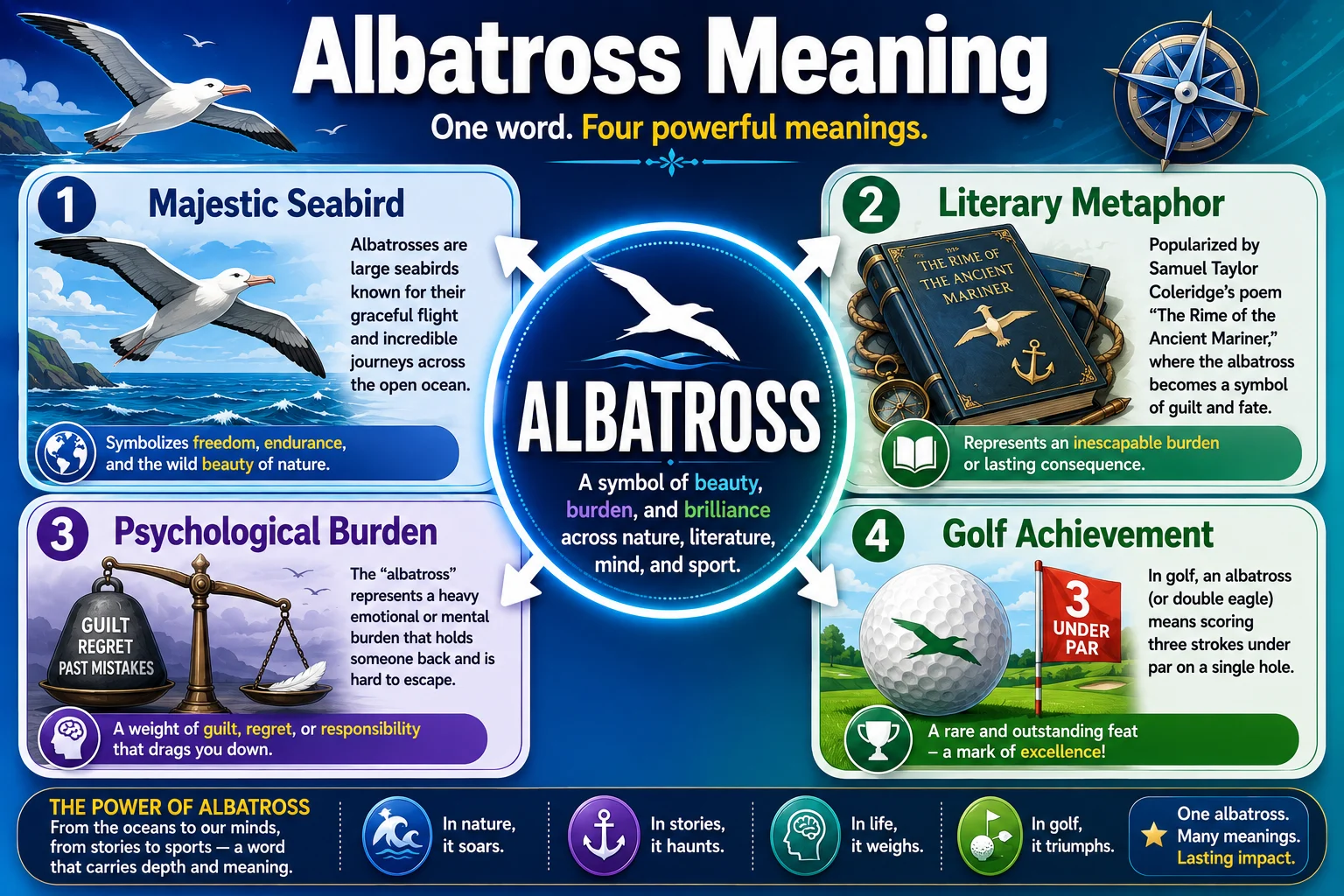
An albatross refers to a large seabird known for its impressive wingspan and ability to glide effortlessly over vast ocean distances. Symbolically and idiomatically, “an albatross” or “an albatross around one’s neck” represents a heavy psychological burden, persistent obstacle, or inescapable source of guilt that hinders a person’s progress.
Understanding the complete albatross meaning helps you navigate literary references, everyday idioms, psychological metaphors, and environmental conservation discussions. Furthermore, this evocative term carries a rich cultural legacy that bridges ancient maritime folklore, classic nineteenth-century poetry, and modern figurative language. Consequently, when people search for this phrase, they usually want to uncover whether it refers to the majestic oceanic bird, the famous literary idiom, or its unique usage in sports like golf.
Additionally, modern media and everyday conversation frequently draw on symbolic metaphors to describe emotional weight and persistent challenges. For example, commentators often describe a political scandal or financial debt as an albatross around an organization’s neck. Similarly, literature and film use the image of the soaring bird to signify freedom, endurance, and deep connection to nature. Therefore, grasping every dimension of the definition enriches your vocabulary and deepens your appreciation for cultural symbolism.
Quick Answer Box
| Aspect | Details |
| Primary Meaning | Large ocean seabird; psychological burden or guilt |
| Context | Literature, idioms, marine biology, psychology, sports |
| Primary Origin | Samuel Taylor Coleridge’s The Rime of the Ancient Mariner |
| Example | The unresolved legal dispute became a heavy albatross for the firm |
| Tone | Symbolic, literary, reflective, profound, analytical |
What Does Albatross Meaning Represent in History and Literature?
To understand the core albatross meaning, one must examine its origins in maritime history and classic English literature. Historically, the word entered English in the late sixteenth century, derived from the Portuguese alcatraz (meaning pelican or large seabird), which was influenced by the Arabic al-ġaṭṭāṣ (meaning sea-eagle). Sailors long regarded albatrosses with awe, viewing them as auspicious signs of good luck, favorable winds, and the spirits of departed mariners.
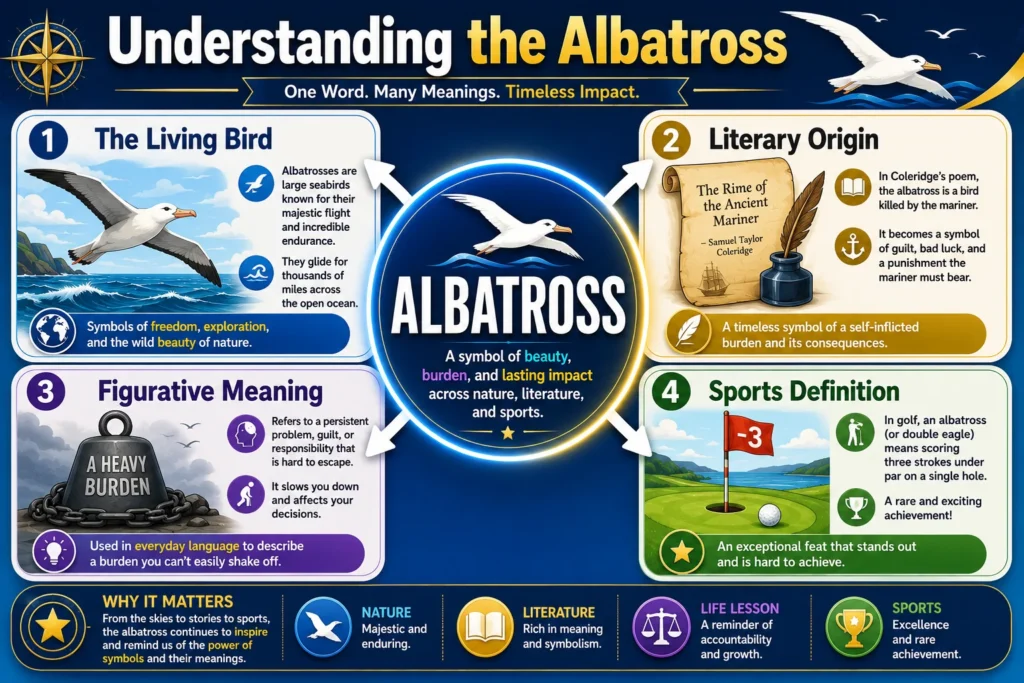
Furthermore, the phrase gained its dramatic idiomatic meaning through Samuel Taylor Coleridge’s famous 1798 poem, The Rime of the Ancient Mariner. In the poem, a sailor shoots a friendly albatross with a crossbow, bringing a curse upon his ship and crew. To punish his senseless act and signify his guilt, the crew hangs the dead bird around the mariner’s neck.
"Ah ! well a-day ! what evil looks
Had I from old and young !
Instead of the cross, the Albatross
About my neck was hung."
— Samuel Taylor Coleridge
Consequently, the image of the dead bird became a immortalized metaphor for an inescapable burden or moral curse. Thus, what began as a respected oceanic creature evolved into one of the most recognizable literary idioms in the English language.
Contextual Dynamics & Nuances of the Term
However, the practical application of the term shifts depending on whether it is used in biological, idiomatic, psychological, or sports contexts.
1. Biological Character: The Oceanic Voyager
In ornithology and marine biology, the albatross belongs to the family Diomedeidae. These massive seabirds possess the largest wingspans of any living bird—reaching up to 11 feet (3.4 meters).
- Oceanic Endurance: They spend years at sea without touching land, riding ocean winds using dynamic soaring.
- Mating for Life: Albatrosses are famous for forming long-term monogamous pair bonds that last decades.
- Conservation Symbol: Because longline fishing and ocean pollution threaten their populations, they serve as key symbols for marine conservation.
2. Idiomatic Meaning: A Heavy Burden
In everyday figurative speech, calling something “an albatross” means it is an ongoing handicap, emotional burden, or embarrassing liability that one cannot easily remove.
- Financial Debt: A costly mortgage or failed investment that drains resources for years.
- Unresolved Guilt: A past mistake that haunts a person’s conscience and reputation.
- Professional Liabilities: An outdated company policy or scandal that holds back a team’s growth.
3. The Sports Context: Exceptional Scoring in Golf
In addition, golf uses the term in a completely positive sense. An “albatross” (also called a double eagle) occurs when a golfer scores three strokes under par on a single hole. Because it is extremely rare—far less common than a hole-in-one—it represents one of the highest achievements in the sport.
Real-Life Conversation Examples Using Albatross Meaning Concepts
Indeed, understanding conversational contexts helps you use the term naturally across literary reviews, workplace discussions, and casual chats. Below are five real-life messaging scenarios that show how people use the word across different settings.
1. Discussing Workplace Challenges
Alex: Hey Sarah! How is the new product launch coming along?
Sarah: It’s going well, but that old software integration has become a real albatross for our dev team.
Alex: That sounds frustrating!
Sarah: Exactly! Consequently, replacing it next quarter will finally let us build new features much faster.
2. Chatting About Classic Literature
Jordan: I’m re-reading The Rime of the Ancient Mariner for my book club tonight.
Taylor: Indeed, I love that poem! The psychological symbolism of the bird around the sailor’s neck is brilliant.
Jordan: That sounds brilliant! Furthermore, it’s amazing how a 200-year-old poem created such a common everyday idiom.
Taylor: Deal, because great literature shapes the way we express burden and guilt forever!
3. Analyzing Business Investments
Maya: The quarterly earnings report showed steady growth across all divisions.
Chloe: Actually, our failing legacy branch is still acting like an albatross on our overall profit margin.
Maya: Oh, that explains why executive leadership wants to restructure that division!
Chloe: Naturally, removing unprofitable weight helps the company thrive!
4. Celebrating Golf Achievements
Liam: Did you see the golf tournament highlights from this morning?
Emma: However, don’t tell me someone hit an albatross on the fifteenth hole!
Liam: Good catch. Consequently, the player moved straight to the top of the leaderboard!
Emma: Trust me, because hitting a double eagle is one of the rarest feats in sports!
5. Clarifying Figurative Vocabulary
Noah: What’s the main difference between saying something is an “albatross” versus a “hurdle”?
Sophia: Meanwhile, a hurdle is a temporary obstacle you jump over, whereas an albatross is a heavy, lingering burden you carry around with you.
Noah: Does it always imply guilt or regret?
Sophia: Yes! In fact, it almost always carries a subtle link to past choices or inescapable obligations.
Platform-Specific Breakdown
Additionally, literary forums, sports communities, and environmental channels discuss the term through distinct digital tools and content formats. Consequently, analyzing how creators discuss the topic across platforms reveals its cultural depth.
How It Is Used on X (Twitter) and BookTok
For instance, literature enthusiasts and student creators on TikTok (#BookTok) and X share video essays and discussions breaking down literary imagery in classic poetry. Furthermore, discussions frequently highlight moral themes and poetic devices.
- Poetry Analysis: Specifically, creators post visual breakdowns of Coleridge’s stanza structures and gothic motifs.
- Metaphor Memes: Similarly, users share humorous memes using “an albatross” to describe unwanted responsibilities or lingering assignments.
- Pop Culture Connections: Meanwhile, creators highlight references to the metaphor in movies, TV shows, and rock songs.
The Role of Nature Communities and Golf Forums
On the other hand, wildlife conservation groups and sports forums like Reddit (r/golf and r/ornithology) discuss the literal bird and the rare golf achievement.
In fact, marine biologists share stunning imagery of ocean flights to raise awareness about endangered species. Consequently, public appreciation for the physical creature grows alongside its symbolic legacy.
- Conservation Campaigns: Posts advocating for safer longline fishing gear to protect soaring seabirds.
- Flight Dynamics: Video highlights demonstrating how the bird glides thousands of miles without flapping its wings.
- Golf Shot Recaps: In addition, community threads celebrating rare double-eagle scores in professional tournaments.
- Birdwatching Sightings: Finally, field reports from pelagic birdwatchers tracking ocean migrations.
Alternative Meanings & NLP Variations of the Phrase
Additionally, search engines use Natural Language Processing (NLP) to connect related symbolic terms, literary devices, and biological keywords. Therefore, understanding the broader lexical web surrounding the topic helps clarify how AI engines categorize the phrase.
Lexical Entities and Synonyms
To fully grasp the albatross meaning in modern English, consider these primary semantic variations and contextual synonyms:
- Burden: Specifically, a heavy load, responsibility, or emotional weight carried over time.
- Millstone: Namely, a heavy mental or moral weight (derived from the phrase “a millstone around one’s neck”).
- Liability: For example, a person or thing whose presence or behavior causes disadvantage.
- Cross to Bear: Similarly, a persistent trial or affliction that a person must endure.
- Double Eagle: In contrast, the positive golf term meaning three strokes under par on a single hole.
- Pelagic Bird: Furthermore, the biological category describing birds that live on the open ocean.
Misinterpretations: When NOT to Misuse the Term
Because the term carries both positive biological awe and negative idiomatic weight, confusing its contexts can cause misunderstandings. However, understanding clear boundaries ensures accurate communication.
1. Assuming the Live Bird Represents Bad Luck
However, the most common mistake occurs when people assume seeing a living albatross brings bad luck. Historically and in Coleridge’s poem, the live bird brought good luck and favorable winds. The curse and burden occurred only after the mariner killed the innocent creature.
2. Confusing an Albatross with a Eagle or Gull
Similarly, observers sometimes confuse the biological bird with standard seagulls or sea eagles. While all are coastal seabirds, the albatross is far larger, belongs to a distinct family, and possesses unique ocean-gliding adaptations.
3. Misinterpreting the Golf Term as Negative
In addition, because the literary idiom represents a heavy burden, non-golfers sometimes assume an “albatross” in golf is a mistake or penalty. However, in golf, an albatross is a rare, triumphant achievement that significantly improves a player’s score.
| Context | Primary Focus | Meaning & Emotional Character |
| Literary Idiom | Emotional/Moral Burden | Negative; persistent guilt, obstacle, or liability |
| Marine Biology | Majestic Ocean Seabird | Positive; freedom, endurance, grace, conservation |
| Golf Sport | 3 Strokes Under Par | Highly Positive; exceptional skill and rare achievement |
| Maritime Folklore | Auspicious Seabird | Positive; good fortune, favorable wind for sailors |
How to Respond in Chat Comfortably
Furthermore, when a colleague or friend uses the metaphor in text messages or group chats, responding thoughtfully keeps the conversation engaging. Below are tailored guidelines for replying depending on the context.
If Someone Mentions a Workplace Burden
When a teammate describes a difficult project or legacy system as an albatross, acknowledge the challenge and offer supportive problem-solving.
- Option 1: “I completely understand! However, finding a way to lift that burden will make a huge difference for the team!”
- Option 2: “That sounds tough! For example, can we break down the problem into smaller steps to make it lighter?”
- Option 3: “Indeed, getting rid of that legacy hurdle will feel like a massive relief for everyone!”
If Someone Discusses Literature or Symbolism
If a friend shares a poetic reference or book recommendation, reply with appreciation for the deeper literary imagery.
- Option 1: “I love that literary connection! Because classic imagery makes everyday conversations so much richer.”
- Option 2: “Referencing Coleridge makes so much sense here since the metaphor fits the situation perfectly.”
- Option 3: “Your text made me smile, bringing a touch of classic literary style to a casual chat!”
FAQs
What is the primary albatross meaning in figurative speech?
In figurative speech, the primary albatross meaning refers to a heavy psychological burden, persistent obstacle, or inescapable source of guilt that hinders a person’s progress or peace of mind.
Where does the phrase “an albatross around one’s neck” originate?
The phrase originates from Samuel Taylor Coleridge’s 1798 poem, The Rime of the Ancient Mariner, where a sailor is forced to wear a dead albatross around his neck as punishment for killing it.
Is an albatross in golf a good or bad thing?
In golf, an albatross is an exceptionally good achievement! It means scoring three strokes under par on a single hole (also known as a double eagle).
What does a live albatross symbolize in marine folklore?
Historically, sailors viewed a living albatross as a symbol of good luck, favorable winds, and a protective spirit guiding ships across ocean waters.
How big is an albatross?
The albatross is one of the largest flying birds in the world, with species like the Wandering Albatross boasting a wingspan of up to 11 feet (3.4 meters).
Why are albatrosses endangered?
Many albatross species face extinction due to longline fishing gear, plastic ocean pollution, climate change, and invasive species attacking their nesting grounds on remote islands.
What is the difference between an albatross and a millstone metaphor?
Both describe heavy burdens. However, “an albatross” often carries a connotation of personal guilt, past mistakes, or moral regret, while “a millstone” refers more broadly to any overwhelming responsibility or weight.
Can an albatross fly without flapping its wings?
Yes! Albatrosses use a dynamic soaring technique that harnesses ocean wind currents, allowing them to glide thousands of miles while expending almost no physical energy.
What is the figurative meaning of killing an albatross?
Figuratively, “killing an albatross” means committing a senseless, destructive act that brings bad luck, regret, or a long-lasting psychological burden upon oneself.
Why do albatrosses mate for life?
Albatrosses form long-term monogamous bonds because raising a single chick requires intense, coordinated cooperation between both parents over many months in harsh ocean environments.
Conclusion
Ultimately, human language continuously draws inspiration from the natural world and timeless literary art. The evolution of the term demonstrates how a magnificent oceanic bird successfully transformed into a iconic symbol of freedom, a classic literary metaphor for moral weight, and an elite achievement in sports. Today, whether you encounter the word in a literature class, in a business meeting, or while watching a golf tournament, its core message remains compelling: choices carry weight, and understanding symbolism helps us navigate life’s journeys with wisdom.
Additionally, environmental conservation initiatives and digital learning platforms keep both the biological species and its rich heritage visible for future generations. Therefore, by understanding every dimension of the definition, you can effortlessly navigate literary discussions, express complex ideas, and appreciate the power of metaphor with total confidence.