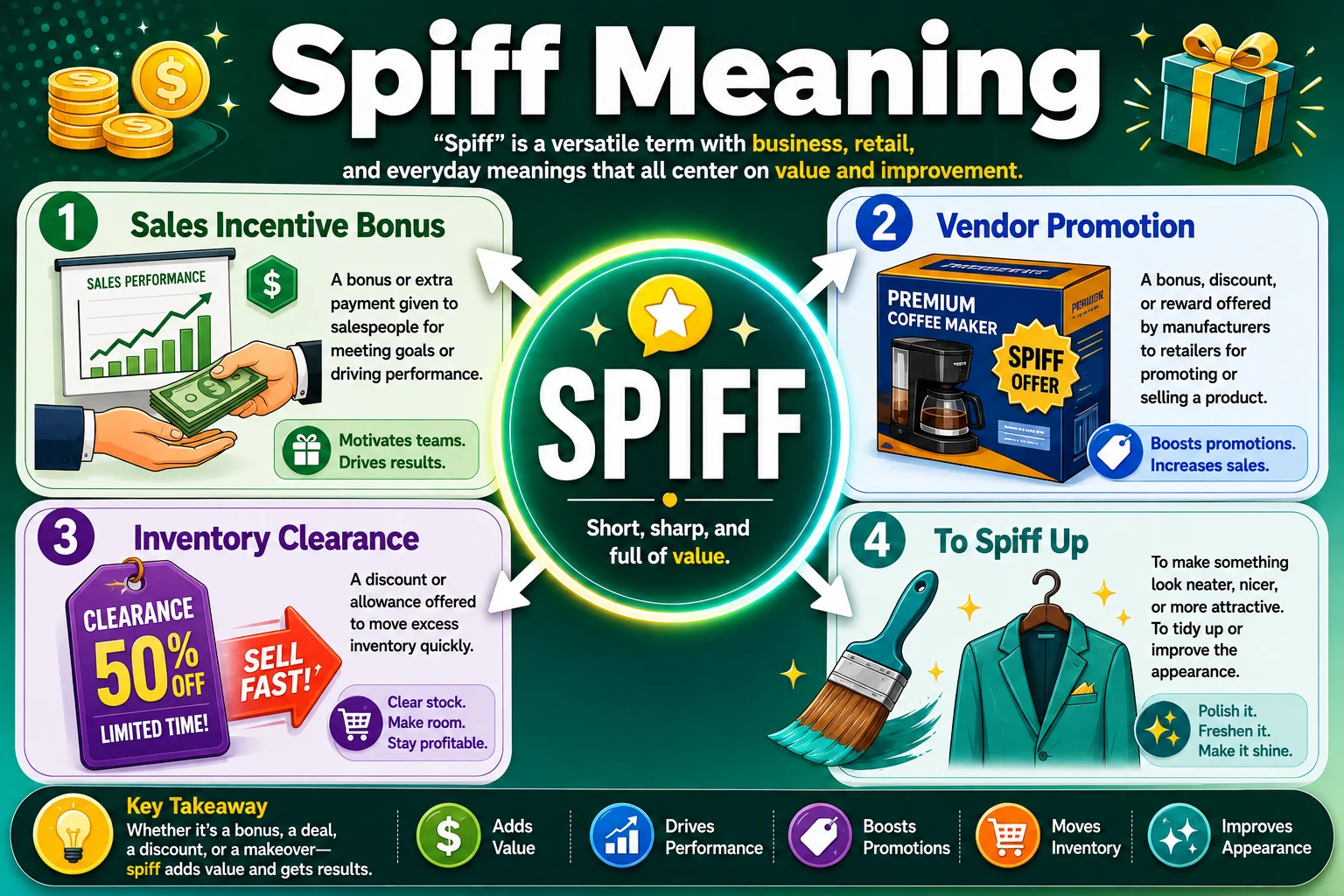
A spiff (or SPIFF) refers to an immediate, short-term financial incentive or bonus offered to sales representatives for promoting and selling a specific product or service. While commonly used in retail, automotive, and technology sales to clear older inventory or push strategic items, the term also describes making something look stylish, neat, or well-groomed (“spiff up”).
Understanding the complete spiff meaning helps you navigate sales compensation models, retail commission structures, business incentives, and everyday vocabulary. Furthermore, this dynamic term carries a fascinating dual nature that shifts depending on whether you are analyzing a corporate sales strategy or describing a quick personal refresh. Consequently, when people search for this phrase, they usually want to uncover how sales spiffs work, who pays them, or how the slang originated.
Additionally, language evolves rapidly as digital sales platforms, e-commerce networks, and modern workplace incentives redefine performance rewards. For example, retail managers frequently deploy temporary spiff bonuses to accelerate product rollouts. Similarly, everyday speakers use the phrase “spiff up” to describe cleaning, renovating, or dressing sharply. Therefore, grasping every dimension of the definition elevates your business acumen and expands your everyday vocabulary.
Quick Answer Box
| Aspect | Details |
| Primary Meaning | Short-term sales incentive/bonus; to make stylish or neat |
| Context | Retail, sales management, automotive, corporate HR, slang |
| Primary Platforms | Sales CRMs, retail management systems, workplace chats |
| Example | The dealership offered a $200 spiff for every EV sold this weekend |
| Tone | Professional, motivating, strategic, practical, energetic |
What Does Spiff Meaning Represent in Culture and History?
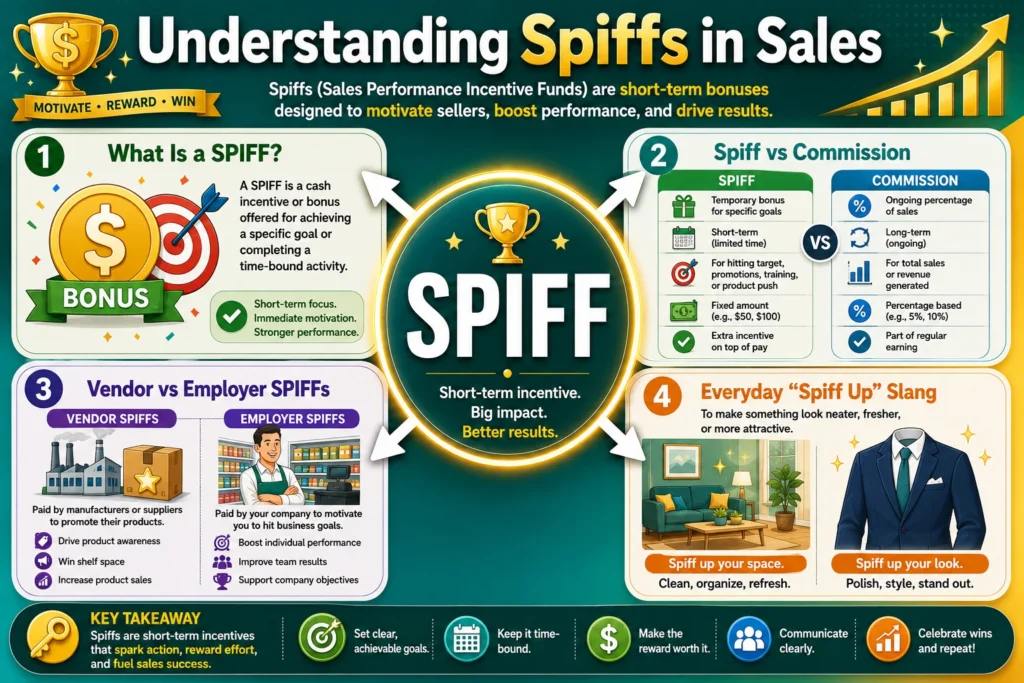
To understand the core spiff meaning, one must examine its etymological origins in nineteenth-century commerce. Historically, the term emerged in Victorian-era British drapery and clothing shops around the 1850s. Shop owners paid clerks a small cash allowance—a “spiff”—for selling old, outdated, or hard-to-move stock. Specifically, the slang derived from the word spiffy, which meant smart, stylish, or neatly presented.
Furthermore, business historians and linguists debate whether SPIFF serves as a backronym created in modern corporate culture. For example, many sales organizations treat SPIFF as an acronym standing for “Sales Performance Incentive Fund,” “Special Pay for Incentive Fast,” or “Specific Price Incentive For Fast-sales.” Consequently, what began as nineteenth-century shopkeeper slang evolved into a formalized corporate sales term.
Moreover, the word expanded beyond retail commission structures into broader pop culture and visual aesthetics. Indeed, the phrase “spiff up” became a widespread idiom meaning to polish, restore, or improve the appearance of a room, outfit, or document. Thus, the definition seamlessly bridged the gap between sales motivation and personal grooming.
Contextual Dynamics & Nuances of the Term
However, the practical usage of the word shifts depending on your immediate industry and workplace context. For instance, a spiff in a car dealership functions very differently from a spiff program in a software technology company.
1. Sales & Retail Incentives (SPIFFs)
In sales management, a spiff acts as a targeted cash reward or gift card given on top of a base salary and regular commission. Specifically, management uses spiffs to drive immediate behavior over a short window—such as a day, a weekend, or a single month.
- Vendor-Sponsored Spiffs: A product manufacturer pays retail store employees directly to push their specific brand over competitors.
- Employer-Sponsored Spiffs: A business owner offers a cash bonus to clear slow-moving inventory before new stock arrives.
- Targeted Goals: Spiffs focus on specific metrics, such as selling warranty add-ons, reaching daily call quotas, or booking product demos.
2. The Idiomatic Usage: “To Spiff Up”
Meanwhile, in everyday casual conversation, the verb phrase “to spiff up” means to clean, decorate, polish, or dress up smartly.
- Personal Appearance: “He spiffed himself up with a sharp suit for the job interview.”
- Home & Space: “We decided to spiff up the guest room with fresh paint and new lighting.”
- Projects & Documents: “Let’s spiff up the presentation slides before the client meeting.”
Real-Life Conversation Examples Using Spiff Meaning Concepts
Indeed, understanding conversational contexts helps you use the term naturally across professional sales meetings and casual dialogue. Below are five real-life messaging scenarios that show how people use the word across different settings.
1. Discussing Weekend Sales Incentives
Alex: Hey Sarah! Are you ready for the big summer sale event this weekend?
Sarah: Absolutely! Management just announced a fifty-dollar spiff for every smart TV we sell.
Alex: That’s fantastic motivation!
Sarah: Exactly! Consequently, my goal is to sell at least ten units before Sunday evening.
2. Planning a Home Renovation Project
Jordan: The living room looks a bit outdated after all these years.
Taylor: Indeed, I agree! Let’s research simple ways to spiff up the space with new rugs and wall art.
Jordan: That sounds brilliant! Furthermore, a fresh coat of paint will make the whole room feel brand new.
Taylor: Deal, because a weekend DIY project will give the house a fantastic refresh!
3. Reviewing Vendor Incentive Programs
Maya: Our software vendor wants us to prioritize their new cloud package this quarter.
Chloe: Actually, they offered a vendor spiff program to reward our sales reps with digital gift cards for every closed lead.
Maya: Oh, that explains why our reps are so enthusiastic about pitching it!
Chloe: Naturally, a direct incentive keeps the team focused on key products!
4. Preparing for a Job Interview
Liam: I have my final interview with the executive team tomorrow morning.
Emma: However, don’t forget to spiff up your portfolio slides so they look polished and sharp.
Liam: Good catch. Consequently, I will update the formatting and color scheme tonight.
Emma: Trust me, because clear, stylish visuals make a great first impression!
5. Clarifying Sales Compensation Terms
Noah: What’s the difference between a regular sales commission and a spiff?
Sophia: Meanwhile, a commission is a permanent percentage paid on overall sales, whereas a spiff is a temporary bonus for selling specific products fast.
Noah: Is a spiff usually paid out right away?
Sophia: Yes! In fact, fast payout is what makes spiffs so effective for short-term motivation.
Platform-Specific Breakdown
Additionally, sales communities and business channels discuss performance strategies through distinct digital tools, forums, and software platforms. Consequently, analyzing how professionals discuss the topic across platforms reveals how modern incentive programs operate.
How It Is Used on LinkedIn and Sales Blogs
For instance, sales leaders and HR specialists on LinkedIn share best practices for designing ethical, high-converting spiff campaigns. Furthermore, discussions frequently focus on balancing short-term bonuses with long-term team morale.
- Campaign Guides: Specifically, consultants post step-by-step frameworks for setting up spiff contests that boost revenue.
- Ethical Sales Discussions: Similarly, posts address avoiding unhealthy competition or pushy sales tactics during spiff promotions.
- Payout Automation: Meanwhile, software reviews showcase tools that deliver instant spiff payouts via digital wallets.
The Role of Reddit (r/sales) and B2B Forums
On the other hand, sales communities on Reddit (such as r/sales and r/retail) offer candid spaces where representatives compare spiff structures and share real-world experiences.
In fact, forum members frequently debate whether vendor spiffs are worth the effort or if employer base pay is more important. Consequently, sales professionals gain practical insights into industry compensation standards.
- Deal Showcases: Threads where reps share record-breaking spiff earnings from major sales events.
- Vendor Reviews: Community ratings of vendor spiff programs in electronics, automotive, and telecom sectors.
- Tax Discussions: In addition, advice on how spiff payouts are taxed as supplemental income.
- Strategy Tips: Finally, posts breaking down how to cross-sell spiff items without alienating customers.
Alternative Meanings & NLP Variations of the Phrase
Additionally, search engines use Natural Language Processing (NLP) to connect related sales terms, compensation models, and slang expressions. Therefore, understanding the broader lexical web surrounding the topic helps clarify how AI engines categorize the phrase.
Lexical Entities and Synonyms
To fully grasp the spiff meaning in modern English, consider these primary semantic variations and contextual synonyms:
- Incentive: Specifically, a payment or concession given to motivate higher performance or effort.
- Bonus: Namely, an extra sum of money given to an employee as a reward or performance boost.
- Commission: For example, a sum of money paid to an agent in a commercial transaction as a percentage.
- Spiff Up: Similarly, to clean, polish, decorate, or improve the appearance of something.
- Kickback: In contrast, an illegal, unethical payment made to someone who facilitated a transaction (unlike a legal, transparent spiff).
- SPIFF: Furthermore, the business acronym standing for Sales Performance Incentive Fund.
Misinterpretations: When NOT to Misuse the Term
Because the term represents a specific business practice, confusing it with illegal payments or using it in wrong contexts can create misunderstandings. However, understanding clear boundaries ensures professional communication.
1. Confusing a Legal Spiff with an Illegal Kickback
However, the most critical mistake occurs when people confuse a legal, transparent spiff with an illegal kickback. A legitimate spiff is disclosed to management, recorded for taxes, and complies with corporate policies. Conversely, an undisclosed or secret payment given under the table to influence a buyer constitutes an illegal kickback.
2. Over-Relying on Spiffs in Sales Management
Similarly, business managers sometimes rely too heavily on spiffs to solve deeper sales problems. If a product is poorly designed or priced incorrectly, offering a temporary cash spiff will not fix long-term market issues.
3. Misinterpreting “Spiff Up” as Financial Terminology
In addition, confusing the idiomatic phrase “spiff up” with sales compensation can sound awkward. Telling a designer to “spiff up a document” refers to visual styling, not paying them an incentive bonus.
| Term | Primary Goal | Legal & Workplace Status |
| Spiff | Short-term sales drive for specific items | Fully legal, transparent, employer/vendor-approved |
| Commission | Ongoing revenue-based sales compensation | Standard legal compensation structure |
| Kickback | Unethical/illegal secret transaction | Illegal, undisclosed, violates corporate policy |
| Spiff Up | Improve appearance, decorate, polish | Casual idiom / slang for grooming or styling |
How to Respond in Chat Comfortably
Furthermore, when a colleague or manager mentions a spiff program in text messages or work chats, responding professionally keeps communication clear and enthusiastic. Below are tailored guidelines for replying depending on the context.
If a Manager Announces a Sales Spiff
When your supervisor announces a new spiff contest in Slack or Teams, acknowledge the opportunity with energy and focus.
- Option 1: “That sounds like a great incentive! However, I’m aiming to hit the top spot by Friday!”
- Option 2: “Awesome promotion! For example, which specific models qualify for the bonus?”
- Option 3: “Indeed, a quick bonus is great motivation for the whole team! Let me check the details!”
If Someone Uses “Spiff Up” in a Project Context
If a coworker asks you to polish a report or presentation, confirm the design edits promptly.
- Option 1: “I love that idea! Because updating the visual design will make our slides pop.”
- Option 2: “Polishing the layout makes so much sense before sending it to the client.”
- Option 3: “I will update the formatting right away, bringing instant polish to the document!”
FAQs
What is the primary spiff meaning in sales?
In sales, the primary spiff meaning refers to a short-term financial bonus or reward given to sales representatives for selling a specific product, service, or warranty package fast.
What does the acronym SPIFF stand for?
While originally nineteenth-century slang, SPIFF is often treated as an acronym standing for “Sales Performance Incentive Fund,” “Special Pay for Incentive Fast,” or “Specific Price Incentive For Fast-sales.”
Is a spiff legal in business?
Yes! Spiffs are legal, standard sales practices as long as they are transparent, approved by management, compliant with company policy, and properly reported for income tax purposes.
What does “to spiff up” mean in casual slang?
In casual conversation, “to spiff up” means to clean, decorate, renovate, or dress sharply to make someone or something look stylish and neat.
What is the difference between a spiff and a commission?
A commission is a standard, ongoing percentage earned on total sales volume, whereas a spiff is an immediate, temporary bonus targeted at specific items or short-term goals.
Who pays for a sales spiff?
Spiffs can be funded either by the employer (to clear old inventory or promote a campaign) or by a third-party product vendor (to encourage retail staff to recommend their brand).
How are spiff payouts taxed?
In most jurisdictions, spiff earnings are considered taxable supplemental income and must be reported on employee tax forms (such as W-2 or 1099 forms in the United States).
Why do companies use spiffs instead of raising base pay?
Companies use spiffs because they offer immediate, flexible motivation for specific, short-term business goals without permanently increasing fixed operational costs.
What industries use spiffs most frequently?
Spiffs are widely used in automotive dealerships, retail electronics, telecommunications, appliance stores, furniture retail, and B2B software sales.
Can spiffs cause negative sales behavior?
If mismanaged, spiffs can lead sales reps to focus excessively on high-bonus items while ignoring customer needs. Therefore, effective managers design spiff programs with customer satisfaction in mind.
Conclusion
Ultimately, business communication continuously evolves as organizations search for dynamic ways to drive growth, motivate teams, and refine messaging. The transformation of the term demonstrates how nineteenth-century shopkeeper slang successfully adapted into a standard sales compensation tool and everyday idiom. Today, whether you encounter the word in a corporate sales meeting, in a retail store, or during a weekend DIY project, its core message remains consistent: targeted effort creates quick, noticeable improvements.
Additionally, digital sales tools and online learning communities keep incentive strategies transparent for newer generations. Therefore, by understanding every dimension of the definition, you can effortlessly navigate sales discussions, evaluate compensation structures, and express ideas with total confidence.





1 thought on “Spiff Meaning| The Ultimate Guide and Semantic Meaning”