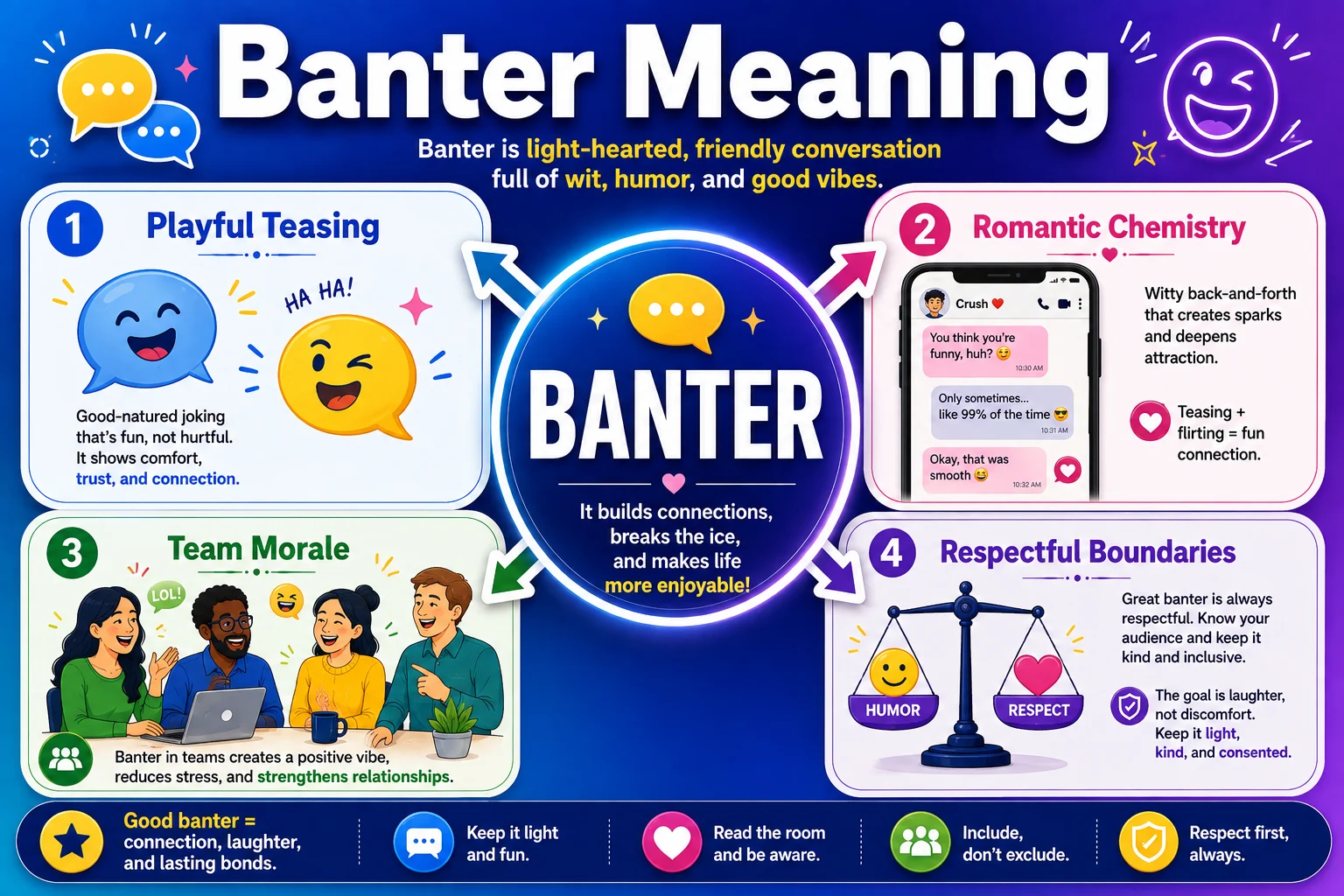
Banter refers to good-humored, playful, and quick-witted teasing or joking conversation between people. While it often involves lighthearted ribbing or clever back-and-forth retorts, it relies heavily on mutual affection, shared context, and respectful boundaries to build social connection without causing offense.
Understanding the complete banter meaning helps you navigate everyday social interactions, office dynamics, romantic dating, and digital messaging culture. Furthermore, this dynamic communication skill carries a rich history that spans centuries of British social traditions, comedic banter, and modern internet banter. Consequently, when people search for this phrase, they usually want to uncover whether it implies playful affection, clever sarcasm, or how to tell when friendly teasing crosses the line.
Additionally, language evolves rapidly as online communities and remote workplaces adopt quick, casual messaging platforms. For example, colleagues on Slack or Teams frequently use witty banter to build camaraderie across virtual teams. Similarly, individuals on dating apps rely on playful banter to build initial spark and chemistry. Therefore, grasping every dimension of the definition elevates your social awareness and enhances your conversational charm.
Quick Answer Box
| Aspect | Details |
| Primary Meaning | Lighthearted, witty, and playful back-and-forth teasing |
| Context | Friendship, romantic dating, office culture, social media |
| Primary Platforms | WhatsApp, Slack, Tinder, TikTok, X (Twitter) |
| Example | Their friendly banter kept the entire dinner party laughing |
| Tone | Playful, witty, warm, lighthearted, energetic |
What Does Banter Meaning Represent in Culture and History?
To understand the core banter meaning, one must examine its origins in English social history. Historically, the word emerged in late seventeenth-century England, originally used as slang for teasing or mock-serious banter. Over time, it evolved into a recognized literary and social art form, praised for fostering social warmth and quick wit.
Furthermore, British culture popularized the concept globally, treating casual banter—often referred to as “chaffing” or “having a laugh”—as a cornerstone of social bonding. For example, pub culture and sports fandoms rely heavily on banter to build inclusion and shared identity. Consequently, engaging in friendly ribbing became a universal sign of trust and familiarity.
Moreover, the word expanded beyond casual conversations into television scripts, romantic comedies, and sports commentary. Indeed, screenwriters craft snappy dialogue between leads to establish undeniable romantic tension. Thus, the definition seamlessly bridged the gap between everyday social banter and professional entertainment storytelling.
Contextual Dynamics & Nuances of the Term
However, the practical usage of the word shifts depending on your immediate setting and relationship depth. For instance, friendly banter with a childhood friend feels very different from workplace banter among corporate colleagues.
1. Social & Friendship Dynamics
Among close friends, banter serves as an affectionate bonding ritual. Specifically, friends tease each other about harmless quirks, shared memories, or funny mistakes to demonstrate emotional closeness.
- Mutual Consent: Both individuals understand the joke and enjoy the verbal sparring.
- Lighthearted Targets: Teasing focuses on minor, funny habits rather than deeply sensitive personal topics.
- Warm Intent: The goal is mutual laughter, never humiliation or social exclusion.
2. Romantic & Dating Contexts
Meanwhile, in dating and romantic relationships, banter plays a central role in generating chemistry. For example, playful teasing, clever wordplay, and banter challenge keep conversations exciting on dating apps like Hinge or Tinder.
3. Workplace & Professional Boundaries
Similarly, modern workplaces encourage lighthearted banter to boost team morale and relieve stress. However, professional banter requires careful awareness of workplace boundaries, cultural differences, and power dynamics to ensure everyone feels respected.
Real-Life Conversation Examples Using Banter Meaning Concepts
Indeed, understanding conversational contexts helps you use the term naturally in everyday social and professional dialogue. Below are five real-life messaging scenarios that show how people use the word across different settings.
1. Reacting to a Friend’s Teasing Text
Alex: Hey Sarah! Are you planning to show up on time today, or should we order dinner without you as usual?
Sarah: Haha, I love your cheerful banter! But don’t worry, I’m actually five minutes early today!
Alex: What?! That’s a miracle!
Sarah: Exactly! Consequently, you owe me an extra dessert for breaking my personal record.
2. Navigating Dating App Chemistry
Jordan: I noticed your bio says you make the best lasagna in town. Is that an official challenge?
Taylor: Indeed, it is! Let’s research some proper cooking competition rules so you can prepare for second place.
Jordan: That sounds brilliant! Furthermore, I’ll bring the garlic bread so I can claim partial victory.
Taylor: Deal, because great garlic bread is the only way you’ll survive my secret sauce!
3. Easing Tension in an Office Project Chat
Maya: Our presentation slide deck is finally complete after twenty revisions!
Chloe: Actually, our director gave a very positive review, so all our slide-color debates were totally worth it!
Maya: Oh, that explains why everyone stopped stressing in the team channel!
Chloe: Naturally, a little office banter helped us survive the tight deadline!
4. Chatting After a Friendly Sports Match
Liam: Good game today! You almost caught up to my score in the final round.
Emma: However, don’t get too comfortable! My rematch training starts tomorrow morning.
Liam: Good catch. Consequently, I will double my coffee intake before our next match.
Emma: Trust me, because you’re going to need all the energy you can get!
5. Discussing Social Boundaries in Group Chats
Noah: What’s the difference between friendly banter and actual mean comments?
Sophia: meanwhile, banter relies on mutual laughter where both people feel happy, whereas mean comments make one person feel targetted or uncomfortable.
Noah: Is tone of voice the main factor?
Sophia: Yes! In fact, shared respect and checking in with your friend keep teasing fun for everyone.
Platform-Specific Breakdown
Additionally, digital channels and social platforms explore conversational wit through distinct video formats, memes, and short-form text formats. Consequently, analyzing how creators discuss the topic across platforms reveals how modern banter evolves digitally.
How It Is Used on TikTok and X (Twitter)
For instance, TikTok creators and X users leverage quick video skits and snappy retorts to demonstrate playful banter in modern relationships. Furthermore, viral trends frequently feature couples or coworkers engaging in clever back-and-forth dialogue.
- POV Skits: Specifically, creators act out humorous scenarios highlighting banter between friends or dating partners.
- Text Screenshots: Similarly, users post viral screenshots of witty text exchanges on messaging apps.
- Match Recap Videos: Meanwhile, sports creators share highlights of funny verbal banter between opposing players or commentators.
The Role of Workplace Apps (Slack & Teams)
On the other hand, remote work channels like Slack or Microsoft Teams serve as digital watercoolers where coworkers exchange quick banter to build community across distance.
In fact, teams frequently set up dedicated “watercooler” or “random” channels specifically for casual banter, pet pictures, and holiday memes. Consequently, employees feel connected despite working from home.
- Meme Sharing: Threads filled with funny industry memes to lighten busy workweeks.
- Friendly Ribbing: Playful comments about sports rivalries or funny video meeting mishaps.
- Emojis & GIFs: In addition, using animated reaction GIFs to add visual humor to text chats.
- Celebration Channels: Finally, posts congratulating team milestones with energetic, humorous captions.
Alternative Meanings & NLP Variations of the Phrase
Additionally, search engines use Natural Language Processing (NLP) to connect related communication terms, psychological concepts, and social keywords. Therefore, understanding the broader lexical web surrounding the topic helps clarify how educators and search engines categorize the phrase.
Lexical Entities and Synonyms
To fully grasp the banter meaning in modern English, consider these primary semantic variations and contextual synonyms:
- Repartee: Specifically, a swift, witty reply or conversation characterized by clever retorts.
- Badinage: Namely, humorous, playful, or lighthearted conversation or banter.
- Chaffing: For example, good-natured teasing or ridiculing among close companions.
- Raillery: Similarly, good-humored satire, joking, or light teasing.
- Bantering: In contrast, engaging in playful back-and-forth conversation.
- Friendly Ribbing: Furthermore, lighthearted teasing designed to show affection without causing offense.
Misinterpretations: When NOT to Misuse the Term
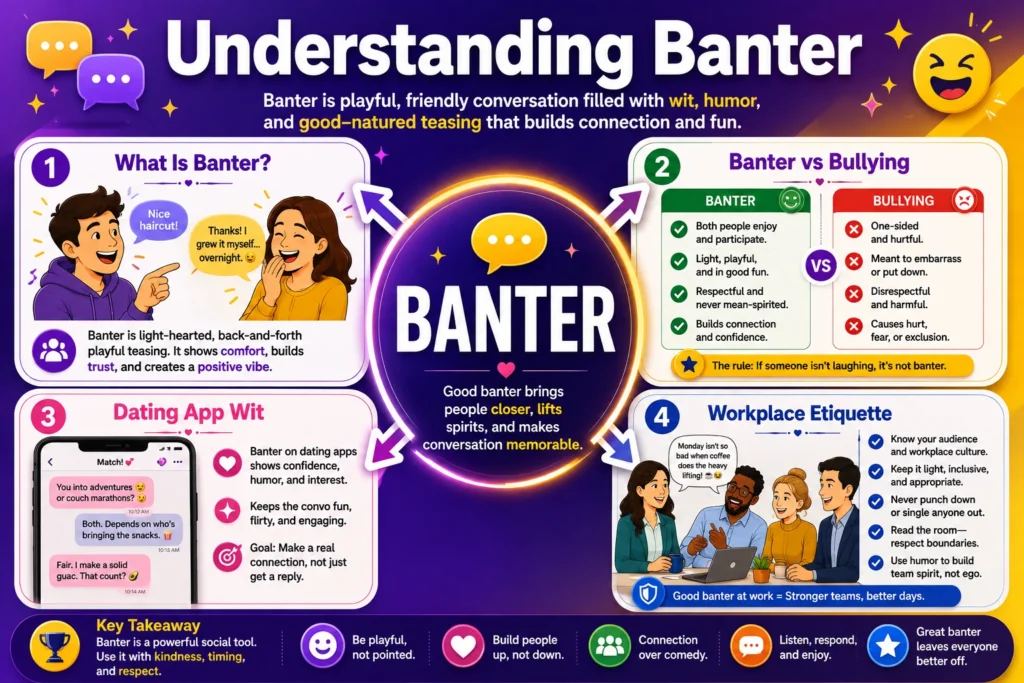
Because the term represents positive, mutual social connection, using it to excuse rude behavior can cause misunderstandings or harm relationships. However, understanding clear boundaries ensures healthy communication.
1. Using “It’s Just Banter” to Excuse Bullying
However, the most severe error occurs when someone uses “it was just banter” as an excuse after making hurtful, discriminatory, or personal attacks. Real banter requires mutual enjoyment. Specifically, if the recipient feels hurt, embarrassed, or targeted, the interaction is no longer banter.
2. Ignoring Power Dynamics at Work
Similarly, senior managers or supervisors must exercise caution when engaging in banter with junior employees. Because of the difference in workplace authority, team members may feel pressured to laugh along even if a joke crosses a personal boundary.
3. Misreading Social Readiness or Cultural Differences
In addition, humor varies widely across different cultures and personal comfort levels. Assuming a new acquaintance or international client will appreciate sarcastic ribbing can lead to awkward misunderstandings.
| Term | Primary Goal | Emotional Impact |
| Banter | Mutual fun, connection, chemistry | Warmth, laughter, inclusion |
| Bullying | Control, belittling, exclusion | Hurt, anxiety, distress |
| Sarcasm | Sharp irony, humor, satire | Amusing or biting (depends on context) |
| Criticism | Feedback, correction, evaluation | Serious, analytical, reflective |
How to Respond in Chat Comfortably
Furthermore, when a friend or colleague sends a witty remark in a text chat, responding gracefully keeps the fun momentum going. Below are tailored guidelines for replying depending on the context.
If Someone Sends a Playful Teasing Text
When a friend teases you playfully in text, acknowledge the joke with a clever retort or a lighthearted emoji.
- Option 1: “Haha! However, just wait until my comeback arrives in 3 to 5 business days!”
- Option 2: “That sounds like fighting words! For example, are you ready for a rematch?”
- Option 3: “Indeed, your wit is sharp today! I’ll give you a 10/10 for effort!”
If Someone Invites You to a Witty Exchange
If a dating match or friend starts a back-and-forth joke, keep your response light, positive, and open-ended.
- Option 1: “I love that idea! Because your sense of humor makes texting so much fun.”
- Option 2: “Challenging me to a banter battle makes so much sense since I never lose!”
- Option 3: “Your text made me laugh out loud, bringing instant fun to a busy afternoon!”
FAQs
What is the primary banter meaning in everyday conversation?
In everyday conversation, the primary banter meaning refers to good-humored, playful, and quick-witted back-and-forth teasing or joking between people who share mutual trust and rapport.
How can you tell if teasing is friendly banter or rude behavior?
Friendly banter is mutual, lighthearted, and brings laughter to both people. Conversely, if one person feels hurt, embarrassed, targeted, or uncomfortable, the behavior crosses into disrespect or bullying.
What is British banter?
British banter refers to a distinct cultural style of witty, self-deprecating, and sarcastic back-and-forth teasing commonly enjoyed in pubs, sports teams, and social gatherings across the United Kingdom.
Is banter important in romantic dating?
Yes! In dating, witty banter helps build flirtatious chemistry, showcases intelligence and humor, and tests conversational compatibility between potential partners.
What is the difference between banter and repartee?
While both involve quick wit, “repartee” emphasizes fast, exceptionally clever, and polished retorts, whereas “banter” covers a broader, more relaxed range of casual teasing and jokes.
Can banter exist in a professional office environment?
Yes, lighthearted workplace banter can boost team morale and relieve stress. However, employees should ensure jokes remain inclusive, respectful, and free of inappropriate personal topics.
What does “it’s just banter” mean when someone says it?
People often say “it’s just banter” to clarify that a teasing remark was intended as a harmless joke. However, it should never be used to dismiss someone’s genuine feelings if a comment caused hurt.
How do you improve your banter skills?
You can improve your banter skills by practicing active listening, observing clever comedy or dialogue, maintaining warm body language, and tailoring your humor to the comfort levels of your friends.
What topics should be avoided during casual banter?
It is best to avoid sensitive topics such as physical appearances, personal insecurities, family matters, religious beliefs, political views, or traumatic events.
Why do friends use teasing to show affection?
Teasing among close friends signals psychological safety and trust. It shows that the friendship is strong enough to play with gentle humor without threatening the bond.
Conclusion
Ultimately, human communication continuously thrives when built on warmth, wit, and shared laughter. The evolution of the term demonstrates how a centuries-old social habit successfully adapted into modern digital chats, dating culture, and workplace dynamics. Today, whether you encounter the word in a group chat, on a dating app, or during an office break, its core message remains consistent: playful wit connects people when handled with respect and care.
Additionally, digital platforms and creative channels keep conversational humor vibrant for newer generations. Therefore, by understanding every dimension of the definition, you can effortlessly navigate social interactions, enjoy witty back-and-forth exchanges, and build meaningful connections with total confidence.