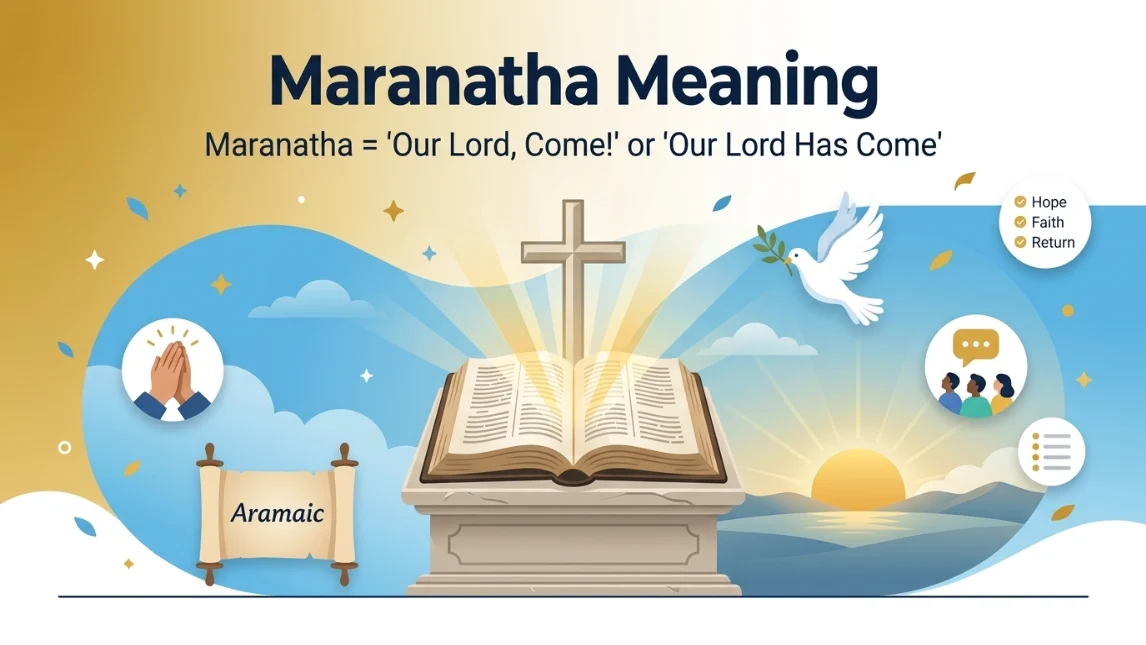
The maranatha meaning translates from Aramaic as “Our Lord, come!” or “Our Lord has come.” Christians use this ancient phrase as an expression of hope, faith, and expectation regarding the return of Jesus Christ.
Understanding the maranatha meaning opens a clear window into ancient biblical history, early Christian liturgy, and modern spiritual expression. For centuries, believers have used this distinct Aramaic term to convey deep hope, spiritual endurance, and eager expectation. While the phrase originated thousands of years ago in the New Testament, modern faith communities continuously adapt it for social media posts, group chats, and digital ministry. Consequently, learning how to interpret and use this sacred expression enriches your understanding of historical theology and modern Christian communication.
Quick Answer Summary
| Metric | Details |
| Meaning | “Our Lord, come!” or “Our Lord has come” |
| Context | Biblical theology, early Christian liturgy, worship music, and faith-based social posts |
| Primary Platforms | YouVersion Bible App, Instagram, TikTok, YouTube, and Church Text Groups |
| Example | “Through every trial, we stand strong in faith. Maranatha!” |
| Tone | Reverent, hopeful, encouraging, and spiritually triumphant |
What Does Maranatha Meaning Signal in Sacred Texts?
The phrase originates directly from the Aramaic language, which served as the common spoken dialect in first century Judea and Galilee. Specifically, the Apostle Paul embedded this Aramaic expression within his Greek letter to the Corinthians in First Corinthians chapter sixteen verse twenty two. Early believers adopted the phrase as a core liturgical exclamation during communion services and communal gatherings.
To fully grasp the primary maranatha meaning, one must examine its linguistic breakdown and theological roots:
- Mar (Lord): The Aramaic title for master, ruler, or divine lord.
- Ana (Our): The possessive pronoun suffix indicating collective belief and unity among believers.
- Tha (Come): The imperative verb calling for arrival or action.
When early Christians faced severe persecution under Roman rule, this single word functioned as a secret greeting, a sign of mutual encouragement, and a statement of steadfast hope. Furthermore, it served as a powerful reminder that current earthly struggles remain temporary compared to eternal divine promises.
Contextual Dynamics & Nuances of the Term
While the foundational maranatha meaning carries profound spiritual authority, its precise translation depends on how scholars divide the original Aramaic letters in the manuscripts.
| Aramaic Division | Transliteration | English Translation | Theological Focus |
| Marana tha | Imperative phrase | “Our Lord, come!” | Eager anticipation of the second coming of Christ. |
| Maran atha | Indicative phrase | “Our Lord has come” | Celebration of the incarnation and earthly ministry of Jesus. |
| Maran athan | Perfect tense phrase | “Our Lord is present” | Recognition of divine presence during communion and worship. |
Biblical Context in 1 Corinthians and Revelation
In First Corinthians chapter sixteen, Paul uses the phrase immediately alongside a solemn warning about divine judgment. In that setting, the expression seals his epistle with an earnest prayer for Christ’s return to establish ultimate righteousness. Similarly, the Book of Revelation concludes with the Greek translation of this identical sentiment: “Even so, come, Lord Jesus.” Therefore, both testaments unite around this singular expectation of ultimate restoration.
The Jesus Movement and Modern Christian Culture
During the late 1960s and early 1970s, the phrase experienced a major cultural revival throughout the United States during the Jesus Movement. Calvary Chapel and Maranatha! Music popularized the word across millions of worship records and contemporary hymnals. Consequently, generations of modern believers recognize the term as a symbol of vibrant corporate praise and acoustic worship music.
Real-Life Conversation Examples Using Maranatha
Understanding how believers use the term in daily digital communication makes spiritual interactions more meaningful. Here are five distinct, realistic dialogue scenarios demonstrating natural usage in modern messaging.
1. Encouraging a Friend in Hard Times
- David: “Honestly, this past week has felt so overwhelming with work and family stress.”
- Rachel: “I am so sorry to hear that, David. I am praying for peace in your heart today.”
- David: “Thank you! I am just keeping my eyes focused on eternity. Maranatha!”
- Rachel: “Amen! He is faithful, and our current troubles will not last forever.”
2. Coordinating Sunday School and Worship
- Pastor Mark: “Team, the sanctuary is set up for tomorrow morning’s communion service.”
- Sarah: “Awesome! Our youth choir prepared two special worship songs as well.”
- Pastor Mark: “Wonderful news. Let us gather with joyful expectation. Maranatha!”
- Sarah: “Looking forward to a powerful morning together!”
3. Social Media Post Comment
- Hannah: “Just published a new blog post on finding hope during times of global uncertainty.”
- Joshua: “Reading it now! That section on future hope brought tears to my eyes.”
- Hannah: “Praise God! That is why we share the gospel message daily.”
- Joshua: “Indeed! Maranatha, come Lord Jesus!”
4. Texting After a Church Retreat
- Caleb: “I still cannot stop thinking about the altar service from Saturday night at the mountain retreat.”
- Ethan: “Same here, man! That prayer time revived my faith completely.”
- Caleb: “We need to keep that spiritual fire burning in our daily lives.”
- Ethan: “100 percent. Maranatha! Standing strong until He returns.”
5. Family Group Chat Encouragement
- Mom: “Grandma’s surgery went smoothly this morning, and the doctor says recovery looks great!”
- Grace: “Praise the Lord! So thankful for all your prayers, everyone.”
- Michael: “God is good! Praying for quick healing and strength for her this week.”
- Mom: “Amen! He holds our past, present, and future in His hands. Maranatha!”
Platform-Specific Breakdown
Modern Christian creators, ministries, and everyday believers use online platforms to share faith content. The core maranatha meaning remains sacred, but users adapt its visual presentation across different apps.
| Social Platform | Primary Format | Typical Usage & Style |
| TikTok | Short Videos & Reels | Used in worship covers, bible study clips, and end-times theology commentary. |
| Carousel Posts & Stories | Printed on aesthetic graphic design slides, scripture quotes, and story overlays. | |
| YouVersion App | Community Notes | Added to shared prayer lists, verse-of-the-day highlights, and study plans. |
| YouTube | Long-Form Worship | Featured in video titles, worship playlists, and live stream prayer chats. |
How It Is Used on Snapchat
Snapchat users often post quick photo snaps of morning devotionals, open Bibles, or church service stages. On Snapchat, users add the term as a short text caption over photos of sunrises or worship gatherings. Because Snapchat relies on visual speed, the phrase communicates deep spiritual encouragement without requiring long text blocks.
The Role of Maranatha on TikTok
TikTok creators frequently use the word in short video captions, hashtag trends, and background audio tracks. Creators share videos explaining biblical prophecy, historical Aramaic terms, and worship music history under hashtags like #Maranatha. Consequently, TikTok serves as a dynamic educational hub where younger generations discover ancient liturgical expressions.
Instagram and Texting Dynamics
On Instagram, faith influencers feature the term in elegant typography posts, bio descriptions, and aesthetic reel captions. In direct messaging and church group text threads, believers use the acronym or full word as a powerful sign-off. It acts as a sacred closing that replaces standard goodbyes with an uplifting declaration of eternal hope.
Alternative Meanings & Semantic Variations
While the spiritual definition remains most common, the word also represents various institutions, music labels, and community names worldwide. Knowing these distinct contexts prevents confusion.
| Name or Variant | Entity Type | Description & Primary Function |
| Maranatha! Music | Christian Record Label | Pioneers of praise and worship music founded during the 1970s Jesus Movement. |
| Maranatha Baptist University | Higher Education | Private Baptist university located in Watertown, Wisconsin. |
| Maranatha Volunteers International | Non-Profit Organization | Christian volunteer organization building churches and schools globally. |
| Marana Tha | Two-Word Spelling | Alternative transliteration emphasizing the imperative call for Christ’s return. |
| Maran Atha | Two-Word Variant | Historical spelling interpretation translating to “Our Lord has arrived.” |
In academic circles, professors discuss the term during lectures on first-century linguistics and early church history. Similarly, global humanitarian groups choose the name to signal their mission of serving local communities with hope and practical aid.
Misinterpretations: When NOT to Use the Term
Because the word carries deep sacred meaning, using it in casual, secular, or irreverent contexts causes misunderstanding. Avoid using this phrase in the following scenarios:
Secular Business Communication
Using sacred liturgical expressions in corporate emails or formal commercial negotiations creates confusion. Colleagues may misunderstand the phrase or view it as out of place in professional business environments.
Casual Humor or Meme Culture
Attempting to turn sacred biblical terms into internet jokes or sarcastic memes erodes their historical and spiritual weight. Believers treat the word with reverence, so using it lightly can offend faith-focused audiences.
High-Stress Conflict Resolution
Dropping complex theological exclamations into heated interpersonal arguments can feel dismissive or overly preachy. Instead, use clear, empathetic, and direct language when working through personal disagreements.
How to Respond in Chat Comfortably
When a friend, family member, or ministry partner sends you a message containing the phrase, responding thoughtfully honors the shared faith context. Here are several natural ways to reply:
1. Affirming Eternal Hope
“Amen! Truly keeping my mind focused on eternal promises today. Hope you have a blessed week!”
2. Agreement with Praise
“Amen, come Lord Jesus! So thankful for His grace and constant presence in our lives.”
3. Reciprocating Encouragement
“Thank you for that wonderful reminder! Sending prayers and blessings back to you and your family.”
4. Brief Digital Response
“Amen! Maranatha! See you at church on Sunday!”
FAQs
What is the primary maranatha meaning in the Bible?
The primary maranatha meaning translates from Aramaic as “Our Lord, come!” or “Our Lord has come.” It expresses joyful hope and eager expectation regarding the return of Jesus Christ.
Is the word Greek or Aramaic in origin?
The word is originally Aramaic, although Paul wrote it using Greek letters within his letter to the Corinthians in the New Testament.
Where is the exact phrase found in Scripture?
The exact phrase appears in First Corinthians chapter sixteen verse twenty two. A similar Greek translation also concludes the Book of Revelation chapter twenty two verse twenty.
Why did Paul use an Aramaic phrase when writing in Greek?
Paul used the Aramaic term because it was an established liturgical watchword among early Jewish and Gentile Christians across the Mediterranean world.
What is the difference between Marana tha and Maran atha?
Marana tha” translates as an imperative prayer meaning “Our Lord, come!” while “Maran atha” functions as a statement meaning “Our Lord has come.
Do Catholic and Protestant churches both use the word?
Yes, both Catholic and Protestant traditions recognize and respect the term in liturgy, theology, and traditional worship music.
Is Maranatha used as a greeting today?
Yes, many Christians use the word as a faith-filled greeting or text message closing to encourage fellow believers in their daily walk.
What is Maranatha Music?
Maranatha! Music is a well-known Christian music publishing label founded in 1971 that played a major role in developing modern praise and worship songs.
Can the word be used as a personal name or ministry name?
Yes, many churches, Christian schools, universities, and missionary groups adopt the name to reflect their dedication to gospel outreach.
How should I pronounce the word correctly?
The most common English pronunciation is “MAH-ruh-NAH-thuh,” with primary emphasis placed on the third syllable.
Conclusion
The maranatha meaning bridges ancient history and modern digital culture, offering believers a timeless phrase to express enduring faith. While many internet slang words fade quickly, this sacred expression has survived for thousands of years across languages, cultures, and media platforms. Whether shared in a quiet morning prayer, posted on an Instagram story, or typed into a family text thread, the phrase continues to unite people around a shared promise of hope, peace, and ultimate restoration.

Andrew Morris is a writer at Meaninga.com who specializes in word meanings, slang, idioms and modern language trends. He creates clear, accurate and easy to understand content for everyday readers.