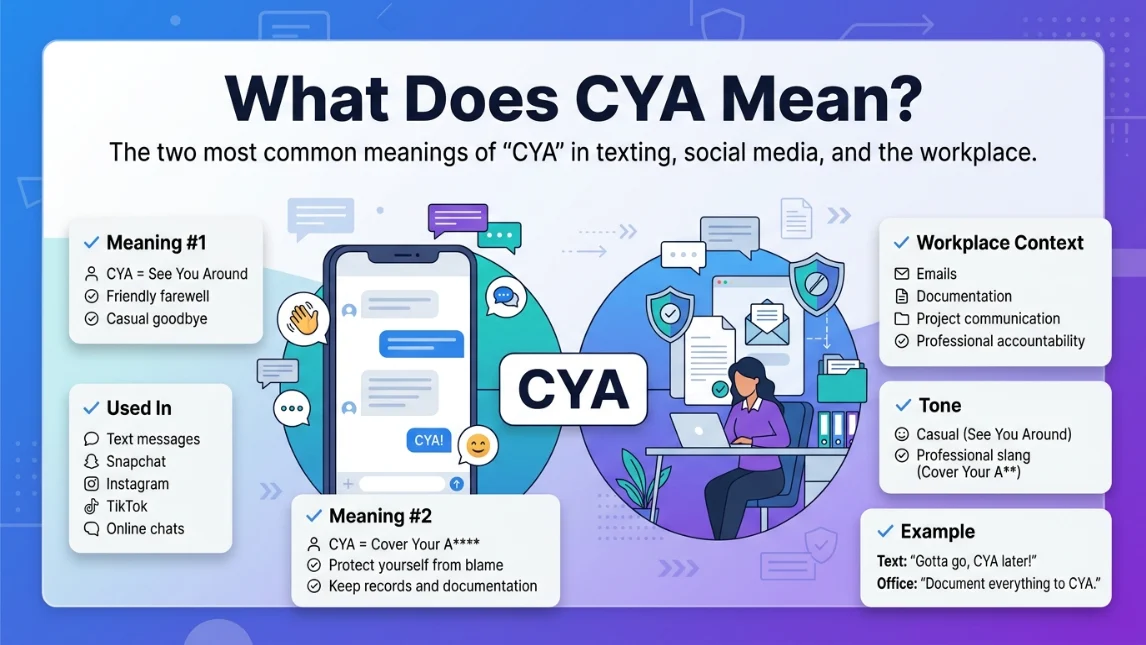
CYA meaning: The acronym CYA primarily stands for “See You Around” or “See Ya” in casual text messages and social media, serving as a quick, friendly way to say goodbye. However, in corporate and professional settings, it is widely used as an abbreviation for “Cover Your A“**, which means taking proactive steps to protect yourself from future blame, liability, or criticism.
Quick Answer Box
| Aspect | Casual Definition | Professional Definition |
| Primary Meaning | See You Around / See Ya | Cover Your A** |
| Common Context | Texting, Snapchat, TikTok, Gaming | Corporate emails, Slack, Business strategy |
| Communication Tone | Warm, informal, relaxed, friendly | Defensive, strategic, risk-averse, cautious |
| Typical Example | “Great catching up, CYA later!” | “Make sure you log that client call to CYA.” |
| Primary Platforms | iMessage, WhatsApp, Discord, TikTok | Corporate Slack, Outlook Email, Microsoft Teams |
What Does CYA Meaning Entail?
Understanding the complete CYA meaning requires looking at the dual nature of modern English shorthand, where a single acronym thrives simultaneously in two completely different worlds. On one hand, the term serves as a phonetic, lighthearted abbreviation born out of early internet chat culture. By replacing the word “see” with the letter C, and the word “you” with the letter Y, internet users created a highly efficient farewell. Consequently, millions of digital natives use the term daily as a low-stakes sign-off, signaling a temporary departure while maintaining a warm connection with friends.
On the other hand, the corporate world recognizes a much sharper, highly strategic CYA meaning that dates back several decades before the internet existed. In professional environments, the phrase represents a survival tactic centered on documentation, liability management, and workplace self-defense. When a colleague advises you to engage in this behavior, they are telling you to create an unassailable paper trail. This secondary definition has deep roots in American military, political, and bureaucratic history, where individuals routinely faced public blame for organizational failures. For example, during the mid-20th century, government officials heavily relied on written memos specifically to insulate themselves from administrative blowback.
As communication shifted from paper memos to digital servers, this workplace ethos integrated perfectly into modern internet slang. Today, the acronym occupies a unique space in the lexicon, acting either as a friendly wave or a defensive shield depending entirely on the user’s environment. Recognizing this duality is essential for navigating modern communication channels without causing confusion.
Contextual Dynamics & Nuances of the Term
The meaning shifts dramatically based on target demographics, professional hierarchies, and communication mediums. In the casual sphere, the phrase is thoroughly democratic, appearing across global messaging apps without any hidden agendas. Young adults and teenagers use it interchangeably with other shorthand departures like “ttyl” (talk to you later) or “brb” (be right back). In these interactions, the emotional weight of the term is virtually nonexistent, serving merely as linguistic grease to keep conversations moving fluidly.
Conversely, the professional application of the term carries significant psychological and structural weight. When utilized in an office setting, it often hints at an underlying culture of distrust, anxiety, or strict accountability. Employees engage in defensive documentation because they anticipate potential projects failing or clients lodging complaints. Therefore, sending a confirmation email after a verbal conversation is a classic example of this workplace strategy in action.
Furthermore, the medium itself dictates how the term is interpreted by the recipient. A text message reading “CYA” at 10 PM is universally understood as a casual goodbye. However, a Slack message from a senior project manager stating “We need to CYA on this project” serves as an immediate directive to log every single piece of data, file, and approval. This dynamic demonstrates how modern acronyms adapt effortlessly to their structural surroundings, demanding high levels of contextual awareness from users.
Real-Life Conversation Examples Using CYA Meaning
1: A Casual Goodbye Between High School Friends
- Person A: I need to log off discord now because I have to study for the chemistry exam tomorrow morning.
- Person B: That sounds rough, good luck studying tonight.
- Person A: Thanks, I will definitely need it. CYA meaning to talk tomorrow after class!
- Person B: Sounds good, catch you later!
2: Two Corporate Colleagues Discussing a Problematic Client
- Person A: Did the client verbally approve the budget increase during your afternoon phone call?
- Person B: Yes, they said the new numbers looked completely fine to them.
- Person A: You need to send them a follow-up email outlining everything you discussed to establish a clear paper trail.
- Person B: Good point, I need to understand the CYA meaning in this corporate culture before things go sideways.
- Person A: Exactly, always get those verbal approvals in writing.
3: Group Chat Planning a Weekend Hangout
- Person A: Are we still meeting up at the downtown coffee shop around 2 PM today?
- Person B: Yes, I am already on my way there now.
- Person C: I am running about ten minutes late, but save me a seat near the window.
- Person A: No worries, CYA meaning see you all in a few minutes!
4: A Slack Conversation Regarding Shifting Project Requirements
- Person A: The executive team keeps changing the design requirements for this new app feature every week.
- Person B: It is getting impossible to track what they actually want from us.
- Person A: Make sure you save every single design brief they send in the shared team folder.
- Person B: Absolutely, we definitely need to keep our documentation organized to CYA meaning protect our team if the launch gets delayed.
- Person A: Agreed, let’s log everything meticulously moving forward.
5: A Rapid Text Exchange Between Siblings
- Person A: Can you grab some milk from the grocery store on your way home tonight?
- Person B: Sure, do you need the whole milk or the oat milk variant?
- Person A: Grab the oat milk please, thank you so much!
- Person B: Got it, CYA meaning see you at home in an hour.
Platform-Specific Breakdown
How It Is Used on Snapchat
On Snapchat, the acronym functions strictly within its casual parameters, appearing frequently in text chats, image captions, and quick video responses. Because Snapchat rewards rapid, ephemeral communication, users rely heavily on short phrases to maintain their digital connections without typing out full sentences. Furthermore, the visual nature of the platform means the term is often paired with emojis, such as a waving hand or a smiling face, to emphasize a friendly departure. It rarely carries any professional or defensive connotations here, as the platform’s user base consists primarily of younger demographics engaging in low-stakes social interactions.
The Role of CYA Meaning on TikTok
On TikTok, the slang often takes on an expanded role within comedic skits, corporate satire videos, and educational content. Creators making videos about “corporate survival tips” frequently explain the CYA meaning to younger Gen Z viewers entering the workforce for the very first time. These viral videos highlight the stark contrast between the casual internet goodbye and the cutthroat corporate strategy of self-preservation. Consequently, the term has become a cultural meme on the platform, used to mock overly cautious office behavior or toxic workplace cultures where everyone is constantly trying to avoid blame.
Instagram and Texting Dynamics
Within Instagram direct messages and standard text messaging platforms, the term behaves as a highly efficient linguistic shortcut. Users slide it into comments, story replies, and group messages to wrap up conversations smoothly. The dynamics here are defined by speed and casual intimacy, allowing individuals to exit a digital interaction gracefully without appearing abrupt or rude. Additionally, because these platforms bridge the gap between close friends and professional acquaintances, the acronym occasionally bridges both definitions, depending entirely on whether the conversation thread is personal or business-related.
Alternative Meanings & NLP Variations of the Phrase
While the casual farewell and the corporate self-defense strategy dominate the linguistic landscape, several niche industries have developed alternative interpretations of the acronym. Natural Language Processing (NLP) models must carefully analyze surrounding entities and industry terms to differentiate these specific uses from mainstream internet slang.
| Industry or Sector | Specific Acronym Definition | Contextual Application |
| Aviation & Military | Cover Your Assets | Protecting high-value physical hardware, vehicles, or strategic military positions during deployment. |
| Government Bureaucracy | Cover Your Actions | Meticulously archiving policy decisions, votes, and official meeting minutes to satisfy legal transparency requirements. |
| Medical Field | Chronic Yellow Atrophy | A historical, highly specific medical term referring to severe, progressive liver degeneration and tissue death. |
| Finance & Insurance | Capital Yield Analysis | Evaluating the long-term profitability, dividend payouts, and risk profiles of specific corporate financial assets. |
Misinterpretations: When NOT to Use the Term
One of the greatest risks associated with this specific acronym is deploying it in the wrong environment, which can lead to severe communication breakdowns or unintended offense. For instance, using the acronym as a casual sign-off in a highly formal email to a new corporate client can make you look remarkably unprofessional. The client might not understand internet shorthand, or worse, they might interpret the acronym via its corporate definition, assuming you are acting defensively or hiding something from them.
Furthermore, you should never use the defensive version of the term in workplace environments that explicitly prioritize radical transparency and psychological safety. If a manager constantly tells their team members to engage in defensive logging, it signals a deep systemic lack of trust within the organization. Overusing the term in collaborative team settings can inadvertently alienate your coworkers, making them feel as though you care more about avoiding personal blame than solving collective problems. Consequently, clear verbal communication should always replace ambiguous shorthand whenever high-level stakes, delicate professional relationships, or complex emotional situations are involved.
How to Respond in Chat Comfortably
Responding to the acronym is incredibly straightforward once you have successfully identified the sender’s underlying context. If a friend sends it to you as a casual goodbye at the end of a long text conversation, you do not need to overthink your reply. A simple, low-effort response like “Later!”, “Bye!”, or a friendly emoji is completely sufficient to close out the interaction loop smoothly.
| Sender’s Intent | Appropriate Response Strategy | Concrete Example Reply |
| Casual Farewell | Match their casual energy with a short, friendly sign-off or an emoji. | “Sounds good, talk to you tomorrow!” |
| Corporate Defensive | Acknowledge the need for documentation and confirm that you will help build the paper trail. | “Agreed, I will copy the whole team on the email confirmation.” |
| Ambiguous Text | Politely clarify their meaning if the context could swing either way. | Just to confirm, did you mean see ya, or do we need to log this? |
FAQs
What does CYA mean in a text message?
In a standard text message, it almost always stands for “See You Around” or “See Ya,” serving as a quick, informal way to say goodbye to friends, family, or casual acquaintances.
Is it professional to use this acronym in a business email?
Generally, it is not advisable to use the literal acronym in formal business emails, as it can appear overly casual or imply that you are actively trying to dodge professional accountability.
Where did the corporate definition of the phrase originate?
The professional phrase “Cover Your A” originated within American political, military, and bureaucratic circles during the mid-20th century to describe the practice of creating extensive paper trails to survive internal investigations.
How do I know if someone means “See Ya” or “Cover Your A”?
You must look closely at the platform and the topic; social media chats among friends point to a friendly goodbye, while discussions about workplace documentation clearly point to the corporate strategy.
What is a CYA letter in legal and business terms?
A defensive business letter or email is an official document sent specifically to confirm a verbal agreement, verify instructions, or log a decision, ensuring that the sender cannot be held legally liable if things go wrong later.
Does Gen Z use this acronym frequently on TikTok?
Yes, Gen Z creators use it frequently, often using corporate satire videos to explain the CYA meaning to younger viewers who are adapting to office politics for the very first time.
What are some common synonyms for the casual version of the term?
Common text shorthand synonyms include l8r (later), ttyl (talk to you later), brb (be right back), and bfn (bye for now).
Can this acronym mean “Cover Your Assets” in finance?
Yes, in financial, military, and asset management industries, professionals frequently use the acronym to mean protecting physical investments, capital, or high-value infrastructure.
Why is the corporate strategy considered controversial in workplace culture?
While it protects individual workers, an obsession with defensive documentation often signals low organizational trust, increases bureaucratic drag, and slows down collective problem-solving.
How should I reply when my boss uses this term?
If your boss uses it in a professional context, you should immediately confirm that you will meticulously document the current project steps, communications, and client approvals.
Conclusion
Ultimately, the trajectory of this specific acronym highlights the incredible adaptability and fluid nature of the English language in the digital era. What began decades ago as a gritty piece of military and bureaucratic jargon has evolved seamlessly into a multifaceted linguistic tool. It functions gracefully as both a lighthearted digital wave across Snapchat and TikTok, and a vital shield within high-stakes corporate boardrooms. This ability to bridge generations, platforms, and vastly different social contexts proves that internet slang is rarely one-dimensional.
Furthermore, as digital workspaces and casual communication channels continue to merge, the demand for nuanced context clues will only grow. Success in navigating today’s hyper-connected landscape requires a sharp understanding of these shifting definitions. By mastering the distinct layers of meaning behind the shorthand, you can communicate with absolute confidence, ensuring your messages always hit the exact right note, whether you are signing off a text to a close friend or securing your professional standing at work.

Andrew Morris is a writer at Meaninga.com who specializes in word meanings, slang, idioms and modern language trends. He creates clear, accurate and easy to understand content for everyday readers.




12 thoughts on “CYA Meaning| The Ultimate Guide to Internet Slang”