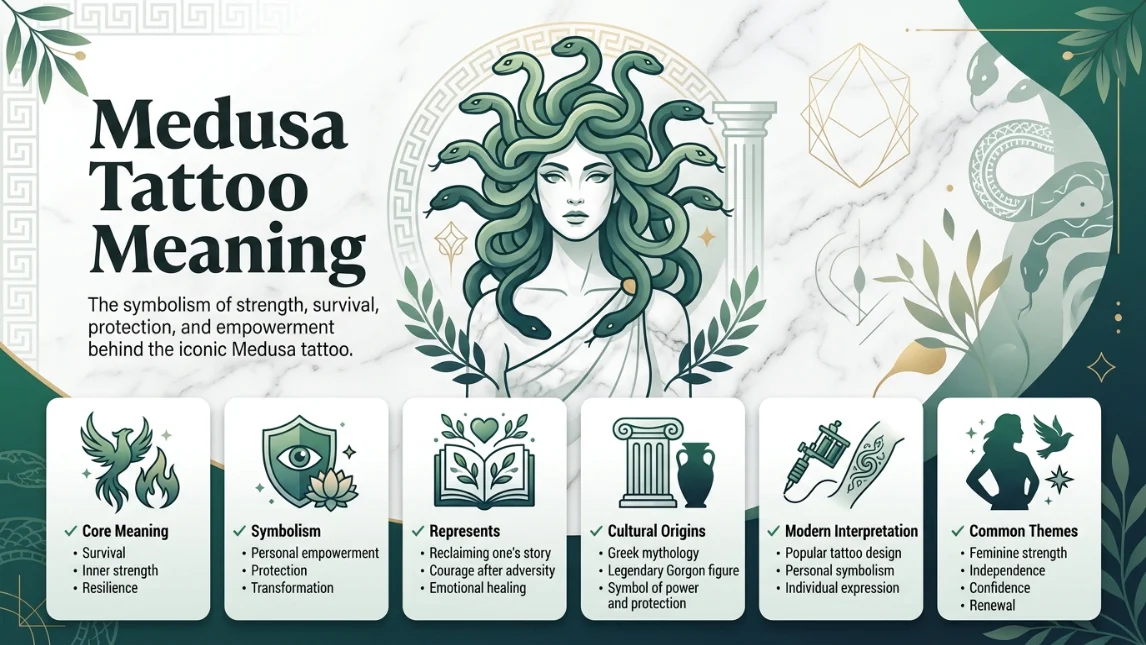
The medusa tattoo meaning primarily represents survival, personal strength, and overcoming trauma, particularly for survivors of sexual assault or abuse. Additionally, it serves as a powerful symbol of female empowerment, protection against evil, and reclaiming one’s narrative after experiencing profound betrayal.
Understanding the medusa tattoo meaning helps individuals unpack one of the most powerful symbols of survival and female empowerment in modern body art. For centuries, classical history painted this mythological figure as a terrifying monster with hair of living snakes. However, contemporary internet culture and modern tattoo communities have completely flipped this narrative on its head. Consequently, what once stood for terror now stands for resilience, healing, and absolute reclaiming of personal autonomy. Furthermore, millions of people worldwide share their ink designs on digital platforms to signal solidarity and strength.
Quick Answer Box
| Core Meaning | Contextual Use | Primary Platforms | Real-World Example | Tone |
| Survival and trauma recovery | Tattoo culture, mental health advocacy | TikTok, Instagram, Snapchat | Sharing an ink photo with a message of survival | Empathetic, empowering, resilient |
| Feminine power and fury | Feminist art, personal transformation | X, Pinterest, TikTok | Showcasing the snake hair as a sign of sacred defense | Defiant, bold, supportive |
What Does the Medusa Tattoo Meaning Represent?
To fully comprehend the deep medusa tattoo meaning, one must look closely at the ancient Greek myth through a modern, trauma-informed lens. According to classical poetry, specifically the works of Ovid, Medusa was originally a stunningly beautiful maiden. She served devotedly as a priestess in the temple of Athena. However, the sea god Poseidon assaulted her inside that very sacred space. Instead of punishing Poseidon, the goddess Athena directed her fury toward the victim. Consequently, Athena transformed Medusa into a winged gorgon with a gaze that turned onlookers into solid stone.
For generations, mainstream art history emphasized the monstrous nature of her punishment. For example, traditional portrayals focused heavily on her ability to petrify heroes like Perseus. Yet, modern interpretations reject this victim-blaming framework entirely. Instead of viewing her stone-turning gaze as a curse, survivors look at it as an ultimate form of protection. The living snakes on her head represent a shield against predators. Therefore, the contemporary medusa tattoo meaning serves as a badge of honor for anyone who has survived assault, abuse, or deep psychological distress. It signifies that the wearer is no longer a passive victim, but a formidable force capable of guarding their own boundaries.
Contextual Dynamics & Nuances of the Term
The cultural landscape surrounding this specific body art choice contains several complex layers. For instance, the meaning can shift significantly depending on the design choices made by the individual. A portrait featuring a weeping Medusa often highlights the deep grief and sorrow associated with past trauma. Conversely, a design showcasing a fierce, snarling face emphasizes rage, vengeance, and unmatched internal power.
Furthermore, the placement of the art on the body carries distinct symbolic weight. Placing the image prominently on the forearm or hand serves as an open statement of pride and open survival. On the other hand, placing it on the ribs or back often indicates a private, deeply personal journey of healing. Because of these variations, the tattoo acts as a flexible canvas for individual stories. It allows the wearer to control exactly how much of their personal history they wish to reveal to the public.
Real-Life Conversation Examples Using a Medusa Tattoo
1: Discussing Ink Meanings in a Casual Setting
- Person A: “Hey, I noticed your new ink yesterday! The detail on those snakes is absolutely incredible.”
- Person B: “Thank you so much! I spent months researching the exact medusa tattoo meaning before booking my session.
- Person A: “It looks fantastic. Did you choose it mainly because you love Greek mythology?”
- Person B: “Partly, yes, but for me, it really represents surviving a very difficult period in my life and reclaiming my own strength.”
2: Supportive Dialogue Online
- User 1: “Thinking about getting a Gorgon portrait on my shoulder. What does everyone think?”
- User 2: “You absolutely should go for it! The underlying medusa tattoo meaning is deeply beautiful and empowering for women.
- User 1: “Exactly, that is why I want it. It feels like a protective shield.”
- User 2: “It definitely is. Post a picture as soon as the line work is finished!”
3: Explaining the Concept to a Friend
- Friend A: “I keep seeing these snake-haired lady designs everywhere on my feed lately.”
- Friend B: “Oh, you are definitely noticing the massive trend around the medusa tattoo meaning right now.
- Friend A: “Oh wow, is there a specific reason why it became so popular all of a sudden?”
- Friend B: “Yes, it exploded because people use it to share their stories of overcoming abuse and supporting other survivors.”
4: Comment Section on a Social Media Post
- Creator: “Finally got my dream piece done today. Safe space in the comments below.”
- Follower 1: “This looks absolutely breathtaking! The medusa tattoo meaning always makes me feel so emotional.
- Creator: “Thank you love! It took a lot of courage to finally put this on my skin permanently.”
- Follower 2: “Standing in solidarity with you. Your strength shines through the art.”
5: Discussing Design Variations with an Artist
- Client: “I want to make sure the face does not look entirely evil. Can we make her expression look calm yet strong?”
- Tattoo Artist: “We can definitely do that. Many clients want the true medusa tattoo meaning to emphasize resilience rather than just horror.
- Client: “Perfect. Let us focus on making the eyes look intensely protective instead of furious.”
- Tattoo Artist: “Understood. We will use soft shading on the face and sharp contrast on the serpents to get that balance.”
Platform-Specific Breakdown
How It Is Used on Snapchat
On Snapchat, users often share close-up photos of their healing ink using private stories or direct snaps to close friends. Because the platform emphasizes real-time, fleeting communication, the context is usually highly personal. For example, a user might overlay a caption about hitting a recovery milestone alongside their photo. Furthermore, the platform features custom community lenses that allow users to preview snake-hair designs on their skin before committing to an actual studio appointment.
The Role of the Medusa Tattoo Meaning on TikTok
TikTok acts as the primary global engine behind the massive resurgence of this mythological symbol. Creators frequently post emotional transformation videos set to trending audio tracks. Typically, these videos begin with a raw explanation of personal trauma and transition into a proud reveal of the finished artwork. Consequently, the medusa tattoo meaning became a viral shorthand for trauma survival on the platform. The algorithm actively connects these videos, creating an expansive, decentralized support network where survivors find comfort, validation, and shared strength without needing to disclose explicit details of their past.
Instagram and Texting Dynamics
Instagram serves as the premier aesthetic archive for high-quality portfolio photos of this trend. Tattoo artists use the platform to showcase intricate fine-line work, dotwork, and neo-traditional styles. Within captions and text threads, individuals use the symbol to discuss art aesthetics alongside mental health advocacy. For example, texting a friend a post of a Medusa design often serves as a silent nod of understanding regarding shared personal struggles or mutual empowerment.
Alternative Meanings & NLP Variations of the Phrase
While trauma survival remains the most prominent modern association, the classic figure carries several alternative cultural meanings. In the world of high fashion, for example, the luxury brand Versace uses the Gorgon head as its iconic logo. In this specific commercial context, the symbol represents absolute luxury, hypnotic attraction, and fatal beauty that stops people dead in their tracks. Therefore, some individuals choose the design purely to express their passion for high-end style, glamor, and undeniable allure.
Additionally, within psychological frameworks, the figure represents the concept of the “terrible mother” or the untamed feminine shadow. Carl Jung analyzed the myth as a representation of detachment and psychological petrification. Furthermore, political movements have occasionally adopted the image as a symbol of fierce anti-authoritarianism. In these cases, the snake-haired figure represents a revolutionary force cutting through institutional oppression and paralyzing corrupt systems with truth.
Misinterpretations: When NOT to Use the Symbol
Because this emblem carries such intense emotional weight, using it casually can sometimes lead to awkward social misunderstandings. For instance, getting this design purely because you think snakes look cool is completely valid as an artistic choice. However, you should remain fully aware that many people will naturally assume you are a trauma survivor when they spot it. Consequently, you might face well-meaning but intensely personal questions about your past from acquaintances who recognize the modern viral movement.
Moreover, it is highly inappropriate to use the image as a symbol of malice, cruelty, or literal monstrosity. Portraying the figure solely to glorify violence or terrify others ignores the profound healing movement built around the art. Wearers should avoid weaponizing the imagery in a way that mocks the vulnerability and survival concepts that give the modern trend its genuine, life-changing value.
How to Respond in Chat Comfortably
When someone shares a photo of their new Gorgon design with you in chat, your response should balance respect, appreciation for the art, and emotional intelligence. If they do not explicitly bring up past trauma, it is best to focus your compliments on the craftsmanship and visual impact of the piece.
"Wow, the linework on that piece is absolutely stunning! The artist did an incredible job with the expression."
If the person explicitly mentions that the piece represents their personal healing journey, your response should immediately shift to validate their courage and resilience.
"Thank you so much for sharing that with me. I know how much that symbol means, and it looks incredibly powerful on you."
FAQs
What is the core medusa tattoo meaning for survivors?
The design primarily symbolizes overcoming sexual assault, domestic abuse, or severe emotional trauma. It represents reclaiming personal power, bodily autonomy, and building an unbreakable protective shield against future harm.
Can men get this design without changing the message?
Yes, men can absolutely wear this symbol to represent their own survival stories, protection against betrayal, or to show deep solidarity with the survivors in their lives.
Does the number of snakes change the medusa tattoo meaning?
Generally, the number of snakes does not alter the fundamental message. However, more intricate designs with numerous interwoven serpents often emphasize a complex, multi-layered journey of healing.
Why did this specific mythological figure go viral on TikTok?
The figure went viral because the community reframed the ancient myth from a story of a punished monster into a powerful anthem for victim validation and survival.
Is it disrespectful to get the design just for the aesthetic?
It is not inherently disrespectful, but wearers should be prepared for the fact that others will likely interpret the ink as a symbol of trauma survival.
What are the best placement options for this artwork?
Popular and meaningful placements include the forearm for visible empowerment, the thigh for a larger canvas, and the sternum or ribs for a private, protective shield.
How does the Versace version differ from the survival version?
The luxury brand version focuses entirely on fatal attraction, high fashion, and hypnotic luxury, whereas the survival version emphasizes healing and resilience.
Should the face look angry or sad in the design?
The choice depends entirely on the individual. An angry face represents defiance and power, while a sad or weeping face highlights grief and the emotional processing of past pain.
What tattoo style works best for this specific subject?
Realism, fine-line black and grey, and neo-traditional styles are all highly effective at capturing the intricate details of the snakes and the deep emotion of the expression.
Does a medusa tattoo meaning imply a hatred of men?
No, it does not. The symbol represents self-protection, personal healing, and the rejection of victim-blaming, rather than animosity toward any specific group.
Conclusion
Ultimately, the cultural evolution of the visual language surrounding mythology proves that communities can rewrite ancient narratives to serve modern healing. What began as a tragic tale of punishment in classical antiquity has successfully transformed into a universal emblem of safety, community support, and unyielding strength. Through digital spaces like TikTok and Instagram, individuals continue to use this powerful imagery to signal that they have conquered their past struggles. By understanding the deep history and modern nuances of this body art choice, society can better support survivors as they proudly wear their resilience for the world to see.