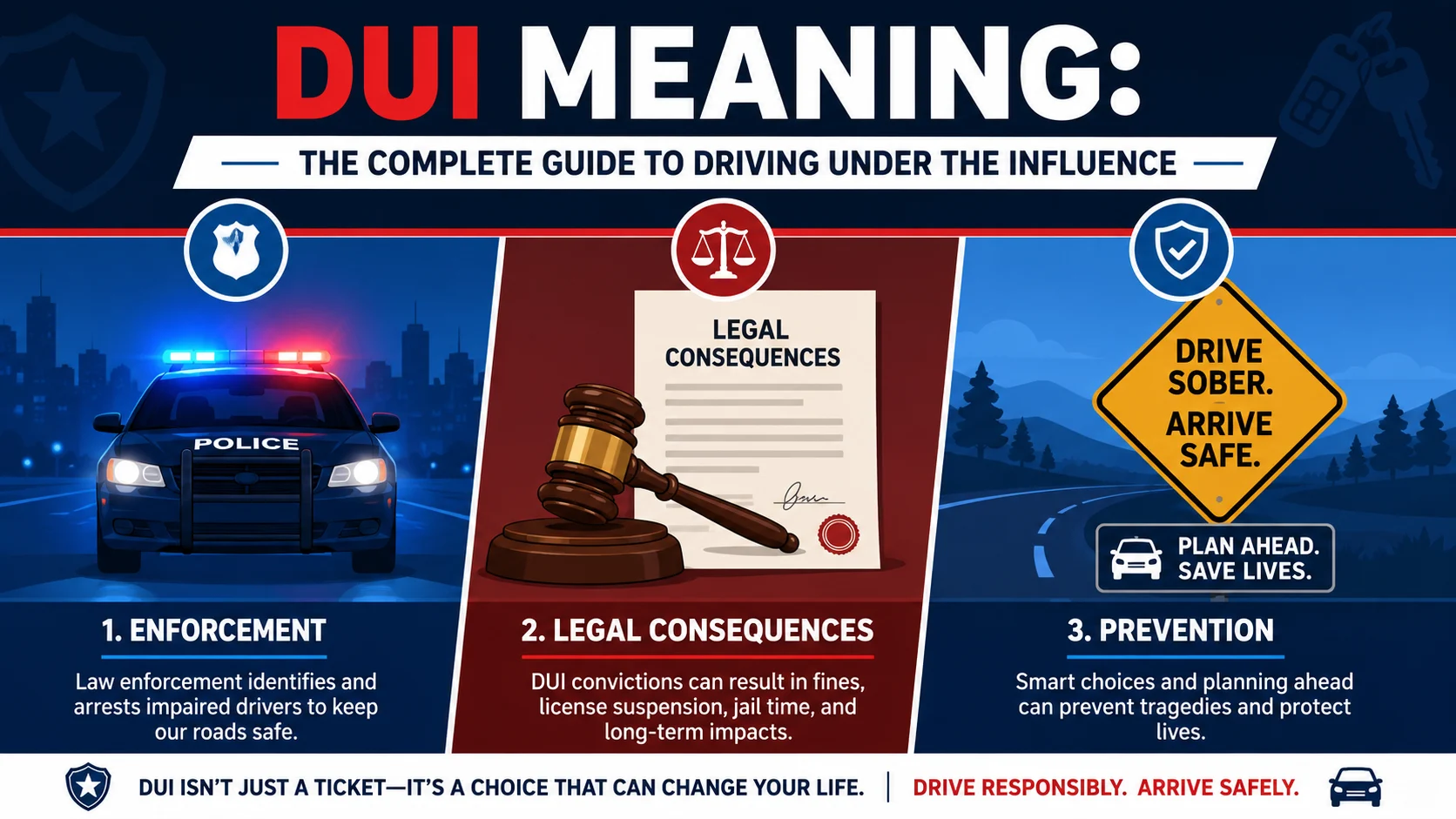
DUI is an abbreviation that stands for “Driving Under the Influence.” It is a criminal offense that occurs when a person operates a motor vehicle while impaired by alcohol, drugs, or a combination of both. The term is used in many states and countries to describe the illegal act of driving after consuming substances that affect one’s ability to drive safely.
Have you ever seen the abbreviation DUI and wondered exactly what it means? This three-letter acronym carries significant legal weight and appears frequently in news reports, legal documents, and public safety campaigns. Understanding its meaning is essential for every driver.
The DUI meaning is straightforward: driving while impaired by alcohol or drugs. However, the legal implications, penalties, and variations across different jurisdictions can be complex. Many people also confuse DUI with other similar acronyms like DWI, OWI, or OVI. This confusion often leads to misunderstandings about the seriousness of the charge and its consequences.
This article clears up the confusion around DUI once and for all. You will learn its definition, the different terms used across states and countries, and the serious consequences of a DUI conviction. By the end, you will have a thorough understanding of what DUI means and why it is such a significant legal matter.
The main takeaway is that DUI stands for “Driving Under the Influence” and refers to operating a motor vehicle while impaired by alcohol, drugs, or other substances . Different states and countries use various terms like DWI, OWI, or OVI to describe similar offenses, but the core concept remains the same-driving while impaired is illegal and dangerous. The consequences of a DUI conviction can include fines, license suspension, imprisonment, and a permanent criminal record. Understanding the specifics of DUI laws in your jurisdiction is crucial for every driver.
Definitions and Explanations
What Does DUI Mean?
DUI is an acronym that stands for “Driving Under the Influence” . It is a criminal offense that involves operating a motor vehicle while impaired by alcohol, drugs, or other controlled substances . The term is used primarily in the United States, though similar concepts exist worldwide.
When a person is charged with DUI, it means that law enforcement believes the driver was unable to operate their vehicle safely due to the effects of substances they had consumed. This impairment is often measured through blood alcohol concentration (BAC) testing, field sobriety tests, or observations of erratic driving behavior .
| Aspect | Detail |
| Full form | Driving Under the Influence |
| Part of speech | Noun (abbreviation) |
| Pronunciation | /ˌdiː.juːˈaɪ/ |
| Type | Criminal offense |
| Related terms | DWI, OWI, OVI |
What Substances Are Covered?
DUI laws typically cover impairment caused by two main categories of substances:
Alcohol: The most common cause of DUI charges. Most states set the legal blood alcohol concentration (BAC) limit at 0.08% for drivers over 21 . However, some states have lower limits for commercial drivers or drivers under 21.
Drugs: DUI charges can also result from drug impairment. This includes:
- Illegal drugs like marijuana, cocaine, or methamphetamine
- Prescription medications that impair driving ability
- Over-the-counter medications that cause drowsiness or impairment
Some states have also introduced presence-based offenses, where driving with certain drugs in the system is illegal regardless of whether the driver appears impaired .
DUI vs. DWI: What’s the Difference?
The terms DUI and DWI are often used interchangeably, but they can have different meanings depending on the state or country . Here is a breakdown of the differences:
| Term | Meaning | Usage |
| DUI | Driving Under the Influence | Used in most states; often covers alcohol and drug impairment |
| DWI | Driving While Intoxicated | Used in states like New York and Texas; may indicate more severe impairment or higher BAC |
In some states, the distinction is important. For example:
- Some states use DUI for general impairment and DWI for high alcohol levels
- Others use DWI as the only charge for impaired driving
- Some states treat them as the same offense with different names
Practical takeaway: The difference between DUI and DWI depends entirely on the state where the charge was issued .
Other Related Terms
Different jurisdictions use various acronyms to describe impaired driving offenses:
| Term | Meaning | Used In |
| DUI | Driving Under the Influence | Most U.S. states, including California |
| DWI | Driving While Intoxicated | Texas, New York, New Jersey |
| OWI | Operating While Intoxicated | Iowa, Wisconsin, Indiana |
| OVI | Operating a Vehicle Impaired | Ohio |
| BUI | Boating Under the Influence | Federal law, all states |
The Legal Standard: BAC
Blood alcohol concentration (BAC) is the primary measure used to determine alcohol impairment in most jurisdictions. The federal limit in the United States is 0.08% for drivers over 21 .
States may impose stricter limits for certain categories:
- Under 21 drivers: Zero-tolerance policies, often 0.01% or 0.02% BAC
- Commercial drivers: Typically 0.04% BAC
- DUI probation: Drivers on probation may have a 0.01% BAC limit
Some jurisdictions are lowering their BAC limits. For example, Singapore has tightened drink-driving limits from 35mcg of alcohol in 100ml of breath to 15mcg, and from 80mg of alcohol per 100ml of blood to 30mg .
Advantages and Disadvantages
Advantages of Strict DUI Laws
| Advantage | Explanation |
| Road safety | Strict DUI laws reduce the number of alcohol-related accidents and fatalities |
| Deterrence | Harsh penalties discourage people from driving after consuming substances |
| Public awareness | DUI enforcement raises awareness about the dangers of impaired driving |
| Victim protection | Laws provide legal recourse for victims of impaired driving accidents |
Disadvantages and Challenges
| Challenge | Explanation |
| Legal complexity | Different definitions and penalties across jurisdictions can be confusing |
| Potential for error | Field sobriety tests and breathalyzers can produce inaccurate results |
| Over-criminalization | Some argue that certain offenses could be addressed with treatment rather than incarceration |
| Economic impact | DUI convictions can lead to job loss, financial hardship, and stigma |
Real-World Examples
Examples of DUI in Sentences
- “He was arrested for DUI after failing the sobriety test.”
- “The penalties for a DUI conviction vary by state.”
- “Hiring a lawyer can help reduce the consequences of a DUI charge.”
DUI Penalties in Singapore
In Singapore, the offense of driving under the influence of alcohol under Section 67(1) of the Road Traffic Act carries :
| Offense | Penalty |
| First conviction | Fine of $2,000–$10,000 or up to 12 months imprisonment, or both; disqualification from driving for 2 years |
| Second conviction | Fine of $5,000–$20,000 and up to 2 years imprisonment; disqualification from driving for 5 years |
| Third conviction | Mandatory life disqualification from driving |
DUI vs. DWI by State
| State(s) | Term Used | Notes |
| California, Florida, Illinois | DUI | Covers both alcohol and drug impairment |
| Texas, Missouri, New York | DWI | DWI = driving while intoxicated; some states also use DUI for lesser offenses |
| Iowa, Wisconsin, Indiana | OWI | Operating while intoxicated; applies even when vehicle is parked |
| New Jersey | DWI only | No separate DUI statute; DWI covers all impaired driving |
Regional and Global Usage
United States
Most states use DUI as the primary term for impaired driving offenses. However, some states use different terms :
DUI states: California, Arizona, Florida, Colorado, and others
DWI states: New York, Texas
Mixed states: Maryland, North Carolina, where both terms may apply
California does not have a separate DWI statute. All impaired driving offenses in the state fall under the DUI statute, covering alcohol, drug, and combined impairment .
Singapore
In Singapore, the legal term used is “driving while under the influence of alcohol” under the Road Traffic Act . The term DUI (Driving Under the Influence) is also recognized internationally in Singapore. The law is specific about penalties:
- Lowered drink-driving limits: 15mcg of alcohol in 100ml of breath and 30mg of alcohol per 100ml of blood
- The government’s message is clear: “When you drink, do not drive”
Australia
In South Australia, it is an offence to drive a vehicle, or attempt to put a vehicle in motion, while so much under the influence of alcohol or a drug as to be incapable of exercising effective control of the vehicle . The offence applies to all vehicles rather than just motor vehicles.
South Africa
In South Africa, “Dui” is used as an abbreviation for “driving under the influence (of alcohol)” .
Global Differences
Different countries have varied legal definitions and penalties for DUI. In some nations, DUI is a criminal offense, while in others, it results in fines or license suspension . Awareness campaigns emphasize the risks associated with DUI to encourage responsible behavior .
Common Mistakes
Mistake 1: Confusing DUI with DWI
Many people assume DUI and DWI are always interchangeable. While they are often used similarly, they can have different legal meanings depending on the state .
Correction: Always check the specific definition in your state. In California, DUI is the only term used. DWI is used in Texas. In some states, both terms exist with different meanings .
Mistake 2: Assuming DUI Only Involves Alcohol
While alcohol is the most common cause of DUI, the offense can also involve drugs—including prescription medications and illegal substances .
Correction: DUI can be charged for impairment caused by any substance that affects your ability to drive safely. This includes alcohol, recreational drugs, and even some prescription medications.
Mistake 3: Thinking the Legal Limit is the Only Standard
Many believe they are safe to drive as long as their BAC is below 0.08%. However, a driver can still be charged with DUI below this limit if there is evidence of actual impairment .
Correction: The 0.08% BAC limit creates a legal presumption of impairment, but it is not a floor below which charges cannot be brought . If your driving shows signs of impairment, you can still be charged.
Exercises
Exercise 1: Identify the Meaning
Determine what DUI stands for in each context:
- “He was arrested for DUI after leaving the bar.”
- “The state’s DUI laws have been updated to include drug impairment.”
- “She faced a DUI charge despite having a BAC below 0.08%.”
Exercise 2: Choose the Correct Term
Select the appropriate term based on the state:
- California uses (DUI/DWI) for impaired driving offenses.
- Texas primarily uses (DUI/DWI) for impaired driving offenses.
- Iowa uses (DUI/OWI) for impaired driving offenses.
Answer Key
Exercise 1 Answers:
- Driving Under the Influence (standard definition)
- Driving Under the Influence (legal definition)
- Driving Under the Influence (can be charged below the limit with evidence of impairment)
Exercise 2 Answers:
- DUI (California uses DUI only)
- DWI (Texas uses DWI)
- OWI (Iowa uses OWI)
FAQs
What does DUI stand for?
DUI stands for “Driving Under the Influence.” It is a criminal offense that involves operating a motor vehicle while impaired by alcohol, drugs, or other controlled substances .
What is the difference between DUI and DWI?
The difference depends on the state. Some states use the terms interchangeably, while others use DUI for general impairment and DWI for higher levels of impairment or different categories of substances .
What is the legal BAC limit for DUI?
The federal limit in the United States is 0.08% for drivers over 21 . However, some states have lower limits for commercial drivers or drivers under 21 .
Can you get a DUI without drinking alcohol?
Yes. DUI laws cover impairment caused by drugs, including prescription medications, over-the-counter drugs, and illegal substances .
What are the penalties for a DUI conviction?
Penalties vary by jurisdiction but often include fines, license suspension, imprisonment, mandatory alcohol education programs, and installation of an ignition interlock device .
Is a DUI a felony or a misdemeanor?
DUI can be either a misdemeanor or a felony depending on the jurisdiction, whether it is a first or repeat offense, and whether there were aggravating factors (like injury to another person).
What happens if you refuse a breathalyzer test?
In most jurisdictions, refusing a chemical test results in an automatic forfeiture of driving licensure due to implied consent laws .
What is the difference between DUI and OWI?
OWI stands for “Operating While Intoxicated.” It is used in some states (like Iowa and Wisconsin) and is often broader than DUI, as it can apply when a person is in the vehicle even if it is not moving .
Can you be charged with DUI for driving with prescription medication?
Yes, if the medication impairs your ability to drive safely, you can be charged with DUI .
How long does a DUI stay on your record?
This varies by jurisdiction. Many states have a 10-year lookback period for prior DUI convictions , but the conviction itself may remain on your record permanently.
Conclusion
This guide has explored the meaning and implications of DUI. DUI stands for “Driving Under the Influence” and is a serious offense that carries significant legal, financial, and personal consequences. Understanding the specific laws in your jurisdiction, including whether your state uses DUI or another term like DWI or OWI, is essential for every driver.
The best practical advice is simple: never drive under the influence of alcohol or drugs. If you have consumed any substance that could impair your driving, arrange for alternative transportation. The legal BAC limit of 0.08% is not a target—it is a threshold that should never be approached. Many jurisdictions are tightening their laws and lowering BAC limits , so staying completely sober behind the wheel is the only truly safe choice.











4 thoughts on “DUI Meaning| The Complete Guide to Driving Under the Influence”