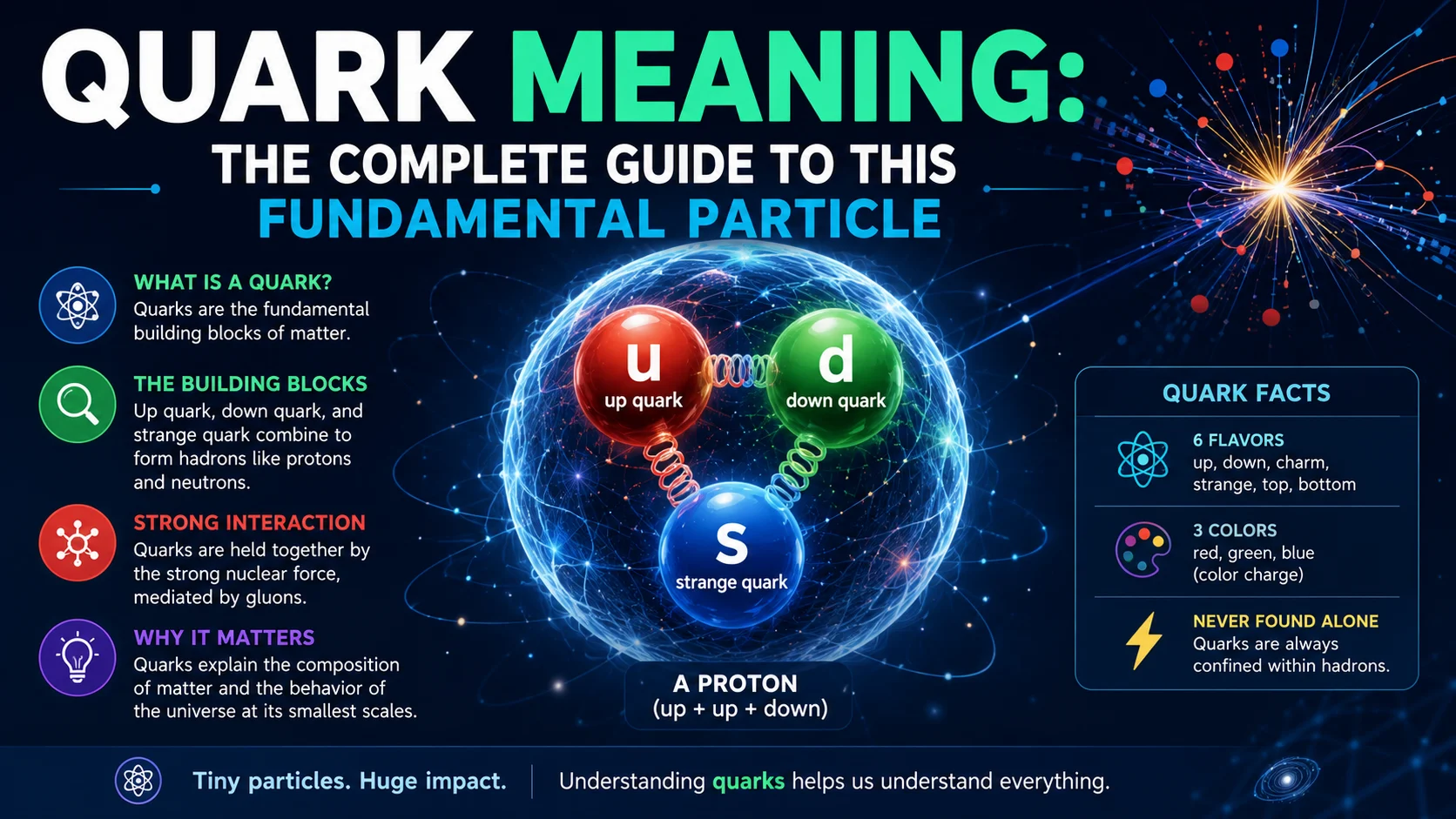
A quark is a fundamental building block of matter . Quarks combine to form protons and neutrons, which are the particles that make up the nuclei of atoms . They are elementary particles that cannot be broken down into smaller components .
Have you ever wondered what the universe is made of at its most basic level? The answer leads us to the word quark. It sounds strange, and its origin is even stranger. Yet, this small word represents one of the most important discoveries in modern physics.
The quark meaning goes far beyond a simple dictionary definition. It represents a shift in how scientists understand the fundamental nature of reality. Quarks are the building blocks of protons and neutrons. They are the reason matter has mass and structure . Without them, the universe would not exist as we know it.
The confusion around quarks often comes from how unusual they are. Quarks have fractional electric charges and are never found in isolation. They exist in six distinct “flavors”: up, down, charm, strange, top, and bottom. These properties make them fascinating but also difficult to understand.
This article clears up the confusion around quarks once and for all. You will learn their definition, their history, and how they work. By the end, you will have a thorough understanding of this fundamental particle. Good science knowledge depends on understanding these basic building blocks.
The main takeaway is that quarks are fundamental particles that combine to form hadrons like protons and neutrons . They come in six types, or “flavors”: up, down, strange, charm, bottom, and top . Quarks have fractional electric charges and are never found alone due to a property called “color confinement” . The name quark was taken from James Joyce’s novel Finnegans Wake by physicist Murray Gell-Mann .
Definitions and Explanations
What Is a Quark?
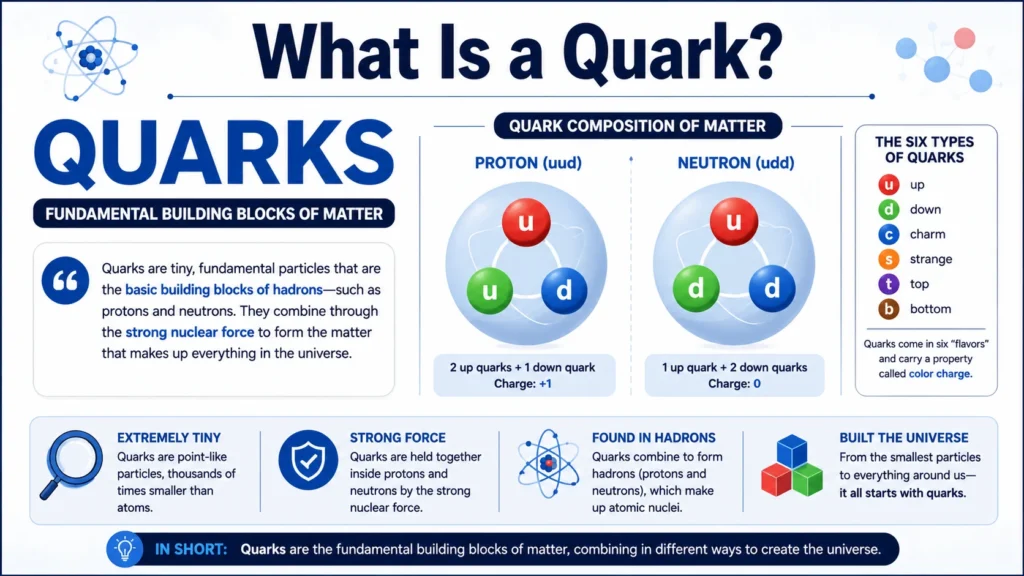
A quark is a type of elementary particle that serves as a fundamental building block of matter . It is one of the two main groups of fundamental particles, the other being leptons . Quarks are the essential components of hadrons, which include protons and neutrons .
Quarks are extremely small. A proton is about 10-15 meters across, and quarks are even smaller than that . They are considered truly elementary because they have no known substructure . They are not made of anything else.
The properties of quarks are unusual. They have fractional electric charges of either +2/3 or -1/3 of the elementary charge . They also have a property called “color charge,” which is related to the strong nuclear force that holds them together .
| Property | Description |
| Type | Elementary particle |
| Function | Building blocks of hadrons |
| Charge | +2/3 or -1/3 of elementary charge |
| Spin | 1/2 |
| Baryon number | 1/3 |
What Does “Quark” Mean in Physics?
In physics, the quark meaning refers specifically to a fundamental constituent of matter. Quarks are the particles that make up protons, neutrons, and other hadrons. The term is central to the Standard Model of particle physics.
The Standard Model describes three generations of quarks . Each generation contains two quarks with different charges:
- First generation: Up quark (+2/3) and down quark (-1/3)
- Second generation: Charm quark (+2/3) and strange quark (-1/3)
- Third generation: Top quark (+2/3) and bottom quark (-1/3)
Protons consist of two up quarks and one down quark. Neutrons consist of two down quarks and one up quark .
The Six Flavors of Quarks
Physicists use the term “flavor” to distinguish the different types of quarks. There are six flavors in total, organized into three generations.
| Flavor | Symbol | Charge | Discovery Year |
| Up | u | +2/3 | 1968 |
| Down | d | -1/3 | 1968 |
| Strange | s | -1/3 | 1947 |
| Charm | c | +2/3 | 1974 |
| Bottom | b | -1/3 | 1977 |
| Top | t | +2/3 | 1995 |
The up and down quarks are the lightest and most stable. They form protons and neutrons . The strange, charm, bottom, and top quarks are heavier and only appear in high-energy environments .
What Is Color Charge?
Color charge is a property of quarks that relates to the strong nuclear force. It comes in three types: red, green, and blue. Antiquarks have anticolors: antired, antigreen, and antiblue .
Color charge is different from electric charge. It governs how quarks interact through the strong force. The force carriers are particles called gluons .
Quarks cannot exist alone due to a phenomenon called “color confinement.” They are always found in combinations that result in no net color. This is why free quarks are never observed .
Color Confinement Explained
Color confinement means that quarks are permanently bound together. You can never find a single, isolated quark. They always come in groups that balance out to “white” or colorless .
There are two main types of quark combinations:
- Baryons: Three quarks (red, green, blue) combine to form a baryon. Protons and neutrons are baryons.
- Mesons: A quark and an antiquark combine to form a meson .
This confinement is due to the strong force. As you try to pull quarks apart, the force between them actually increases .
Advantages and Disadvantages
Advantages of Quarks in Physics
| Advantage | Explanation |
| Explains matter structure | Quarks account for all hadrons in the Standard Model . |
| Predictive power | The quark model predicted the existence of particles that were later discovered . |
| Unity of forces | QCD explains the strong force using quarks and gluons . |
| Understanding the universe | Quarks help explain how matter formed after the Big Bang. |
Limitations of Quark Theory
| Limitation | Explanation |
| Cannot be observed alone | Quarks are always confined, making them difficult to study directly . |
| Complexity | The math of QCD is extremely complex and not fully solved. |
| Fractional charges | Quarks have charges not seen in other particles. |
| Requires high energy | Heavy quarks only appear in particle accelerators. |
Real-World Examples
Quarks in Protons and Neutrons
The most common place to find quarks is in protons and neutrons. These particles make up the nuclei of atoms. They are the reason matter has mass and stability.
Proton composition: 2 up quarks, 1 down quark
Neutron composition: 2 down quarks, 1 up quark
The charges add up correctly:
- Proton: +2/3 + +2/3 + -1/3 = +1
- Neutron: +2/3 + -1/3 + -1/3 = 0
Quarks in Particle Accelerators
Particle accelerators like the LHC at CERN create heavy quarks. They smash particles together at high energies. This produces charm, bottom, and top quarks. These decay quickly, but detectors can see their effects.
The bottom and top quarks were discovered at Fermilab in the United States . The charm quark was discovered in 1974 at SLAC and Brookhaven .
Quarks and Everyday Life
Quarks have a direct impact on everyday life, even if most people do not realize it.
- Mass: The mass of protons and neutrons comes from quark interactions.
- Stability: The strong force holds nuclei together, enabling atoms.
- Technology: Particle physics research leads to medical imaging and other technologies.
Regional and Global Usage
Scientific Usage
The term “quark” is used consistently in the global scientific community. The pronunciation is generally /kwɔːrk/ (kwark) in American English and /kwɑːk/ (kwahk) in British English . The meaning is identical.
In Popular Culture
The quark meaning has entered popular culture. The word appears in:
- The name of a character on the TV show Star Trek: Deep Space Nine
- Company names like Quark (software)
- Various books and articles about physics
The James Joyce Connection
The word quark comes from James Joyce’s novel Finnegans Wake. The line is: “Three quarks for Muster Mark!” .
Murray Gell-Mann, the physicist who named quarks, read Joyce’s work. He was struck by the line and thought “The allusion to three quarks seemed perfect” . Originally, only three quarks were proposed: up, down, and strange .
| Aspect | Detail |
| Source | James Joyce’s Finnegans Wake |
| Line | “Three quarks for Muster Mark!” |
| Proposed by | Murray Gell-Mann |
| Year | 1963 |
Common Mistakes
Mistake 1: Thinking Quarks Are Made of Something Else
Some people believe quarks are made of smaller particles. This is incorrect. Quarks are elementary and have no known substructure . They are fundamental.
Correction: Quarks are considered fundamental particles. They cannot be broken down further.
Mistake 2: Confusing Quarks with Atoms
Atoms are made of protons, neutrons, and electrons. Quarks are smaller than protons and neutrons. They are inside them.
Correction: Quarks are subatomic particles. They are not atoms.
Mistake 3: Mispronouncing “Quark”
The pronunciation of “quark” varies. In American English, it is often pronounced “kwark.” In British English, it is more commonly “kwahk” . Both are correct.
Correction: Either pronunciation is acceptable. Use the one that fits your audience.
Mistake 4: Confusing Quark with the Cheese
There is also a type of cheese called quark . It is a soft, creamy cheese popular in Europe. This has nothing to do with the particle. The two words are spelled the same but mean different things .
Correction: Context determines the meaning. In physics, “quark” refers to the particle. In food, it refers to the cheese.
Exercises
Exercise 1: Fill in the Blank
Complete each sentence with the correct word or phrase.
- A ________ is an elementary particle that combines to form hadrons.
- Protons consist of two ________ quarks and one ________ quark.
- Quarks have ________ electric charges that are not whole numbers.
- The ________ quark is the heaviest of all quarks.
- Quarks are held together by particles called ________.
Exercise 2: Identify the Error
Each sentence has a mistake. Identify and correct any errors.
- “Quarks are made of even smaller particles called preons.”
- “Free quarks can be observed in particle detectors.”
- “The proton consists of three down quarks.”
- “Quarks only have whole number charges.”
Answer Key
Exercise 1 Answers:
- Quark (definition)
- Up and down (proton composition)
- Fractional (charge property)
- Top (heaviest quark)
- Gluons (force carriers)
Exercise 2 Corrections:
- “Quarks are elementary particles. They are not made of anything smaller.” (Quarks have no substructure)
- “Free quarks cannot be observed due to color confinement.” (Quarks are always confined)
- “The proton consists of two up and one down quark.” (Proton composition is uud)
- “Quarks have fractional charges of +2/3 or -1/3.” (Charges are not whole numbers)
Related Concepts and Comparisons
Quarks vs. Leptons
Quarks and leptons are both fundamental particles. They are the two main groups of elementary particles .
| Aspect | Quarks | Leptons |
| Examples | Up, down, charm, strange, top, bottom | Electron, muon, tau, neutrinos |
| Charge | Fractional (+2/3 or -1/3) | Whole (0 or -1) |
| Interaction | Strong force | No strong force |
| Combinations | Form hadrons | Do not combine |
Quarks vs. Hadrons
Hadrons are particles made of quarks. They are not fundamental .
| Term | Definition |
| Quark | Fundamental building block |
| Hadron | Particle made of quarks |
| Baryon | Three quarks (e.g., proton, neutron) |
| Meson | One quark, one antiquark |
Quarks vs. Gluons
Gluons are the force carriers that hold quarks together. They are particles of the strong force .
| Aspect | Quarks | Gluons |
| Function | Building blocks | Force carriers |
| Role | Make matter | Hold quarks together |
| Number | Six flavors | Eight types |
| Charge | Electric and color | Only color |
Quantum Chromodynamics (QCD)
QCD is the theory that describes how quarks interact. It is part of the Standard Model .
- Color charge: The property that governs quark interactions
- Gluons: The force carriers
- Confinement: Why quarks are always bound
- Asymptotic freedom: Quarks interact weakly at high energy
FAQs
What is a quark in simple terms?
A quark is a tiny particle that makes up protons and neutrons . They are the fundamental building blocks of matter . Protons and neutrons, which form atomic nuclei, are composed of quarks.
What does quark mean in physics?
In physics, a quark is an elementary particle that combines to form hadrons . It has fractional electric charge and never exists alone due to color confinement .
How many types of quarks are there?
There are six types, or “flavors,” of quarks: up, down, strange, charm, bottom, and top . They are organized into three generations.
What are quarks made of?
Quarks are elementary particles. They are not made of anything smaller . They are considered fundamental building blocks.
Why can’t quarks be found alone?
Quarks are always confined in groups due to color charge . The strong force binds them together. This is called color confinement .
What is the difference between a quark and an atom?
An atom is made of protons, neutrons, and electrons. Quarks are inside protons and neutrons . Atoms are much larger than quarks.
Where did the name “quark” come from?
The name comes from James Joyce’s novel Finnegans Wake . Physicist Murray Gell-Mann read the line “Three quarks for Muster Mark!” and used the name for these particles .
What is the heaviest quark?
The top quark is the heaviest quark . It was discovered in 1995 at Fermilab . It has a mass of about 173 GeV/c².
What is color charge in quarks?
Color charge is a property of quarks related to the strong force . It comes in three types: red, green, and blue. Quarks combine to form colorless particles .
What are gluons?
Gluons are the force carriers that hold quarks together . They transmit the strong nuclear force. They are particles of quantum chromodynamics (QCD).
Conclusion
This guide has explored the rich meaning of the word quark. A quark is an elementary particle that forms the building blocks of matter . It combines with other quarks to make protons, neutrons, and other hadrons . Quarks have fractional electric charges and are never found alone .
The best practical advice for understanding quarks is to remember their three key properties: they are elementary, they have fractional charge, and they are always confined in groups. These characteristics set them apart from other particles. Understanding quarks helps you grasp the fundamental nature of matter and the universe.
Quarks are essential to modern physics. They explain the structure of matter and how the universe works at its most basic level. Their discovery has changed our understanding of reality. Now you have the knowledge to understand this fundamental particle and its place in the cosmos.

Andrew Morris is a writer at Meaninga.com who specializes in word meanings, slang, idioms and modern language trends. He creates clear, accurate and easy to understand content for everyday readers.