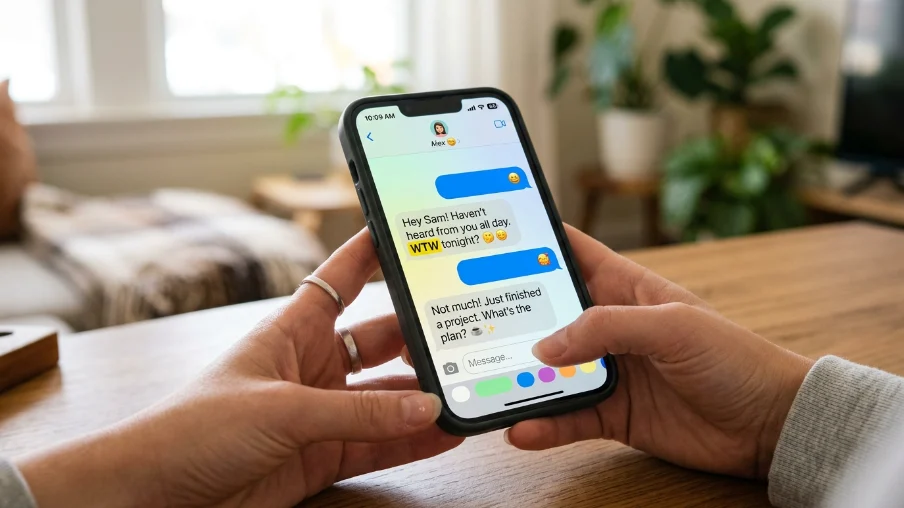
WTW meaning in text is usually “what’s the word?”—an informal way to ask what is happening, what someone is doing, or whether they have plans. People often send it to friends as a conversation starter or to see if anyone is available to hang out. Common on Snapchat, Instagram, TikTok, and in group chats, WTW can invite anything from a quick update to a plan for the evening.
A message containing just three letters—WTW—can be an easy way to open a conversation. Short for “what’s the word?”, this casual expression is similar to asking “what’s up?” or “what’s going on?” People use it to check in with friends, find out what is happening, or see whether someone is free to make plans.
For example, a friend might text “WTW tonight?” to ask what everyone is doing later. In another chat, sending “WTW?” may simply be a relaxed way to say hello and get the conversation started. The meaning often depends on whether the sender is looking for an update, making plans, or just checking in.
You may see WTW in Snapchat messages, Instagram DMs, TikTok comments, and group chats. Because it is informal, it generally fits conversations with friends and people you know well. When you receive it, you can reply with what you are doing, ask the same question back, or suggest a plan if you think the sender wants to hang out.
Quick Answer Box
| Category | Details |
| Meaning | “What’s the Word?” |
| Context | Casual greeting, check-in, or conversation starter |
| Usage | Texting, social media DMs, group chats, gaming |
| Platforms | Snapchat, TikTok, Instagram, WhatsApp, Discord, Roblox |
| Example | “WTW tonight?” = “What are you doing tonight?” |
| Tone | Friendly, informal, chill, sometimes flirty |
What Does WTW Mean in Text?
At its core, WTW stands for “What’s the Word?”. It’s a casual, slang-heavy abbreviation used primarily in text messages and online conversations.
Think of it as the digital equivalent of asking:
- “What’s up?”
- “What’s going on?”
- “What are you doing?”
- “How’s it going?”
WTW is a way to check in with someone, start a conversation, or ask for updates without sounding too formal or intense. It’s short, simple, and gets straight to the pointperfect for the fast-paced world of modern texting.
The phrase “what’s the word?” itself has been around for decades in spoken English, but the abbreviation WTW emerged with the rise of texting and instant messaging. It’s part of a broader trend of shortening common phrases to save time and keystrokesthink LOL, BRB, or WYD.
Full Form and Variations
While “What’s the Word?” is the most common full form, WTW can sometimes stand for other things depending on the context:
| Meaning | Context |
| What’s the Word? | Casual greeting / check-in |
| What’s the What? | Expressing surprise or confusion |
| What the What? | Shock or disbelief (similar to WTF but milder) |
| What to Wear? | Asking for outfit advice |
| What to Watch? | Asking for streaming recommendations |
| Worth the Wait | Expressing satisfaction after a delay |
| Walk the Walk | Motivational or sports contexts |
However, in the vast majority of texting and social media contexts, WTW means “What’s the Word?” and that’s what we’ll focus on throughout this guide.
Context & Usage: When and How to Use WTW
WTW is informal slang through and through. You wouldn’t use it in a professional email, a job interview, or a formal report. But in casual conversations with friends, family, or peers? It’s fair game.
Here are the most common situations where people use WTW:
1. Checking In on Someone
When you haven’t talked to a friend in a while, WTW is a low-pressure way to reconnect.
“Hey, long time no talk. WTW?”
2. Asking About Plans
WTW is frequently used to ask what someone is doing or if they’re free to hang out.
“WTW tonight? You free?”
3. Starting a Conversation
Sometimes you just want to open the door for a chat without overthinking it. WTW works perfectly as a conversation starter.
“WTW? Bored and looking for someone to talk to.”
4. Asking for Updates
If you’re waiting for news or information about a specific situation, WTW can serve as a quick follow-up.
“WTW with the group project? Did you finish your part?”
5. In Group Chats
In group settings, WTW is often used to gauge what everyone is doing or planning.
“WTW this weekend? Anyone down for a movie?”
Real-Life Conversation Examples
To truly understand how WTW works in the wild, let’s look at some realistic text exchanges. These examples show the natural flow of conversations using WTW across different scenarios.
Example 1: Casual Check-In
Person A: “Hey, WTW? Haven’t heard from you in a minute.”
Person B: “Not much, just working. You?”
Person A: “Same old. Wanna grab coffee later?”
Example 2: Making Plans
Person A: “WTW tonight?”
Person B: “Nothing planned. What did you have in mind?”
Person A: “New spot opened downtown. Wanna check it out?”
Person B: “Sounds dope. What time?”
Example 3: Friendly Greeting
Person A: “Yo bro, WTW?”
Person B: “Just chillin’ at home. What’s good?”
Person A: “Not much. Bored fr. You tryna hang?”
Example 4: Asking for an Update
Person A: “WTW with the tickets? Did you get them yet?”
Person B: “Yeah, just copped them. Sending you the confirmation now.”
Person A: “Bet. Thanks!”
Example 5: Flirty / Playful Tone
Person A: “WTW? You look good in your story btw”
Person B: “Haha thanks. Just chilling. What about you?”
Person A: “Thinking about you tbh. Wanna call?”
Note: In flirtier contexts, WTW can carry a more suggestive or romantic undertone.
Platform-Specific Meaning
WTW is used across virtually every major messaging and social media platform. While the core meaning stays the same, there are slight nuances depending on where you encounter it.
Snapchat
On Snapchat, WTW is frequently used as an alternative to WYD (“What You Doing?”) or WYA (“Where You At?”). It fits perfectly with Snapchat’s fast-paced, casual vibe. Users often send WTW to check if someone is available to chat, snap, or meet up.
Snapchat example: “WTW? Send a snap”
TikTok
On TikTok, WTW appears in comments, DMs, and even video captions. It’s often used to ask about trends, plans, or simply to engage with other users. Because TikTok’s audience skews younger, WTW is especially popular among Gen Z users.
TikTok comment: “WTW with this trend? I’m confused lol”
Instagram DMs and comments are another common home for WTW. It’s used to start conversations, ask about stories, or check in with mutuals.
Instagram DM: “Saw your story. WTW? You looked like you were having fun.”
On WhatsApp, WTW is used in both one-on-one chats and group conversations. It’s a quick way to check in with friends or family without typing out a full message.
WhatsApp group: “WTW everyone? Any plans for the weekend?”
Discord / Gaming Chats
In gaming communities, WTW is used to ask what other players are doing, what the plan is, or to express surprise. On Roblox, for instance, WTW might mean “What the What?” or “What’s the Word?” depending on the situation.
Discord: “WTW? Anyone down for a raid?”
Text Messages (SMS)
In standard phone texting, WTW serves the same purpose as on social mediaa casual, friendly greeting or check-in.
SMS: “WTW? You free to talk?”
Alternative Meanings & Misinterpretations
While “What’s the Word?” is the primary meaning, WTW can occasionally be misinterpreted. Here are some alternative meanings to be aware of:
1. What the What?
Sometimes WTW is used as a milder version of “WTF” to express shock, confusion, or disbelief.
“She quit her job and moved to Bali? WTW!”
2. What to Wear?
In conversations about events, parties, or outings, WTW might be asking for fashion advice.
“The dress code is ‘summer chic.’ WTW? I have no idea what to wear.”
3. What to Watch?
When people are deciding on a movie or show, WTW can mean “What to Watch?
“Bored and scrolling Netflix. WTW?”
4. Worth the Wait
In some contexts, WTW is used to say that something was worth the delay.
“The concert started two hours late but WTW honestly.”
5. Walk the Walk
In motivational or sports contexts, WTW might mean “Walk the Walk”as in, backing up your words with actions.
“You talk a big game. But can you WTW?”
6. Welcome to Work
In office settings (rarely), WTW could be a playful way to say “Welcome to Work”.
How to Avoid Confusion
The good news is that context usually makes the meaning clear. If someone asks “WTW tonight?” they’re clearly asking about plans, not expressing shock. If they respond “WTW!” to shocking news, they’re probably saying “What the What?”
When in doubt, look at the punctuation and the overall conversation tone. A question mark usually means “What’s the Word?” An exclamation point often means surprise.
Related Terms & NLP Variations
WTW doesn’t exist in a vacuum. It’s part of a broader ecosystem of texting slang and casual greetings. Here are some related terms you might encounter:
| Term | Meaning |
| WYD | What You Doing? |
| WYA | Where You At? |
| SUP | What’s Up? |
| HYD | How You Doing? |
| WYF | Where You From? |
| WTM | What’s the Move? (similar to WTW) |
| HMU | Hit Me Up |
| FR | For Real |
| NGL | Not Gonna Lie |
| TBH | To Be Honest |
| Lowkey | Secretly / Kind of |
These terms often appear together in casual conversations. For example:
“WTW? WYD tonight?”
“NGL, lowkey bored. WTW?”
Understanding these related terms helps you navigate modern digital communication with confidence.
How to Respond to “WTW?”
Getting a “WTW?” text can sometimes feel like a pop quizwhat’s the right response? The good news: there’s no single correct answer. Your reply depends on your mood, your relationship with the sender, and what you’re actually doing.
Here are some natural, engaging ways to respond:
Casual Responses
- “Not much, you?” The classic, low-effort reply.
- “Just chilling. What about you?” Friendly and open-ended.
- “Same old. You?” Short and to the point.
If You’re Busy
- “Kinda busy rn. Talk later?” Polite and lets them know you’re interested but unavailable.
- “Working. What’s up?” Acknowledges their message while setting expectations.
If You’re Down to Hang Out
- “Nothing planned. What did you have in mind?” Opens the door for plans.
- “Free rn. Wanna do something?” Direct and enthusiastic.
- “Just got home. WTW with you?” Flips the question back.
Playful / Flirty Responses
- “Thinking about you, actually. Wanna call?”
- “Just got ready. You like?” (if you’re feeling confident)
- “Why? You miss me?” Playful and teasing.
If You’re Not Sure What They Want
- “Why? What’s up?” Buys you time to figure out their intent.
- “Just chilling. What’s going on?” Keeps the conversation flowing.
Pro Tip
A common and effective reply to WTW is simply “Not much. What about you?”. It’s neutral, friendly, and shows interest in the other person without overcommitting.
When NOT to Use WTW
WTW is not appropriate in every situation. Here’s when you should avoid it:
1. Professional Settings
Never use WTW in work emails, professional messages, or formal correspondence. It’s too casual and might make you look unprofessional.
❌ Bad: “WTW with the quarterly report?”
✅ Good: “Do you have an update on the quarterly report?”
2. With Someone You Don’t Know Well
If you’re texting a new acquaintance, a boss, a professor, or anyone in a position of authority, stick to more formal language.
❌ Bad: “WTW? Nice to meet you.”
✅ Good: “It’s nice to meet you. How are you doing?”
3. Serious or Sensitive Conversations
If you’re discussing something important, emotional, or serious, WTW can come across as dismissive or tone-deaf.
❌ Bad: “WTW with your mom’s surgery?”
✅ Good: “How is your mom doing after her surgery?”
4. Formal Writing
Never use WTW in essays, reports, articles, or any form of formal writing.
5. When You Need Clarity
If there’s any chance of confusion or misunderstanding, spell out the full phrase instead of using the acronym.
Usage Tips: How to Use WTW Like a Pro
1. Keep It Casual
WTW is inherently informal. Use it with friends, family, and peersnot in professional or formal contexts.
2. Read the Room
Pay attention to the conversation tone. If someone seems upset or serious, WTW might not be the best choice.
3. Use Lowercase
In most texting contexts, WTW is typed in lowercase: wtw. Using all caps can come across as shouting or aggressive.
✅ Good: “wtw tonight?”
❌ Bad: “WTW TONIGHT?”
4. Match the Energy
If someone sends you a low-effort “wtw,” a low-effort reply like “nm u?” is perfectly acceptable. If they send a more detailed message, match their energy with a fuller response.
5. Don’t Overthink It
WTW is meant to be simple and easy. Don’t stress about finding the “perfect” replyjust be natural and honest.
Misinterpretations & Edge Cases
1. WTW vs. WTF
Because WTW and WTF look similar, they’re sometimes confused. Remember: WTW = “What’s the Word?” (casual greeting) and WTF = “What the F*”** (expression of shock or anger). Mixing them up could lead to some awkward moments!
2. Is WTW Rude?
No, WTW is not inherently rude. It’s a friendly, casual greeting. However, tone and context matter. If someone sends “WTW?” in an aggressive or demanding way, it could come across as rude. But in most cases, it’s just a chill way to start a conversation.
3. WTW in Different Age Groups
WTW is most popular among teens and young adults. Older generations might not be familiar with it, so use it with caution if you’re unsure of the recipient’s familiarity with internet slang.
4. WTW in International Contexts
While WTW is primarily used in the US and other English-speaking countries, it’s also recognized in international online communities. However, non-native English speakers might not understand it, so it’s best to avoid it in cross-cultural communication unless you’re sure they’ll get it.
FAQs
1. What does WTW mean in text?
WTW stands for “What’s the Word?” It’s a casual way to ask “What’s up?” or “What’s going on?”
2. Is WTW the same as WYD?
Not exactly, but they’re similar. WTW means “What’s the Word?” (asking for updates or plans), while WYD means “What You Doing?” (asking what someone is currently doing).
3. Can WTW mean something else?
Yes, depending on context, WTW can also mean “What the What?” (surprise), “What to Wear?” (outfit advice), “What to Watch?” (streaming suggestions), or “Worth the Wait.
4. How do you reply to WTW?
Common replies include “Not much, you?”, “Just chilling. What about you?”, “Kinda busy rn. Talk later?”, or “Nothing planned. What did you have in mind?”
5. Is WTW slang?
Yes, WTW is definitely slang. It’s informal and should only be used in casual conversations with friends or peers.
6. Can I use WTW in a professional email?
No. WTW is too informal for professional or formal communication. Stick to proper English in work settings.
7. Where is WTW most commonly used?
WTW is commonly used on Snapchat, TikTok, Instagram, WhatsApp, Discord, and in regular text messages.
8. What does WTW mean on Snapchat?
On Snapchat, WTW typically means “What’s the Word?” and is used as a casual way to ask what someone is doing or if they want to chat.
9. Is WTW still popular?
Yes, WTW remains popular, especially among Gen Z and millennials. It’s frequently used on social media and in messaging apps.
10. What’s the difference between WTW and WTM?
WTW means “What’s the Word?” while WTM typically means “What’s the Move?”both are used to ask about plans or what’s happening.
Conclusion
So there you have iteverything you need to know about the WTW meaning in text.
To recap: WTW stands for “What’s the Word?” and it’s a casual, friendly way to ask “What’s up?” or “What’s going on?”. You’ll see it everywhereon Snapchat, TikTok, Instagram, WhatsApp, and in regular text messages. It’s a quick, easy way to check in with friends, start a conversation or ask about plans.
While WTW can have alternative meanings like “What the What?” or “What to Wear?” depending on the context, the primary meaning is almost always “What’s the Word?. Just remember to keep it casualthis isn’t a phrase you’d use in a professional email or formal setting.
Now that you know what WTW means, you’ll never have to pause and wonder again when you see it pop up in your messages. Whether you’re replying with a casual “Not much, you?” or using it yourself to check in on a friend, you’re now fully equipped to navigate this piece of modern digital slang.
Go aheadsend that “wtw?” text. You’ve got this.
Discover More Articles:
- Namaste Meaning in text |Origin, Spiritual Significance & How to Use It
- Habibi Meaning| What It Really Means & How to Use It For 2026

Andrew Morris is a writer at Meaninga.com who specializes in word meanings, slang, idioms and modern language trends. He creates clear, accurate and easy to understand content for everyday readers.




5 thoughts on “WTW Meaning in Text| A Casual Way to Start a Chat”