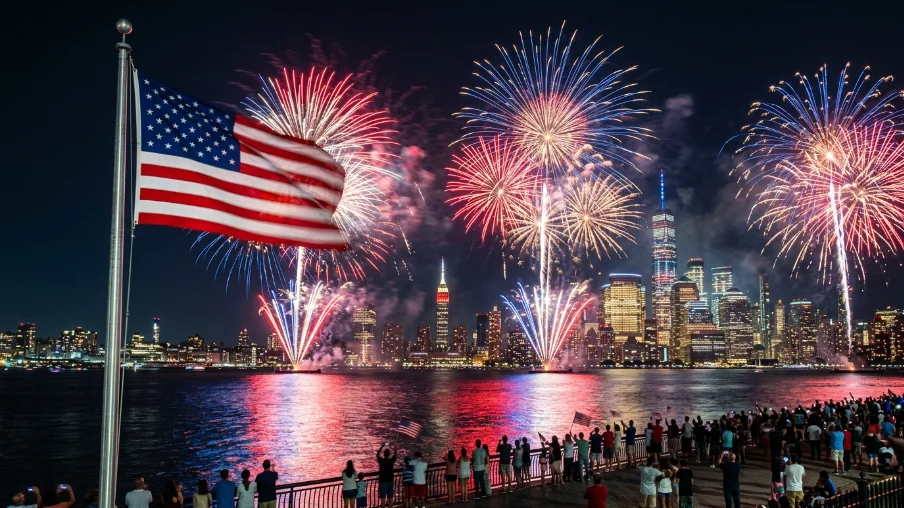
The 4th of July meaning is rooted in American independence. On July 4, 1776, the Continental Congress adopted the Declaration of Independence, announcing that the 13 American colonies regarded themselves as free from British rule. Today, the date is celebrated as Independence Day, a national holiday marked by fireworks, parades, family gatherings, and displays of the American flag. It also serves as a reminder of the nation’s founding ideals and the history behind them.
Every summer, July 4 brings fireworks, neighborhood celebrations, cookouts, and red, white, and blue decorations across the United States. These familiar traditions mark Independence Day, but the holiday’s significance reaches far beyond a day of festivities. It commemorates a defining moment in the American struggle to separate from British rule.
On July 4, 1776, the Continental Congress adopted the Declaration of Independence. The document announced that the 13 colonies considered themselves independent states rather than territories under British authority. Although the Revolutionary War continued for several years, the declaration established a powerful statement of the new nation’s aspirations for liberty and self-government.
Understanding the 4th of July meaning also involves looking at the ideals associated with the holiday and how Americans interpret them today. The celebration honors the country’s founding while offering an opportunity to reflect on its history, achievements, and continuing efforts to fulfill the principles expressed in the Declaration of Independence.
Quick Answer Box
| Aspect | Details |
| Meaning | The 4th of July, or Independence Day, commemorates the adoption of the Declaration of Independence on July 4, 1776. |
| Context | The 13 American colonies declared their separation from British rule, ending King George III’s authority over them. |
| Usage | Americans celebrate with fireworks, parades, barbecues, concerts, and patriotic displays of red, white, and blue. |
| Platforms | Celebrated nationwide across all 50 states; a federal holiday with government offices closed. |
| Example | “We’re hosting a barbecue on the 4th of July to celebrate Independence Day with family and friends.” |
| Tone | Patriotic, festive, reflective, and community-oriented. |
What Does 4th of July Mean in American History?
The 4th of July, also called Independence Day or July 4th, is the annual celebration of the birth of the United States as an independent nation. It commemorates the day in 1776 when the Second Continental Congress formally adopted the Declaration of Independence, a document that announced to the world that the 13 American colonies were no longer part of the British Empire.
But the story of Independence Day begins even earlier. In the 18th century, the North American continent along the Atlantic coastknown as the Thirteen Colonieswas under British rule. The colonists grew increasingly frustrated with British policies, particularly “taxation without representation”being forced to pay taxes to King George III while having no voice in the British Parliament.
By 1775, tensions had erupted into armed conflict with the Battles of Lexington and Concord, marking the beginning of the American Revolutionary War. Yet even as the fighting began, complete independence was not yet the goal for most colonists. Many still hoped for reconciliation with Britain.
That changed over the following year. The publication of Thomas Paine’s pamphlet “Common Sense” in early 1776 spread revolutionary sentiments and convinced many more colonists that independence was the only path forward. On June 7, 1776, Virginia delegate Richard Henry Lee introduced a resolution in the Second Continental Congress calling for the colonies’ independence.
The Vote for Independence
On July 2, 1776, the Continental Congress voted in favor of independence. John Adams, who would later become the second U.S. president, wrote to his wife Abigail that this day “will be the most memorable epoch in the history of America” and should be celebrated with “pomp and parade, with shows, games, sports, guns, bells, bonfires, and illuminations from one end of this continent to the other from this time forward forever more.”
However, Adams was off by two days. While the vote for independence happened on July 2, the formal adoption of the Declaration of Independencethe document explaining the decisiondid not occur until July 4.
Why July 4 Became the Date
July 4 became the defining date because that was when the Declaration of Independence was formally adopted. The document, primarily drafted by Thomas Jefferson in consultation with John Adams, Benjamin Franklin, Roger Sherman, and Robert R. Livingston, had undergone extensive revision before the final version was approved.
The date that appears on the Declaration is July 4, 1776, which is why Americans have celebrated on that day ever since. Historians have long debated whether members of Congress actually signed the document on July 4many believe it was signed a month later, on August 2but the adoption date remains July 4.
Full Definition: Independence Day and Its Significance
What the Declaration of Independence Established
The Declaration of Independence was more than just a statement of separation. It was a bold philosophical document that articulated the principles upon which the new nation would be built. The preamble famously declares:
“We hold these truths to be self-evident, that all men are created equal, that they are endowed by their Creator with certain unalienable Rights, that among these are Life, Liberty and the pursuit of Happiness.”
This assertion that governments derive their power from the consent of the governed was revolutionary in an age of monarchies. It established that the purpose of government is to secure the rights of the people, and when a government becomes destructive of those ends, the people have the right to alter or abolish it.
The Birth of a Nation
While the Revolutionary War continued for another seven years after the Declaration was adoptednot ending until the Treaty of Paris in 1783July 4, 1776, is considered the nation’s birthday. The Declaration announced to the world that the colonies were free and independent states, and from that moment forward, the United States existed as a sovereign nation.
The Declaration also listed grievances against King George III, justifying why the colonies had chosen to break away. These grievances included imposing taxes without consent, dissolving colonial legislatures, maintaining standing armies in peacetime, and cutting off trade with the rest of the world.
Context & Usage: How the 4th of July Fits Into American Life
A Federal Holiday
Independence Day has been a federal holiday since 1870, when Congress made it an unpaid holiday for federal workers. In 1938, Congress reaffirmed it as a paid holiday for federal employees. Today, all non-essential federal government offices are closed, federal employees receive paid time off, and many businesses also close in observance.
National Identity and Unity
Throughout American history, the Fourth of July has served as a unifying force, bringing together Americans from all walks of life to celebrate their shared identity. In the 19th century, major events like the groundbreaking ceremonies for the Erie Canal and the Baltimore and Ohio Railroad were deliberately scheduled to coincide with July 4 festivities.
By the 1870s, the Fourth of July had become the most important secular holiday on the American calendar. Even far-flung communities on the western frontier managed to gather on Independence Day, with one pioneer recalling it as the “big event of the year” when “everyone in the countryside got together on that day for the only time in the year.”
A Day of Reflection and Protest
The Fourth of July has also been a day of protest and reflection. In 1859, the Banneker Institute of Philadelphia urged African Americans to celebrate Independence Day while bearing witness to the contradictions between the Declaration’s ideals and the reality of slavery. Frederick Douglass’s famous 1852 speech “What to the Slave Is the Fourth of July?” powerfully highlighted these contradictions.
The holiday has also been used to protest for civil rights, women’s suffrage, and other causes, demonstrating that the pursuit of the Declaration’s ideals is an ongoing process.
Real-Life Examples of 4th of July Celebrations
Historical Firsts
The First Anniversary (1777)
One year after the Declaration was adopted, Philadelphia marked Independence Day by adjourning Congress and celebrating with bonfires, bells, and fireworks. The Pennsylvania Evening Post reported on July 5, 1777: “Yesterday the 4th of July, being the anniversary of the Independence of the United States of America, was celebrated in this city with demonstrations of joy and festivity.”
The 50th Anniversary (1826)
On July 4, 1826the 50th anniversary of the Declarationtwo of its key architects, John Adams and Thomas Jefferson, both died within hours of each other. This remarkable coincidence was seen by many as a sign of divine providence. Jefferson had written just days earlier that “the annual return of this day forever refresh our recollections of these rights, and an undiminished devotion to them.”
Modern Celebrations
City-Wide Festivities
Major cities across the United States host elaborate celebrations. New York City boasts the largest fireworks display in the country. Washington, D.C., holds the “A Capitol Fourth” concert on the National Mall, featuring performances by major artists and a spectacular fireworks show. Philadelphia, where the Declaration was signed, hosts parades, concerts, and historical reenactments.
Family and Community Gatherings
For most Americans, the 4th of July is a time for family reunions, picnics, and barbecues. Communities organize parades featuring marching bands, floats, and veterans’ groups. Baseball games are a traditional part of the holiday, with many stadiums hosting special firework shows after the game.
Patriotic Displays
Americans decorate their homes and businesses in red, white, and bluethe colors of the American flag. Many people fly the flag outside their homes, wear patriotic clothing, and attend ceremonies where the Pledge of Allegiance is recited and “The Star-Spangled Banner” is performed.
Conversation Example
Person A: “What are you doing for the 4th of July?”
Person B: “We’re hosting a big barbecue at our place. My brother is bringing his famous ribs, and we’re going to watch the fireworks downtown after dark. You should come!”
Person A: “That sounds great! I’ll bring some drinks and dessert.”
Person B: “Perfect. Don’t forget to wear something red, white, and blue!”
Platform-Specific Meaning: The 4th of July Across Contexts
In Social Media
On social media platforms, the 4th of July is marked by a flood of patriotic posts, photos of fireworks, and red-white-and-blue imagery. Common hashtags include #FourthOfJuly, #IndependenceDay, #July4th, and #USA. Brands and influencers often share themed content, from recipes for barbecues to historical facts about the holiday.
In Education
In American schools, the 4th of July is taught as the nation’s birthday. Students learn about the Declaration of Independence, the Founding Fathers, and the American Revolution. The holiday serves as a key moment for teaching civic values and American history.
In Politics
Politicians often use the 4th of July to give speeches about American values, freedom, and democracy. The holiday is an opportunity to reflect on the nation’s founding principles and to discuss current challenges in the context of the country’s ideals.
In Business
Many businesses close on the 4th of July, while othersparticularly in retail and hospitalityrun special promotions and sales. The holiday is one of the biggest weekends for travel, with millions of Americans hitting the road or taking to the skies to visit family or vacation destinations.
Alternative Meanings and Related Terms
Independence Day vs. Fourth of July
While “Independence Day” is the official name of the holiday, “Fourth of July” is the more common colloquial term. Both refer to the same celebration, though “Fourth of July” is often used in more casual contexts.
Related Historical Terms
- Declaration of Independence: The document adopted on July 4, 1776, that announced the colonies’ separation from Britain.
- Continental Congress: The governing body of the colonies that adopted the Declaration.
- Thirteen Colonies: The British colonies that became the first U.S. states.
- American Revolution: The war fought from 1775 to 1783 that secured American independence.
- Founding Fathers: The leaders who signed the Declaration and established the United States.
- John Adams’s Prediction: Adams predicted July 2 would be celebrated; he was wrong about the date but right about the celebrations.
Global Context
While the 4th of July is uniquely American, the ideals expressed in the Declaration of Independence have inspired independence movements around the world. Thomas Jefferson himself believed the document would be “the signal of arousing men to burst the chains … and to assume the blessings and security of self-government.”
How to Respond: Engaging with the 4th of July
When Someone Asks About Your Plans
Example Responses:
- “We’re having a backyard barbecue with family and watching the fireworks downtown.”
- “I’m going to the parade in the morning and then heading to the lake for the day.”
- “We’re keeping it low-key this yearjust grilling some burgers and watching the fireworks from our porch.”
When Explaining the Holiday to Someone
Example Explanation:
“The 4th of July is America’s Independence Day. It celebrates the day in 1776 when the colonies declared their independence from Britain. We celebrate with fireworks, parades, and barbecues. It’s basically the nation’s birthday.”
When Participating in Celebrations
- Attend a parade: Many towns and cities host parades with marching bands, floats, and veterans.
- Watch fireworks: Fireworks are the hallmark of the holiday, with displays in almost every community.
- Host a cookout: Grilling burgers, hot dogs, and other summer foods is a beloved tradition.
- Fly the flag: Displaying the American flag is a common way to show patriotism.
- Learn the history: Take a moment to reflect on what the day truly means.
Misinterpretations: Common Myths About the 4th of July
Myth 1: The Declaration Was Signed on July 4
While the Declaration of Independence was adopted on July 4, 1776, most historians believe it was not actually signed until August 2, 1776. The confusion arises because the date on the document is July 4.
Myth 2: July 4 Marks the End of the Revolutionary War
The Revolutionary War continued for another seven years after the Declaration was adopted. The war did not end until the Treaty of Paris was signed in 1783.
Myth 3: The Vote for Independence Happened on July 4
The Continental Congress actually voted in favor of independence on July 2, 1776. July 4 is when the Declaration was formally adopted.
Myth 4: All Americans Have Always Celebrated July 4
Observing Independence Day didn’t become widespread until after the War of 1812. Even then, the holiday has meant different things to different groups of Americans. For enslaved people and their descendants, the holiday long represented a painful contradiction.
When NOT to Use the Term
While the 4th of July is a joyous occasion for most Americans, there are contexts where referencing the holiday might be inappropriate or insensitive:
- In discussions of colonialism: For Native Americans, the 4th of July can be a reminder of dispossession and broken treaties.
- In international contexts with sensitivity: While many countries respect American independence, some may view the holiday as a symbol of American exceptionalism.
- In serious historical discussions: Avoid reducing the complex history of the American Revolution to just “fireworks and barbecues.”
Usage Tips: Making the Most of the 4th of July
Educators
- Teach the history: Use the holiday to teach students about the Declaration of Independence and its principles.
- Discuss the contradictions: Address the gap between the Declaration’s ideals and historical realities like slavery.
- Connect to the present: Help students understand how the Declaration’s principles continue to shape American politics and society.
Travelers
- Plan ahead: The 4th of July is one of the busiest travel weekends of the year. Book accommodations and transportation early.
- Check local events: Many cities have unique celebrations. Research what’s happening in your destination.
- Stay safe: Fireworks can be dangerous. Attend professional displays rather than setting off your own.
Hosts
- Plan your menu: Classic 4th of July foods include burgers, hot dogs, ribs, corn on the cob, and watermelon.
- Decorate: Red, white, and blue decorations set the festive mood.
- Organize activities: Lawn games, music, and a designated area for watching fireworks make the celebration more enjoyable.
FAQs
1. Why do we celebrate the 4th of July?
We celebrate the 4th of July because it marks the adoption of the Declaration of Independence on July 4, 1776, when the 13 American colonies declared their independence from Great Britain.
2. What actually happened on July 4, 1776?
On July 4, 1776, the Continental Congress formally adopted the Declaration of Independence, a document primarily drafted by Thomas Jefferson that announced the colonies’ separation from Britain.
3. Why is July 4 celebrated instead of July 2?
While the vote for independence happened on July 2, July 4 is celebrated because it was the day the Declaration of Independence was formally adopted and the date that appears on the document.
4. Is the 4th of July a federal holiday?
Yes, Independence Day has been a federal holiday since 1870, and it became a paid holiday for federal employees in 1938.
5. How do Americans celebrate the 4th of July?
Americans celebrate with fireworks, parades, barbecues, picnics, concerts, baseball games, and family reunions. Many also display the American flag and wear red, white, and blue.
6. Why are fireworks associated with the 4th of July?
The tradition of setting off fireworks on July 4 began in Philadelphia in 1777, during the first organized celebration of Independence Day. John Adams had predicted that the day would be celebrated with “illuminations.”
7. Who wrote the Declaration of Independence?
Thomas Jefferson was the principal author of the Declaration of Independence, working with a committee that included John Adams, Benjamin Franklin, Roger Sherman, and Robert R. Livingston.
8. Did all the Founding Fathers sign the Declaration on July 4?
Most historians believe the Declaration was not actually signed until August 2, 1776, though the date on the document is July 4.
9. What happened to the Founding Fathers after the Declaration?
The signers faced tremendous personal risk. They were hunted by the British, and several lost their homes, families, and fortunes. Nine died of wounds or hardship, five were captured and imprisoned, and 17 died as paupers, having lost everything.
10. Why did John Adams refuse to celebrate the 4th of July?
Adams refused to celebrate on July 4 because he believed July 2the day of the vote for independencewas the true Independence Day.
11. Which presidents died on July 4?
John Adams and Thomas Jefferson both died on July 4, 1826the 50th anniversary of the Declaration. James Monroe also died on July 4, 1831.
12. What is the significance of the “salute to the union”?
A salute of one gun for each state in the U.S. is fired on Independence Day at noon by any capable military base.
13. Has the 4th of July always been widely celebrated?
Observing Independence Day didn’t become widespread until after the War of 1812. By the 1870s, it had become the most important secular holiday in the U.S.
14. What does “taxation without representation” mean?
It means the colonists were forced to pay taxes to the British government without having elected representatives in the British Parliament who could vote on those taxes.
15. How has the meaning of the 4th of July changed over time?
The holiday has evolved from a celebration of independence to a broader expression of American identity. It has also been used as a platform for protest and reflection on the nation’s ideals versus its realities.
Conclusion
The 4th of July is far more than a day for fireworks and barbecues. It is the anniversary of one of the most consequential events in world historythe moment when a group of colonies dared to assert that they would be free. The Declaration of Independence, adopted on July 4, 1776, articulated principles that would inspire revolutions around the globe and shape the course of human freedom.
But the meaning of the 4th of July is not static. It has evolved over the centuries, from a celebration of separation from Britain to a broader expression of American identity and values. It has been a day of unity and a day of protest, a day of patriotic pride and a day of reflection on the gap between ideals and reality.
As Americans gather each year to watch fireworks, wave flags, and share meals with loved ones, they are participating in a tradition that stretches back to the nation’s founding. They are also affirming the enduring power of the Declaration’s visionthat all people are created equal and endowed with unalienable rights.
The 4th of July is America’s birthday, but it is also a reminder that the work of building a more perfect union is never finished. It is a day to celebrate how far the nation has come and to recommit to the ideals that still guide it forward.
Discover More Articles:
- Namaste Meaning in text |Origin, Spiritual Significance & How to Use It
- Habibi Meaning| What It Really Means & How to Use It For 2026








4 thoughts on “4th of July Meaning| The Story Behind American Independence”