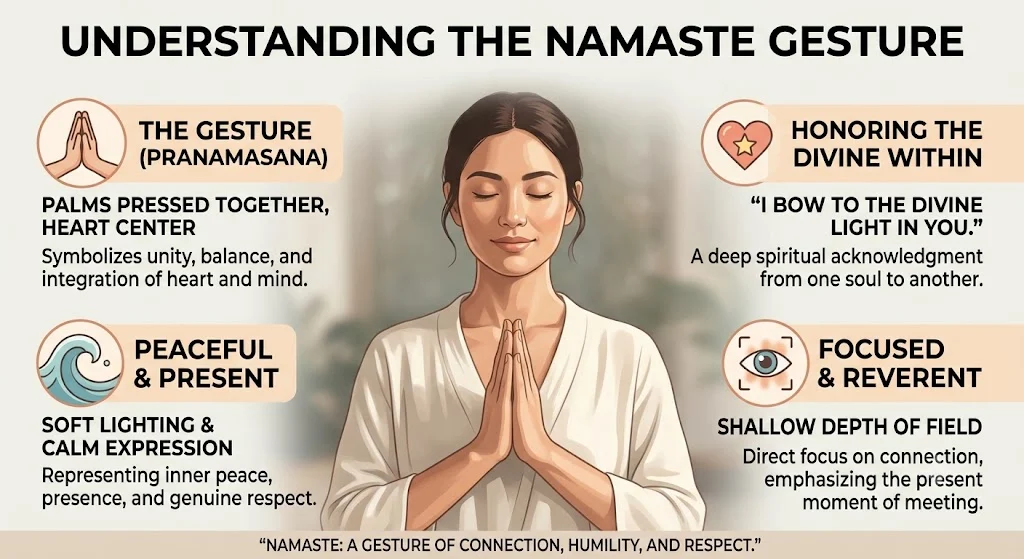
Namaste meaning comes from Sanskrit and is commonly understood as “I bow to you.” Used as a respectful greeting or farewell, the word carries cultural and spiritual significance in South Asia. People often accompany it with palms pressed together and a slight bow. Its meaning can express respect, gratitude, humility, or spiritual recognition, depending on the tradition and situation.
You may hear namaste at the end of a yoga class, see it in a greeting, or notice the familiar palms-together gesture in photos and videos. Although many people associate the word with yoga and meditation, its history reaches much further into South Asian languages and cultural traditions. It is more than a fashionable expression or a simple way to say hello.
The word comes from Sanskrit and is traditionally interpreted as a respectful acknowledgment of another person. In everyday settings, people may use it to greet someone, say goodbye, or show appreciation. The accompanying gesture, often called añjali mudrā, involves bringing the palms together and may include a slight bow.
The deeper significance of namaste varies across cultural and spiritual contexts. In Hindu traditions, the greeting can carry religious meaning, including interpretations connected with recognizing the divine. However, not every person who says namaste intends a spiritual message; some use it as an ordinary, respectful greeting.
Understanding namaste meaning involves recognizing both its literal interpretation and its cultural background. Learning when and how people use the expression can help you appreciate its significance without assuming that everyone follows the same customs or beliefs.
Quick Answer Box
| Aspect | Details |
|---|---|
| Meaning | “I bow to you” (literal); “The divine in me bows to the divine in you” (spiritual) |
| Language | Sanskrit |
| Pronunciation | NAH-muh-stay (American) or nuh-MUH-stheh (more traditional) |
| Gesture | Palms together at heart center, slight bow of the head |
| Usage | Greeting, farewell, gratitude, respect, yoga classes |
| Tone | Respectful, humble, reverent |
What Does Namaste Mean?
At its most basic level, namaste is a greeting. But to fully understand its meaning, you need to look at the word itself.
Literal Translation
The word namaste comes from Sanskrit, an ancient language of India. It is formed by combining two parts:
- Namah (नमः) – meaning “bow,” “obeisance,” “reverential salutation,” or “adoration”
- Te (ते) – meaning “to you”
Put together, namaste literally means “I bow to you.”
The root nam carries meanings of bending, bowing, humbly submitting, and becoming silent. So when you say namaste, you are physically and verbally expressing humility and respect toward the person you are greeting.
Spiritual Interpretation
In Hindu tradition, namaste carries a much deeper spiritual meaning. It is often interpreted as:
“The divine in me bows to the divine in you.”
This interpretation comes from the Hindu belief that divinity resides within every living being. Hindus believe that God (Paramatma) dwells in each person’s soul (atma), and every person should be treated, respected, and greeted accordingly.
When you say namaste, you are acknowledging the sacred spark or spiritual essence in the other person not their physical appearance, social status, or external identity. As one source puts it, namaste helps us “drop all the walls that separate us” and recognize our shared divinity.
Context and Usage
Where and When Is Namaste Used?
Namaste is the most common and universal greeting in India and Nepal. Unlike English greetings that change with the time of day (“good morning,” “good evening”), namaste works for any hour day or night.
Common situations include:
- Meeting someone – whether a stranger, friend, elder, or family member
- Saying goodbye – namaste works as both a hello and a farewell
- Showing gratitude – a way to express sincere thanks
- Entering or leaving a space – acknowledging those present
- Yoga classes – used by instructors to honor students and close the session
The Namaste Gesture (Mudra)
The verbal greeting is almost always accompanied by a physical gesture. Here is how to perform it correctly:
- Press your palms together in front of your chest, fingers pointing upward.
- Keep your thumbs lightly touching your sternum (breastbone).
- Bow your head slightly as a sign of respect.
- Make gentle eye contact with the person you are greeting.
This hand position is called anjali mudra a prayer-like gesture that symbolizes the bringing together of spirit and matter, or the self meeting the Self.
Levels of the Gesture
The height of the hands can convey different levels of respect:
| Hand Position | Meaning |
|---|---|
| Palms at heart | Standard greeting for friends, peers, and acquaintances |
| Palms at forehead (third eye) | Deeper veneration, respect for elders or mentors |
| Palms above head | Highest reverence reserved for God and the holiest of spiritual teachers |
Real-Life Examples
To truly understand namaste meaning, it helps to see it in action. Here are five realistic conversation examples showing how namaste is used in everyday life.
Example 1: Meeting a Friend
Priya: Namaste, Raj! How have you been?
Raj: Namaste, Priya! I’m doing well, thank you. And you?
Priya: All good here. Let’s grab chai sometime.
Raj: Sounds perfect. Namaste!
Example 2: Greeting an Elder
Aryan: (palms together, bowing slightly) Namaste, Grandma.
Grandma: (smiling, returning the gesture) Namaste, beta. Come, sit with me.
Example 3: Entering a Shop
Shopkeeper: Namaste! Welcome to my store. How can I help you?
Customer: Namaste! I’m just looking around, thank you.
Example 4: Ending a Yoga Class
Yoga Instructor: Thank you all for your practice today. Bring your hands to your heart. Bow your head. Namaste.
Students: (in unison) Namaste.
Example 5: Saying Goodbye
Neha: It was wonderful seeing you. Take care.
Vikram: You too, Neha. Namaste.
Neha: Namaste.
Platform-Specific Meaning
Namaste in Yoga
In the West, namaste is most commonly associated with yoga. Yoga instructors often say it at the end of a session to close the practice and honor the relationship between teacher and student.
The spiritual meaning “the light in me honors the light in you” aligns perfectly with yoga’s emphasis on seeing the divine within all creation. However, some South Asians find this usage puzzling, as in Indian culture, namaste is typically used as a greeting when meeting someone, not as a farewell.
Note: The term namaskar (a more formal variant) has little to no historical role in Indian yoga its modern use in Western yoga classes is a relatively recent phenomenon.
Namaste in Indian Culture
In India, namaste is an everyday greeting used by people of all ages, religions, and social statuses. It transcends religious boundaries while rooted in Hinduism, it is used by Muslims, Sikhs, Christians, and others across the subcontinent.
The gesture has practical benefits too. It requires no physical contact, making it hygienic and respectful of personal space. During the COVID-19 pandemic, namaste saw a global resurgence as a safe, no-touch greeting.
Namaste on Social Media
On platforms like Instagram and TikTok, namaste is often used as a caption for yoga posts, travel content, or spiritual imagery. While this has helped spread awareness of the term, it has also led to oversimplification and, in some cases, cultural appropriation.
Many influencers use the word without understanding its depth or cultural context, reducing it to a trendy aesthetic. If you are posting about namaste online, consider including educational content that honors its origins.
Alternative Meanings and Variations
Namaste vs. Namaskar
Namaste and namaskar are often used interchangeably, but they have subtle differences:
Similar Gestures in Other Cultures
The namaste gesture (palms together, slight bow) appears in various forms across Asia:
- Wai (Thailand) – similar hand position, used for greeting, respect, and apologies
- Sampeah (Cambodia) – the Cambodian equivalent
- Añjali Mudra – the Sanskrit name for the prayer-like hand position itself
Namaste in Written Communication
In India and Nepal, namaste is also used as a friendly greeting in written communication, such as emails, letters, and text messages.
Related Terms and NLP Variations
To fully understand namaste meaning, it helps to know related terms and concepts:
- Pranam – a more reverent form of greeting, often involving touching the feet of elders
- Vanakkam – the Tamil equivalent greeting
- Sat Sri Akaal – the greeting used by Sikhs
- Assalamu Alaikum – the greeting used by Muslims
- Namah – the root word meaning “bow” or “obeisance”
- Anjali – from the root anj, meaning “to adorn, honor, or celebrate”
How to Respond to Namaste
If someone says namaste to you, the appropriate response is simply to say namaste back while performing the gesture.
Here are a few tips:
- Return the gesture with palms together at your heart
- Bow your head slightly
- Make gentle eye contact
- Say “namaste” in return
There is no need for a lengthy response the beauty of namaste is its simplicity. It acknowledges the other person’s presence and inherent dignity.
Misinterpretations and Common Mistakes
“Namaste” Is Not Just “Hello”
While namaste is used as a greeting, reducing it to simply “hello” misses its spiritual and cultural depth. Unlike “hello,” namaste carries an acknowledgment of the divine or sacred in the other person.
It’s Not Just a Yoga Word
Namaste has been used for thousands of years in South Asia long before yoga became popular in the West. Using it only in yoga contexts can erase its broader cultural and religious significance.
Pronunciation Errors
Many Americans pronounce namaste as “nah-mah-stay.” While this is widely accepted, a more accurate pronunciation is:
The first two syllables should have more of an “uh” sound than an “ah” sound.
Overuse and Cultural Appropriation
Some critics argue that using namaste outside its cultural context especially on merchandise, in casual Western settings, or without understanding its meaning can be a form of cultural appropriation.
To use namaste respectfully:
- Learn its origins and meaning
- Use it in appropriate contexts
- Avoid trivializing or commercializing it
- Acknowledge its Hindu and South Asian roots
When NOT to Use Namaste
While namaste is widely acceptable, there are times when it may not be appropriate:
In Formal Religious Settings of Other Faiths
If you are in a mosque, church, or gurdwara (Sikh temple), it is respectful to use the greetings of that tradition rather than assuming namaste is universal.
If You Don’t Understand the Meaning
Using namaste without knowing what it means can come across as performative or disrespectful. Take the time to learn before you use it.
In Cultures with Different Greeting Norms
In some parts of India, particularly in Muslim-majority or Sikh-majority regions, other greetings may be more appropriate.
As a Casual Catchphrase
Avoid using namaste as a trendy catchphrase or joke. It is a meaningful spiritual greeting, not a punchline.
Usage Tips
- Pair the word with the gesture – saying namaste without the hand position loses much of its meaning.
- Bow slightly – a small bow shows humility and respect.
- Use it sincerely – namaste is not just a word; it is an intention.
- Pronounce it thoughtfully – making an effort to pronounce it correctly shows respect for its origins.
- Know your audience – in South Asian contexts, namaste is always appropriate. In Western settings, be mindful of whether you are using it respectfully.
- Don’t overuse it – like any greeting, using it too frequently or inappropriately can dilute its significance.
FAQs
1. What does namaste mean in English?
Namaste translates to “I bow to you” in English. Spiritually, it means “The divine in me bows to the divine in you.”
2. Is namaste a religious word?
Namaste originates from Hindu and Sanskrit traditions and carries spiritual significance. However, it is used as a secular greeting by people of many faiths across South Asia.
3. How do you pronounce namaste?
In American English, it is pronounced NAH-muh-stay. A more traditional pronunciation is nuh-MUH-stheh, with a soft “th” sound at the end.
4. What is the difference between namaste and namaskar?
Namaste is casual and used in everyday conversations. Namaskar is more formal and respectful, often used with elders, dignitaries, or in spiritual contexts.
5. Why do yoga teachers say namaste?
Yoga teachers say namaste at the end of class to honor the teacher-student relationship and acknowledge the divine spirit within each student.
6. Can Christians say namaste?
Yes. While namaste has Hindu origins, many Christians use it as a respectful greeting without adopting Hindu theology. Some Christians, however, choose not to use it due to its spiritual associations.
7. What does the namaste hand gesture mean?
The gesture (palms together at the heart) symbolizes unity, respect, and the acknowledgment of the divine spark in the other person.
8. Is it okay to say namaste if I’m not Indian?
Yes, but it is important to use it respectfully understand its meaning, pronounce it properly, and avoid trivializing or commercializing it.
9. Do people in India actually say namaste?
Yes. Namaste is the most common greeting in India and Nepal, used daily by people of all ages and backgrounds.
10. What is the proper response to namaste?
The proper response is to say namaste back while performing the same gesture with palms together and a slight bow.
11. Does namaste mean hello or goodbye?
Namaste can mean both hello and goodbye. It is used as a greeting when meeting someone and as a farewell when parting.
12. What is the literal translation of namaste?
The literal translation is “I bow to you” – from namah (bow) and te (to you).
13. Is namaste mentioned in the Vedas?
Yes, the gesture and concept are mentioned in the Rig Veda, one of the oldest Hindu texts, dating back thousands of years.
14. Why is namaste used as a no-touch greeting?
Namaste requires no physical contact, making it hygienic and respectful of personal space which is why it gained global popularity during the COVID-19 pandemic.
15. Can namaste be used in written communication?
Yes. In India and Nepal, namaste is commonly used in emails, letters, and text messages as a friendly greeting.
Conclusion
Namaste is far more than a word it is a philosophy, a gesture, and a way of being. From its Sanskrit roots meaning “I bow to you” to its spiritual interpretation as “the divine in me honors the divine in you,” namaste encapsulates humility, respect, and the recognition of shared humanity.
Whether you encounter it in a yoga studio, on a trip to India, or in everyday conversation, understanding the true namaste meaning allows you to use it with the respect and authenticity it deserves. It is a reminder that beneath our differences, we all share a common spark and that is worth honoring.
So the next time you press your palms together and bow your head, remember: you are not just saying hello. You are bowing to the divine in another person. And that is a beautiful thing.
Namaste.

Andrew Morris is a writer at Meaninga.com who specializes in word meanings, slang, idioms and modern language trends. He creates clear, accurate and easy to understand content for everyday readers.









5 thoughts on “Namaste Meaning| The Greeting With a Deeper Message”