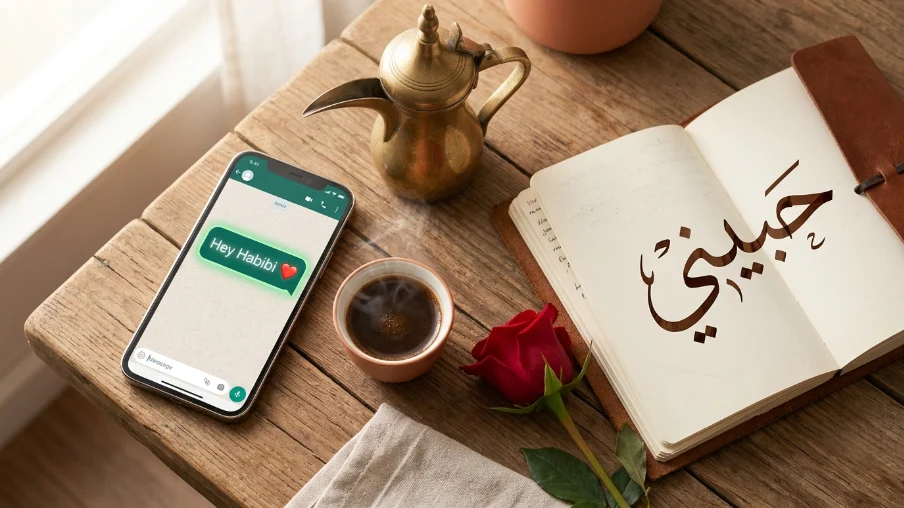
Habibi (pronounced ha-BEE-bee) is an Arabic term of endearment that literally means “my love,” “my beloved,” or “my dear.” It comes from the Arabic root word ḥubb (love), with the suffix *-i* making it possessive“my love.” While traditionally masculine, it is widely used today in a gender-neutral way among friends, family, and romantic partners across social media, messaging apps, and everyday conversation.
You’ve probably seen it in a TikTok caption, heard it in a song, or received it in a WhatsApp message from a friend: habibi. It’s one of those words that feels warm, familiar, and somehow instantly cooleven if you don’t speak a word of Arabic.
But what does habibi actually mean? Is it romantic or platonic? Can you use it with anyone? And what’s the deal with habibti?
Whether you’re trying to understand a text from a friend, decode a social media post, or just want to sound like you know what you’re talking about, this guide breaks down everything you need to know about the meaning of habibifrom its literal translation to its modern internet slang usage.
Quick Answer Box
| Aspect | Details |
| Meaning | “My love,” “my beloved,” “my dear,” or “darling” |
| Language | Arabic (حبيبي) |
| Root | *Ḥ-b-b* (حبّ) the Arabic root for love |
| Pronunciation | ha-BEE-bee |
| Gender | Masculine form (habibi); feminine form is habibti (حبيبتي) |
| Used For | Friends, family, romantic partners, and even strangers in some contexts |
| Tone | Affectionate, warm, playful, or sarcastic depending on context |
| Common Platforms | WhatsApp, TikTok, Instagram, Snapchat, and everyday speech |
What Does Habibi Mean?
At its most basic level, habibi is an Arabic word that translates to “my love” or “my beloved.” It comes from the root word habib (حبيب), which means “beloved” or “loved one.” The *-i* at the end is a possessive suffixit turns “love” into “my love.”
Think of it as the Arabic equivalent of “darling,” “sweetheart,” “honey,” or even “babe” in English. But unlike many English terms of endearment that are usually reserved for romantic partners, habibi has a much broader range of use.
The Feminine Form: Habibti
If you’re addressing a female, the correct form is habibti (حبيبتي). It means the exact same thing“my love” or “my dear”but it’s grammatically feminine.
Here’s the breakdown:
- Habibi → used for males (or gender-neutrally in slang)
- Habibti → used for females
💡 Pro tip: In modern slangespecially on social media and in casual textingmany people use habibi for everyone regardless of gender. It’s become a catch-all term of affection, kind of like “dude” or “bro” in English.
Context & Usage
Habibi isn’t just a wordit’s a tone-shifter. It changes how a sentence feels without changing what it says.
1. Romantic Context
When used between romantic partners, habibi carries its full weight: “my love,” “my beloved.” It’s intimate, warm, and deeply affectionate.
Example:
“I miss you so much, habibi.”
2. Friendly / Platonic Context
Between friends, habibi works like “buddy,” “bro,” or “dude.” It conveys warmth and camaraderie without any romantic implication.
Example:
“Hey habibi, how’s it going?”
3. Family Context
Parents often call their children habibi or habibtiit’s the Arabic equivalent of “sweetie” or “honey.”
Example:
“Come here, habibi, let me fix your collar.”
4. Casual / Stranger Context
In some Arabic-speaking regionslike Lebanon and parts of the Gulfhabibi is used to soften interactions with strangers, similar to how “hon” or “sweetie” is used in some parts of the US.
Example:
“That’ll be $5, habibi.” (said by a shopkeeper to a customer)
5. Sarcastic / Playful Context
In internet slang and among younger generations, habibi can be used ironicallyto tease, gently mock, or throw playful shade.
Example:
“Bro, relax, habibiyour mixtape isn’t that good.”
Real-Life Examples
Here are five realistic conversation examples showing how habibi is used in everyday life:
Example 1: Between Romantic Partners
Girl: “Do you want to go to the park, habibi?”
Boy: “Sure! Should we pack a lunch, habibi?”
Girl: “Sounds good! There’s chicken and pop in the fridge.”
Example 2: Between Close Friends (Casual Greeting)
You: “Hey habibi, how’s it going?”
Friend: “I’m good, thanks! What about you, habibi?”
You: “Just wanted to check in on my favorite habibi! Everything is great.”
Example 3: Between Friends (Nostalgic)
You: “Remember that time we pulled an all-nighter playing video games, habibi?”
Friend: “Of course, habibi! That was one of the best nights ever.”
You: “Absolutely! We need to plan another gaming session soon, habibi.”
Example 4: Parent to Child
Mom: “Habibi, did you eat breakfast before school?”
Child: “Yes, mama.”
Mom: “Good. Don’t forget your jacketit’s cold outside.”
Example 5: Sarcastic / Playful
Friend 1: “I waited three hours for youdid your camel take the scenic route?”
Friend 2: “Habibi, relax. I’m here now.”
Platform-Specific Meaning
Habibi has taken on slightly different flavors depending on where you encounter it.
On WhatsApp, habibi is often used as a greeting or a term of endearment in personal messages. You might see:
“Habibi, how are you?”
It’s casual, warm, and works between friends, family, and partners alike. In group chats, it’s common to see people using it to address the whole group in a friendly way.
TikTok
TikTok played a huge role in popularizing habibi globally. A Swedish rap song called “Habibi” went viral on the platform in 2021, introducing the word to millions of new users.
On TikTok today, habibi appears in:
- Captions to create a playful or affectionate vibe
- Comments as a friendly way to address creators
- Duet videos and trends that play on the word’s warmth
The hashtag #habibi is used across countless videosfrom couple content to comedy skits to travel vlogs.
On Instagram, habibi shows up in captions, DMs, and comments as a way to express affection, pride, or unity. It’s often used in:
- Couple posts (“My habibi ❤️”)
- Friend group photos (“The habibis”)
- Cultural pride contentespecially among Arab creators and diaspora communities
Snapchat
On Snapchat, habibi is used casually in snaps and chats between friendssimilar to how you’d use “bro” or “dude.” It’s quick, affectionate, and low-effort.
Alternative Meanings & Related Terms
Habibi is just one of many beautiful Arabic terms of endearment. Here are some others you might encounter:
| Term | Meaning |
| Habibti (حبيبتي) | Feminine form of habibi“my love” (to a female) |
| Hayati (حياتي) | “My life”used to express deep affection |
| Rohi (روحي) | “My soul”a deeply emotional term |
| Albi (قلبي) | “My heart”similar to “my sweetheart” |
| Omri (عمري) | “My life” or “my age”used for someone very dear |
| Nour Al Ain (نور العين) | “Light of my eyes”deep love and admiration |
| Azizi (عزيزي) | “My dear” or “my cherished one” |
Other Ways to Say Habibi in English
If you’re looking for an English equivalent, here are some close matches depending on context:
- Romantic: My love, beloved, darling, babe, sweetheart
- Friendly: Dude, bro, buddy, mate, pal
- Family: Sweetie, honey, dear
How to Respond to Habibi
Not sure what to say when someone calls you habibi? Here are some natural responses:
| Context | Response |
| Romantic | “Habibi” back, or “I love you too” |
| Friendly | “Hey habibi!” back, or “What’s up?” |
| Family | Smile and respond naturally |
| Sarcastic | Laugh it off or play along |
| Stranger | A simple smile or nod is fine |
The beauty of habibi is that you don’t overthink itit’s meant to feel natural and warm.
Misinterpretations to Avoid
Habibi is generally positive, but there are a few things to keep in mind:
1. It’s Not Always Romantic
Just because someone calls you habibi doesn’t mean they’re hitting on you. In many contexts, it’s purely platoniclike “bro” or “dude.”
2. Don’t Overuse It
In Arabic-speaking cultures, using habibi too casuallyespecially with people you’ve just met or with elderscan come across as disrespectful.
3. Gender Matters (Sometimes)
While slang usage is often gender-neutral, in formal or traditional contexts, using habibi for a woman is grammatically incorrect. Use habibti instead.
4. Tone Is Everything
Habibi can be warm, playful, sarcastic, or even slightly annoyedit all depends on tone and context.
When NOT to Use Habibi
Habibi is versatile, but it’s not for every situation:
- Formal/professional settingsavoid using it with bosses, clients, or in official correspondence
- With strangers (in some cultures)in many Western contexts, it might feel too forward
- With elders (in traditional Arab settings)use honorifics like aamu (uncle) or ukhty (sister) instead
- When you’re unsureif you don’t know the person well, err on the side of caution
Usage Tips
Here are some quick tips for using habibi like a pro:
✅ Do use it with close friendsit’s a great way to show warmth
✅ Do use it with familyespecially with parents, siblings, and children
✅ Do use it romanticallyit’s perfect for partners
✅ Do match the toneif someone uses it playfully, respond playfully
❌ Don’t use it in formal settingskeep it casual
❌ Don’t overuse itlike any term of endearment, it loses meaning if you say it too much
❌ Don’t use it with strangers (in most Western contexts)
❌ Don’t forget habibtiif you’re addressing a woman, use the correct form when appropriate
FAQs
1. What does habibi mean in English?
Habibi means “my love,” “my beloved,” or “my dear” in English.
2. Is habibi romantic?
Not always. It can be romantic, but it’s also used platonically between friends and family.
3. What is the difference between habibi and habibti?
Habibi is the masculine form (used for males), and habibti is the feminine form (used for females).
4. Can you call a girl habibi?
In traditional Arabic grammar, noyou would say habibti. But in modern slang, many people use habibi for everyone regardless of gender.
5. What does “habibi” mean in texting?
In texts and chats, habibi is used as a warm greeting or term of endearmentsimilar to “hey buddy” or “my dear.”
6. Is habibi used in the Quran?
The root word habib appears in the Quran, but the possessive form habibi is more commonly used in everyday speech and poetry.
7. What does “ya habibi” mean?
Ya habibi means “oh my love” or “hey my dear.” The ya is a vocative particle used to call someone.
8. Why is habibi so popular on TikTok?
A viral song called “Habibi” by Swedish rappers Ricky Rich and ARAM Mafia popularized the word on TikTok in 2021.
9. Can I use habibi if I’m not Arabic?
Yes! Habibi has become a globally recognized term of endearment. Just be mindful of context and tone.
10. What does “habibi” mean in Arabic culture?
In Arabic culture, habibi is one of the most widely used terms of endearmenta way to express love, warmth, and closeness to anyone from friends to family to romantic partners.
Conclusion
Habibi is far more than just a wordit’s a cultural bridge, a tone-shifter, and one of the most versatile terms of endearment in the world. Whether you’re using it romantically with a partner, casually with a friend, or playfully in a TikTok comment, it carries a warmth that transcends language barriers.
The key is understanding the context: who you’re talking to, what tone you’re going for, and whether habibi or habibti is the right choice.
So next time someone calls you habibi, you’ll know exactly what it meansand exactly how to respond.
Habibi, you’ve got this. 👊

Andrew Morris is a writer at Meaninga.com who specializes in word meanings, slang, idioms and modern language trends. He creates clear, accurate and easy to understand content for everyday readers.








5 thoughts on “Habibi Meaning| What It Really Means & How to Use It For 2026”