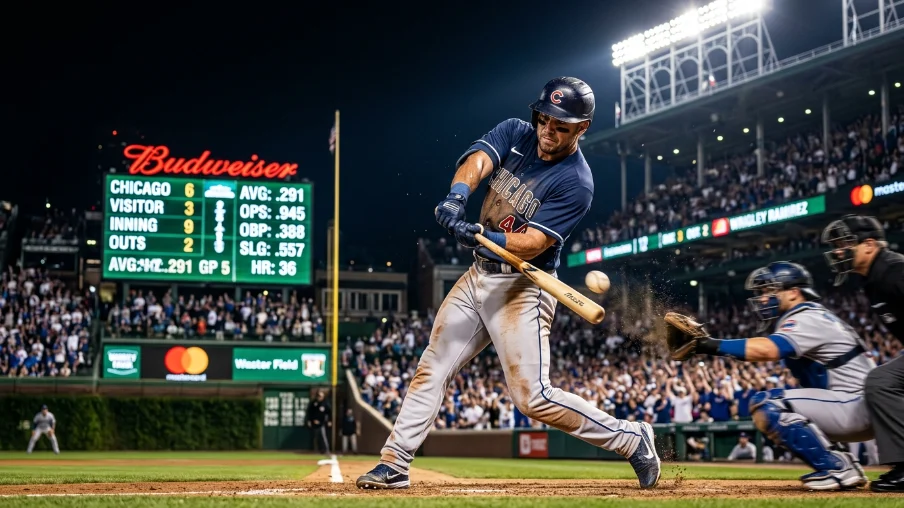
OPS in baseball stands for On-base Plus Slugging, a statistic that combines a player’s ability to get on base and hit for power. It is calculated by adding On-base Percentage (OBP) and Slugging Percentage (SLG). OPS helps measure overall offensive performance in a single number, making it one of the most widely used advanced baseball stats in MLB analytics.
OPS Meaning in Baseball Explained
OPS in baseball stands for On-base Plus Slugging. It blends two key offensive skills into one number. First, it measures how often a player reaches base. Then it measures how much power they bring when they hit.
Think of OPS like a “full offensive scorecard.” Instead of looking at separate stats, you get one clean number that tells a bigger story.
A player with a high OPS doesn’t just hit singles. They also get on base often and hit for extra bases like doubles, triples, and home runs.
That combination makes OPS one of the most important baseball stats in modern MLB analysis.
OPS Full Form and Origin in Sabermetrics
OPS stands for:
- O = On-base Percentage (OBP)
- P = Plus
- S = Slugging Percentage (SLG)
So the full idea becomes:
OPS = OBP + SLG
This stat comes from sabermetrics, the science of baseball analytics. Analysts created OPS to simplify offensive evaluation.
Before OPS, fans and scouts looked at multiple stats separately:
- Batting average
- Walks
- Home runs
- RBIs
That approach felt messy. OPS fixed that by combining key offensive skills into one number.
Bill James, a pioneer of sabermetrics, helped popularize this type of thinking. He pushed baseball toward smarter data instead of surface-level stats.
How OPS Is Calculated in Baseball
OPS comes from two core components:
- On-base Percentage (OBP)
- Slugging Percentage (SLG)
Once you calculate both, you simply add them together.
OPS Formula in Baseball
OPS = OBP + SLG
Now let’s break both parts down.
On-base Percentage (OBP)
OBP measures how often a player reaches base.
It includes:
- Hits
- Walks
- Hit by pitch
It ignores errors and focuses on real offensive value.
OBP Formula:
OBP = (H + BB + HBP) ÷ (AB + BB + HBP + SF)
Where:
- H = Hits
- BB = Walks
- HBP = Hit by pitch
- AB = At bats
- SF = Sacrifice flies
A higher OBP means the player avoids outs and keeps innings alive.
Slugging Percentage (SLG)
SLG measures power.
Unlike batting average, it values extra-base hits more.
SLG Formula:
SLG = Total Bases ÷ At Bats
Total bases come from:
- Single = 1 base
- Double = 2 bases
- Triple = 3 bases
- Home run = 4 bases
A player who hits more extra-base hits will have a higher SLG.
Putting It Together: OPS Calculation Example
Let’s imagine a player:
- OBP = .360
- SLG = .480
Now we add:
OPS = .360 + .480 = .840
That .840 OPS shows a strong offensive player.
Why OPS Matters in Baseball Analytics
OPS matters because it simplifies offensive evaluation.
Instead of scanning multiple stats, teams can quickly judge a hitter’s impact.
OPS Helps With:
- Player comparison
- Lineup construction
- MVP discussions
- Contract decisions
- Scouting reports
OPS gives a quick “big picture” of offensive production.
Why Coaches Love OPS
Coaches don’t want confusion. They want clarity.
OPS provides:
- Fast evaluation
- Easy ranking
- Clear offensive value
A coach can instantly see who produces more runs.
OPS and Run Production
High OPS usually means:
- More runners on base
- More extra-base hits
- More scoring opportunities
That directly connects to winning games.
What Is a Good OPS in MLB?
OPS values vary across eras, but modern MLB uses general benchmarks.
OPS Rating Table
| OPS Range | Performance Level | Meaning |
| .900+ | Elite | MVP-level hitter |
| .800 – .899 | Very Good | Strong starter |
| .700 – .799 | Average | Solid contributor |
| .600 – .699 | Below Average | Weak offense |
| Below .600 | Poor | Struggles offensively |
Real MLB Context
In today’s MLB:
- League average OPS sits around .720 – .740
- Power hitters often exceed .850
- Superstars can reach 1.000+
A player with a 1.000 OPS feels like a video game character.
What Makes a “Good” OPS?
It depends on:
- Position (catchers often lower)
- Ballpark size
- Era of baseball
But generally:
Anything above .800 signals strong offensive ability.
OPS vs Other Baseball Stats
OPS often gets compared with traditional stats.
Let’s break it down clearly.
OPS vs Batting Average
Batting average only counts hits.
It ignores:
- Walks
- Power
- On-base skills
Example:
- Player A: .300 AVG, low walks
- Player B: .260 AVG, high walks + power
Player B may have higher OPS and better overall value.
OPS vs OBP
OBP measures getting on base.
OPS adds power on top of that.
So:
- OBP = survival skill
- OPS = survival + damage
OPS vs SLG
SLG measures power only.
OPS balances:
- Contact
- Plate discipline
- Power
Why OPS Wins in Comparison
OPS gives a full offensive picture in one number.
That’s why analysts prefer it over isolated stats.
Limitations of OPS in Baseball
OPS helps a lot, but it has flaws.
Let’s be honest about them.
1. OBP and SLG Are Weighted Unevenly
OPS simply adds them together.
But:
- OBP is more valuable than SLG in run creation
- OPS treats them equally
That creates distortion.
2. It Ignores Situational Hitting
OPS doesn’t care about:
- Clutch hitting
- Game-winning situations
- Base-running impact
3. No Park Adjustment
Some stadiums boost offense:
- Coors Field increases hitting stats
- Pitcher-friendly parks suppress OPS
OPS doesn’t adjust for that.
4. Better Stats Exist
Modern analytics prefer:
- wOBA
- wRC+
These improve accuracy over OPS.
Still, OPS remains popular because it’s simple.
How to Read OPS for Players
Reading OPS becomes easy once you understand ranges.
Let’s break it down with examples.
Example Player Profiles
Elite Hitter
- OPS: 1.050
- Think: Aaron Judge level impact
- Dominates pitching consistently
Strong All-Star
- OPS: .870
- Produces runs often
- Key lineup piece
Average Starter
- OPS: .730
- League baseline performance
- Serviceable contributor
Weak Hitter
- OPS: .620
- Struggles to reach base
- Low offensive value
Simple Mental Trick
Think of OPS like this:
Higher OPS = more chances to score runs + more damage per hit
OPS in Modern MLB Strategy
Teams now build entire strategies around OPS.
Front offices use it to:
- Build lineups
- Evaluate trades
- Draft prospects
OPS and Lineup Construction
Teams place:
- High OPS hitters in the middle order
- High OBP players at the top
- Power hitters in cleanup spots
This maximizes run production.
OPS in Player Contracts
Players with high OPS often earn:
- Bigger contracts
- Longer deals
- Higher market value
OPS directly impacts money.
OPS in Scouting Young Talent
Scouts use OPS in minor leagues to:
- Predict future MLB success
- Identify breakout players
- Compare prospects quickly
Frequently Asked Questions
What does OPS stand for in baseball?
OPS stands for On-base Plus Slugging. It combines OBP and SLG into one stat.
How do you calculate OPS?
You add on-base percentage and slugging percentage.
OPS = OBP + SLG
What is a good OPS in baseball?
Anything above .800 is considered good in MLB.
Why is OPS important?
OPS gives a quick snapshot of a player’s offensive strength.
Is OPS better than batting average?
Yes. OPS gives a fuller picture because it includes power and on-base skills.
Final Insight
OPS in baseball changes how you understand hitters. It strips away guesswork and replaces it with clarity. When you see a player’s OPS, you don’t just see hits. You see impact, consistency, and power combined into one number that tells the real offensive story.