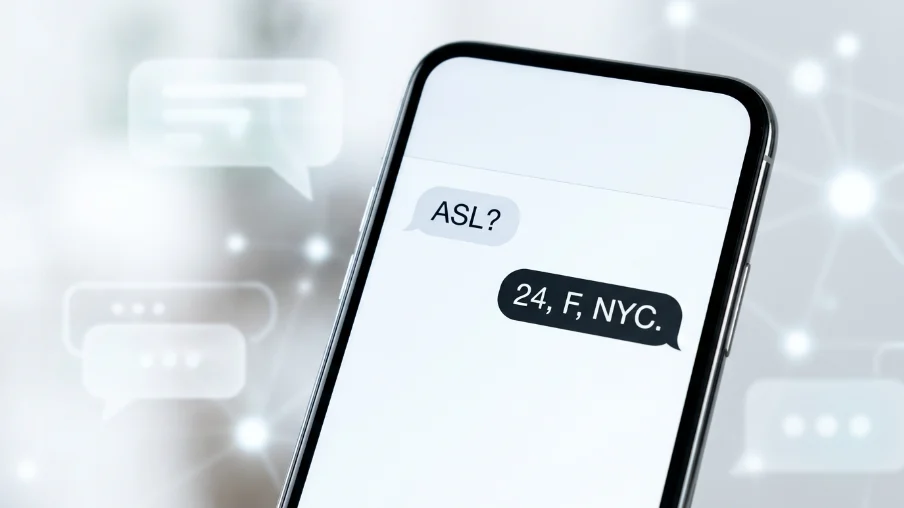
When you encounter “ASL” in online conversations, it’s not about American Sign Language. In text messaging and digital communication, ASL stands for “Age, Sex, Location” a common abbreviation used to request basic personal information from someone you’re chatting with, particularly in anonymous or casual online settings.
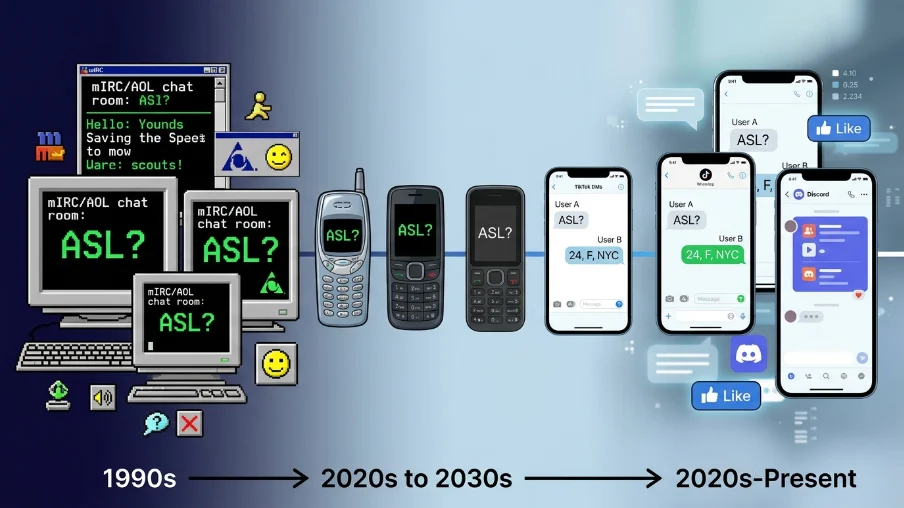
This shorthand became popular in the early days of internet chat rooms, AIM (AOL Instant Messenger), and dating platforms. Today, it remains a quick way to learn more about someone you’re interacting with online, though its usage has evolved with digital culture.
Quick Answer Box
| Element | Details |
| Meaning | Age, Sex, Location |
| Context | Online chat, dating apps, social media, gaming |
| Usage | Asking for someone’s basic personal info |
| Platforms | WhatsApp, Snapchat, TikTok, Discord, Tinder, Instagram |
| Example | “Hey, ASL?” → “21, male, NYC” |
| Tone | Direct, sometimes flirtatious or casual |
What Does ASL Mean in Text?
The Core Definition
ASL is an acronym that stands for Age, Sex, Location. When someone asks “ASL?” in a chat, they’re essentially asking:
- Age: How old are you?
- Sex/Gender: Are you male, female, or non-binary?
- Location: Where do you live (city, state, country)?
Origin and Evolution
The abbreviation emerged during the 1990s internet boom when chat rooms like AOL, Yahoo Messenger, and ICQ dominated online communication. Users would frequently ask “ASL?” to quickly filter potential conversation partners. This became so common that many chat platforms even had automated scripts to display users’ ASL status automatically.
Digital Culture Impact
While still used today, “ASL” has transformed:
- 1990s–2000s: Essential icebreaker in chat rooms
- 2010s: Expanded to dating apps and social media
- 2020s: Mixed usage sometimes ironic, sometimes serious
Full Definition and Linguistic Breakdown
The Three Components
Age
- Usually refers to chronological age in years
- Often asked to determine age-appropriate conversation
- Can indicate maturity level or life stage
Sex
- Refers to biological sex or gender identity
- Often used to gauge romantic/sexual interest
- Sometimes replaced with “gender” in modern usage
Location
- Typically refers to city, state, or country
- Used to establish time zone compatibility
- Can indicate proximity for potential meetups
Grammar and Usage Patterns
The question “ASL?” is typically framed as:
- Standard: “ASL?”
- Polite: “Would you mind sharing your ASL?”
- Casual: “asl pls?”
- Direct: “Age, sex, location?”
Response Variations
Responses follow a predictable pattern:
- Complete: “22, F, LA” (22, female, Los Angeles)
- Partial: “23, M” (age and sex only, often when location is private)
- Vague: “20s, female, East Coast” (protecting privacy)
Context and Usage: Understanding When and How ASL Is Used
Primary Contexts
Casual Chat Rooms
In anonymous chat environments, ASL serves as an immediate conversation starter. Users want to know who they’re talking to before investing time in deeper conversation.
Dating Apps
Apps like Tinder, Bumble, and Hinge often display basic demographics, but “ASL” might be used in the initial messaging phase to confirm details or start conversation.
Gaming Communities
Gamers frequently ask ASL to coordinate playing times, ensure age-appropriate interactions, and sometimes to form teams based on location for better server connections.
Secondary Contexts
Social Media DMs
Instagram, Twitter (X), and TikTok DMs sometimes include “ASL” questions when users connect through comments or mutual friends.
Professional Settings (Rare)
While unusual, “ASL” might appear in professional networking contexts to understand a person’s demographic though more formal phrasing is typical.
Digital Etiquette Surrounding ASL
When It’s Appropriate
- Anonymous chat rooms
- Dating app conversations
- Gaming lobbies
- New friendships forming online
When It’s Inappropriate
- Professional work messages
- Academic settings
- Any context where age or gender is irrelevant
- When the other person has clearly indicated discomfort
Real-Life Examples of ASL in Text Conversations
Example 1: Standard Chat Room Interaction
UserA: “Hey, what’s up?”
UserB: “Not much, just chillin. ASL?”
UserA: “19, M, Texas, u?”
UserB: “22, F, California. Cool, what are you up to?”
Example 2: Dating App Opening
UserA: “Hey, saw you liked my profile.”
UserB: “Yeah, you seem cool. ASL?”
UserA: “28, male, Chicago”
UserB: “26, female, also Chicago! Small world fr.”
Example 3: Gaming Community
UserA: “Looking for teammates for tonight’s raid.”
UserB: “I’m down. ASL?”
UserA: “24, M, PST time zone.”
UserB: “21, M, same zone. Let’s go!”
Example 4: TikTok DMs (Modern Usage)
UserA: “Omg your content is amazing!”
UserB: “Tysm! You seem cool, asl?”
UserA: “17, she/her, NYC”
UserB: “Nice! I’m 19, they/them, London. Let’s collab sometime!”
Example 5: Protective Response
UserA: “Hey, ASL?”
UserB: “I’d rather not share, but happy to chat about common interests!”
UserA: “Fair enough, what music are you into?”
Platform-Specific Meaning and Usage
On WhatsApp, “ASL” usage varies:
- Individual chats: More common when talking to strangers (group invites, business inquiries)
- Group chats: Used as an icebreaker when new members join
- Cultural variations: More common in international groups
Example WhatsApp Conversation
UserA: “Hi, you were recommended by Jake for the project.”
UserB: “Oh great! ASL btw? Just so I know who I’m talking to.”
UserA: “35, male, UK. You?”
UserB: “29, female, US. Perfect, let’s discuss details.”
Snapchat
Snapchat’s ephemeral nature makes “ASL” slightly different:
- Quick add features: Often used after adding someone randomly
- Streaks: Can appear in casual conversation
- Snap Map: Location is already visible, making the “L” part less common
Example Snapchat Conversation
UserA: sends snap with “hey”
UserB: “Hey! asl?”
UserA: “20, she/her. You can see my location on the map lol”
UserB: “Oh true! I’m 22, non-binary, and same city actually 👀”
TikTok
TikTok’s younger demographic uses “ASL” with variations:
- More gender-inclusive: Often “ASL?” might be replaced with “age and pronouns?”
- Irony factor: Sometimes used ironically or as a joke
- Filter usage: Some content creators specifically ask ASL in videos
Example TikTok DMs
UserA: “Your dance videos are everything!!”
UserB: “Tysm! 🥰 asl if you don’t mind?”
UserA: “22, she/her, Florida! Love your style”
UserB: “19, they/them, Cali! So glad we connected, no cap”
Discord
Discord communities have unique ASL patterns:
- Server introductions: Often included in “introduce yourself” channels
- Voice channels: Less common in voice chat, but appears in text
- Gaming teams: Used to coordinate team composition and time zones
Example Discord Conversation
UserA: “New to this server, what’s the vibe?”
UserB: “Chill mostly. ASL? Always good to know who’s around.”
UserA: “27, male, EST”
UserB: “Cool, I’m 23, female, same zone. Welcome!”
Instagram DMs see varied ASL usage:
- Influencer interactions: Fans might ask ASL to connect
- Story replies: Often arises from responding to stories
- Privacy concerns: Many are more guarded due to real-name associations
Example Instagram Conversation
UserA: “Loved your story about NYC! I used to live there.”
UserB: “Oh cool! Where are you now? Also ASL? Nice to know who I’m chatting with.”
UserA: “28, non-binary, LA now. You?”
UserB: “25, female, still in NYC. We should grab coffee if you’re ever back!”
Alternative Meanings and Semantic Variations
American Sign Language
The most common alternative meaning, particularly in academic or professional contexts. When someone says “ASL” in these settings, they almost certainly mean American Sign Language.
Example: “I’m taking ASL classes to communicate with my deaf cousin.”
Associated Student Leaders
In educational settings, ASL can refer to Associated Student Leaders a student government or leadership organization at some schools.
Example: “The ASL is planning the homecoming dance.”
Advanced Semiconductor Lithography
In technical contexts, particularly in engineering or chip manufacturing, ASL might refer to Advanced Semiconductor Lithography.
Example: “Our ASL process enables 3nm chip production.”
Academic Support Learning
Some universities use “ASL” to mean Academic Support Learning tutoring and academic assistance programs.
Anti-Social Language
In psychiatry or linguistics research, ASL sometimes appears as an abbreviation for Anti-Social Language patterns, though this is extremely niche.
Medical Contexts
In healthcare, ASL might mean:
- Arterial Spin Labeling: An MRI technique
- Asymptomatic (rare usage)
Gaming Contexts
Some games use “ASL” for:
- Advanced Soccer League (video games)
- Age, Skill, Level (modified gaming version)
Related Terms and NLP Variations
Common Variations
| Variation | Meaning | Context |
| A/S/L | Age, Sex, Location | Older format, often with slashes |
| ASL? | Question form | Most common usage |
| asl pls | Age, sex, location please | Polite request |
| ASL info | Request for details | More formal |
| GSL | Gender, Sexuality, Location | Modern inclusive alternative |
| ASMR | Different acronym | Sometimes confused by AI |
| ALS | Different acronym | Often confused by spellcheck |
Social Media Hashtags
- #asl: Mixed usage (both American Sign Language and Age, Sex, Location)
- #aslmeaning: Educational content
- #aslsign: Sign language content
- #aslchat: Chatroom references
Semantic Relationships
Direct Synonyms
- “Who are you?”
- “Tell me about yourself”
- “What’s your basic info?”
Related Phrases
- “Age and location?”
- “Where are you from?”
- “How old are you?”
Contextual Paraphrases
- “Can I get to know you?”
- “What’s your background?”
- “Your deets?” (details)
Entity Integration
| Entity Type | Examples |
| Platforms | AOL, Yahoo, ICQ, Discord, WhatsApp, Snapchat |
| Apps | Tinder, Bumble, Hinge, Omegle, Chatroulette |
| Cultural References | Early internet culture, chat room nostalgia |
| Demographics | Millennials, Gen Z, Gen Alpha |
How to Respond When Someone Asks “ASL?”
Quick Response Guide
If You Want to Share
Complete Response: “25, F, Chicago”
With Return: “28, M, LA, you?”
Polite: “I’m 32, female, from Texas. How about you?”
If You Don’t Want to Share
Polite Decline: “I’d rather not share personal info, but happy to chat!”
Vague Response: “I’m in my 20s and on the East Coast”
Deflection: “That’s private, but tell me more about you!”
If You Feel Uncomfortable
Set Boundaries: “I don’t share that online”
Change Subject: “I prefer not to say. What’s your favorite movie?”
Report: If the conversation feels inappropriate, consider blocking or reporting the user.
Modern Inclusive Responses
- “24, they/them, Vancouver”
- “30, non-binary, London”
- “19, she/her, Texas”
Tone and Approach
Your response should match the context:
| Context | Suggested Tone | Example |
| Casual chat room | Friendly, direct | “24, M, Cali, hbu?” |
| Dating app | Flirty, open | “28, F, Miami. What’s your sign?” |
| Gaming | Practical | “22, M, EST for server sync” |
| Professional | Formal or decline | “I’d rather keep it professional” |
| Unsafe feeling | Firm boundary | “Not comfortable sharing, sorry” |
Misinterpretations and Common Mistakes
Confusion with American Sign Language
The most common misunderstanding especially among older adults or those unfamiliar with internet slang. If you use “ASL” around someone unfamiliar with texting slang, clarify immediately.
- Them: “Are you learning sign language?”
- You: “Oh, no, I meant age, sex, location it’s a texting thing!”
Mistaking ALS
In medical contexts, “ALS” (Amyotrophic Lateral Sclerosis) can be confused with “ASL.” This is particularly problematic because ALS is a serious condition, and the abbreviation confusion can cause misunderstandings.
Example: “My mom was diagnosed with ASL” vs. “My mom was diagnosed with ALS”
Geographical Confusion
Users sometimes assume “ASL” is asking for specific addresses rather than general locations. The abbreviation typically expects city, state, or country, not a home address.
Misunderstanding Example:
- Them: “ASL?”
- You: “Wait, you want my actual address?”
Gender Assumptions
The “S” (Sex) component can be problematic when someone doesn’t identify as male or female. Many users now respond with pronouns instead of biological sex.
Inclusive Alternative: “AGL” (Age, Gender, Location) or “ASL” (Age, Sexuality, Location)
Overreliance on ASL
Some users use ASL as their only conversational opener, which can feel robotic or impersonal. It’s often better to pair it with a genuine question about interests.
Better Approach: “Hey! ASL? Also, what kind of music are you into?”
When NOT to Use ASL
Professional Settings
Never use ASL in:
- Work emails
- Professional messaging platforms (Slack, Teams)
- Client communications
- Job interviews or recruitment chats
Academic Environments
Avoid ASL in:
- Educational forums
- University chats
- Teacher-student communications
- Academic research contexts
Public Social Media Posts
Using ASL in public posts can:
- Invite unwanted attention
- Violate platform terms of service (especially for minors)
- Be seen as inappropriate or cringey
Sensitive Conversations
Don’t use ASL:
- When discussing serious topics
- During emotional conversations
- When someone is seeking genuine advice
- In support groups
Age-Related Restrictions
Important: Minors should NEVER share their ASL with strangers online, and platforms often prohibit asking ASL from users identified as underage.
Usage Tips for Effective Communication
Best Practices
- Read the Room: Use ASL in casual, anonymous contexts only
- Be Inclusive: Use gender-neutral language or ask for pronouns
- Share First: To get better responses, share your ASL first
- Protect Privacy: Never share specific addresses or identifiable info
- Respect Boundaries: If someone declines, move on gracefully
- Pair with Real Conversation: Don’t make it the only thing you ask
- Be Age-Appropriate: If you’re over 18, avoid asking minors
Digital Safety Rules
| Rule | Why It Matters |
| Never share your exact address | Prevents stalking and harassment |
| Don’t share with strangers | Reduces risk of scams and catfishing |
| Avoid sharing your workplace | Prevents unwanted visits or doxxing |
| Be vague if uncomfortable | Protects your personal safety |
| Report inappropriate users | Keeps platforms safer for everyone |
Politeness Framework
Polite ✅:
- “Would you mind sharing your ASL?”
- “If you’re comfortable, what’s your ASL?”
- “Just curious, ASL?”
Impolite ❌:
- “ASL NOW”
- “Give me your ASL”
- “asl quick”
Modern Communication Tips
- Match Energy: If they’re casual, be casual; if formal, stay formal
- Add Context: “ASL?” can feel abrupt pair it with a friendly introduction
- Use Emojis: Soften the request: “ASL? 😊”
- Be Clear: If you mean American Sign Language, spell it out to avoid confusion
Frequently Asked Questions
1. What does ASL mean in text?
Answer: ASL stands for “Age, Sex, Location” in text messaging. It’s a question people ask to learn basic personal information about someone they’re chatting with online.
2. What does ASL mean on Snapchat?
Answer: On Snapchat, ASL means “Age, Sex, Location.” However, since Snapchat’s Snap Map feature often shows location, people may ask “AS” (Age, Sex) or “ASL” if they want a specific location.
3. What does ASL mean in a dating app context?
Answer: In dating apps like Tinder or Bumble, ASL helps people verify compatibility and start conversation. It’s a way of confirming age appropriateness, gender preferences, and location for potential meetups.
4. Is ASL still used in 2026?
Answer: Yes, ASL is still used in 2026, though its usage has evolved. Younger generations (Gen Z) often use it ironically or add humor, while older internet users still use it as a standard icebreaker.
5. How do you respond to ASL?
Answer: To respond to ASL, state your age, gender/pronouns, and location. For example: “25, she/her, NYC.” If you’re uncomfortable sharing, you can decline politely or give vague information.
6. What does ASL mean in text from a girl?
Answer: ASL means the same thing regardless of who’s asking. A girl asking “ASL?” simply wants to know your age, sex, and location just like anyone else asking the question.
7. What does ASL mean in chat rooms?
Answer: In chat rooms, “ASL” is an icebreaker question. Users ask it to quickly determine if they want to continue a conversation based on age compatibility, gender, and time zone.
8. What’s the difference between ASL and A/S/L?
Answer: ASL and A/S/L mean the same thing “Age, Sex, Location.” A/S/L is an older formatting style from early internet chat rooms, while ASL is the modern shorthand.
9. Why do people ask ASL?
Answer: People ask ASL to learn basic information about someone they’re talking to. It helps with establishing common ground, verifying compatibility, filtering inappropriate interactions, or simply making conversation.
10. Is it safe to share ASL online?
Answer: Sharing your general age, gender, and city is generally safe, but you should never share your full address, workplace, or other identifying details with strangers. Always protect your personal privacy online.
11. What should you say if you’re uncomfortable answering ASL?
Answer: You can say “I’d rather not share personal info, but happy to chat!” or “That’s private how about we talk about [other topic] instead?” It’s always okay to set boundaries.
12. Do people still say ASL on TikTok?
Answer: Yes, ASL is still used on TikTok, particularly in DMs. However, Gen Z users often ask it in a more inclusive way, like “Age and pronouns?” or sometimes use it ironically.
13. What does ASL mean in texting when a boy asks?
Answer: Same meaning Age, Sex, Location. A boy asking ASL is just looking for basic information, though it can sometimes carry romantic or flirtatious intent, depending on the platform.
14. What does ASL mean in Roblox?
Answer: On Roblox, ASL means “Age, Sex, Location.” However, Roblox has strict safety guidelines, and minors should never share this information with strangers on the platform.
15. How do you ask ASL in a polite way?
Answer: To ask ASL politely, you can say: “If you don’t mind me asking, what’s your ASL?” or “I’m curious what’s your age, gender, and general location?” Always respect if someone declines.
Conclusion
ASL, meaning “Age, Sex, Location,” is a foundational piece of internet culture that has persisted from 1990s chat rooms to today’s social media and dating apps. While its usage has evolved to include more inclusive language and varying levels of irony, it remains a practical tool for establishing basic information in online communication.
Understanding the context, tone, and platform-specific usage of ASL can help you navigate digital conversations more effectively. Whether you choose to share your information freely, decline politely, or adapt your response to be more inclusive, the key is respecting boundaries and maintaining digital safety.
The acronym’s longevity speaks to a universal human need: we naturally want to know who we’re talking to. ASL provides a quick, efficient way to achieve that in a fast-paced digital world. However, as online communication continues to evolve, so does the etiquette around asking and answering these personal questions. Being aware of these nuances and always prioritizing safety and comfort will serve you well in any online interaction.

Andrew Morris is a writer at Meaninga.com who specializes in word meanings, slang, idioms and modern language trends. He creates clear, accurate and easy to understand content for everyday readers.

7 thoughts on “ASL Meaning in Text| Definition, Usage & Examples For 2026”