A tarot yes or no reading uses one or more tarot cards to explore a question that appears to have a yes-or-no answer. Readers interpret each card’s traditional meaning, position, and orientation to suggest yes, no, or maybe.
Tarot yes or no readings offer a simple way to explore a question when you want a quick answer, such as “Should I contact them?” or “Is this the right time to change jobs?” Using one or three tarot cards, you can interpret traditional card meanings as a possible yes, no, or maybe.
However, tarot does not provide a guaranteed prediction of the future. Instead, a reading can help you reflect on your choices, notice possible obstacles, and consider what you may have overlooked. The most useful answers often include a condition, such as “yes, if you prepare” or “not yet, because more information is needed.”
This guide explains how yes-or-no tarot works, which cards traditionally lean toward yes or no, how to perform a reading, and how to interpret the results thoughtfully.
What Does Tarot Yes or No Mean?
A yes-or-no tarot reading is a simple tarot method designed to explore a specific question. Rather than interpreting a large spread, you draw one or a few cards and consider whether their traditional symbolism leans toward a positive, negative, or uncertain answer.
For example, you might ask, “Should I apply for this job?” A card associated with confidence and forward movement could suggest that taking action is worth considering. In contrast, a card associated with uncertainty may encourage you to gather more information first.
There is no universal yes-or-no system shared by every tarot reader. Different traditions assign different meanings to cards, and the same card can suggest different things depending on the question.
Therefore, treat the result as a reflective prompt rather than a fixed prediction. The explanation behind the answer is often more useful than the word “yes” or “no” alone.
Which Tarot Cards Mean Yes or No?
No tarot card has a universally agreed-upon yes-or-no meaning. Still, many readers use traditional symbolism to create a practical reference system.
The following guide offers common interpretations for selected cards. Your own tarot tradition may differ.
Tarot Cards That Often Lean Toward Yes
These cards commonly symbolize progress, opportunity, confidence, fulfillment, or positive momentum.
| Tarot Card | Common Yes Interpretation |
|---|---|
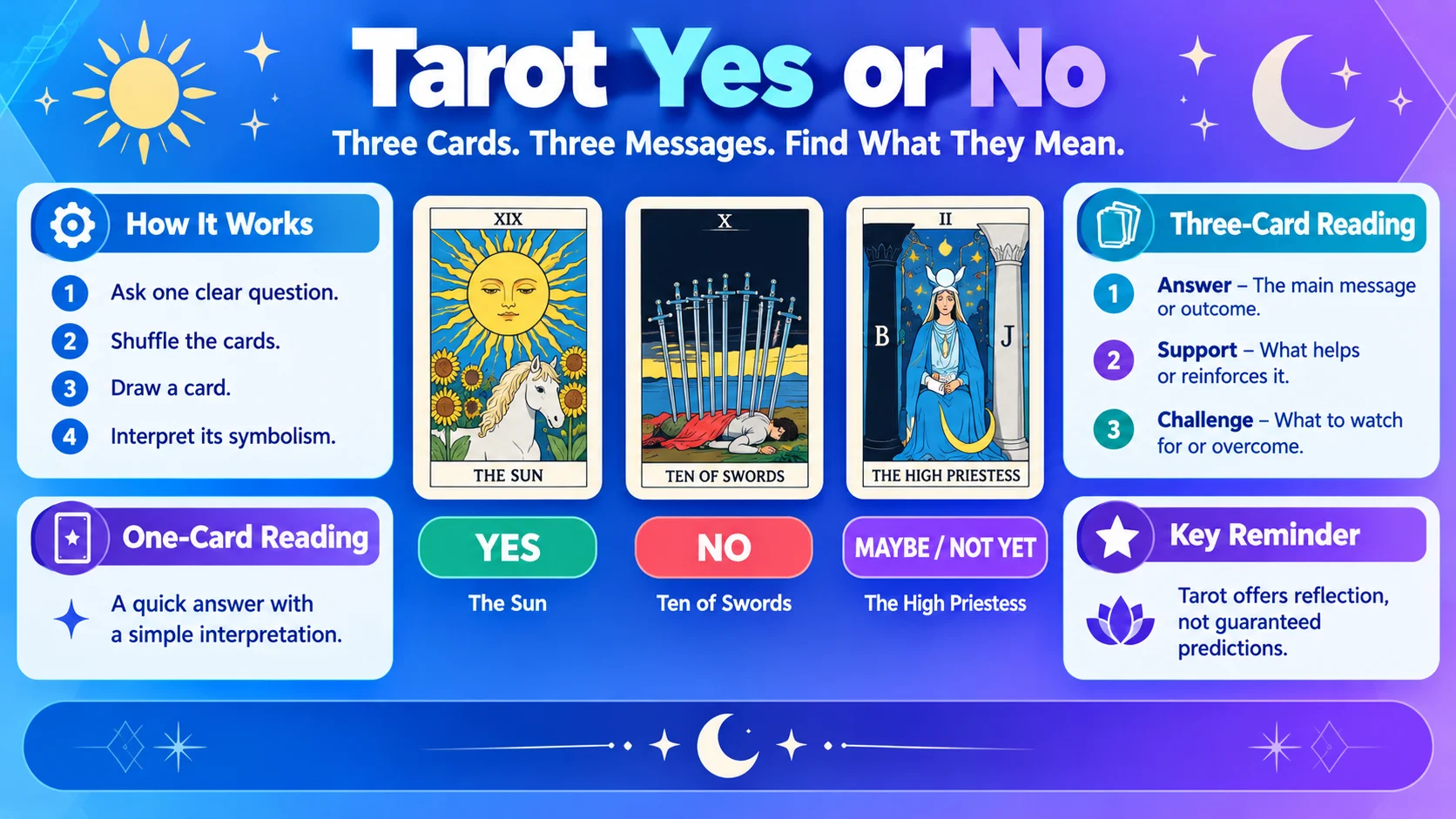
| The Sun | Clarity, success, optimism |
| The Star | Hope, renewal, encouragement |
| The World | Completion, achievement, fulfillment |
| The Magician | Initiative, ability, taking action |
| The Chariot | Determination, progress, control |
| Ace of Cups | Emotional openness, new beginnings |
| Ace of Wands | Inspiration, enthusiasm, opportunity |
| Six of Wands | Recognition, progress, confidence |
| Nine of Cups | Satisfaction, wishes, personal fulfillment |
| Ten of Cups | Harmony, emotional happiness, connection |
For example, The Sun may encourage you to move forward when asking about a new opportunity. Similarly, the Ace of Wands can suggest that an idea deserves action.
Nevertheless, a traditionally positive card does not guarantee a particular outcome. Consider whether the card’s message actually fits your question.
Tarot Cards That Often Lean Toward No
These cards may symbolize obstacles, disappointment, conflict, restriction, or the need to reconsider a situation.
| Tarot Card | Common No Interpretation |
|---|---|
| The Tower | Disruption, instability, sudden change |
| The Devil | Unhealthy attachment, limitation |
| Ten of Swords | Painful ending, exhaustion |
| Three of Swords | Heartbreak, disappointment |
| Five of Pentacles | Difficulty, lack of support |
| Five of Cups | Regret, disappointment, loss |
| Seven of Swords | Secrecy, avoidance, incomplete information |
| Eight of Swords | Feeling restricted, limited options |
For instance, the Ten of Swords might suggest that a particular approach has reached its limit. Meanwhile, the Eight of Swords may encourage you to examine the beliefs or circumstances that make you feel stuck.
Importantly, a challenging card does not always mean an absolute no. Sometimes, it suggests that you should change your approach before proceeding.
Tarot Cards That May Mean Maybe or Not Yet
Some cards point toward uncertainty, hidden information, patience, or a decision that needs more thought.
| Tarot Card | Possible Interpretation |
|---|---|
| The High Priestess | Information is hidden; listen and observe |
| The Moon | Confusion, uncertainty, unclear motives |
| The Hanged Man | Pause, wait, consider another perspective |
| Two of Swords | Indecision, competing choices |
| Seven of Cups | Too many options, unclear priorities |
| The Hermit | Reflection, patience, personal insight |
For example, the Moon may suggest that you do not have enough information to make a confident decision. Likewise, the Hanged Man can indicate that waiting may be more useful than rushing.
Therefore, do not force every card into a strict yes-or-no answer. Sometimes, “not yet” is the most meaningful interpretation.
How to Read Upright and Reversed Cards
A tarot card can appear upright or reversed. In a yes-or-no reading, its orientation may affect how you interpret the answer.
An upright card appears in its normal orientation. Depending on the card, it may suggest open opportunities, movement, confidence, or a challenge that needs attention.
A reversed card appears upside down. Some readers interpret reversals as the opposite of the upright meaning, while others see them as delays, internal struggles, blocked energy, or a need to reconsider.
For example, an upright Sun may lean toward yes because it traditionally symbolizes clarity and success. A reversed Sun might suggest delayed progress, unrealistic expectations, or a positive outcome that requires more effort.
However, reversal rules vary among readers. Before starting, choose a method and apply it consistently. If you usually read without reversals, you can use the upright meanings alone.
One-Card vs. Three-Card Yes or No Tarot
Both methods can help you explore a question. The main difference is how much context you receive.
| Method | How It Works | Best For |
|---|---|---|
| One-card reading | Draw one card and interpret its overall leaning | Quick, straightforward questions |
| Three-card reading | Read the answer alongside supporting factors and possible obstacles | Questions needing more context |
One-Card Tarot Reading
The one-card method is the simplest option. First, state your question clearly. Next, shuffle and draw one card. Finally, interpret its symbolism in relation to your question.
For example, if you ask whether to apply for a job and draw the Chariot, you might interpret it as encouragement to take initiative and move forward with determination.
Even so, the card cannot confirm that you will get the job. Instead, it can prompt you to consider whether you are ready to act.
Three-Card Tarot Reading
A three-card spread provides more context than a single card. You can assign the cards these positions:
- The answer: What direction does the situation lean?
- The support: What may help the outcome?
- The challenge: What obstacle or condition should you consider?
For instance, a positive first card, a supportive second card, and a challenging third card might suggest “yes, if you address the obstacle.”
This method does not have one official interpretation. Rather, it offers a structured way to think about the question without reducing every detail to a single word.
How to Interpret Tarot Yes or No Answers by Topic
The question you ask changes how a card may apply. Therefore, consider the situation instead of relying on a universal card list.
Love and Relationships
Love questions often involve emotions, communication, boundaries, and expectations. A card associated with connection may encourage an honest conversation, while a card associated with uncertainty may suggest taking time to understand the situation.
However, tarot cannot reliably reveal another person’s private thoughts or guarantee that someone will return, contact you, or fall in love with you.
Instead, consider questions about your own choices, such as “Would an honest conversation help me understand this relationship?” This keeps the reading focused on actions you can control.
Career and Work
Career questions can involve opportunities, preparation, timing, and personal goals. Cards associated with initiative or recognition may encourage you to take practical steps toward an opportunity.
On the other hand, cards suggesting restriction or uncertainty may prompt you to review the details before making a decision.
For example, “Am I prepared to apply for this position this month?” gives you a clearer focus than “Will my career be successful?”
Money and Finances
Financial questions need extra care because tarot cannot predict market movements or guarantee financial results. A card may encourage patience, careful planning, or a closer look at your spending habits.
Instead of asking whether an investment will definitely make money, consider asking what financial risks you should review before deciding.
Use budgets, reliable information, and professional advice for real financial decisions. Tarot can serve as a reflection tool, but it should not replace evidence-based planning.
Personal Decisions
For everyday decisions, yes-or-no tarot can help you explore your feelings and priorities. You might ask whether to attend an event, start a project, or have a difficult conversation.
Even so, the reading works best when you already understand the practical options. Use the card to consider a perspective you may have missed, then make your own decision.
Common Mistakes in Yes or No Tarot Readings
A simple spread can still become confusing if you use it without clear rules.
- Asking vague questions: “Will everything work out?” is difficult to interpret. Instead, identify one specific decision or situation.
- Asking several questions at once: Combining relationship, career, and money questions makes the answer harder to understand.
- Treating every card as absolute: A card’s traditional meaning provides context, not guaranteed knowledge of the future.
- Ignoring the card’s meaning: Assigning yes or no based only on whether a card looks attractive can lead to inconsistent readings.
- Repeating the same question: Drawing cards repeatedly until you receive the answer you want can increase confusion rather than clarity.
- Ignoring practical evidence: A reading should not override clear facts, safety concerns, or sound judgment.
Above all, consistency matters. Choose an interpretation method, reflect on the result, and avoid changing the rules simply because you dislike the answer.
Frequently Asked Questions
What is tarot yes or no?
Tarot yes or no is a reading method that uses one or more cards to explore a question with a possible yes, no, or maybe answer. Readers interpret traditional symbolism rather than relying on a universal answer chart.
How many cards should I draw for a yes or no tarot reading?
Beginners can start with one card for a quick interpretation. Alternatively, a three-card spread can provide more context by exploring the answer, supporting factors, and possible obstacles.
Which tarot card is the strongest yes?
The Sun is often interpreted as a strong yes because it symbolizes clarity, optimism, vitality, and success. However, its meaning still depends on your question, the reading method, and the surrounding context.
Which tarot card means no?
Cards such as the Tower, Ten of Swords, and Three of Swords can lean toward no in some systems because they symbolize disruption, endings, or disappointment. Still, their meanings are not universally fixed.
Do reversed tarot cards mean no?
Not always. Some readers interpret reversed cards as the opposite of their upright meanings, while others see delays, blocked energy, or internal challenges. Decide how you will use reversals before beginning your reading.
Can tarot yes or no predict the future accurately?
Tarot has not been scientifically established as a reliable way to predict future events. Many people use it for reflection, symbolism, and exploring choices, but its answers should not be treated as guaranteed outcomes.
Can I ask the same yes-or-no question twice?
You can, but repeatedly drawing cards for the same question may make the result harder to interpret. Instead, reflect on the first reading and consider whether a different, more practical question would help.
Is yes or no tarot suitable for beginners?
Yes. A one-card reading is easy to learn because it requires only a clear question and a basic understanding of card meanings. Beginners should focus on consistency and reflection rather than perfect predictions.
Conclusion
Tarot yes or no readings can offer a simple way to reflect on a question. By drawing one or three cards, you can explore whether a situation leans toward yes, no, or maybe. However, card meanings vary by tradition, and no spread guarantees what will happen. Instead, consider the symbolism, the context, and the practical choices available to you. Whether you ask about love, work, or a personal decision, use the reading to clarify your thoughts rather than surrender your judgment. Ultimately, the most helpful answer is one that encourages thoughtful action, realistic expectations, and greater confidence in your own decisions.