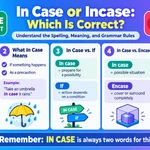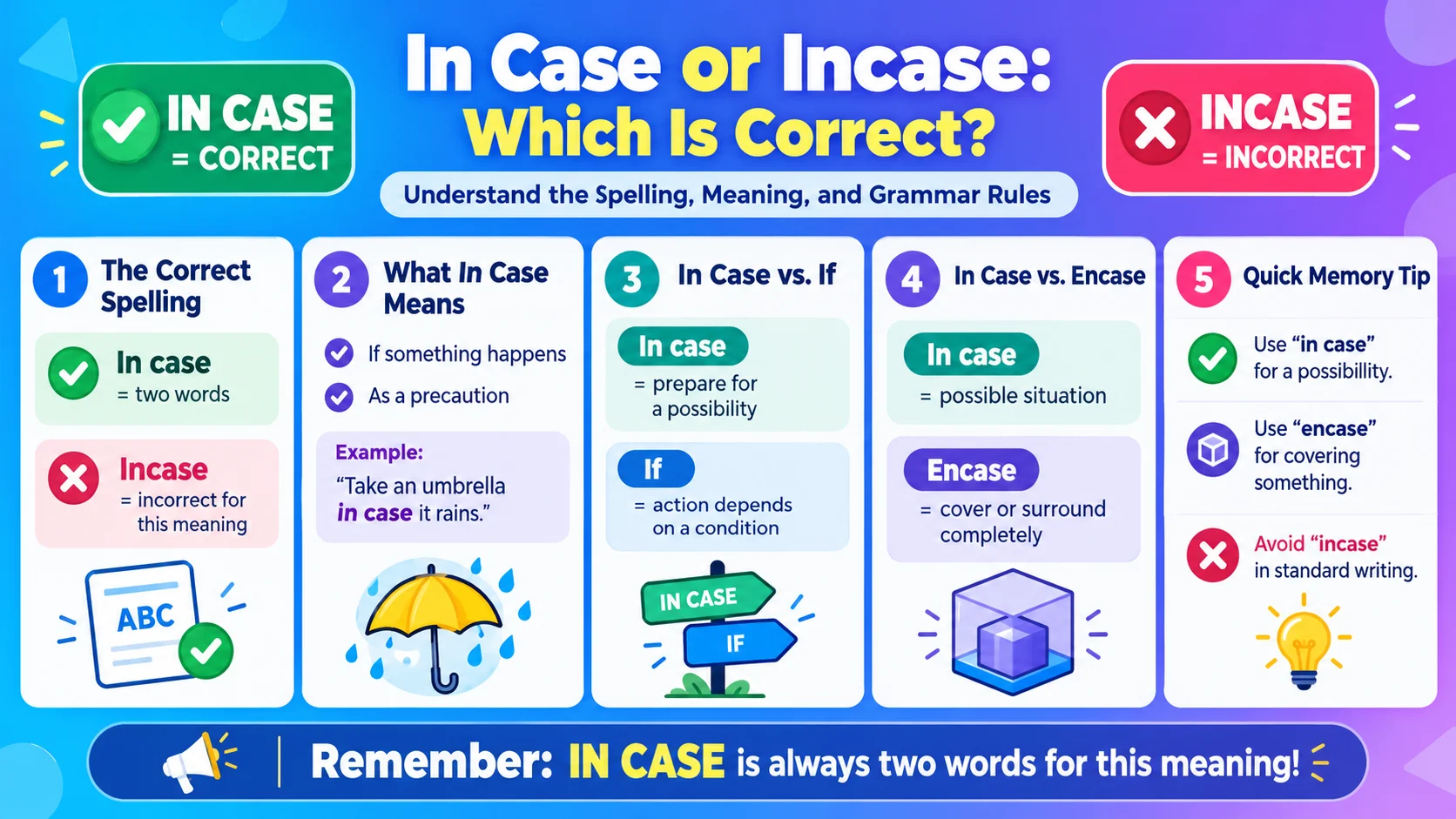
In case is the correct spelling when you mean “if something happens” or “as a precaution.” It is always written as two words in this expression. Meanwhile, incase is generally a misspelling. Use encase when you mean to cover or surround something completely.
In case or incase? The correct spelling is in case, written as two separate words. It means “if something happens” or “as a precaution.” By contrast, incase is generally a misspelling in standard English. For example, write “Take an umbrella in case it rains,” not “Take an umbrella incase it rains.” However, there is another word worth knowing: encase. It means to cover or surround something completely. Although these expressions look and sound similar, they have different meanings. Therefore, understanding the difference will help you avoid spelling mistakes in emails, school assignments, social media posts, and everyday writing.
| Word or Phrase | Correct? | Meaning | Example |
|---|---|---|---|
| In case | success | If something happens; as a precaution | Take a jacket in case it gets cold. |
| Incase | danger | Common misspelling of in case | Avoid writing “incase it rains.” |
| Encase | success | To cover or surround completely | Encase the cable in protective material. |
The main difference is simple. Use in case when preparing for a possible situation. On the other hand, use encase when describing something covered or enclosed.
What Does In Case Mean?
In case is a two-word expression that refers to a possible event or situation. People commonly use it when taking precautions or preparing for something that might happen.
For example:
- Take an umbrella in case it rains.
- Save your work in case the computer crashes.
- Bring some extra money in case you need it.
- Keep my phone number in case you have questions.
In each example, someone prepares for a possible situation. The event may or may not happen. Nevertheless, the person takes action to avoid a problem.
You can also use in case at the beginning of a sentence.
For example:
- In case you forget, your appointment is at 10 a.m.
- In case it gets cold, I brought an extra jacket.
- In case anyone asks, we are meeting at the library.
Additionally, you can use just in case to emphasize a precaution. For instance, “I packed an extra shirt just in case” means you packed it because you might need it.
Why Is Incase Incorrect?
Incase is generally not accepted as the standard spelling of the phrase in case. Writers often combine the two words because they sound like one expression when spoken.
However, pronunciation does not determine correct spelling. English contains many expressions that sound connected but remain separate words in writing.
Consider these examples:
| Incorrect | Correct |
|---|---|
| Bring water incase you get thirsty. | Bring water in case you get thirsty. |
| Call me incase you need help. | Call me in case you need help. |
| Save a copy incase something happens. | Save a copy in case something happens. |
| Take cash incase your card fails. | Take cash in case your card fails. |
| Keep the receipt incase you return it. | Keep the receipt in case you return it. |
Therefore, remember to leave a space between in and case whenever you mean a possible situation or precaution.
When Should You Use In Case?
Use in case when you do something now because a particular event might happen later. In other words, the expression describes preparation for a possibility.
Here are common situations where it fits naturally.
1. Preparing for Bad Weather
People often prepare for weather changes. For example:
- Take an umbrella in case it rains.
- Bring a jacket in case the temperature drops.
- Keep your windows closed in case a storm arrives.
In these sentences, the weather event is uncertain. Nevertheless, the person prepares ahead of time.
2. Preparing for an Emergency
You can also use the phrase when discussing safety or unexpected problems.
- Keep a first-aid kit nearby in case someone gets hurt.
- Save emergency contacts in case you need assistance.
- Carry a flashlight in case the power goes out.
Similarly, these examples show preparation rather than certainty.
3. Preparing for Everyday Situations
The expression also works in ordinary conversations.
- I brought an extra pen in case you need one.
- Keep some snacks in case we get hungry.
- I saved your address in case I visit.
- Take your charger in case your battery runs low.
As you can see, the phrase fits many everyday situations.
4. Using In Case in Messages and Emails
You can use in case in both casual and professional communication. It helps explain why you are taking a precaution.
For example:
- “I attached another copy in case the first file doesn’t open.”
- “Please keep my number in case you need to reach me.”
- “I’ll send the address again in case you missed it.”
In professional writing, the expression is perfectly acceptable. Just make sure you spell it as two words.
In Case vs. If: What’s the Difference?
Although in case and if sometimes appear in similar sentences, they do not always mean the same thing.
If introduces a condition. By contrast, in case often explains a precaution taken because something might happen.
Compare these examples:
| Using In Case | Using If |
|---|---|
| Take an umbrella in case it rains. | Take an umbrella if it rains. |
| Save the document in case your computer crashes. | Save the document if your computer crashes. |
| Bring extra money in case you need it. | Bring extra money if you need it. |
| I’ll keep your number in case I need help. | I’ll call you if I need help. |
The difference becomes clearer when you consider the timing.
- In case: You prepare before the possible event.
- If: Your action depends on whether the condition happens.
For example, “I’ll take an umbrella in case it rains” means you take it now because rain is possible. However, “I’ll take an umbrella if it rains” means you will take it only when rain occurs.
Therefore, the two expressions are related, but they are not always interchangeable.
What Does Just In Case Mean?
Just in case means taking an extra precaution because something might happen. It has almost the same meaning as in case, but the word “just” adds emphasis.
For example:
- I’ll bring an extra charger just in case.
- Keep some cash in your wallet just in case.
- I saved the address just in case we get lost.
- She packed another pair of shoes just in case.
Notice that the expression remains two words after “just.” Therefore, just incase is incorrect in standard writing.
You can also use it as a short response.
Person A: “Why did you bring an extra jacket?”
Person B: “Just in case!”
Here, the speaker does not need to explain the possible situation. The context makes the meaning clear.
What Does In Case Of Mean?
In case of is another correct expression. It usually means “if something happens” and is followed by a noun or noun phrase.
For example:
- In case of fire, use the nearest safe exit.
- In case of emergency, contact the appropriate authorities.
- In case of rain, the outdoor event will move indoors.
- In case of delay, please notify the office.
However, do not confuse in case of with in case.
Use in case + a clause when the following words include a subject and a verb.
Correct: Bring a jacket in case it gets cold.
Use in case of + a noun or noun phrase when referring to an event or situation.
Correct: Bring a jacket in case of cold weather.
The difference is important because you cannot normally place a full subject-and-verb clause directly after “in case of.”
Incorrect: In case of it rains, bring an umbrella.
Correct: In case it rains, bring an umbrella.
Encase vs. In Case: What’s the Difference?
Although encase and in case look similar, they have completely different meanings.
Encase is a verb that means to cover, enclose, or surround something completely. Meanwhile, in case refers to a possible event or precaution.
| Expression | Meaning | Example |
|---|---|---|
| Encase | Cover or surround something | Encase the wire in plastic. |
| In case | Prepare for a possibility | Bring a charger in case your phone dies. |
Examples of Encase
- The artist decided to encase the sculpture in glass.
- Workers will encase the pipes in protective material.
- The museum placed the valuable object in a case.
- The protective coating encases the electronic components.
In addition, encased is the past tense and past participle of encase.
For example: “The delicate object was encased in glass.”
Remember, encase is a real word. However, it cannot replace in case when you are talking about a possible event.
Common Mistakes With In Case and Incase
Even experienced writers sometimes confuse these expressions. Fortunately, a few simple rules can help you avoid the mistake.
Mistake 1: Writing Incase as One Word
Incorrect: I’ll call you incase I need help.
Correct: I’ll call you in case I need help.
Always separate the words when expressing a possibility or precaution.
Mistake 2: Writing Just Incase
Incorrect: Bring an extra shirt just incase.
Correct: Bring an extra shirt just in case.
The word “just” does not change the spelling rule. Therefore, keep the space between “in” and “case.”
Mistake 3: Confusing In Case With If
Incorrect for the intended precaution: I’ll bring an umbrella if it rains, when you mean you will bring it beforehand.
Better: I’ll bring an umbrella in case it rains.
The first sentence makes the action depend on rain. By contrast, the second describes preparation.
Mistake 4: Confusing In Case With Encase
Incorrect: Please in case the gift in wrapping paper.
Correct: Please encase the gift in wrapping paper.
Here, the sentence describes covering an object. Consequently, the verb encase is the correct choice.
Mistake 5: Forgetting the Space in Professional Writing
Small spelling errors can affect the quality of an email, report, or assignment. Therefore, proofread expressions such as in case, at least, and a lot before submitting your work.
How to Remember the Correct Spelling
A simple memory trick can help you remember in case.
Think of the phrase as two separate words:
- In means within or inside.
- Case refers to a situation or possibility.
Together, in case introduces a possible situation that you want to prepare for.
For example, “Take an umbrella in case it rains” means you are preparing for the possibility of rain.
On the other hand, remember encase as an action. When you encase something, you cover or surround it.
You can also use this quick test:
- If you mean “if something happens,” write in case.
- If you mean “cover something completely,” write encase.
- If you are using “incase” for either meaning, check the spelling again.
Ultimately, focusing on the meaning is more reliable than relying on pronunciation.
Frequently Asked Questions
Is incase one word or two?
For the meaning “if something happens” or “as a precaution,” the correct spelling is in case, written as two words. Incase is generally a misspelling in standard English. However, encase is a separate correct verb.
Is in case correct grammar?
Yes. In case is grammatically correct when used to describe a possible event or precaution. For example, “Take an umbrella in case it rains” explains why someone prepares for a possible change in the weather.
Should I write just in case or just incase?
Write just in case, with a space between “in” and “case.” The expression describes an extra precaution or preparation. For example, “I saved an extra copy just in case” is correct.
What is the difference between in case and if?
In case usually describes preparation for a possible event, while if introduces a condition. For example, taking an umbrella in case it rains means preparing beforehand. Taking it if it rains makes the action conditional.
What does in case of mean?
In case of means “if something happens” and is normally followed by a noun or noun phrase. For example, “In case of emergency, call for assistance” is a common and correct construction.
Is encase a real word?
Yes. Encase is a verb meaning to cover, surround, or enclose something completely. For example, “The technician will encase the wires in protective material.” It is different from the phrase “in case.”
Can I start a sentence with in case?
Yes. You can begin a sentence with in case when introducing a possible situation. For example, “In case you need help, I’ll be available.” This construction is grammatically correct.
Why do people spell in case as incase?
People often combine the words because they sound connected in everyday speech. Additionally, typing quickly can lead to spelling mistakes. Nevertheless, standard English keeps the expression as two separate words.
Conclusion
In case is the correct spelling when you mean “if something happens” or “as a precaution.” Although many people write incase, that form is generally incorrect in standard English. For example, write “Take an umbrella in case it rains,” not “Take an umbrella incase it rains.” However, remember that encase is a separate and correct verb meaning to cover or surround something completely. Therefore, focus on the meaning before choosing the spelling. Once you understand this simple difference, you can use these expressions confidently in everyday conversations, emails, and professional writing.