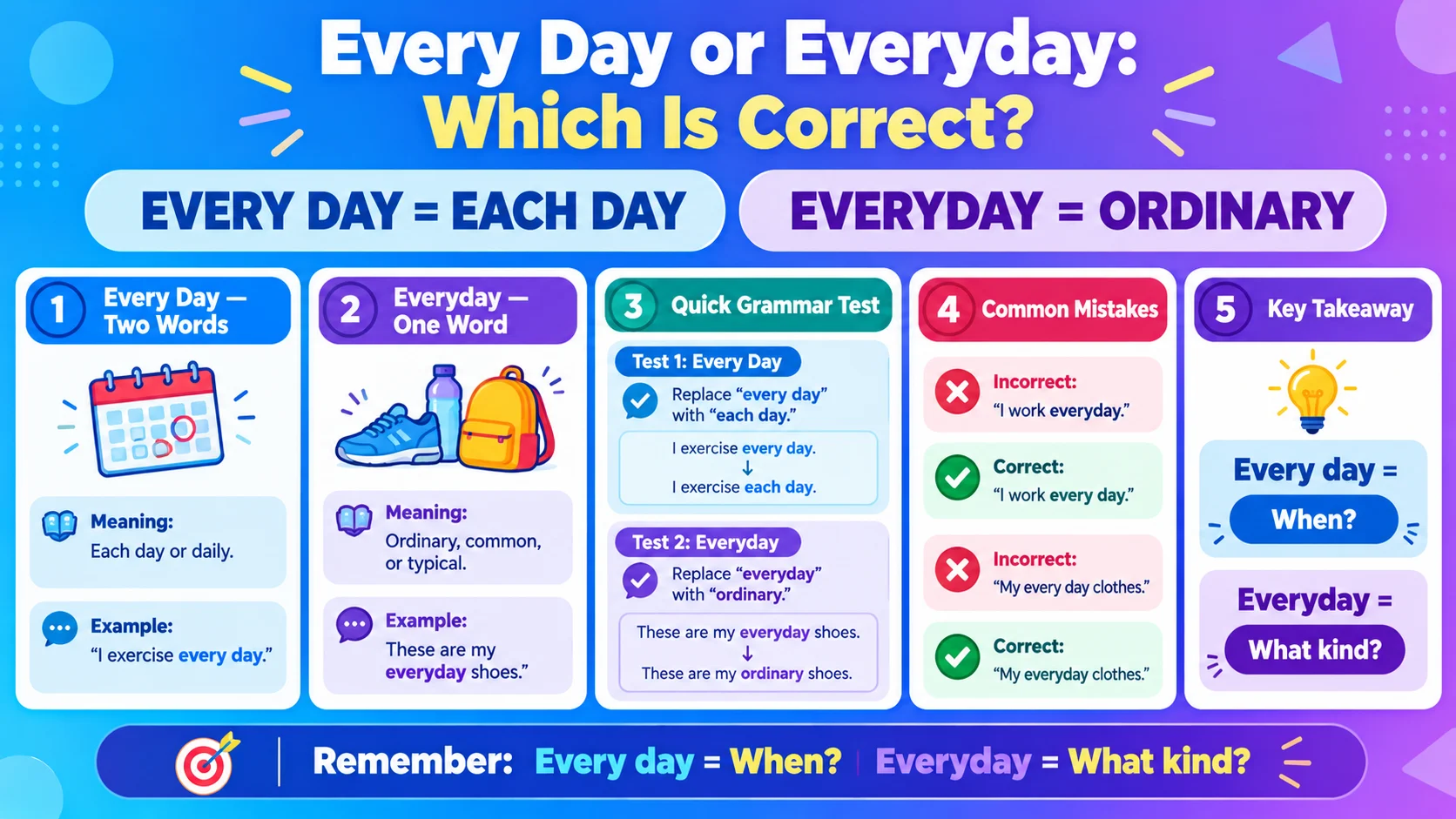
Every day or everyday, which spelling should you use? Both are correct, but they have different meanings and grammatical functions. Every day (two words) means “each day” or “daily.” In contrast, everyday (one word) is an adjective meaning “ordinary,” “common,” or “typical.” For example, “I exercise every day” describes how often you exercise, while “These are my everyday shoes” describes the type of shoes. Although the two forms sound alike, their uses are different. Fortunately, a simple substitution trick can help you choose the correct spelling every time.
Every Day vs. Everyday
| Spelling | Meaning | Part of Speech | Example |
|---|---|---|---|
| Every day | Each day or daily | Adverbial phrase | I read every day. |
| Everyday | Ordinary or typical | Adjective | These are my everyday clothes. |
The easiest rule: Use every day when you mean “each day.” Use everyday when you mean “ordinary” or “common.”
What Is the Difference Between Every Day and Everyday?
The main difference is their meaning and grammatical role. Although both forms contain the words every and day, they do different jobs in a sentence.
Every day refers to frequency. It tells readers how often an action happens. For example, “She walks every day” means she walks each day.
Everyday, however, describes something ordinary or commonly used. It usually appears before a noun. For instance, “She wears everyday shoes” describes shoes intended for regular use.
Therefore, the space between the words matters. It can change the meaning of an entire sentence.
Remember these two definitions:
- Every day = Each day
- Everyday = Ordinary or typical
When to Use Every Day (Two Words)
Use every day when you want to describe something that happens daily or on each day. It commonly works as an adverbial phrase because it explains how often an action occurs.
For example, you might say, “I practice English every day.” Here, the phrase explains the frequency of the practice.
Similarly, you can use it when discussing habits, schedules, routines, and repeated activities.
Examples of Every Day in Sentences
- I drink plenty of water every day.
- She reads a new book every day.
- We walk our dog every day.
- He checks his emails every day.
- They practice basketball every day.
- My mother calls me every day.
- I learn something new every day.
- The children play outside every day.
- He takes the bus to work every day.
- We clean the kitchen every day.
In each example, every day means “each day.” Consequently, the two-word form is correct.
Every Day in Different Contexts
The phrase appears in many types of writing. For example:
Daily routines:
“I make my bed every day.”
Work schedules:
“She checks the sales report every day.”
Education:
“Students should practice reading every day.”
Fitness:
“He exercises every day to stay active.”
Relationships:
“We talk to each other every day.”
In all these examples, the phrase describes frequency rather than the type of activity.
When to Use Everyday (One Word)
Use everyday when you mean something ordinary, regular, common, or typical. Unlike the two-word phrase, this spelling is an adjective.
An adjective describes a noun. Therefore, everyday usually appears before a noun or another adjective that modifies a noun.
For example, “I wear everyday clothes” means you wear ordinary clothes rather than special or formal outfits.
Likewise, “Technology is part of everyday life” describes technology as a normal part of daily living.
Examples of Everyday in Sentences
- These are my everyday shoes.
- Cooking is an everyday activity for her.
- Smartphones are part of everyday life.
- He prefers everyday clothing over formal outfits.
- Traffic is an everyday problem in this city.
- She uses an everyday bag for work.
- Good communication is important in everyday situations.
- These products are designed for everyday use.
- Walking is an everyday habit for many people.
- We face everyday challenges at work.
In these sentences, everyday describes a noun. Therefore, the one-word spelling is correct.
Everyday in Different Contexts
You can use everyday in several common situations.
Clothing:
“I bought a pair of everyday sneakers.”
Lifestyle:
“Music plays an important role in everyday life.”
Activities:
“Cooking and cleaning are everyday activities.”
Products:
“This phone case is designed for everyday use.”
Language:
“People use everyday language when talking with friends.”
As you can see, everyday describes something familiar, ordinary, or regularly used.
Every Day vs. Everyday: Side-by-Side Examples
Comparing both forms in similar sentences makes the difference easier to understand.
| Every Day (Each Day) | Everyday (Ordinary) |
|---|---|
| I exercise every day. | Exercise is part of my everyday routine. |
| She reads every day. | Reading is an everyday activity. |
| He wears that jacket every day. | He wears an everyday jacket. |
| We use the computer every day. | Computers are everyday tools. |
| They cook dinner every day. | Cooking is an everyday task. |
| I practice English every day. | English is part of my everyday learning routine. |
Notice how the meaning changes. The two-word form tells you when something happens. Meanwhile, the one-word form describes what kind of thing it is.
Easy Tricks to Remember Every Day or Everyday
If you still find these spellings confusing, try the following simple tests.
1. The Each Day Test
Replace every day with each day.
If the sentence still makes sense, use the two-word form.
Example:
- Correct: I study English every day.
- Test: I study English each day.
Both sentences make sense. Therefore, every day is correct.
However:
- Incorrect: I wear each day clothes.
- Correct: I wear everyday clothes.
The substitution does not work in the second example. As a result, everyday is the correct choice.
2. The Ordinary Test
Try replacing everyday with ordinary or common.
If the sentence still makes sense, use the one-word spelling.
Example:
- Correct: These are my everyday shoes.
- Test: These are my ordinary shoes.
The sentence still makes sense. Therefore, everyday is correct.
By contrast:
- Incorrect: I exercise ordinary.
- Correct: I exercise every day.
Here, the sentence describes how often you exercise, not the type of exercise.
3. The Noun Test
Check whether the word describes a noun.
If it does, everyday is usually the correct choice.
For example:
- Everyday clothes
- Everyday activities
- Everyday problems
- Everyday language
- Everyday life
On the other hand, if the phrase explains how frequently an action happens, use every day.
For instance, “She studies every day” describes the frequency of studying.
Common Mistakes With Every Day and Everyday
Even experienced writers sometimes confuse these spellings. However, understanding their grammatical roles can help prevent errors.
Mistake 1: Writing Everyday Instead of Every Day
Incorrect: I go to the gym everyday.
Correct: I go to the gym every day.
The sentence describes how frequently the person visits the gym. Therefore, the two-word form is necessary.
Mistake 2: Writing Every Day Instead of Everyday
Incorrect: These are my every day shoes.
Correct: These are my everyday shoes.
Here, the word describes the type of shoes. Consequently, the adjective form is correct.
Mistake 3: Confusing Daily Frequency With Ordinary Things
Incorrect: She wears every day clothes.
Correct: She wears everyday clothes.
The sentence describes ordinary clothing, not how often she wears it.
Mistake 4: Assuming Both Forms Are Interchangeable
Although the spellings sound alike, they cannot replace each other in every sentence.
For example, “I work every day” describes a schedule. However, “I wear everyday clothes” describes ordinary clothing.
Therefore, always consider the meaning before choosing a spelling.
Everyday vs. Every Day in American English
Both spellings are standard in American English. However, they serve different grammatical purposes.
American writers use every day to describe something that happens each day. For example, “The store opens every day.”
Meanwhile, everyday describes something ordinary or common. For instance, “The store sells everyday household products.”
The same distinction applies in British English and other major English varieties. Therefore, the difference is grammatical rather than regional.
In formal writing, professional emails, school assignments, and online articles, using the correct form helps keep your sentences clear.
Every Day or Everyday: Practice Quiz
Now that you understand the difference, test your knowledge with these ten questions.
Choose the correct spelling for each sentence.
- I brush my teeth (everyday / every day).
- These are my (everyday / every day) clothes.
- She practices piano (everyday / every day).
- Technology is part of (everyday / every day) life.
- We go shopping (everyday / every day).
- Cooking is an (everyday / every day) activity.
- He checks his phone (everyday / every day).
- These shoes are suitable for (everyday / every day) use.
- I learn something new (everyday / every day).
- They face (everyday / every day) challenges.
Quiz Answers and Explanations
- Every day — It describes how often you brush your teeth.
- Everyday — It describes the type of clothes.
- Every day — It tells how frequently she practices.
- Everyday — It describes ordinary life.
- Every day — It describes the frequency of shopping.
- Everyday — It describes the type of activity.
- Every day — It tells how frequently he checks his phone.
- Everyday — It describes the intended use of the shoes.
- Every day — It means each day.
- Everyday — It describes ordinary challenges.
Your takeaway: If you can replace the phrase with “each day,” choose every day. If you can replace it with “ordinary,” choose everyday.
Frequently Asked Questions
Is every day one word or two?
Every day is written as two words when it means “each day” or “daily.” However, everyday is one word when it describes something ordinary or typical. Both spellings are correct, but they serve different grammatical purposes.
Is everyday one word?
Yes, everyday is one word when used as an adjective meaning ordinary, common, or typical. For example, “everyday clothes” refers to regular clothing rather than special or formal outfits.
Is every day two words?
Yes, every day is two words when it means “each day.” It usually describes how often an action happens. For example, “She exercises every day” means she exercises daily.
What is the difference between everyday and every day?
Everyday is an adjective that describes ordinary things. In contrast, every day is a phrase meaning “each day.” Therefore, use everyday before nouns and every day when describing frequency.
Is it every day or everyday in a sentence?
The correct spelling depends on the sentence. Write “I study every day” because it describes frequency. However, write “I use everyday language” because everyday describes the type of language.
Can everyday mean daily?
Yes, everyday can describe something associated with normal daily life or regular use. Nevertheless, it does not replace “every day” when describing the exact frequency of an action. For that meaning, use two words.
Is everyday a noun or an adjective?
Everyday is primarily an adjective. It describes nouns such as clothes, activities, problems, language, and life. For example, “everyday responsibilities” means ordinary responsibilities that people commonly handle.
What is another word for everyday?
Common alternatives include ordinary, usual, regular, typical, common, and routine. The best choice depends on context. For example, “everyday clothing” can mean “ordinary clothing” or “regular clothing.”
Conclusion
Every day and everyday are both correct, but they have different meanings. Use every day when describing something that happens each day or daily. In contrast, choose everyday when describing something ordinary, common, or typical. Fortunately, the difference is easy to remember. Simply replace every day with “each day” or everyday with “ordinary.” If the replacement makes sense, you have found the correct spelling. Therefore, pay attention to the sentence’s meaning before writing. With a little practice, you can avoid this common grammar mistake and use both forms confidently in everyday writing.