If your wrist hurts when you bend it or put pressure on it, the cause may be a sprain, tendon irritation, repetitive strain, arthritis, or a small injury. Rest, ice, and avoiding painful activities may help. However, severe pain, deformity, numbness, or significant swelling needs medical attention.
If your wrist hurts when you bend it or put pressure on it, even simple activities can become uncomfortable. You might notice pain when doing push-ups, lifting a heavy object, opening a jar, typing, or pushing yourself up from a chair. Sometimes, the discomfort appears suddenly after an injury. In other cases, it develops gradually because of repeated movements or overuse.
However, wrist pain does not always have the same cause. A mild sprain, irritated tendon, joint problem, or nerve condition can produce similar symptoms. Therefore, the location of the pain, how it started, and whether you have swelling or tingling can provide useful clues.
This guide explains common causes, symptoms, home treatments, and warning signs. Most importantly, it helps you understand when wrist pain needs professional evaluation rather than continued self-care.
Why Does My Wrist Hurt When I Bend It or Put Pressure on It?
Wrist pain during bending or pressure often means that a structure in or around the joint is irritated, injured, or under strain.
Your wrist contains small bones, ligaments, tendons, muscles, and nerves. These structures work together to help you grip, lift, twist, and move your hand. Consequently, irritation in even one area can make certain movements painful.
For example, bending your wrist backward puts pressure on different structures than bending it forward. Similarly, placing your body weight on your palm can stress the wrist joint and its supporting ligaments.
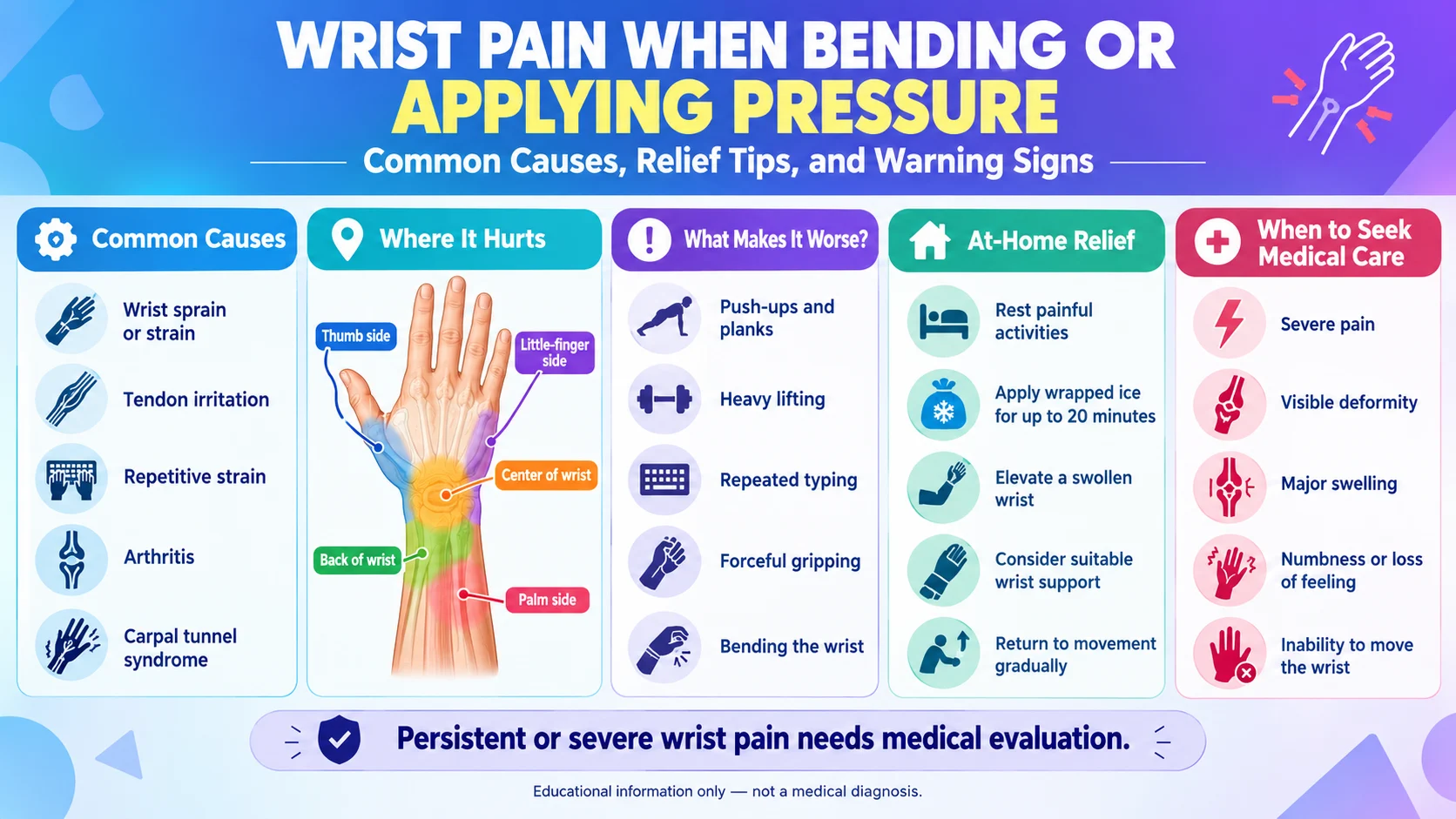
Common explanations include:
- Wrist sprain or strain
- Tendon irritation or tendonitis
- Repetitive strain from daily activities
- Carpal tunnel syndrome
- Arthritis
- Ganglion cyst
- Bone injury or fracture
Nevertheless, the exact cause cannot be determined from this symptom alone. A healthcare professional may need to examine your wrist, especially if the pain is persistent or severe.
Common Causes of Wrist Pain When Bending
Several conditions can make your wrist hurt during movement. Although some involve temporary irritation, others may require specific treatment.
Wrist Sprain
A wrist sprain occurs when the ligaments supporting the joint stretch too far or tear. Ligaments connect bones and help stabilize the wrist.
This injury often happens after falling onto an outstretched hand. However, a sudden twist or forceful movement can also cause a sprain.
Common symptoms include:
- Pain when bending the wrist
- Swelling around the joint
- Tenderness when touching the area
- Bruising after an injury
- Difficulty gripping or lifting objects
For a mild sprain, rest and cold packs may help. However, severe pain, substantial swelling, or difficulty moving the wrist should be assessed by a healthcare professional.
Tendonitis or Tendon Irritation
Tendons connect muscles to bones. When a tendon becomes irritated, wrist movement can cause discomfort.
Repetitive activities may contribute to this problem. For instance, frequent typing, lifting, sports, or repeated gripping can place stress on the tendons.
You might notice pain when bending your wrist, moving your thumb, or gripping something tightly. In addition, tenderness may develop around the affected tendon.
De Quervain’s tenosynovitis is one specific condition involving tendons near the base of the thumb. It can cause pain on the thumb side of the wrist, especially during gripping or thumb movement.
Repetitive Strain Injury
Repetitive strain develops when you repeatedly perform movements that place stress on the wrist and surrounding tissues.
Common activities include:
- Long hours of computer use
- Repeated phone scrolling
- Frequent lifting
- Playing tennis or other racket sports
- Using vibrating tools
- Repetitive gripping at work
Initially, the discomfort may appear only during certain activities. However, continued strain can make the pain more frequent.
Therefore, reducing the movements that trigger discomfort is an important first step.
Carpal Tunnel Syndrome
Carpal tunnel syndrome develops when the median nerve becomes compressed as it passes through a narrow space in the wrist.
Unlike a simple sprain, this condition often causes nerve-related symptoms. You may experience:
- Tingling in the thumb and fingers
- Numbness in the hand
- Burning or aching discomfort
- Weakness when gripping objects
- Symptoms that become worse at night
Although wrist pain can occur, tingling and numbness are important clues. If these symptoms persist or worsen, arrange a medical assessment.
Arthritis
Arthritis can cause inflammation, stiffness, and pain in the wrist joint.
Osteoarthritis develops as joint cartilage changes over time. Rheumatoid arthritis, on the other hand, is an inflammatory condition that can affect multiple joints.
You may notice stiffness after resting, tenderness during movement, or swelling around the wrist. Additionally, symptoms may become more noticeable in the morning or after periods of inactivity.
A medical examination can help identify the type of joint problem and guide treatment.
Ganglion Cyst
A ganglion cyst is a fluid-filled lump that commonly develops near the wrist joint or tendon.
Some cysts do not cause symptoms. However, others may produce discomfort when you bend your wrist, grip objects, or put pressure on the affected area.
You might notice a smooth, round lump on the wrist. Its size can change over time, and pain may increase when it presses on nearby structures.
If a lump becomes painful, red, hot, or rapidly changes, seek medical advice rather than trying to squeeze or puncture it.
Wrist Fracture
A fracture means that one or more wrist bones have broken. It can happen after a fall, direct impact, or other injury.
A broken wrist may cause sharp pain, swelling, bruising, and difficulty moving the hand. Sometimes, the wrist looks visibly different.
Importantly, not every fracture causes an obvious deformity. Some small fractures can initially resemble a sprain.
Therefore, if wrist pain started after a fall or impact, do not assume it is minor simply because you can still move your hand.
Why Does My Wrist Hurt When I Put Pressure on It?
Pain during pressure often becomes noticeable when you place your palm against a surface or use your hand to support your body weight.
For example, you might feel discomfort during push-ups, planks, yoga poses, or when pushing yourself out of a chair.
Several factors may explain this symptom.
Joint irritation: Pressure can aggravate an already irritated wrist joint.
Ligament injury: A sprain may make the wrist painful when it supports weight.
Tendon problems: Inflamed or irritated tendons may hurt during gripping and movement.
Previous injury: An injury that has not healed properly may cause discomfort during weight-bearing activities.
Limited wrist mobility: If the wrist cannot bend comfortably, certain positions may place extra stress on surrounding structures.
Consequently, avoid repeatedly testing the painful movement. Instead, reduce pressure on the wrist until you understand what is causing the discomfort.
What Does the Location of Wrist Pain Tell You?
The location of your discomfort can offer useful clues. However, it cannot confirm a diagnosis on its own.
| Pain Location | Possible Causes | Other Clues |
|---|---|---|
| Thumb side | De Quervain’s tenosynovitis, arthritis, sprain | Pain when moving the thumb |
| Little-finger side | Tendon or ligament irritation, joint problems | Pain when twisting or gripping |
| Center of wrist | Sprain, joint irritation, ganglion cyst | Pain during bending or pressure |
| Palm side | Carpal tunnel syndrome, tendon irritation | Tingling or numbness |
| Back of wrist | Sprain, tendon irritation, ganglion cyst | Pain when bending backward |
For instance, pain near the thumb may suggest a tendon problem. Meanwhile, tingling in the thumb and fingers may point toward nerve compression.
Still, a proper examination is necessary to distinguish between these conditions.
Symptoms That May Occur Along With Wrist Pain
Wrist pain does not always appear by itself. Depending on the underlying problem, you may experience additional symptoms.
Swelling: This can occur after an injury or because of inflammation.
Stiffness: Your wrist may feel difficult to bend or straighten, especially after resting.
Tenderness: Pressing a particular area may cause discomfort.
Weak grip: You may struggle to hold a cup, open a jar, or carry a bag.
Tingling: Pins and needles can suggest nerve irritation.
Numbness: Reduced sensation in the fingers or hand needs medical attention if it persists.
Clicking or popping: Some wrist movements may produce sounds, although painless clicking alone does not necessarily indicate an injury.
However, severe pain, major swelling, deformity, or loss of sensation should never be ignored.
How to Relieve Wrist Pain at Home
If your pain is mild and there are no warning signs of a serious injury, several self-care steps may help.
Rest Your Wrist
First, reduce activities that trigger pain. Avoid heavy lifting, push-ups, planks, forceful gripping, and repeated wrist bending.
However, complete immobilization for a long period is not always helpful. Gentle, comfortable movement may help prevent stiffness when a serious injury has been ruled out.
Apply an Ice Pack
Cold therapy may help reduce pain and swelling, particularly after a recent injury.
- Wrap an ice pack in a thin towel.
- Apply it to the painful area for up to 20 minutes.
- Repeat every two to three hours if needed.
- Never place ice directly against your skin.
If cold makes the area uncomfortable or causes skin irritation, stop using it.
Keep Your Wrist Elevated
If your wrist is swollen, support your hand and raise it above heart level when possible.
This may help reduce swelling. Additionally, remove tight watches, bracelets, or rings if your hand begins to swell.
Consider a Wrist Splint
A wrist splint can support the joint and limit painful movements.
For some conditions, a comfortable splint may be useful during activities or at night. However, it should not feel tight or cause numbness, tingling, or changes in finger color.
A pharmacist or healthcare professional can help you choose an appropriate support.
Adjust Your Daily Activities
Small changes can reduce repeated stress on your wrist.
For example:
- Keep your wrist in a comfortable, neutral position while typing.
- Take regular breaks from computer work.
- Avoid lifting heavy objects with one hand.
- Use both hands when carrying heavier items.
- Reduce activities that require forceful gripping.
As your symptoms improve, gradually return to normal activities rather than immediately resuming heavy exercise.
Ask About Pain Relief
Over-the-counter pain medicines may help some people. However, the safest option depends on your age, medical history, other medicines, and possible allergies.
A pharmacist or healthcare professional can advise whether paracetamol or an anti-inflammatory medicine is suitable. Do not exceed the recommended dose or use a medicine that is unsafe for you.
Wrist Exercises: Should You Stretch a Painful Wrist?
Gentle movement can help maintain wrist mobility when the problem is mild. Nevertheless, exercises are not appropriate for every injury.
If your wrist is swollen, severely painful, or recently injured, seek advice before starting exercises.
Once a serious injury has been ruled out, a healthcare professional may recommend gentle movements such as:
Wrist bending: Slowly move your wrist forward and backward within a comfortable range.
Finger movement: Gently open and close your fingers without squeezing tightly.
Wrist rotation: Slowly turn your palm upward and downward while keeping your elbow close to your body.
Gentle stretching: Move only as far as feels comfortable, without forcing the joint.
Stop if an exercise increases pain, swelling, tingling, or numbness. In addition, avoid using exercises as a way to push through sharp pain.
When Should You See a Doctor for Wrist Pain?
Some mild wrist problems improve with appropriate self-care. However, persistent or worsening symptoms deserve medical attention.
Arrange an appointment if:
- Your wrist pain interferes with everyday activities.
- The discomfort keeps returning.
- Pain is getting worse instead of improving.
- Symptoms have not improved after about two weeks of home care.
- You experience persistent tingling or numbness.
- Your grip becomes weaker.
- Your wrist feels warm, swollen, or stiff.
- You have diabetes and develop new wrist or hand symptoms.
A healthcare professional can examine your wrist and determine whether you need imaging, medication, a splint, or physical therapy.
When Is Wrist Pain an Emergency?
Certain symptoms may indicate a fracture, serious injury, or infection. Therefore, do not wait for home treatment to work if you notice:
- Severe wrist pain after an injury
- A visibly deformed wrist
- Inability to move your wrist or hold objects
- Loss of feeling in part or all of your hand
- A sudden loss of strength
- A hot, red, and very swollen wrist
- A painful lump that becomes hot or red
- Fever or feeling seriously unwell alongside wrist symptoms
Seek urgent medical care if these warning signs occur. If your fingers become pale, blue, cold, or suddenly numb after an injury, get emergency assessment.
How Do Doctors Diagnose Wrist Pain?
A healthcare professional usually begins by asking when the pain started and what makes it worse.
For example, they may ask whether you recently fell, lifted something heavy, started a new exercise routine, or spent more time using a computer.
Next, they may examine the wrist for tenderness, swelling, movement limitations, and changes in grip strength.
Depending on the findings, additional tests may be useful.
| Test | Purpose |
|---|---|
| Physical examination | Checks movement, tenderness, swelling, and strength |
| X-ray | Looks for fractures and some joint changes |
| Ultrasound | Examines certain tendons and soft tissues |
| MRI | Provides detailed images of bones and soft tissues |
| Nerve testing | Helps assess possible nerve compression |
Not everyone needs imaging. Instead, the appropriate test depends on the suspected cause and examination findings.
How Long Does Wrist Pain Take to Heal?
Recovery time depends on the cause, severity, and treatment.
A mild strain may improve within days or a few weeks. However, a more significant sprain can take several weeks or longer.
Tendon problems may take longer, especially when the activities causing irritation continue. Similarly, nerve conditions and arthritis may require ongoing management.
Therefore, avoid judging recovery only by whether the pain disappears for a day. Your wrist should also regain comfortable movement and function.
If symptoms remain unchanged, worsen, or repeatedly return, arrange a medical assessment.
How to Prevent Wrist Pain in the Future
You can reduce some causes of wrist discomfort by changing how you use your hands.
- Maintain a neutral wrist position: Keep your wrist comfortable while typing or lifting.
- Take regular breaks: Avoid repeating the same movement for long periods.
- Build strength gradually: Increase exercise intensity slowly.
- Use proper technique: Pay attention to wrist alignment during sports and workouts.
- Avoid sudden increases in workload: Give your body time to adjust.
- Use suitable equipment: Choose comfortable tools and sports equipment.
- Respond to early discomfort: Reduce painful activities before symptoms become persistent.
Most importantly, do not ignore recurring pain just because it disappears after resting.
Frequently Asked Questions
Why does my wrist hurt when I bend it backward?
Pain when bending your wrist backward may result from a sprain, tendon irritation, joint inflammation, or a previous injury. Additionally, putting weight on your palm can increase pressure on sensitive wrist structures.
Why does my wrist hurt when I put pressure on it?
Pressure-related wrist pain can occur when irritated tendons, ligaments, or joints become compressed. For example, push-ups and planks place body weight through the wrist. Persistent pain deserves a medical assessment.
Can typing cause wrist pain?
Yes. Long periods of typing or repetitive computer use can contribute to wrist discomfort. However, typing is not the only possible cause. Poor positioning, repetitive gripping, and existing tendon or nerve problems may also contribute.
Can a wrist sprain heal on its own?
Mild wrist sprains often improve with appropriate rest and home care. Nevertheless, moderate or severe injuries may require a splint or medical treatment. Persistent pain, swelling, or weakness should be evaluated.
Should I wear a wrist brace while sleeping?
A comfortable wrist splint may help certain conditions, including carpal tunnel syndrome. However, the right support depends on the cause. Avoid wearing a brace that causes numbness, tingling, swelling, or discomfort.
Is wrist pain a sign of carpal tunnel syndrome?
It can be, but wrist pain alone does not confirm carpal tunnel syndrome. Tingling, numbness, and weakness in the hand or fingers are more characteristic. A healthcare professional can assess these symptoms.
Should I exercise if my wrist hurts?
Avoid exercises that increase pain or put heavy pressure on your wrist. Gentle movement may be appropriate for mild problems, but a recent injury, swelling, or severe pain should be assessed first.
When should I worry about wrist pain?
Seek urgent care if your wrist is deformed, severely painful, very swollen, or impossible to move. Additionally, sudden numbness, loss of strength, or a hot, red wrist with fever needs prompt medical attention.
Conclusion
If your wrist hurts when you bend it or put pressure on it, the cause may be a sprain, tendon irritation, repetitive strain, arthritis, or another condition. Fortunately, mild problems may improve with rest, ice, and changes to painful activities. However, persistent discomfort, swelling, weakness, or tingling should not be ignored. Severe pain, deformity, or loss of feeling requires urgent medical attention. Most importantly, avoid forcing painful movements or continuing activities that aggravate your wrist. Because different conditions can produce similar symptoms, a healthcare professional can help identify the cause and recommend appropriate treatment for a safe recovery.