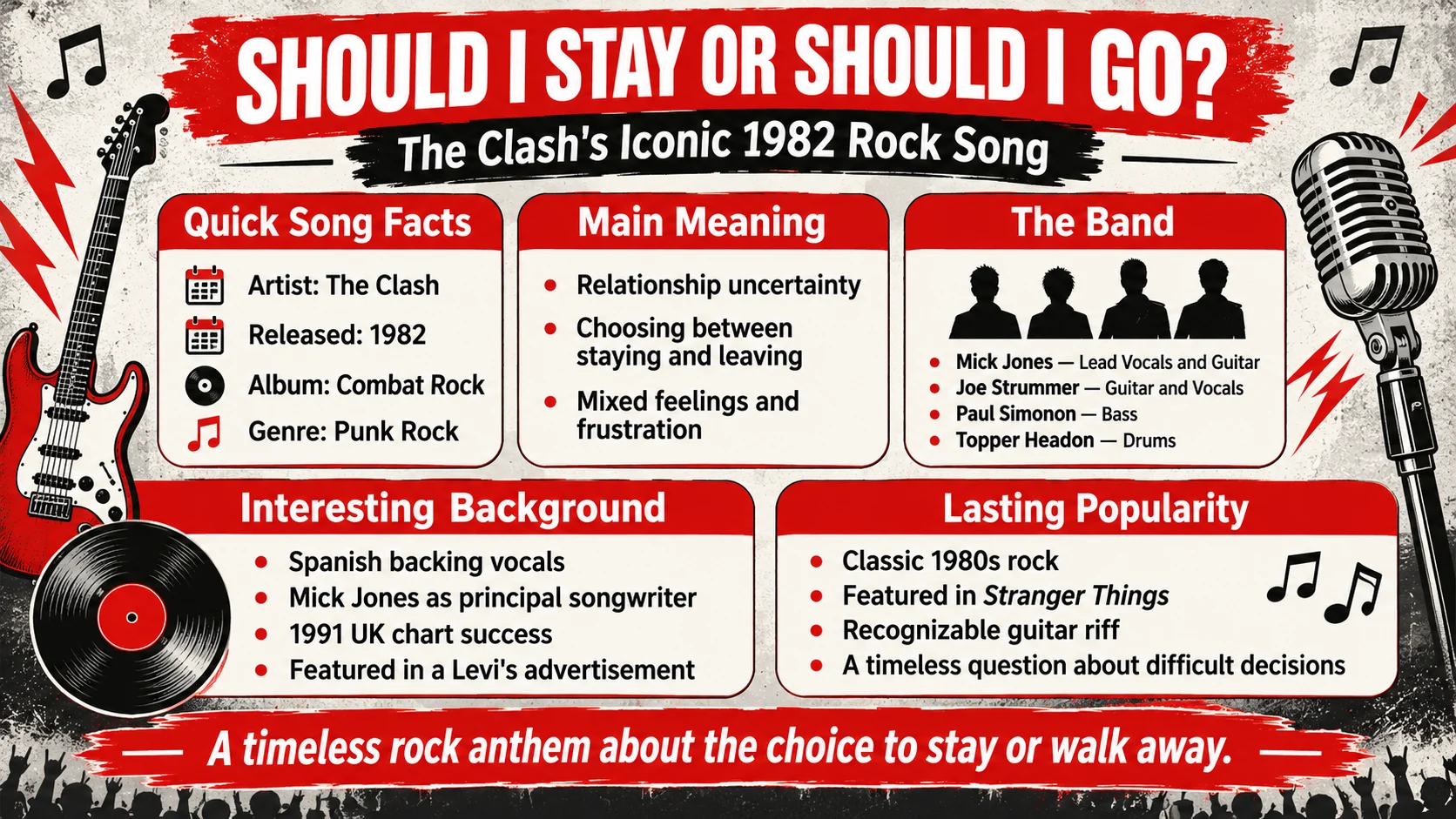
“Should I Stay or Should I Go” is a 1982 song by The Clash about relationship uncertainty and the difficult choice between staying with someone or leaving. It expresses frustration, mixed feelings, and the desire for a clear decision.
“Should I Stay or Should I Go” is a famous rock song by the British punk band The Clash. Released in 1982, the song explores the confusion of being caught between staying in a relationship and walking away. Its catchy guitar riff, memorable chorus, and energetic performance helped make it one of the band’s best-known songs.
At first, the title sounds like a simple question about leaving or staying. However, the song captures a deeper feeling: uncertainty when a relationship becomes emotionally complicated. The narrator wants a clear answer, yet neither choice seems easy. As a result, the track connects with listeners who have experienced mixed signals, relationship problems, or difficult decisions.
Over time, the song became even more popular through a 1991 re-release and its appearance in popular culture. This article explores its meaning, original release, background, musical style, history, and lasting popularity.
Should I Stay or Should I Go
| Detail | Information |
|---|---|
| Song title | Should I Stay or Should I Go |
| Artist | The Clash |
| Original release | 1982 |
| Album | Combat Rock |
| Genre | Punk rock, rock |
| Lead vocalist | Mick Jones |
| Songwriting | The Clash |
| Record label | CBS Records |
| Language | English and Spanish backing vocals |
| 1991 milestone | Reached No. 1 on the UK Singles Chart |
The track appeared on Combat Rock, The Clash’s fifth studio album. Moreover, its later success introduced the song to a new generation of listeners.
What Is Should I Stay or Should I Go About?
The song explores a relationship in which one person cannot decide whether to remain or leave. The narrator wants the other person to make their feelings clear. However, the relationship seems unpredictable, creating frustration and emotional tension.
The central question reflects a familiar experience. Someone may care about a relationship but feel exhausted by uncertainty. Meanwhile, staying can bring more conflict, while leaving can create a different kind of pain.
That tension gives the song its lasting appeal. Instead of presenting a simple answer, it captures the struggle of making a difficult personal decision.
The song also uses a direct, conversational style. Consequently, listeners can understand its central conflict without needing a complicated explanation.
Who Sang Should I Stay or Should I Go?
The Clash performed “Should I Stay or Should I Go.” Mick Jones sings the lead vocal, while the other band members contribute to the track’s energetic sound.
The classic lineup associated with the recording includes:
| Band Member | Role |
|---|---|
| Mick Jones | Lead vocals and guitar |
| Joe Strummer | Guitar and vocals |
| Paul Simonon | Bass guitar |
| Nicky “Topper” Headon | Drums |
Mick Jones was the principal songwriter behind the track. Nevertheless, the song was credited to The Clash as a band composition.
Joe Strummer also helped make the recording distinctive. In particular, the Spanish backing vocals give the song an unusual musical touch.
When Was Should I Stay or Should I Go Released?
The Clash released “Should I Stay or Should I Go” as a single in 1982. It also appeared on their fifth studio album, Combat Rock, released that year.
Initially, the song achieved moderate chart success. However, its popularity grew significantly after its use in a Levi’s jeans advertisement in 1991.
That exposure helped bring the track back to the public’s attention. Subsequently, the re-released single reached No. 1 on the UK Singles Chart.
This second wave of success made the song one of The Clash’s most recognizable recordings. It also introduced the band’s music to listeners who may not have known the original 1982 release.
The Story Behind the Song
The history of “Should I Stay or Should I Go” is closely connected to The Clash’s creative period around Combat Rock.
The band worked on the song during sessions that began before the album was completed. Eventually, it developed into a catchy rock track that stood apart from some of the album’s more politically focused material.
Mick Jones later explained that the song was not written about one specific person. He also rejected the idea that it was a prediction of his departure from the band.
Although listeners have connected the song to Jones’s personal relationships and tensions within The Clash, those interpretations should not be treated as confirmed explanations.
Instead, the song works as a straightforward expression of relationship uncertainty. Its simple question gives listeners room to connect it with their own experiences.
Why Does Should I Stay or Should I Go Have Spanish Vocals?
One of the most recognizable features of the song is its Spanish backing vocals.
Joe Strummer decided to include Spanish lines during the recording process. However, the band needed help translating the words.
Their recording engineer, Eddie Garcia, contacted his mother in Brooklyn. She translated the lines over the phone, drawing on her Ecuadorian Spanish background.
Joe Ely, a Texas musician and friend of the band, also contributed to the Spanish backing vocals.
As a result, the recording gained a distinctive bilingual element. Rather than sounding like a formal translation exercise, the Spanish parts add character and playful energy to the performance.
This unusual detail is one reason the song remains recognizable among classic rock recordings.
What Genre Is Should I Stay or Should I Go?
“Should I Stay or Should I Go” is commonly described as a punk rock song. It also features accessible rock melodies and a strong, straightforward guitar arrangement.
The track combines several musical elements:
- Punk energy: The performance has a direct and lively feel.
- Guitar-driven sound: Its memorable riff gives the song much of its identity.
- Strong rhythm: Bass and drums create a steady, driving foundation.
- Catchy vocals: Mick Jones delivers the central question in an energetic style.
- Spanish backing vocals: These add a distinctive musical detail.
Although The Clash were known for combining punk with reggae, rock, and other influences, this track leans toward a more direct rock sound.
Therefore, it became accessible to listeners beyond the band’s original punk audience.
Why Did Should I Stay or Should I Go Become So Popular?
The song’s popularity comes from several factors. First, its central question is easy to understand. Almost everyone can relate to feeling uncertain about a relationship or an important decision.
Second, the guitar riff and chorus make the track memorable. In addition, its energetic sound works well on radio, at parties, and during live performances.
The 1991 Levi’s advertisement also played an important role. After the song appeared in the commercial, renewed attention helped the re-release reach the top of the UK chart.
Years later, its appearance in Stranger Things introduced the recording to another generation. Consequently, the song continued to attract listeners long after its original release.
Its combination of a relatable theme, distinctive sound, and cultural exposure helped secure its place in rock history.
Is Should I Stay or Should I Go About Mick Jones Leaving The Clash?
Some listeners have interpreted the song as a reference to tensions within The Clash, especially the circumstances surrounding Mick Jones’s eventual departure.
However, Jones said the song was not written about his leaving the band. He also explained that it was not about a particular person.
That clarification is important because popular interpretations are not always the same as an artist’s stated intention.
The song can certainly sound like a conversation about a relationship that may be ending. Nevertheless, there is no need to connect its meaning to one specific event in Jones’s life.
Instead, its open-ended message allows listeners to apply the question to relationships, personal choices, and other difficult situations.
Should I Stay or Should I Go in Popular Culture
The song has remained part of popular culture for decades. Its return to the UK charts in 1991 gave it a second life, while later television appearances helped keep it familiar.
One notable example is Stranger Things. The series uses music from the 1980s to help establish its setting and emotional atmosphere. The Clash’s song became recognizable to younger viewers through its connection to the show.
Additionally, the song has appeared in advertisements, music collections, radio playlists, and live performances.
Its popularity also comes from its flexibility. The same track can feel like a relationship anthem, a fun rock song, or a nostalgic reminder of the 1980s.
What Makes the Song Still Relevant Today?
The question at the center of the song remains familiar. People still face situations where they must decide whether to stay in a relationship, leave a difficult situation, or wait for someone else to make a choice.
Furthermore, the song does not offer an easy solution. Instead, it captures the frustration of wanting certainty when emotions make a decision harder.
Its energetic sound also helps it cross generations. While the original recording belongs to the early 1980s, its theme still connects with modern listeners.
Ultimately, the song remains relevant because uncertainty is not limited to one decade. People continue to face difficult choices, and the question of staying or leaving still carries emotional weight.
Frequently Asked Questions
Who originally sang Should I Stay or Should I Go?
The British punk rock band The Clash originally performed “Should I Stay or Should I Go.” Mick Jones sings the lead vocal, while Joe Strummer, Paul Simonon, and Topper Headon contribute to the recording.
When did Should I Stay or Should I Go come out?
The Clash released “Should I Stay or Should I Go” in 1982. The song appeared on their album Combat Rock and later received a successful re-release in 1991.
Who wrote Should I Stay or Should I Go?
The song was credited to The Clash, with Mick Jones serving as its principal songwriter. The track was developed during the band’s recording period around the Combat Rock album.
What does Should I Stay or Should I Go mean?
The song explores uncertainty in a relationship. The narrator wants a clear decision about whether to stay together or separate. As a result, it expresses frustration, mixed emotions, and the difficulty of choosing between two options.
Is Should I Stay or Should I Go about a real relationship?
Listeners have connected the song to Mick Jones’s personal relationships. However, Jones said it was not written about a specific person. Therefore, interpretations about a particular relationship remain speculation.
Why does the song include Spanish vocals?
Joe Strummer decided to add Spanish backing vocals during recording. The band then received translation help from the mother of recording engineer Eddie Garcia, who provided an Ecuadorian Spanish interpretation.
What album features Should I Stay or Should I Go?
The song appears on Combat Rock, The Clash’s fifth studio album. Released in 1982, the album also includes other well-known tracks from the band’s career.
Did Should I Stay or Should I Go reach No. 1?
Yes. The song reached No. 1 on the UK Singles Chart after its 1991 re-release. Its appearance in a Levi’s advertisement helped bring it back into public attention.
Conclusion
“Should I Stay or Should I Go” remains one of The Clash’s most recognizable songs. Released in 1982, the track combines energetic punk rock with a relatable story about relationship uncertainty. Mick Jones’s lead vocals, the memorable guitar riff, and the unusual Spanish backing vocals give it a distinctive sound. Moreover, its 1991 chart success and later appearance in Stranger Things introduced it to new audiences. Although the song asks a simple question, its emotional message remains meaningful. Ultimately, it reminds listeners that choosing between staying and leaving can be difficult, especially when feelings and uncertainty collide.