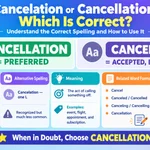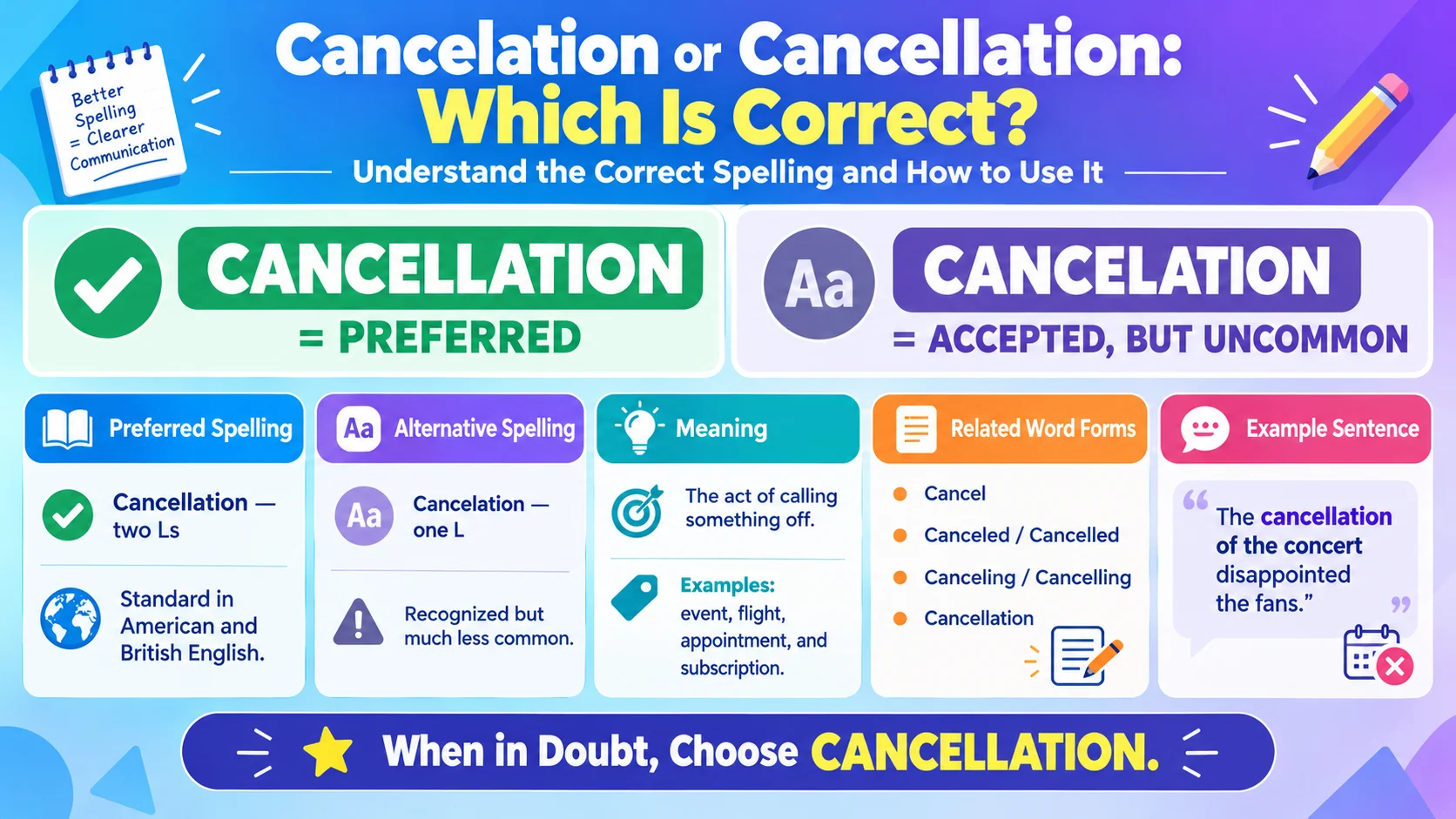
Cancellation is the preferred and standard spelling in American English. However, cancelation is also an accepted variant, although it is much less common. Both words mean the act of calling off, stopping, or ending something that was previously planned. For clear, professional writing, choose cancellation.
Are you unsure whether to write cancelation or cancellation? You’re not alone. The two spellings look almost identical, and both appear in English writing. However, one version is much more widely accepted.
The preferred spelling is cancellation, with two Ls. You will see it in American newspapers, business documents, school announcements, and everyday communication. Meanwhile, cancelation, with one L, is a recognized but uncommon alternative.
The confusion often comes from the spelling of related words. For example, American English usually uses canceled and canceling with one L. Nevertheless, the noun cancellation keeps two Ls. This difference can seem inconsistent at first. Fortunately, a few simple examples make the rule easier to remember.
Cancelation vs. Cancellation
| Spelling | Status | Usage |
|---|---|---|
| Cancellation | Standard and preferred | Common in American and British English |
| Cancelation | Accepted but uncommon | Occasional alternative, mainly in US usage |
Both spellings refer to the same action. However, cancellation is far more common and is the safest choice for almost every writing situation.
For example:
- Correct and preferred: The airline announced the cancellation of the flight.
- Accepted but uncommon: The airline announced the cancelation of the flight.
Although the second sentence uses a recognized spelling, most readers are more familiar with the first version.
What Does Cancellation Mean?
Cancellation is a noun that describes the act or result of canceling something. It means stopping an arrangement, event, service, order, or activity that was previously planned or approved.
For instance, a concert cancellation means the concert will no longer take place. Similarly, a subscription cancellation means a person has ended a recurring service.
The word can describe both the action and the result. Therefore, its exact meaning depends on the situation.
Here are some common uses:
- Event cancellation: An event will not happen.
- Flight cancellation: An airline has withdrawn a scheduled flight.
- Appointment cancellation: A planned meeting or visit will not take place.
- Order cancellation: A purchase request has been withdrawn.
- Subscription cancellation: A recurring service has been ended.
- Contract cancellation: An agreement has been terminated or withdrawn.
In each example, cancellation refers to the ending of something that was previously arranged.
Why Is Cancellation Spelled With Two Ls?
The spelling of cancellation comes from the base word cancel and the noun-forming ending -ation.
When you form the noun, the standard spelling retains the double L:
Cancel + ation = Cancellation
At first, this may seem unusual because American English often drops the second L in related forms. For example, Americans commonly write canceled and canceling.
However, the noun follows a different established spelling pattern. As a result, cancellation remains the standard form in both major English varieties.
Consider these examples:
- Cancel → Cancellation
- Canceled → Cancellation
- Canceling → Cancellation
The spelling may look inconsistent, but that is how standard English usage has developed. Therefore, it is best to memorize cancellation as a complete word rather than trying to apply the spelling of canceled to it.
Is Cancelation a Real Word?
Yes, cancelation is a recognized spelling. It is not simply a typing mistake or an invented word.
However, it is much less common than cancellation. Most dictionaries and writing references identify cancellation as the preferred form.
You may occasionally encounter cancelation in American publications or older documents. Nevertheless, its appearance does not make it the better choice.
For everyday writing, business communication, academic work, and website content, use cancellation. This spelling is familiar to readers in the United States, the United Kingdom, and many other English-speaking countries.
In short, both forms can be understood, but cancellation is the more reliable option.
Cancelation vs. Cancellation in American and British English
Unlike some spelling differences between American and British English, this pair does not follow a simple regional split.
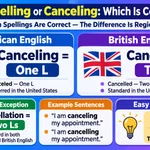
In American English, canceled and canceling usually have one L. Meanwhile, cancelled and cancelling are standard in British English.
However, cancellation is the preferred noun spelling in both varieties.
| Word Form | American English | British English |
|---|---|---|
| Base verb | Cancel | Cancel |
| Past tense | Canceled | Cancelled |
| Present participle | Canceling | Cancelling |
| Noun | Cancellation | Cancellation |
| Alternative noun | Cancelation (rare) | Cancelation (rare) |
This distinction is important because people sometimes assume that every form must follow the same pattern. That is not the case.
For example, an American writer might say, “The company canceled the meeting.” However, the same writer would normally write, “The cancellation surprised everyone.”
Therefore, remember that the spelling of the verb forms does not change the standard spelling of the noun.
Cancellation in Everyday Sentences
The best way to understand a word is to see how people use it. Fortunately, cancellation appears in many familiar situations.
Everyday examples:
- The cancellation of our dinner plans disappointed everyone.
- I received an email confirming the cancellation.
- The sudden cancellation changed our weekend schedule.
- She requested the cancellation of her membership.
- The company announced the cancellation of its event.
Business examples:
- Please review the cancellation policy before making a reservation.
- The customer received confirmation of the order cancellation.
- We processed the cancellation according to company rules.
- The manager explained the cancellation procedure to the client.
Travel examples:
- The airline announced a flight cancellation because of bad weather.
- Passengers received updates about the cancellation.
- A flight cancellation can affect connecting travel plans.
- The hotel offered a refund after the reservation cancellation.
Notice how cancellation works as a noun in each sentence. In addition, it often appears before another noun, as in cancellation policy and cancellation notice.
Common Expressions Using Cancellation
You will often see cancellation used in familiar phrases. These expressions appear in travel, business, entertainment, and everyday communication.
| Expression | Meaning | Example |
|---|---|---|
| Cancellation policy | Rules for canceling a booking or service | Check the cancellation policy before booking. |
| Cancellation fee | A charge for canceling an arrangement | The hotel applied a cancellation fee. |
| Cancellation notice | A message announcing that something is canceled | We received a cancellation notice. |
| Flight cancellation | A scheduled flight being withdrawn | The flight cancellation caused delays. |
| Event cancellation | An event being called off | Heavy rain led to the event cancellation. |
| Subscription cancellation | Ending a recurring service | I requested my subscription cancellation. |
| Order cancellation | Withdrawing a purchase request | The store confirmed the order cancellation. |
| Appointment cancellation | Calling off a scheduled appointment | The clinic sent an appointment cancellation message. |
These expressions all use the standard double-L spelling. Therefore, you should keep the same spelling when adding another word before or after cancellation.
Cancellation vs. Canceled vs. Canceling
These words come from the same base verb, but they have different grammatical functions.
Cancellation is a noun. It names the action or result of canceling something.
Canceled is the past-tense form of the verb in standard American English. It describes something that has already been called off.
Canceling is the present participle or gerund form commonly used in American English. It describes the action of calling something off.
| Word | Part of Speech | Example |
|---|---|---|
| Cancellation | Noun | The cancellation was unexpected. |
| Canceled | Past-tense verb | They canceled the concert. |
| Canceling | Present participle or gerund | She is canceling her subscription. |
| Cancel | Base verb | Please cancel my order. |
British English commonly uses cancelled and cancelling instead. Nevertheless, the noun remains cancellation.
As a result, do not confuse the spelling rules for the verb forms with the noun form.
Common Mistakes When Using Cancellation
Even confident writers sometimes mix up these related spellings. However, remembering a few simple points can prevent most mistakes.
Writing Cancelation in Formal Documents
Although cancelation is recognized, cancellation is the more established spelling.
For that reason, use cancellation in professional emails, reports, articles, and official notices.
Assuming American English Always Uses One L
American English often uses one L in canceled and canceling. However, cancellation is normally spelled with two Ls.
This is an important exception to remember.
Confusing Cancellation With Canceled
These words have related meanings, but they do different grammatical jobs.
For example, “The event was canceled” uses a verb. In contrast, “The event cancellation was announced” uses a noun.
Using Inconsistent Spelling
Consistency matters, especially in longer documents. Therefore, follow the appropriate spelling conventions throughout your writing.
For American English, use canceled, canceling, and cancellation. For British English, use cancelled, cancelling, and cancellation.
Treating Cancelation as a Typographical Error Every Time
Cancelation is uncommon, but it is an accepted alternative. Nevertheless, its rarity makes cancellation the better choice for general writing.
Synonyms of Cancellation
Sometimes, another word can communicate the same general idea. However, the best synonym depends on the context.
| Synonym | Meaning | Example |
|---|---|---|
| Annulment | Making something legally invalid | The court approved the annulment. |
| Termination | Bringing something to an end | The company announced the termination of the agreement. |
| Revocation | Officially withdrawing permission or authority | The agency confirmed the revocation of the license. |
| Withdrawal | Removing or taking something back | The candidate announced the withdrawal of the application. |
| Rescission | Formally canceling an agreement or contract | Both parties agreed to the rescission of the contract. |
| Abandonment | Giving up a plan or activity | The abandonment of the project surprised the team. |
These words are related, but they are not always interchangeable. For example, annulment often has a legal meaning, while withdrawal can describe removing an application or offer.
Therefore, choose a synonym that matches the situation rather than replacing cancellation automatically.
Frequently Asked Questions
Is it cancelation or cancellation?
Cancellation is the preferred and standard spelling in American and British English. Although cancelation is an accepted alternative, it is uncommon. Therefore, cancellation is the safest spelling for everyday and professional writing.
Why does cancellation have two Ls?
Cancellation retains the double L in its standard spelling, even though American English often uses one L in canceled and canceling. The noun has an established spelling of its own, so remember it separately.
Is cancelation spelled wrong?
Not necessarily. Cancelation is a recognized alternative spelling, but it is much less common than cancellation. For that reason, most writers should choose cancellation, especially in formal documents and published content.
Is cancellation American or British English?
Cancellation is standard in both American and British English. Unlike canceled and cancelled, which vary by region, the noun generally keeps two Ls regardless of the English variety being used.
What is the difference between cancellation and cancelation?
There is no difference in meaning. Both words refer to the act of calling something off. However, cancellation is much more widely used, while cancelation is a rare alternative spelling.
Is cancellation one word or two?
Cancellation is one word. It is a noun formed from the verb cancel and the ending -ation. Therefore, write it as a single word with two Ls.
What is the plural of cancellation?
The plural form is cancellations. Simply add an S to the end of the word. For example, “The airline announced several flight cancellations because of severe weather.”
Which spelling should I use in an SEO article?
Use cancellation in an SEO article. It is the familiar and widely preferred spelling, so it is the clearest choice for readers. In addition, use the same spelling consistently in headings, examples, and metadata.
Conclusion
Cancellation is the preferred spelling, while cancelation is an accepted but uncommon alternative. Although both forms share the same meaning, cancellation is the safer choice for American and British English. Remember, the related verb forms follow different regional patterns: Americans generally write canceled and canceling, while British writers commonly use cancelled and cancelling. However, the noun keeps its double L in standard usage. Therefore, whenever you write about a canceled appointment, flight, event, or subscription, choose cancellation. This simple spelling choice keeps your writing clear, consistent, and professional.