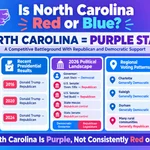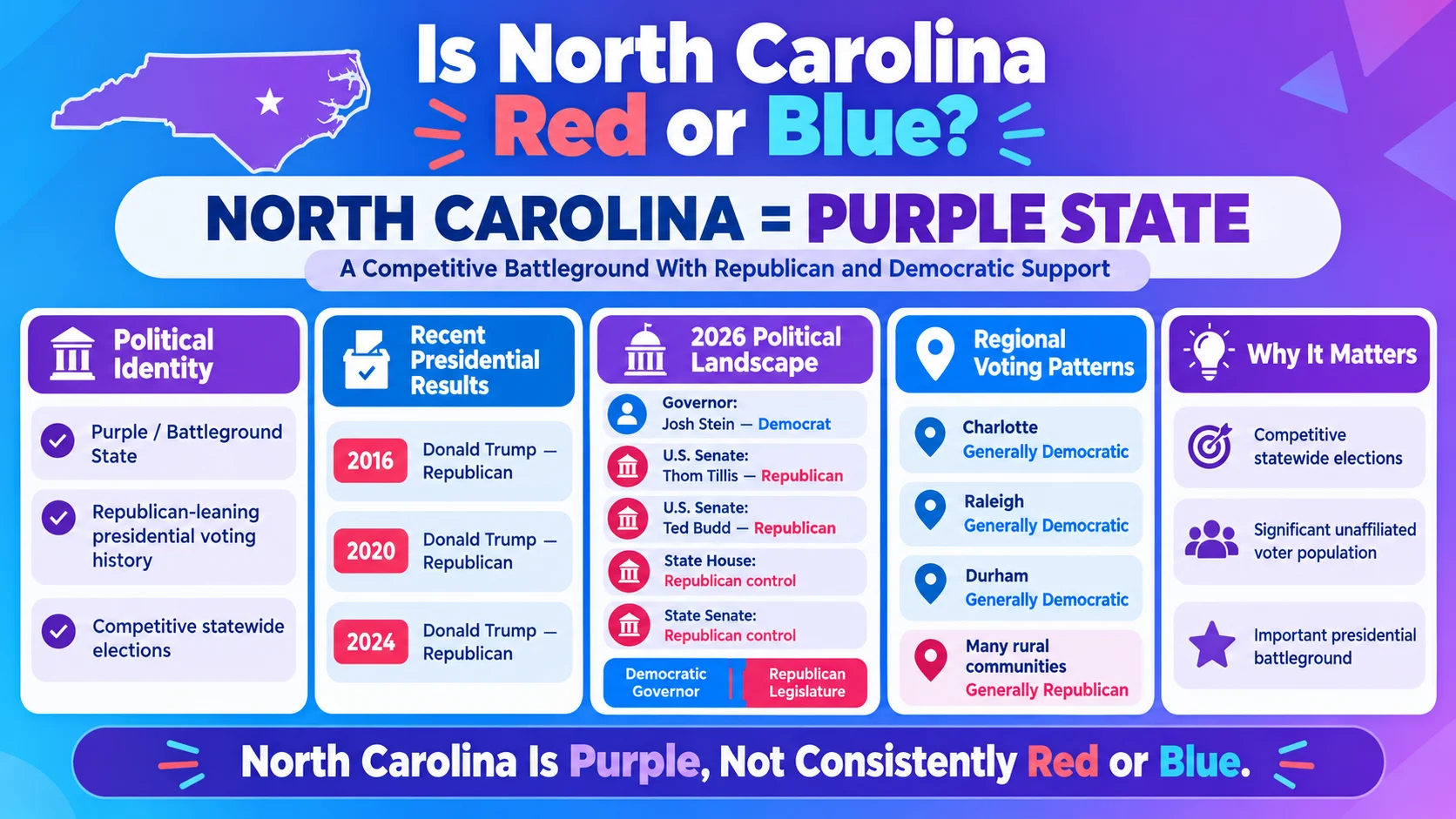
North Carolina is a purple state that has recently leaned Republican in presidential elections. However, Democrats remain competitive in statewide races and made major gains in the 2026 midterms. Therefore, it is best described as a politically competitive battleground state.
Is North Carolina red or blue? North Carolina is generally considered a purple or battleground state because voters support both Republicans and Democrats. However, its recent presidential voting history has leaned Republican. At the same time, Democrats have won important statewide offices and made significant gains in the 2026 midterm elections. Therefore, North Carolina does not fit neatly into either political category.
The state’s political identity depends on the election, the candidates, and the region. For example, rural communities often favor Republicans, while major metropolitan areas tend to support Democrats. Meanwhile, suburban voters can influence close statewide races.
As a result, North Carolina remains an important state in American politics. Its competitive elections, divided political history, and changing voter coalitions make it a key battleground.
North Carolina’s Political Identity
| Political Detail | Position |
|---|---|
| Overall political classification | Purple / battleground |
| Recent presidential voting pattern | Republican-leaning |
| 2024 presidential winner | Donald Trump (Republican) |
| Governor | Josh Stein (Democrat) |
| 2026 U.S. Senate result | Roy Cooper (Democrat) won the open seat |
| State legislature after 2026 election | Divided between the parties |
| Major Democratic areas | Charlotte, Raleigh, Durham, Asheville |
| Many Republican-leaning areas | Rural and smaller communities |
North Carolina’s political balance is more complicated than a simple red-or-blue label. In fact, the state has frequently elected politicians from both parties during the same election cycle.
Why Is North Carolina Considered a Purple State?
A purple state has significant support for both major political parties. In other words, neither Republicans nor Democrats consistently dominate every major election.
North Carolina fits this description for several reasons.
First, Republican presidential candidates have won the state in recent elections. Donald Trump carried North Carolina in 2016, 2020, and 2024. Consequently, the state has developed a Republican-leaning record in presidential contests.
However, Democratic candidates have also won important statewide races. Roy Cooper served as governor from 2017 through 2024, and Josh Stein won the governorship in 2024. In addition, voters elected Democrat Roy Cooper to the U.S. Senate in 2026.
The state’s voting history also shows a pattern of split-ticket voting. According to the North Carolina State Board of Elections, voters selected presidential and gubernatorial winners from different parties in nine of the past 16 presidential elections listed in its historical record. Therefore, North Carolina’s political identity cannot be explained by presidential results alone.
North Carolina Election Results: Recent Voting History
Election results help explain why North Carolina is considered a battleground state. Although Republicans have had success in presidential contests, Democrats have remained competitive in statewide races.
| Election Year | Presidential Winner in North Carolina | Governor Winner |
|---|---|---|
| 2008 | Barack Obama (Democrat) | Bev Perdue (Democrat) |
| 2012 | Mitt Romney (Republican) | Pat McCrory (Republican) |
| 2016 | Donald Trump (Republican) | Roy Cooper (Democrat) |
| 2020 | Donald Trump (Republican) | Roy Cooper (Democrat) |
| 2024 | Donald Trump (Republican) | Josh Stein (Democrat) |
Source: North Carolina State Board of Elections historical presidential and gubernatorial results.
Notice the difference between presidential and gubernatorial voting. While Republican presidential candidates won North Carolina in 2016, 2020, and 2024, Democratic gubernatorial candidates also won those election cycles.
Therefore, voters do not always support the same party across different offices. Candidate experience, local concerns, and campaign issues can all influence their choices.
Who Controls North Carolina’s Government?
North Carolina has experienced divided political control, meaning one party does not necessarily control every major government office.
As of November 6, 2026, the state’s political landscape reflects significant changes following the November 3 midterm elections.
Governor: Josh Stein
Democrat Josh Stein serves as North Carolina’s governor. He took office in January 2025 after winning the 2024 gubernatorial election.
The governor leads the state’s executive branch. In addition, the office plays an important role in state budgets, public policy, emergency management, and government appointments.
U.S. Senate: Roy Cooper and Ted Budd
North Carolina has two seats in the U.S. Senate.
Republican Ted Budd continues to hold one seat. Meanwhile, Democrat Roy Cooper, the state’s former governor, won the other seat in the November 2026 election.
Cooper’s victory changed the state’s Senate representation and gave Democrats a significant statewide result. However, it does not mean that every part of North Carolina has shifted toward the Democratic Party.
State Legislature: Divided Political Control
The 2026 elections also changed the balance in the North Carolina General Assembly.
Democrats gained control of the state House of Representatives, while Republicans retained control of the state Senate. As a result, the legislature is divided between the two parties.
This arrangement means lawmakers from both parties must navigate competing priorities. Furthermore, the governor’s political party does not control both legislative chambers.
Political Control at a Glance
| Government Position | Party |
|---|---|
| Governor | Democratic |
| U.S. Senator Roy Cooper | Democratic |
| U.S. Senator Ted Budd | Republican |
| State House | Democratic |
| State Senate | Republican |
The 2026 results illustrate why North Carolina is difficult to classify as entirely red or blue. Instead, its government reflects a combination of Democratic and Republican representation.
Why Does North Carolina Often Vote Republican for President?
Although North Carolina is competitive, Republican presidential candidates have won several recent elections there. Several factors help explain this pattern.
First, rural communities often provide substantial support for Republican candidates. These areas may prioritize issues such as agriculture, taxes, gun laws, energy, and government regulation.
Second, the state’s population includes many suburban and smaller-city voters whose preferences can influence statewide results. In some communities, Republican candidates have built consistent support across multiple election cycles.
Additionally, national political issues can shape presidential voting. The economy, immigration, public safety, healthcare, and federal government policies may influence voters differently from local or state-level concerns.
However, Republican success in presidential elections does not automatically translate into victories in every other race. Democratic candidates have continued to win statewide offices, as the governor’s race and 2026 Senate election demonstrate.
Why Do Democrats Win Elections in North Carolina?
Democrats have a strong voter base in several urban areas and have shown they can compete statewide.
For example, Democratic candidates often perform well in large metropolitan areas such as Charlotte, Raleigh, and Durham. These communities include diverse populations, universities, younger voters, and large professional workforces.
In addition, Democratic candidates have sometimes attracted support from suburban voters and independent voters. These groups can be especially important when an election is close.
The 2026 Senate election provides a recent example. Former governor Roy Cooper defeated Republican Michael Whatley, flipping a Republican-held Senate seat. Democrats also gained ground in congressional and state legislative races.
Nevertheless, these results should be understood in their specific election context. They do not erase North Carolina’s recent Republican presidential voting history.
Which Cities in North Carolina Are More Democratic?
North Carolina’s major metropolitan areas generally provide stronger support for Democratic candidates. However, political preferences can vary between city centers, suburbs, and surrounding counties.
Charlotte
Charlotte, located in Mecklenburg County, is one of North Carolina’s largest urban centers. Democratic candidates generally perform strongly in the city.
Its population includes professionals, students, diverse communities, and residents working in finance, technology, healthcare, and other industries. As a result, Charlotte is an important part of the Democratic coalition in statewide elections.
Raleigh
Raleigh is the state capital and part of the Research Triangle region. The city generally leans Democratic in major elections.
Additionally, its universities, technology companies, government workforce, and growing population contribute to its political diversity.
Durham
Durham is another major Democratic-leaning city. It has a large university presence, a diverse population, and an active civic community.
Consequently, Democratic candidates often receive substantial support in Durham and its surrounding urban areas.
Asheville
Asheville, in western North Carolina, has generally supported Democratic candidates in recent elections.
Although the surrounding mountain region includes many Republican-leaning communities, Asheville itself has a different political profile.
Greensboro
Greensboro is an important urban center in the Piedmont Triad. Democratic candidates often perform well in the city, although voting patterns vary across the wider region.
Overall, these cities help explain why Democrats remain competitive in a state that has recently favored Republican presidential candidates.
Which Areas of North Carolina Are More Republican?
Republican candidates generally receive stronger support across many rural communities and smaller towns.
For instance, several areas in the eastern, western, and central parts of the state have traditionally supported Republican candidates.
Rural Eastern North Carolina
Many rural communities in eastern North Carolina have become important areas of Republican support. However, voting preferences can differ between counties and local communities.
Western North Carolina
Outside Asheville and some nearby communities, many mountain counties tend to favor Republican candidates.
In addition, local concerns involving agriculture, tourism, small businesses, and land use can shape political discussions.
Smaller Towns and Rural Counties
Republican candidates often perform well in smaller towns and rural counties throughout the state.
Nevertheless, these areas are not politically identical. Some counties remain competitive, and local election results can differ from national voting patterns.
Is North Carolina a Swing State?
Yes. North Carolina is widely considered a swing state or battleground state, particularly in presidential and federal elections.
A swing state is a state where support for the major parties is competitive enough that election outcomes can change from one cycle to another or vary by office.
North Carolina meets this description because:
- Republican presidential candidates have won the state in recent elections.
- Democratic candidates have won multiple gubernatorial elections.
- Independent and unaffiliated voters make up a substantial part of the electorate.
- Urban and rural communities often have different political preferences.
- Both parties continue to compete for statewide offices.
Furthermore, the 2026 midterm results show that political control can change even when a state has a recent presidential voting pattern favoring one party.
Therefore, North Carolina remains an important state for both parties during national elections.
What Does Purple State Mean?
A purple state is a state where Republican and Democratic voters both have significant political influence.
The term comes from the combination of the traditional colors associated with the two major parties:
- Red: Republican Party
- Blue: Democratic Party
- Purple: A combination of red and blue, representing political competition
However, purple does not mean that every county has equal support for both parties.
Instead, it describes the overall political balance of a state. In North Carolina, Republican strength in many rural areas combines with Democratic support in major cities and other communities.
As a result, statewide elections can be competitive even when individual counties strongly favor one party.
How Does North Carolina Compare With Other Southern States?
North Carolina shares some political characteristics with other Southern states. However, its competitive statewide elections make its political profile distinct.
| State | General Political Pattern |
|---|---|
| North Carolina | Purple / Republican-leaning in recent presidential elections |
| South Carolina | Republican-leaning |
| Georgia | Battleground / competitive |
| Virginia | Democratic-leaning in recent statewide federal elections |
| Tennessee | Republican-leaning |
| Florida | Republican-leaning in recent statewide elections |
These descriptions summarize recent general patterns rather than permanent political classifications. In addition, each state has its own regional differences, voter coalitions, and election history.
North Carolina and Georgia, for example, are often discussed together because both have competitive elections and diverse populations. Nevertheless, their results can differ depending on the candidates and issues involved.
What Could Influence North Carolina’s Future Elections?
Several factors may shape North Carolina’s political direction in upcoming elections.
Population growth is one important factor. The state continues to attract new residents, especially around Charlotte, Raleigh, and other growing metropolitan areas. Consequently, changes in population can influence voter registration and turnout.
Suburban voting patterns also matter. These communities can play a decisive role when statewide elections are close.
Furthermore, independent and unaffiliated voters are important. North Carolina has a substantial unaffiliated voter population, so candidates from both parties often compete for their support.
Finally, national issues and local concerns can affect election results. Economic conditions, education, healthcare, public safety, housing, and infrastructure may influence voters differently from one election to another.
Therefore, future political outcomes will depend on voter participation, candidates, campaigns, and changing public priorities.
Frequently Asked Questions
Is North Carolina a red or blue state?
North Carolina is generally classified as a purple or battleground state. However, it has leaned Republican in recent presidential elections. Democrats also hold important statewide offices and made significant gains in the 2026 midterms.
Does North Carolina usually vote Republican or Democrat?
North Carolina has voted Republican in its last three presidential elections: 2016, 2020, and 2024. However, Democratic candidates have also won gubernatorial and other statewide elections, showing that voting preferences vary by office.
Is North Carolina considered a swing state?
Yes. North Carolina is considered a swing state because both major parties compete seriously in statewide and federal elections. Although Republicans have recently won presidential contests, Democrats have also achieved important victories.
Is Charlotte, North Carolina, red or blue?
Charlotte generally leans Democratic in major elections. Its large urban population and diverse communities contribute to Democratic support. However, surrounding suburban and rural areas can have different voting patterns.
Is Raleigh, North Carolina, red or blue?
Raleigh generally leans Democratic. As the state capital and part of the Research Triangle, it has a diverse population that includes university communities, government employees, and professionals.
Is Asheville, North Carolina, red or blue?
Asheville generally leans Democratic, although much of the surrounding western mountain region tends to support Republicans. Therefore, the city’s political preferences differ from those of several nearby rural communities.
Who is the governor of North Carolina?
Josh Stein, a Democrat, is North Carolina’s governor as of November 2026. He won the 2024 gubernatorial election and took office in January 2025.
Who won the 2026 North Carolina Senate election?
Former Democratic governor Roy Cooper won North Carolina’s 2026 U.S. Senate election against Republican Michael Whatley. His victory flipped a Republican-held seat and changed the state’s representation in the Senate.
Conclusion
North Carolina is best described as a purple battleground state rather than a consistently red or blue state. Although Republican presidential candidates have won the state in recent elections, Democrats continue to compete successfully in statewide races. Moreover, the 2026 midterms brought major Democratic gains, including Roy Cooper’s Senate victory and a change in state House control. Meanwhile, rural communities and major cities continue to show different voting patterns. Therefore, North Carolina’s political identity depends on the election and office being considered. Its competitive electorate makes it an important state in American politics, especially during national election cycles.