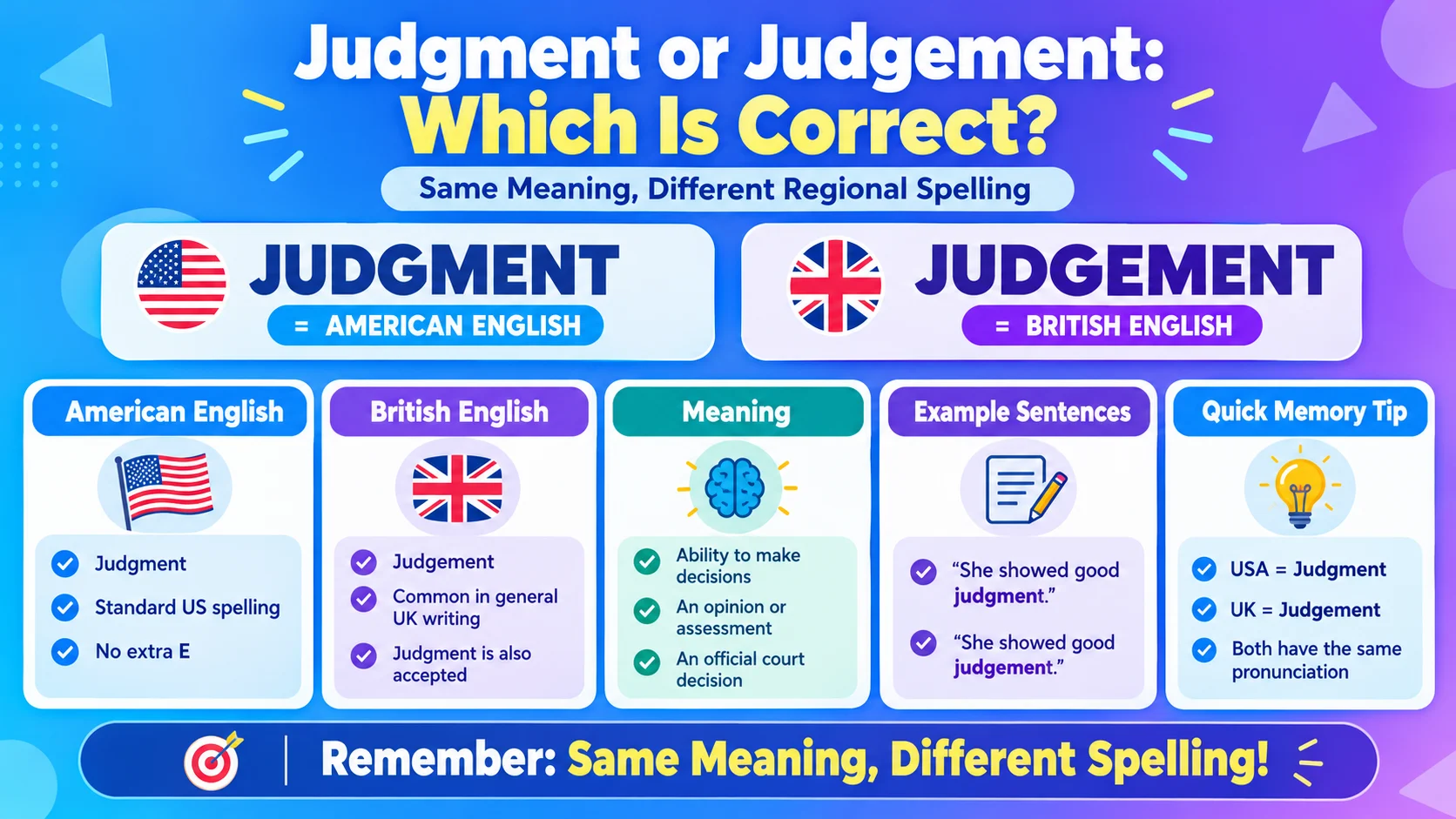
Judgment is the correct spelling in American English, while judgement is the preferred spelling in most British English writing. Both forms mean the ability to make decisions, an opinion, or an official court decision. They have the same pronunciation.
Judgment or judgement? Both spellings are used in English, but the correct choice depends on your audience and preferred writing style. Judgment is the standard spelling in American English. Meanwhile, judgement is common in British English. Both words have the same meaning and pronunciation. For US readers, however, judgment is the correct choice in everyday and legal writing. Understanding this spelling difference will help you avoid mistakes in essays, professional documents, emails, and other writing.
Is It Judgment or Judgement?
The correct spelling depends on the English variety you follow.
| Spelling | English Variety | Usage |
|---|---|---|
| Judgment | American English | Standard spelling |
| Judgement | British English | Common standard spelling |
| Judgment | British English | Also accepted, especially in legal writing |
For example, an American writer would normally write, “She showed excellent judgment.” By contrast, a British writer may use “She showed excellent judgement.”
However, both spellings communicate the same idea. Therefore, choose one form and use it consistently throughout your writing.
What Is the Difference Between Judgment and Judgement?
The main difference between judgment and judgement is regional spelling, not meaning.
Judgment is the standard American English spelling. It appears in everyday writing, academic work, business communication, and legal documents.
Judgement, on the other hand, is common in British English. Writers in the UK often use this form when discussing personal decisions, opinions, or the ability to make sensible choices.
Nevertheless, British English also accepts the spelling judgment. In particular, legal writing often uses the shorter form.
Here is a simple comparison:
- American English: She has good judgment.
- British English: She has good judgement.
- Legal writing: The court issued its judgment.
Both spellings have the same pronunciation and meaning. Consequently, neither version changes the message of a sentence.
When Should You Use Judgment?
Use judgment when writing for an American audience. It is the standard spelling in the United States, regardless of whether you discuss personal decisions or legal rulings.
For example:
- She showed excellent judgment during the meeting.
- Good judgment helps people make better decisions.
- The judge delivered the final judgment.
- His poor judgment caused unnecessary problems.
- I trust your judgment on this matter.
In addition, use judgment in American school assignments, business reports, professional emails, and formal documents.
The shorter spelling is also common in British legal contexts. Therefore, judgment is a useful choice when you need a spelling accepted across different English-speaking regions.
When Should You Use Judgement?
Use judgement when following standard British English conventions in general writing.
For example:
- She showed excellent judgement during the meeting.
- His judgement improved with experience.
- You should use your own judgement.
- The decision required careful judgement.
- I respect her professional judgement.
Similarly, British writers may use judgement in newspapers, books, essays, and everyday communication.
However, some British legal style guides prefer judgment when referring to an official court decision. As a result, the legal context may influence the spelling choice.
If you are writing for a British publication, check its preferred style guide before choosing one form.
Judgment vs. Judgement: Meaning and Definition
Both spellings have the same basic definitions. The word is a noun that describes the ability to make decisions, the opinion someone forms, or a formal decision made by a court.
1. The Ability to Make Good Decisions
Judgment or judgement can describe someone’s ability to think carefully and choose wisely.
For example:
“She has excellent judgment when handling difficult situations.”
This sentence means that she can make sensible decisions. Similarly, someone with poor judgment may make choices without considering the possible consequences.
2. An Opinion or Assessment
The word can also describe an opinion about a person, situation, or event.
For example:
- His judgment of the situation was accurate.
- Do not make a quick judgment about someone.
- I will reserve judgment until I know the facts.
In these examples, the word refers to an assessment rather than a formal court decision.
3. An Official Court Decision
In legal contexts, judgment refers to the formal decision made by a judge or court.
For example:
“The court delivered its judgment after reviewing the evidence.”
Here, the word describes an official legal ruling. Furthermore, judgment is widely used in legal writing in both American and British English.
Judgment or Judgement Examples in Sentences
Examples make the spelling difference easier to understand. Notice that the meaning stays the same even when the spelling changes.
| American English | British English |
|---|---|
| She has good judgment. | She has good judgement. |
| His judgment was correct. | His judgement was correct. |
| Use your best judgment. | Use your best judgement. |
| I trust your judgment. | I trust your judgement. |
| That was a poor judgment call. | That was a poor judgement call. |
Here are additional examples:
- Good judgment: Her good judgment helped the team avoid a costly mistake.
- Poor judgment: He made a poor judgment when he ignored the warning.
- Personal judgment: You should use your own judgment before making a decision.
- Professional judgment: The manager relied on professional judgment to resolve the issue.
- Legal judgment: The court announced its judgment after the hearing.
- Quick judgment: Avoid making a quick judgment without knowing the full story.
- Better judgment: Against my better judgment, I agreed to help.
- Sound judgment: A responsible leader needs sound judgment.
Notice that these examples work with either spelling, depending on the English variety. Therefore, the important point is consistency.
Why Are There Two Spellings?
The two spellings developed through different English spelling conventions.
The word comes from older forms connected to the French word jugement. Over time, English writers used both spellings, and regional preferences developed.
American English generally settled on judgment, without the extra “e.” Meanwhile, British English commonly retained the spelling judgement in general writing.
However, the shorter form never disappeared from British usage. In fact, it remains common in legal contexts and is accepted in other settings.
This is why both forms appear in English dictionaries and published writing. Rather than representing two different words, they are regional spelling variants of the same noun.
Is Judgment or Judgement Correct in American English?
Judgment is the standard spelling in American English.
Therefore, use judgment in US writing, whether you are discussing personal decisions, professional opinions, or court rulings.
Correct American examples include:
- She demonstrated good judgment.
- His judgment was influenced by personal experience.
- The judge issued a final judgment.
- That decision showed poor judgment.
- I trust your judgment completely.
Although you may occasionally see judgement in American publications, it is generally treated as a nonstandard variant in US English.
For this reason, American writers should choose judgment to follow standard spelling conventions.
Is Judgment or Judgement Correct in British English?
In British English, judgement is a common standard spelling, especially in general writing.
Nevertheless, judgment is also accepted. It is particularly common in legal contexts, where courts and legal publications often use the shorter form.
For example:
- General writing: She showed excellent judgement.
- Legal writing: The court delivered its judgment.
Additionally, British publishers and organizations may follow different style guides. Therefore, always check the preferred spelling when preparing formal documents.
The key point is that British English allows both forms, while American English normally uses judgment.
Common Phrases With Judgment or Judgement
Several expressions use this word in everyday English. The spelling depends on your regional writing style, but the meaning remains unchanged.
| Phrase | Meaning | Example |
|---|---|---|
| Good judgment | Ability to make sensible decisions | She showed good judgment. |
| Poor judgment | An unwise decision | That was an example of poor judgment. |
| Better judgment | A wiser choice or decision | I acted against my better judgment. |
| Sound judgment | Careful and reasonable decision-making | Leaders need sound judgment. |
| Personal judgment | An individual’s opinion or assessment | Use your personal judgment. |
| Quick judgment | An opinion formed too quickly | Avoid making a quick judgment. |
| Final judgment | A final decision or ruling | The court announced its final judgment. |
| Judgment call | A decision based on personal assessment | Choosing the winner was a judgment call. |
For example, the phrase “against my better judgment” means doing something even though you believe it may be unwise.
Similarly, “good judgment” describes the ability to make sensible decisions.
Judgment vs. Judgement vs. Judge: What Is the Difference?
These words are related, but they have different grammatical roles.
| Word | Part of Speech | Meaning |
|---|---|---|
| Judge | Verb or noun | To form an opinion or a person who decides a case |
| Judgment | Noun | A decision, opinion, or ability to make decisions |
| Judgement | Noun | The British spelling variant of judgment |
| Judgmental | Adjective | Too quick to criticize or form negative opinions |
Consider these examples:
- Judge: Do not judge someone by appearance.
- Judgment: Her judgment was fair.
- Judgement: Her judgement was fair.
- Judgmental: He sounded judgmental during the discussion.
Therefore, remember that judgment and judgement are spelling variants, while judge and judgment serve different grammatical purposes.
Common Spelling Mistakes to Avoid
Although the difference looks small, writers sometimes confuse these forms. Here are common mistakes and how to avoid them.
1. Mixing Both Spellings in One Article
Using judgment in one paragraph and judgement in another can make your writing inconsistent.
Instead, choose the spelling that matches your audience. For American readers, use judgment throughout the article.
2. Assuming Judgement Is Always Wrong
The spelling judgement is not universally incorrect. Rather, it is a recognized form in British English.
However, it is not the standard choice for American writing.
3. Using the British Spelling in US Legal Documents
American legal writing uses judgment, without the extra “e.”
Therefore, write “court judgment” rather than “court judgement” when following US conventions.
4. Confusing Judgment With Judging
Judgment is a noun, while judging is usually a verb form or a gerund.
For example, “Her judgment was fair” uses the noun. Meanwhile, “She is judging the competition” uses the verb form.
5. Forgetting the Correct Spelling for Your Audience
Regional spelling matters in professional and academic writing.
Consequently, check whether your audience expects American or British English before submitting a document.
How to Remember Judgment or Judgement
A simple memory trick can help you choose the right spelling.
For American English: Judgment = No extra E.
Remember that American English uses the shorter spelling. Meanwhile, British English commonly uses judgement in general writing.
You can also remember these quick rules:
- USA: judgment
- UK: judgement or judgment
- Legal writing: judgment is widely used in both varieties
- Meaning: identical
- Pronunciation: identical
As a result, you do not need to memorize two definitions. You only need to remember which spelling suits your audience.
Frequently Asked Questions
Is judgment or judgement correct?
Both spellings are accepted English variants. However, judgment is the standard American spelling, while judgement is common in British English. Both forms have the same meaning and pronunciation.
Is judgement wrong in American English?
Judgement is generally considered nonstandard in American English. Instead, US writers should use judgment in everyday, academic, professional, and legal writing.
Is judgment British or American spelling?
Judgment is the standard spelling in American English. Nevertheless, British English also accepts it, particularly in legal contexts. British writers often use judgement in general writing.
Why does judgement have an extra E?
The spelling judgement follows a traditional English spelling pattern that retains the letter E. Meanwhile, American English generally uses judgment without the extra letter.
Do judgment and judgement have different meanings?
No. Both spellings represent the same noun. They describe the ability to make decisions, an opinion or assessment, or an official decision issued by a court.
Which spelling should I use in legal writing?
Use judgment in American and British legal writing. It is widely established in legal contexts, even though British general writing also commonly uses judgement.
How do you pronounce judgment and judgement?
Both words have the same pronunciation: JUJ-ment. The extra E in judgement does not change the way the word sounds.
What is the plural of judgment?
The plural form is judgments. For example, “The court issued several judgments during the year.” In standard usage, the plural does not require an extra E.
Conclusion
Judgment or judgement? The right spelling depends on your audience and writing style. In American English, always choose judgment without the extra E. Meanwhile, judgement is common in British English, although judgment is also accepted there. Both forms share the same meaning and pronunciation. Additionally, legal writing often favors judgment in both English varieties. To avoid confusion, follow your preferred style guide and keep your spelling consistent. Whether you are writing an essay, email, report, or legal document, choosing the appropriate form will make your writing clearer and more professional.

Andrew Morris is a writer at Meaninga.com who specializes in word meanings, slang, idioms and modern language trends. He creates clear, accurate and easy to understand content for everyday readers.