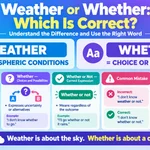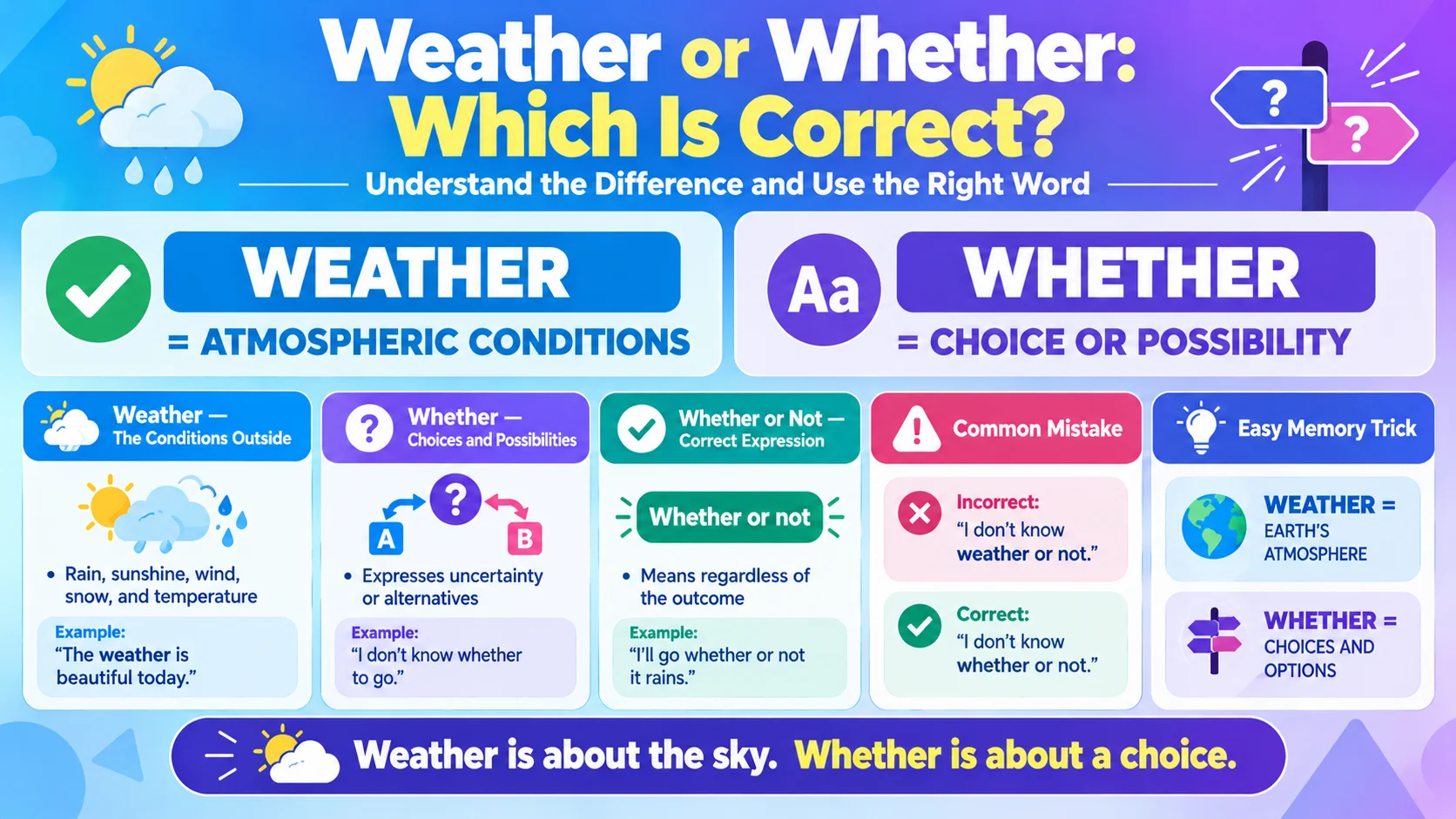
Weather or whether? These two words sound almost identical, but they have completely different meanings. If you are talking about rain, sunshine, wind, or temperature, use weather. However, if you are expressing a choice, possibility, or uncertainty, use whether. The correct phrase is also “whether or not,” not “weather or not,” when discussing alternatives.
Choosing between weather or whether can be confusing because both words sound nearly identical in everyday American English. However, their meanings and grammatical roles are very different. One describes conditions outside, while the other introduces alternatives or uncertainty.
For example, you might say, “The weather looks beautiful today.” On the other hand, you would write, “I don’t know whether she is coming.”
The confusion becomes even more common when people write the expression “whether or not.” Although “weather or not” may look correct at first, it is usually a spelling mistake when you are discussing a choice.
In this guide, you’ll learn the difference between weather and whether, their definitions, grammar rules, common expressions, and practical examples. Additionally, you’ll discover an easy trick to remember the correct spelling.
Weather vs. Whether
The easiest way to understand these words is to remember what each one describes.
| Word | Meaning | Part of Speech | Example |
|---|---|---|---|
| Weather | Conditions in the atmosphere | Noun or verb | The weather is sunny. |
| Whether | A choice, possibility, or uncertainty | Conjunction | I don’t know whether to go. |
| Wether | A castrated male sheep or goat | Noun | The farmer raised a wether. |
As you can see, weather and whether have different grammatical functions. Meanwhile, wether is a separate word with a specialized meaning.
Most everyday writing requires only the first two words. Therefore, focus on understanding when to use weather and when to use whether.
What Does Weather Mean?
Weather is a noun that describes the condition of the atmosphere at a particular place and time. It includes temperature, rainfall, sunshine, wind, humidity, clouds, and storms.
For example, when someone asks, “How is the weather today?” they want to know about the outdoor conditions.
Weather can describe different conditions, including:
- Rainy weather
- Sunny weather
- Cold weather
- Hot weather
- Windy weather
- Cloudy weather
- Snowy weather
- Stormy weather
Additionally, weather can change throughout the day. A morning may be sunny, while the afternoon brings heavy rain.
Example sentences:
- The weather is beautiful today.
- We canceled our picnic because of the bad weather.
- The weather forecast predicts rain tomorrow.
- I enjoy warm weather during the summer.
- Heavy weather delayed several flights.
- The cold weather made driving difficult.
In each example, weather refers to atmospheric conditions. Therefore, use this spelling whenever your sentence discusses what is happening outside.
What Does Whether Mean?
Whether is a conjunction that introduces a choice, possibility, or uncertainty. It often appears when someone is considering different options or trying to determine whether something is true.
Unlike weather, whether has nothing to do with rain, sunshine, or temperature.
For example:
- I don’t know whether she will come.
- He asked whether I needed help.
- We must decide whether to stay or leave.
- She wondered whether the answer was correct.
- They haven’t decided whether to buy the house.
In these sentences, whether introduces an idea that involves uncertainty or a possible choice.
Furthermore, whether can often be replaced by if in indirect questions without changing the basic meaning.
For example:
- I don’t know whether he is coming.
- I don’t know if he is coming.
Both sentences are correct. However, certain grammatical structures require whether rather than if.
Is It Weather or Not or Whether or Not?
The correct expression is “whether or not” when you are talking about two possibilities or saying that something will happen regardless of a condition.
For example:
- I will attend whether or not it rains.
- She will support you whether or not others agree.
- We are leaving whether or not he arrives.
- He must finish the work whether or not he feels tired.
On the other hand, “weather or not” is incorrect when you mean a choice or alternative.
Consider these examples:
| Incorrect | Correct |
|---|---|
| I don’t know weather or not she is coming. | I don’t know whether or not she is coming. |
| Tell me weather or not you agree. | Tell me whether or not you agree. |
| We must decide weather or not to leave. | We must decide whether or not to leave. |
The reason is simple: whether introduces alternatives, while weather describes atmospheric conditions.
However, someone could intentionally write “weather or not” as a joke or wordplay about actual weather. In ordinary grammar, though, use “whether or not” for choices and uncertainty.
When Should You Use Weather?
Use weather whenever you describe the atmosphere or discuss surviving difficult conditions.
As a noun, it refers to conditions such as rain, snow, heat, wind, and sunshine. As a verb, it can mean to endure or survive a difficult situation.
Weather as a Noun
This is the most common use of the word.
Examples:
- The weather is cold this morning.
- We checked the weather before traveling.
- Bad weather caused the flight delay.
- The weather looks perfect for a picnic.
- I prefer warm weather over freezing temperatures.
Weather as a Verb
Weather can also describe how someone or something survives a difficult experience.
For example:
- The company managed to weather the financial crisis.
- They weathered several difficult years together.
- The small business weathered the economic downturn.
- The old house weathered the powerful storm.
In addition, weather can describe the gradual effects of exposure to the elements.
For instance, wooden furniture may become weathered after years of exposure to sunlight and rain.
When Should You Use Whether?
Use whether when introducing alternatives, expressing uncertainty, or discussing a decision.
It is especially common in questions, reported questions, and sentences involving two possible outcomes.
Whether to Make a Decision
When someone must choose between different options, whether is the correct word.
Examples:
- I cannot decide whether to travel or stay home.
- She is considering whether to accept the offer.
- We need to determine whether to continue.
- He hasn’t decided whether to study medicine.
Whether to Express Uncertainty
Whether also works when you are unsure about something.
Examples:
- I wonder whether he remembers me.
- She isn’t sure whether the store is open.
- We don’t know whether the meeting will happen.
- He asked whether I understood the instructions.
Whether to Introduce Alternatives
Sometimes, whether introduces two directly stated possibilities.
For example:
- I don’t know whether she wants tea or coffee.
- We must decide whether to drive or take the train.
- Tell me whether you prefer summer or winter.
- They are discussing whether to move or remain here.
Therefore, whenever your sentence involves a choice or uncertainty, whether is usually the right spelling.
Whether or Not: Meaning and Usage
The expression “whether or not” means that something is possible regardless of which alternative is true. It can also emphasize that a decision or action will not change.
For example:
“I will go whether or not you join me.”
This means the speaker plans to go in both situations. The other person can join, but the decision remains unchanged.
Here are more examples:
- We will finish the project whether or not it takes longer.
- She will succeed whether or not people support her.
- I’ll call you whether or not I receive a reply.
- You should be honest whether or not the truth is difficult.
- They will continue whether or not the weather improves.
In some sentences, the words “or not” are optional.
For instance:
- I don’t know whether she is coming.
- I don’t know whether or not she is coming.
Both are grammatically correct. However, adding “or not” can emphasize uncertainty or explicitly mention both possibilities.
Weather or Whether: Real-Life Conversation Examples
Understanding the difference becomes easier when you see both words in everyday conversations.
Conversation About the Weather
Alex: “Are we going to the park today?”
Jordan: “I’m not sure. The weather looks cloudy.”
Here, weather describes outdoor conditions.
Conversation About a Decision
Mia: “Have you decided whether to accept the job?”
Chris: “Not yet. I’m still thinking about it.”
In this example, whether introduces a decision.
Conversation Using Whether or Not
Sam: “Are you going to the party?”
Taylor: “Yes, I’m going whether or not my friends come.”
The speaker plans to attend regardless of what the friends decide.
Conversation About Rain
Alex: “Should we cancel the trip?”
Jordan: “Let’s check the weather forecast first.”
Here, weather refers to the forecast and atmospheric conditions.
Conversation About Uncertainty
Maya: “Do you know whether the restaurant is open?”
Chris: “I haven’t checked yet.”
In this case, whether introduces uncertainty about the restaurant’s opening status.
Weather vs. Whether: Common Grammar Mistakes
Even experienced English writers sometimes confuse these words. However, remembering their meanings can prevent most spelling mistakes.
Using Weather Instead of Whether
Incorrect: I don’t know weather he will come.
Correct: I don’t know whether he will come.
The sentence expresses uncertainty, so whether is required.
Writing Weather or Not
Incorrect: Tell me weather or not you agree.
Correct: Tell me whether or not you agree.
The expression introduces two possible outcomes. Therefore, whether is the correct choice.
Using Whether When Talking About the Sky
Incorrect: The whether is beautiful today.
Correct: The weather is beautiful today.
The sentence describes outdoor conditions, so use weather.
Confusing Whether With If
Whether and if can both introduce indirect questions in many situations.
For example:
- I don’t know whether she is ready.
- I don’t know if she is ready.
Both are acceptable. However, whether is preferred or required in certain structures, including before an infinitive with to.
For instance:
- I don’t know whether to stay.
- She must decide whether to accept the offer.
Therefore, remember that whether is the safer choice when presenting alternatives or using a structure such as “whether to go.”
Easy Tricks to Remember Weather and Whether
If you regularly confuse these words, a simple memory trick can help.
Remember Weather Has “EA”
The word weather contains the letters “ea,” just like Earth.
Think of this connection:
WEATHER = EARTH’S ATMOSPHERIC CONDITIONS
Whenever you discuss rain, wind, sunshine, or temperature, choose weather.
Remember Whether Introduces Choices
The word whether is commonly used when someone must consider alternatives.
For example:
- Whether to stay or leave.
- Whether to buy or sell.
- Whether to agree or disagree.
- Whether to travel or remain home.
Therefore, think of whether = choices and possibilities.
Use the Replacement Test
Another useful trick is to check whether you can replace the word with “if.”
For example:
“I don’t know whether she is coming.”
You can also write:
“I don’t know if she is coming.”
The meaning remains similar. Consequently, whether is the correct spelling.
However, this replacement does not work in every sentence. For example, “I must decide whether to leave” is correct, while “I must decide if to leave” is not standard English.
What Is the Difference Between Weather, Whether, and Wether?
Although weather and whether are the two words people commonly confuse, a third spelling also exists: wether.
A wether is a castrated male sheep or goat. It is a real English word, but it appears much less frequently in everyday writing.
| Word | Definition | Example |
|---|---|---|
| Weather | Atmospheric conditions | The weather is rainy. |
| Whether | Choice or possibility | I don’t know whether to go. |
| Wether | A castrated male sheep or goat | The farmer raised a wether. |
For most everyday situations, you will only need to choose between weather and whether.
Nevertheless, knowing all three spellings can help you avoid unusual spelling mistakes.
Frequently Asked Questions
Is it weather or whether?
Both words are correct, but they have different meanings. Weather describes atmospheric conditions, while whether introduces a choice, possibility, or uncertainty. Therefore, choose the spelling that matches your sentence.
Is weather or not grammatically correct?
Usually, no. When discussing alternatives or uncertainty, the correct expression is “whether or not.” However, “weather or not” could appear intentionally as a joke or pun about actual weather.
What does whether or not mean?
Whether or not means that something applies regardless of which possibility is true. For example, “I’ll go whether or not it rains” means the speaker plans to go in either situation.
Can I use if instead of whether?
Yes, in many indirect questions, if and whether can be interchangeable. However, whether is preferred in certain grammatical structures, especially before an infinitive, as in “I don’t know whether to leave.”
Are weather and whether pronounced the same?
For most American English speakers, weather and whether are pronounced almost identically. Consequently, they are called homophones. Their different meanings and grammatical functions, however, make their spelling important.
What is the difference between weather and whether in a sentence?
Weather describes atmospheric conditions, as in “The weather is cold.” Meanwhile, whether introduces uncertainty or alternatives, as in “I don’t know whether she is coming.” The surrounding sentence determines the correct spelling.
Is whether or not redundant?
Sometimes, “or not” is optional because whether already introduces alternatives. However, adding it can emphasize that an outcome remains unchanged. Therefore, both “whether she agrees” and “whether or not she agrees” can be correct.
What does wether mean?
A wether is a castrated male sheep or goat. Although it sounds like weather and whether, it has a completely different meaning. It is mainly used in farming and animal-related contexts.
Key Takeaways: Weather or Whether
Remember these simple rules:
- Weather describes rain, sunshine, wind, temperature, and atmospheric conditions.
- Weather can also mean to survive or endure a difficult situation.
- Whether introduces choices, possibilities, and uncertainty.
- Whether or not is the correct expression when discussing alternatives.
- Wether refers to a castrated male sheep or goat.
Ultimately, the easiest way to choose is to check the meaning of your sentence. If you’re discussing the sky, use weather. If you’re discussing a choice, use whether.
Conclusion
Weather or whether? Although these words sound almost identical, their meanings are completely different. Use weather when discussing rain, sunshine, temperature, wind, or surviving a difficult situation. On the other hand, choose whether when expressing uncertainty, introducing alternatives, or discussing a decision. Remember, the correct expression is “whether or not” when you mean regardless of the outcome. Additionally, think of Earth when spelling weather and choices when spelling whether. With these simple rules and examples, you can avoid common spelling mistakes and use both words confidently in everyday conversations and professional writing.