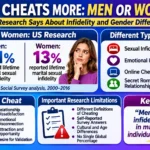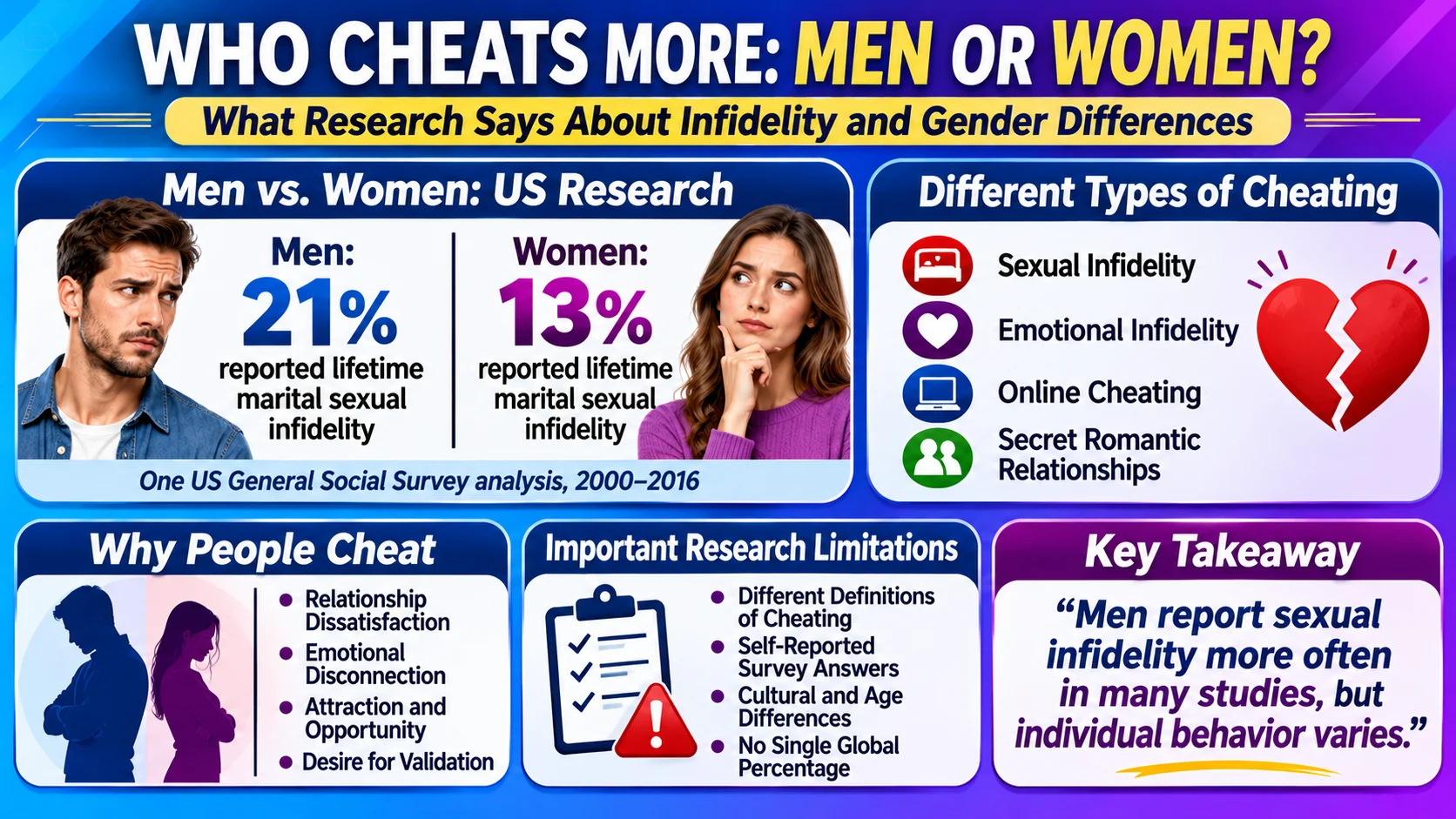
Research generally suggests that men report sexual infidelity more often than women, particularly in studies of married adults. However, the difference varies by age, relationship status, and how researchers define cheating. Emotional and online infidelity can show different patterns.
Who cheats more, men or women? It is one of the most common questions people ask about relationships, marriage, and trust. Although popular opinions often blame one gender, research offers a more complicated picture.
Several studies suggest that men report sexual cheating more frequently than women. However, that does not mean every man is more likely to cheat or that women are always faithful. The results also depend on what researchers count as infidelity.
For example, some studies measure sexual affairs, while others include emotional relationships, online flirting, and secret romantic connections. As a result, the answer can change depending on the definition. This article explores the available statistics, gender differences, reasons for cheating, and what the research actually tells us.
Who Cheats More: Men or Women?
Overall, research on sexual infidelity generally finds that men report cheating more often than women. This pattern appears in several studies involving married adults.
One widely discussed analysis used data from the General Social Survey in the United States. Researchers Lindsay Labrecque and Mark Whisman examined responses collected between 2000 and 2016.
Their findings showed that approximately:
- 21% of men reported having sex with someone other than their spouse during marriage.
- 13% of women reported the same experience.
Therefore, men reported a higher lifetime rate of marital sexual infidelity in that analysis.
However, these figures should not be treated as universal numbers. They describe self-reported behavior among surveyed Americans, not every relationship or every country.
In addition, the difference can become smaller among younger adults. Some research has found that younger women report rates closer to those of men.
The most reasonable conclusion is that men report sexual infidelity more frequently overall in many studies, but the gap depends on the population and measurement method.
Cheating Statistics: Men vs. Women
Statistics provide a clearer picture than assumptions. Nevertheless, every study has limitations, especially when it relies on people reporting private behavior.
Here is a simplified comparison based on research findings.
| Research Finding | Men | Women |
|---|---|---|
| Lifetime marital sexual infidelity in one US analysis | 21% | 13% |
| Reported sexual infidelity in a 2020 Chinese survey | 35% | 23% |
| Past-year sexual infidelity in the same Chinese survey | 27% | 19% |
These figures come from different studies and populations. Therefore, they should not be combined into one overall global rate.
The Chinese survey examined married adults’ reports of sexual infidelity during their current marriage and the previous year. Similarly, the US research examined reported extramarital sex among ever-married adults.
Both studies found higher reported rates among men. However, cultural expectations, age groups, survey methods, and relationship definitions can influence the results.
The key point: Research often finds a gender difference in sexual infidelity, but no single percentage describes everyone.
Do Men Cheat More Than Women in Marriage?
Several studies suggest that married men report sexual affairs more often than married women.
The General Social Survey analysis is one example. It found that men were more likely to report both lifetime and past-year extramarital sex.
Moreover, researchers found differences in attitudes toward affairs. Men were generally less likely than women to describe extramarital sex as always wrong.
However, attitudes do not automatically predict behavior. A person can disapprove of cheating and still be unfaithful. Likewise, someone who expresses more accepting attitudes may remain committed to one partner.
Marriage also introduces factors that can affect relationship behavior. For example, communication problems, dissatisfaction, opportunities, and changing expectations may influence decisions.
Therefore, gender alone cannot explain why someone cheats. Personal values, relationship circumstances, and individual choices matter too.
Do Women Cheat More Emotionally Than Men?
Sexual cheating and emotional cheating are not the same thing. Consequently, statistics about physical affairs do not tell the complete story.
Emotional infidelity generally involves developing a secret romantic or emotionally intimate connection outside an agreed relationship. It may include romantic messages, hidden conversations, or sharing intimacy that a partner considers exclusive.
Some research suggests that women may be more likely to report certain forms of emotional infidelity. However, findings vary, and researchers do not always use the same definition.
For example, one person may consider private romantic conversations cheating. Another may see them as inappropriate but not necessarily an affair.
In addition, emotional and sexual infidelity can overlap. A person may develop an emotional attachment before a physical relationship begins.
| Type of Infidelity | What It Involves |
|---|---|
| Sexual cheating | Sexual activity outside an agreed exclusive relationship |
| Emotional cheating | A secret romantic or emotionally intimate connection |
| Online cheating | Secret romantic or sexual communication online |
| Physical cheating | Physical intimacy that violates relationship boundaries |
| Financial deception | Hiding significant financial behavior from a partner |
As a result, the answer to who cheats more can depend on which behavior a study measures.
Why Do Men Cheat?
There is no single reason men cheat. In fact, people make unfaithful choices for different personal and relationship-related reasons.
Some commonly discussed factors include:
Relationship Dissatisfaction
A man may feel unhappy, disconnected, or unappreciated in his relationship. However, dissatisfaction does not make cheating inevitable or acceptable.
Desire for Novelty
Some people seek excitement or new experiences outside their relationships. In such cases, the attraction of something different may influence their decisions.
Opportunity and Temptation
Frequent social interactions, travel, workplace relationships, and online communication can create opportunities for affairs. Nevertheless, opportunity alone does not determine someone’s behavior.
Emotional Disconnection
Some men may struggle to communicate their feelings or relationship concerns. Consequently, they may seek emotional attention elsewhere instead of addressing problems directly.
Personal Attitudes Toward Commitment
Individual beliefs about exclusivity can influence behavior. For example, someone who does not value relationship boundaries may be more willing to break an agreement.
Importantly, none of these factors applies to all men. Many men remain faithful even when their relationships experience difficulties.
Why Do Women Cheat?
Women also cheat for different reasons. Although popular stereotypes often describe women’s motivations differently, individual experiences vary considerably.
Emotional Disconnection
Some women report feeling emotionally distant from their partners. As a result, attention and affection from another person may become appealing.
Lack of Relationship Satisfaction
Unresolved disagreements, poor communication, and unmet expectations can create relationship dissatisfaction. However, many people respond to these problems through communication rather than infidelity.
Feeling Unappreciated
A person who feels ignored or undervalued may seek validation elsewhere. Even so, this does not mean every unhappy partner will cheat.
Attraction to Someone Else
Physical attraction and romantic interest can develop outside a committed relationship. Nevertheless, acting on those feelings is a separate decision.
Desire for Change
Some people become uncertain about their current relationship or want a different emotional experience. Instead of ending the relationship first, they may begin another connection.
Ultimately, women’s reasons for cheating are not fundamentally separate from men’s in every situation. Both genders can experience dissatisfaction, attraction, loneliness, and opportunities for infidelity.
Does Age Affect Who Cheats More?
Age can influence reported cheating rates. However, the relationship between age and infidelity is not simple.
Some US survey analyses have found that younger adults show a smaller gender gap than older adults. In certain younger age groups, women’s reported rates have been close to or slightly higher than men’s.
By contrast, older age groups have sometimes shown a wider difference, with men reporting more marital sexual infidelity.
Several factors may help explain these patterns:
- Relationship history: Older adults have had more time to experience different relationships.
- Marriage duration: Longer marriages create a longer period in which lifetime infidelity could occur.
- Social expectations: Attitudes toward relationships and sexuality can differ between generations.
- Survey honesty: People from different age groups may feel differently about admitting private behavior.
Therefore, age can influence the statistics, but it does not determine whether someone will cheat.
Does Emotional Cheating Count as Cheating?
Yes, emotional cheating can count as infidelity when it violates the boundaries of a relationship.
However, couples do not always agree on what qualifies. For one couple, a secret romantic conversation may cross a clear boundary. Meanwhile, another couple may consider the same interaction harmless.
Common examples of possible emotional cheating include:
- Hiding romantic messages from a partner.
- Developing a secret romantic attachment.
- Sharing intimate feelings with someone while deliberately excluding a partner.
- Deleting conversations to conceal a connection.
- Expressing romantic interest while pretending to be single.
That said, close friendships are not automatically emotional affairs. People can maintain meaningful friendships outside their romantic relationships.
The important difference involves secrecy, romantic intent, broken agreements, and the boundaries both partners have established.
Do Men and Women Cheat for Different Reasons?
Men and women may report different motivations in some studies. Still, there is considerable overlap.
For instance, both may cheat because of relationship dissatisfaction, attraction, emotional disconnection, opportunity, or a desire for validation.
Some research has associated women’s infidelity with relationship dissatisfaction and a desire to change long-term partners. Meanwhile, other studies have examined men’s attitudes toward casual sexual opportunities.
However, these are research patterns, not fixed rules.
A person’s motivations depend on personality, circumstances, relationship expectations, and individual values. Therefore, it would be misleading to claim that all men cheat for physical reasons or all women cheat for emotional reasons.
In reality, sexual and emotional motivations can exist in anyone.
What Does Research Say About Online Cheating?
Online communication has created additional ways for people to cross relationship boundaries.
For example, someone might develop a secret romantic connection through social media, dating apps, gaming communities, or private messaging.
Online cheating can involve:
- Secret romantic conversations.
- Sexual messages or images.
- Using dating apps while in an exclusive relationship.
- Hiding online relationships from a partner.
- Maintaining a secret emotional connection.
However, not every online friendship or private conversation is cheating.
The couple’s relationship agreements matter. If both partners consider certain online activities unacceptable, secretly engaging in them can damage trust.
Research on online infidelity also faces measurement challenges. Some studies count sexual messages, while others include emotional attachment or online romantic relationships. Consequently, comparisons between men and women can vary.
Why Is It Difficult to Know Who Cheats More?
Although research offers useful evidence, measuring infidelity is difficult.
Most studies depend on people answering personal questions honestly. However, some participants may hide their behavior because they fear judgment or embarrassment.
Other challenges include:
Different Definitions of Cheating
One study may measure sexual affairs only. Another may include emotional relationships, online activity, or secret romantic behavior.
As a result, the findings may not be directly comparable.
Self-Reported Answers
People may forget details, misunderstand questions, or choose not to disclose private behavior. Therefore, survey results cannot capture every instance of infidelity.
Cultural Differences
Relationship expectations vary across countries and communities. In addition, social attitudes can influence whether people admit to cheating.
Age and Relationship Status
A study involving married adults may produce different findings from research involving dating couples. Similarly, lifetime statistics differ from past-year statistics.
A 2024 systematic review and meta-analysis examined 305 studies involving more than 508,000 respondents across 47 countries. It highlighted major differences in how researchers define and measure romantic infidelity.
Thus, the available evidence is useful, but it does not provide one perfect global answer.
Does Cheating Mean Someone Is Unhappy in a Relationship?
Not necessarily. Relationship dissatisfaction can contribute to infidelity, but it is not the only explanation.
Some people cheat despite reporting that they are satisfied with their partners. Others may struggle with personal boundaries, impulsive decisions, or attitudes toward commitment.
Similarly, a person can feel unhappy in a relationship without cheating.
Therefore, cheating should not automatically be treated as proof that a partner failed to provide enough attention, affection, or intimacy.
The responsibility for breaking an agreed relationship boundary belongs to the person who makes that choice. Relationship problems may involve both partners, but dishonesty remains an individual decision.
How Does Cheating Affect a Relationship?
Infidelity can seriously damage trust, emotional security, and relationship satisfaction.
For the betrayed partner, discovering an affair may lead to sadness, anger, anxiety, confusion, or a loss of confidence. In addition, uncertainty about the future can make everyday communication difficult.
The effects may include:
- Loss of trust.
- Frequent arguments.
- Emotional distance.
- Reduced relationship satisfaction.
- Anxiety about future dishonesty.
- Separation or divorce.
However, not every relationship ends after infidelity. Some couples choose to rebuild their relationship through honest communication, clear boundaries, and professional counseling.
Even so, rebuilding trust takes time. Both partners must decide whether they want to continue and what changes are necessary.
How Can Couples Reduce the Risk of Cheating?
No method can guarantee that a partner will never cheat. Nevertheless, healthy relationship habits can strengthen trust and reduce avoidable problems.
Communicate Openly
Discuss feelings, expectations, and concerns before resentment grows. Moreover, make room for honest conversations without turning every disagreement into an argument.
Establish Clear Boundaries
Partners should discuss what they consider cheating. For example, they can talk about private messages, dating apps, romantic friendships, and online interactions.
Spend Quality Time Together
Shared activities and meaningful conversations can help partners maintain emotional closeness. Therefore, make time for each other even when work and daily responsibilities become demanding.
Address Relationship Problems Early
Ignoring recurring problems can create distance. Instead, discuss concerns and look for practical solutions together.
Take Responsibility
Trust depends on honesty and accountability. If someone crosses a boundary, acknowledging the behavior is more constructive than hiding it or blaming the other partner.
Frequently Asked Questions
Do men cheat more than women?
Research generally finds that men report sexual infidelity more frequently than women, especially in studies of married adults. However, the difference varies across age groups, countries, relationship types, and definitions of cheating.
What percentage of men cheat compared to women?
One US analysis of General Social Survey data found that approximately 21% of men and 13% of women reported marital sexual infidelity. These figures describe that study’s population, not everyone worldwide.
Do women cheat more emotionally than men?
Some research suggests that certain forms of emotional infidelity may be more common among women. However, findings vary because researchers define emotional cheating differently, and both men and women can develop secret emotional relationships.
Do younger women cheat more than younger men?
Some survey findings show that younger women’s reported infidelity rates can approach or slightly exceed men’s in certain age groups. However, this pattern does not apply to every population or study.
Why do people cheat even when they love their partners?
People may cheat because of personal choices, attraction, dissatisfaction, validation, opportunity, or difficulties with commitment. Therefore, cheating does not always mean someone has stopped loving their partner.
Is emotional cheating worse than physical cheating?
Neither type is automatically worse for every couple. The impact depends on relationship boundaries, secrecy, personal values, and individual experiences. For many people, both forms of betrayal can cause serious emotional pain.
Can a relationship survive cheating?
Yes, some relationships recover after infidelity. However, rebuilding trust usually requires honesty, accountability, consistent effort, and time. Some couples also benefit from professional relationship counseling.
Are men and women equally likely to cheat worldwide?
There is no single worldwide rate that applies to every country. Research often finds higher reported sexual infidelity among men, but cultural expectations, survey methods, and definitions can change the results.
Conclusion
So, who cheats more: men or women? Research generally shows that men report sexual infidelity more often, particularly among married adults. However, the difference varies across age groups, countries, and relationship types. Emotional cheating also deserves attention because physical affairs do not represent every form of betrayal. Moreover, statistics cannot predict an individual’s behavior or explain every affair. Personal values, honesty, communication, and commitment matter in every relationship. Ultimately, cheating is a personal choice, not an unavoidable result of gender. Understanding the evidence helps replace stereotypes with a more balanced view of relationships and trust.