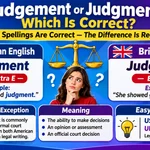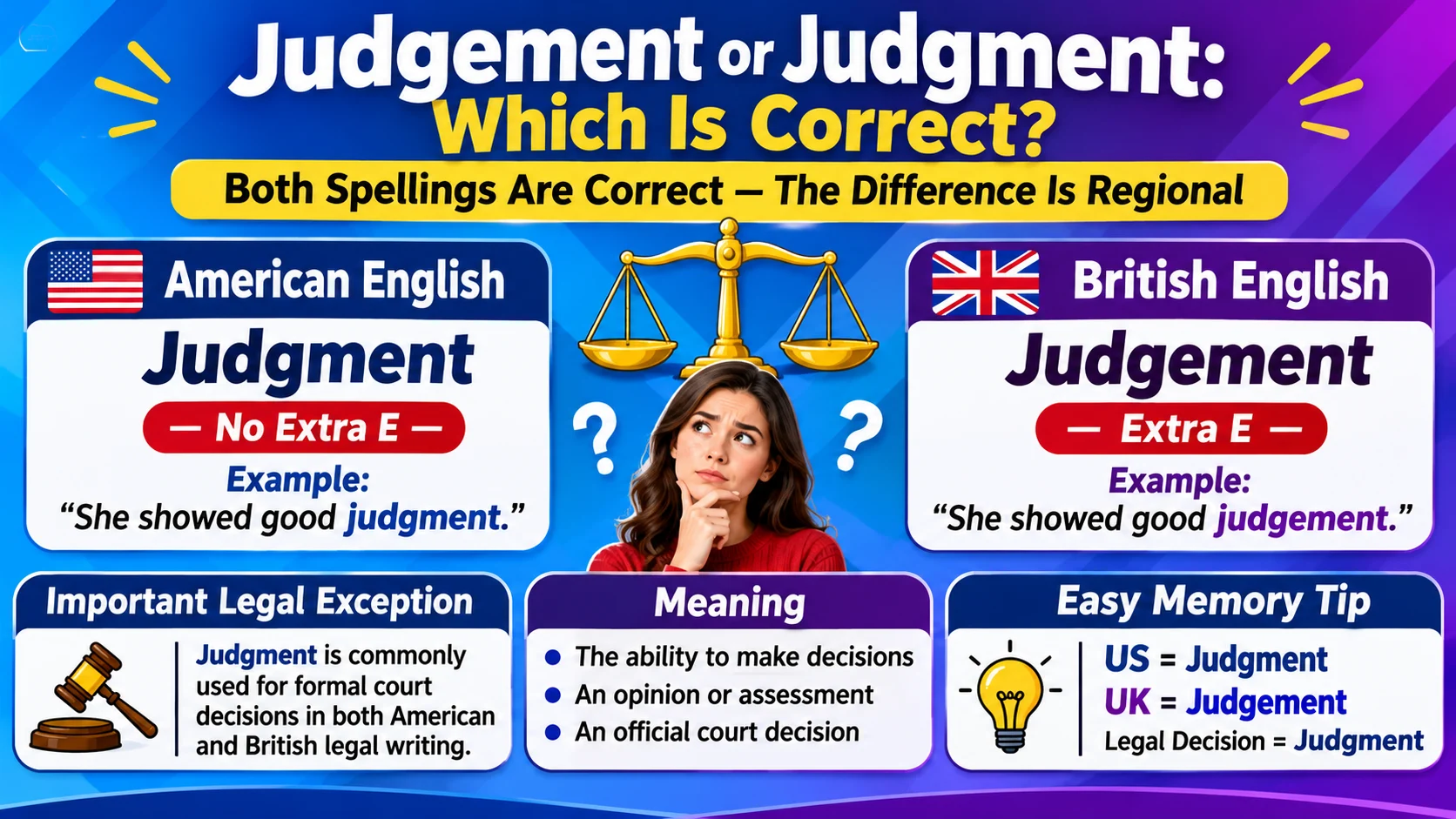
Judgment is the standard spelling in American English. Judgement is the usual spelling in general British English. Both spellings have the same meaning and pronunciation. However, British legal writing generally uses judgment for an official court decision.
Judgement or judgment is a common spelling question because both versions appear in English writing. Although they look different, they share the same meaning. The main difference comes from regional spelling preferences.
In American English, judgment is the standard choice. By contrast, British English commonly uses judgement in general writing. However, British legal documents often use the shorter spelling, too.
This small difference can confuse writers, students, bloggers, and editors. For example, you might see good judgment in an American article but good judgement in a British publication. Both forms communicate the same idea.
So, which spelling should you choose? The answer depends on your audience and writing style. This guide explains both spellings, their meanings, regional differences, examples, and common mistakes. As a result, you can choose the right form with confidence.
What Is the Difference Between Judgement and Judgment?
The difference between judgement and judgment is mainly regional. Both words are nouns, and both describe the ability to make decisions, the process of forming opinions, or a decision itself.
The spelling changes depending on the English variety.
| Spelling | Common Usage | Example |
|---|---|---|
| Judgment | American English | She showed excellent judgment. |
| Judgement | General British English | She showed excellent judgement. |
| Judgment | British legal writing | The court delivered its judgment. |
Therefore, neither spelling has a different meaning. The extra E does not change the word’s pronunciation or definition.
However, regional conventions matter when you prepare an article, school assignment, business document, or legal text. For an American audience, choose judgment. Meanwhile, judgement is a familiar choice in general British writing.
Is Judgment or Judgement Correct in American English?
Judgment is the standard American English spelling. It does not include an extra E between the G and M.
For example:
- She has excellent judgment.
- His judgment was based on the available facts.
- Good judgment can prevent unnecessary problems.
- The manager questioned the employee’s judgment.
- I trust your judgment on this matter.
Although some American readers may recognize judgement, it is not the preferred spelling in standard US writing. Therefore, writers targeting American readers should consistently use judgment.
This rule applies to everyday writing as well as professional documents. In addition, American legal writing uses judgment when referring to a court’s decision.
Is Judgement or Judgment Correct in British English?
In general British English, judgement is a common and traditional spelling. It includes an extra E before the letter M.
For example:
- She showed good judgement.
- His judgement was fair and reasonable.
- I respect your judgement.
- That was a poor judgement call.
- The teacher praised her sound judgement.
However, British English also uses judgment, especially in legal contexts. A court’s official decision is conventionally written as a judgment.
Therefore, British writers may encounter both versions in reputable publications. The best approach is to follow the preferred spelling in the relevant style guide and remain consistent.
What Does Judgment or Judgement Mean?
Both spellings have the same basic meanings. The word can describe a decision, an opinion, or the ability to make sensible choices.
Here are its main meanings.
The Ability to Make Good Decisions
Judgment can describe someone’s ability to think carefully and choose wisely.
For example:
- She has good judgment when choosing friends.
- His professional judgment impressed the entire team.
- Parents often use their judgment when making family decisions.
In these examples, the word refers to someone’s ability to evaluate situations and make sensible choices.
An Opinion or Assessment
The word can also describe an opinion formed after considering information or evidence.
For example:
- My first judgment about the movie was incorrect.
- Do not make a judgment without knowing the facts.
- Her judgment of the situation was accurate.
Similarly, people use the word when discussing opinions about someone’s behavior, character, or decisions.
An Official Court Decision
In legal writing, judgment refers to a formal decision made by a court or judge.
For example:
- The court issued its judgment on Monday.
- The final judgment resolved the dispute.
- The judge delivered a written judgment.
In this context, judgment is the conventional spelling in both American and British legal writing.
Judgement vs. Judgment: Example Sentences
The easiest way to understand the spelling difference is to compare both versions in complete sentences.
| With Judgment | With Judgement |
|---|---|
| She has good judgment. | She has good judgement. |
| His judgment was correct. | His judgement was correct. |
| I trust your judgment. | I trust your judgement. |
| That was a poor judgment call. | That was a poor judgement call. |
| We respect her professional judgment. | We respect her professional judgement. |
As you can see, the meaning stays exactly the same. Only the spelling changes.
However, you should not switch between the two forms randomly within one article. Instead, choose the version that matches your target audience.
For American readers, use judgment throughout. For general British writing, judgement is a suitable choice, unless your style guide specifies otherwise.
Why Are There Two Spellings?
The two spellings developed through different English spelling conventions. The word comes from Old French jugement, which is related to the verb juger, meaning to judge.
Over time, English writers used both forms. Eventually, spelling preferences became associated with different regions.
American English standardized judgment without the extra E. Meanwhile, British English commonly retained judgement in general writing.
However, the shorter form never disappeared from British usage. In particular, legal writing continued to favor judgment.
As a result, both spellings remain recognizable today. The difference reflects writing conventions rather than a change in meaning.
When Should You Use Judgment?
Use judgment when writing for an American audience. It is the safest and most widely recognized spelling in standard US English.
You should use it in:
- American blog articles
- School assignments
- Business reports
- Professional emails
- Academic writing
- News articles
- Legal documents
- Everyday conversations and messages
For example, an American article might say:
“Good judgment helps people make better decisions.”
Similarly, a business report might state:
“The manager used sound judgment when reviewing the proposal.”
In both cases, the spelling without E follows standard American usage.
When Should You Use Judgement?
Use judgement when following general British English spelling conventions.
It is suitable for:
- British blog articles
- UK publications
- General British writing
- Informal and professional communication
- Educational content using British spelling
For example:
“Good judgement is important when making difficult decisions.”
Likewise, a British writer might say:
“She showed excellent judgement during the interview.”
However, remember the legal exception. British legal writing generally uses judgment when referring to a formal court decision.
Common Expressions With Judgment and Judgement
Both spellings appear in several familiar expressions. Their meanings remain the same, regardless of the spelling convention.
| Expression | Meaning | Example |
|---|---|---|
| Good judgment | Ability to make sensible decisions | She has good judgment. |
| Poor judgment | An unwise decision or lack of good sense | That was an example of poor judgment. |
| Sound judgment | A reasonable and careful decision | He showed sound judgment. |
| Against my better judgment | Doing something despite believing it may be unwise | I went against my better judgment. |
| Judgment call | A decision based on personal assessment | Choosing the winner was a judgment call. |
| Quick judgment | A decision made rapidly | Avoid making a quick judgment. |
| Moral judgment | An opinion about right and wrong | People sometimes disagree about moral judgment. |
In British general writing, you may see these expressions with judgement. By contrast, American writers normally use judgment.
Common Mistakes With Judgement and Judgment
Although the difference is simple, writers sometimes make avoidable spelling mistakes. Here are some common issues to watch for.
Using Judgement in American Writing
The most common issue is using judgement in an article written in standard American English.
Instead, use judgment to match US spelling conventions.
Assuming the Words Have Different Meanings
Some writers believe that the two spellings describe different concepts. However, they have the same meaning.
The extra E does not create a separate definition.
Forgetting the British Legal Exception
British English often uses judgement in general writing. Nevertheless, legal documents traditionally use judgment for a court’s formal decision.
Therefore, check the context before choosing the spelling.
Mixing Both Spellings in One Article
Using both versions in the same article can make your writing look inconsistent.
Instead, select one regional spelling convention and apply it throughout the content.
Confusing Judgment With Judging
Judgment is a noun, while judging is the -ing form of the verb judge.
For example:
- Judgment: Her judgment was fair.
- Judging: He is judging the competition.
Although these words are related, they perform different grammatical roles.
How to Remember the Correct Spelling
A simple way to remember the difference is to connect each spelling with its regional audience.
- US = Judgment: American English normally drops the extra E.
- UK = Judgement: General British English commonly keeps the E.
- Legal writing = Judgment: The shorter spelling is conventional for formal court decisions.
You can also remember that the two spellings sound exactly alike. Therefore, pronunciation will not help you decide which version to write.
Instead, think about your readers. If your article targets the United States, choose judgment. If it targets the United Kingdom, follow the preferred British spelling.
Frequently Asked Questions
Is judgment or judgement correct?
Both spellings are correct, but their preferred usage differs by region. American English uses judgment, while general British English commonly uses judgement. However, British legal writing generally prefers the shorter spelling.
Is judgement spelled with an E?
Yes. Judgement includes an extra E between the G and M. It is a common spelling in general British English. However, American English normally uses judgment without the extra letter.
Is judgment the American spelling?
Yes. Judgment is the standard spelling in American English. It is used in everyday writing, academic work, business communication, and legal documents. Therefore, US writers should generally avoid the alternative spelling.
Is judgement the British spelling?
Yes. Judgement is commonly used in general British English. However, British legal writing traditionally uses judgment when referring to a formal decision made by a court.
Do judgment and judgement mean the same thing?
Yes. Both words describe the ability to make decisions, an opinion, or a formal decision. The only difference is their spelling convention. Therefore, neither version has a separate meaning.
Why does judgment have no E?
American English standardized the shorter spelling, judgment, without the extra E. British English commonly retained the longer form in general writing. Nevertheless, both spellings have a long history in English.
How do you spell judgment in a legal document?
Use judgment in American legal documents and generally in British legal writing. The shorter form is conventional when referring to an official court decision. However, always follow the relevant legal style guide.
Is it against my better judgement or judgment?
Both spellings are used in the expression. American English generally writes “against my better judgment,” while general British English commonly uses “against my better judgement.” The meaning remains exactly the same.
Conclusion
Judgment is the standard spelling in American English, while judgement is common in general British English. Both forms have the same meaning and pronunciation. However, British legal writing generally uses judgment when referring to an official court decision. Therefore, your choice should depend on your audience and writing style. If you are creating content for American readers, always choose judgment. Meanwhile, British writers can use judgement in general contexts. Most importantly, stay consistent throughout your article. Once you understand this regional difference, choosing the correct spelling becomes simple and easy.