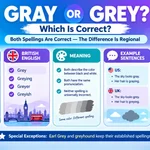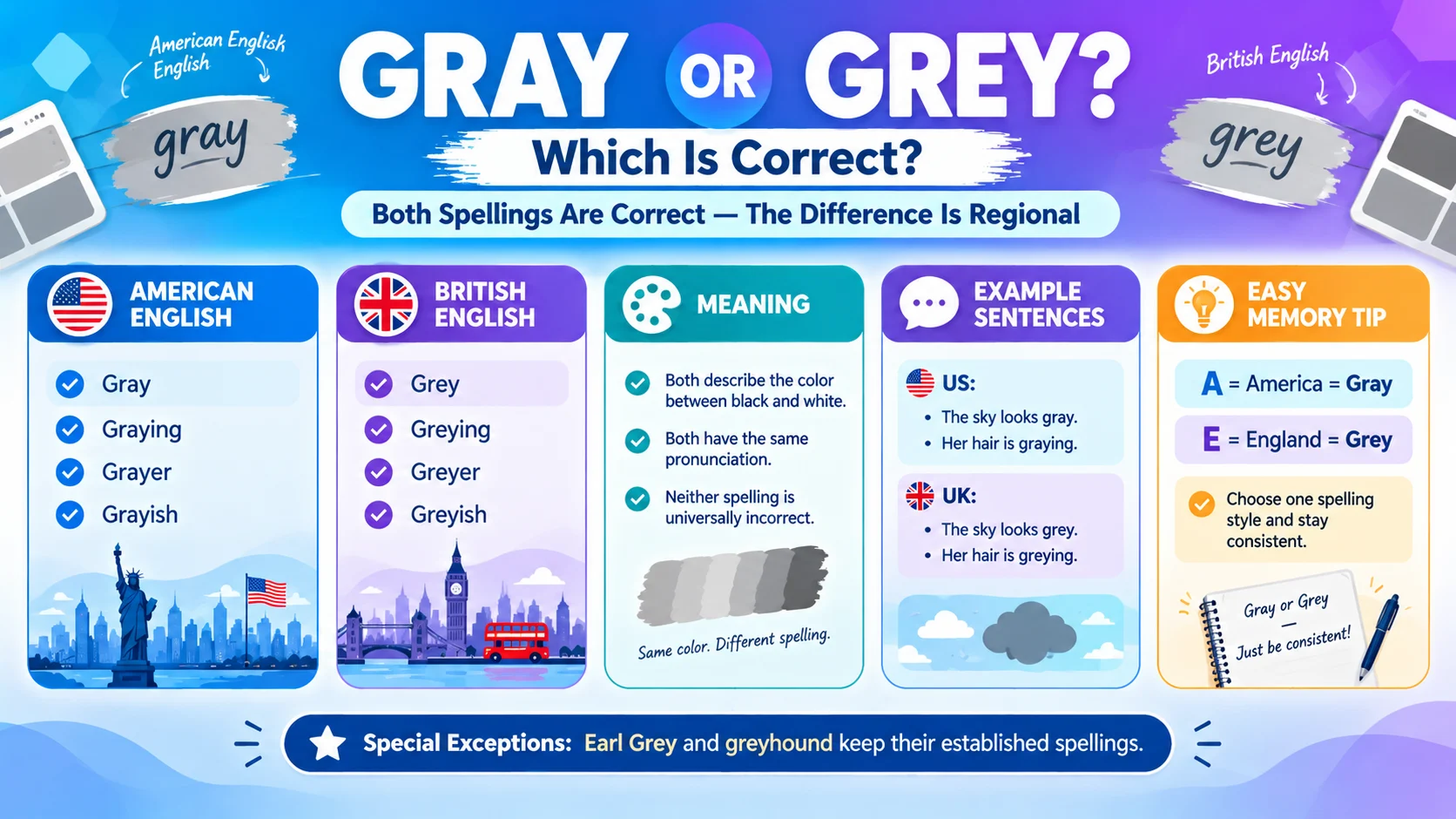
Both gray and grey are correct spellings of the same color. However, gray is the standard spelling in American English, while grey is more common in British English. The meaning and pronunciation remain the same.
Gray or grey is a common spelling question because both versions appear in everyday writing. You might see gray in an American article and grey in a British book. However, neither spelling is incorrect.
The main difference comes from regional English conventions. In the United States, writers generally use gray with an a. Meanwhile, British writers usually prefer grey with an e. Both spellings describe the color between black and white.
Although the difference looks small, choosing the right version can make your writing more consistent. Therefore, this guide explains when to use gray or grey, how their word forms change, and which spelling fits American English. You’ll also find practical examples, common mistakes, and answers to frequently asked questions.
Gray vs. Grey
| Spelling | Preferred In | Example |
|---|---|---|
| Gray | American English | The sky looks gray. |
| Grey | British English | The sky looks grey. |
| Gray | US publications and writing | She bought a gray jacket. |
| Grey | UK publications and writing | She bought a grey jacket. |
Both spellings are correct. However, the preferred version depends on your audience and the English style you follow.
What Does Gray or Grey Mean?
Gray and grey refer to the same color, which sits between black and white. The color can appear in many shades, from very light to almost black.
For example, a light gray wall looks pale and soft. In contrast, a charcoal gray jacket appears much darker.
The word can also describe more than a physical color. Sometimes, writers use it to express uncertainty, sadness, or a lack of clear distinctions.
Consider these examples:
- The clouds turned gray before the storm.
- Her hair is beginning to turn grey.
- He wore a dark gray suit.
- The room had pale grey walls.
- The situation falls into a gray area.
As you can see, both spellings communicate the same basic meaning. The difference is regional rather than semantic.
Gray or Grey: Which Spelling Is American English?
Gray is the preferred spelling in American English. Therefore, writers in the United States generally use gray in school assignments, newspapers, websites, business documents, and everyday communication.
For example:
- My favorite color is gray.
- The gray clouds covered the sky.
- He has a few gray hairs.
- We painted the bedroom light gray.
- She wore a gray sweater to work.
American English also uses the spelling gray in related word forms.
| Word Form | American Spelling |
|---|---|
| Basic word | Gray |
| Becoming gray | Graying |
| More gray | Grayer |
| Somewhat gray | Grayish |
If your audience is primarily American, choose gray throughout your article or document. That way, your spelling remains consistent with US conventions.
Grey or Gray: Which Spelling Is British English?
Grey is the more common spelling in British English. Writers in the United Kingdom generally use it in books, newspapers, schoolwork, and professional communication.
For example:
- The sky looks grey today.
- She has beautiful grey eyes.
- He bought a grey car.
- The old building has grey walls.
- His hair is turning grey.
Similarly, British English uses the letter e in several related forms.
| Word Form | British Spelling |
|---|---|
| Basic word | Grey |
| Becoming grey | Greying |
| More grey | Greyer |
| Somewhat grey | Greyish |
Therefore, if you’re writing for readers in the UK, grey is usually the better choice. The same preference is common in Australia, Ireland, and other regions that follow British English conventions.
Why Are There Two Spellings?
The two spellings developed from the same historical word. Both forms have existed in English for centuries, and their meanings remain closely connected.
Over time, regional writing conventions helped establish different preferences. American English settled on gray, while British English generally favored grey.
As a result, modern writers usually follow the spelling used in their region. This difference is similar to other American and British spelling pairs, such as:
| American English | British English |
|---|---|
| Color | Colour |
| Favorite | Favourite |
| Center | Centre |
| Theater | Theatre |
| Gray | Grey |
| Analyze | Analyse |
However, these differences do not mean one version is better than the other. They simply reflect different English spelling conventions.
Gray or Grey in Example Sentences
Examples make the spelling difference easier to understand. Notice that the meaning stays exactly the same even when the spelling changes.
| American English | British English |
|---|---|
| The sky is gray. | The sky is grey. |
| I bought a gray shirt. | I bought a grey shirt. |
| Her hair is turning gray. | Her hair is turning grey. |
| He drives a gray car. | He drives a grey car. |
| The walls are light gray. | The walls are light grey. |
| The cat has gray fur. | The cat has grey fur. |
Both versions are grammatically correct. Nevertheless, you should choose one spelling style and use it consistently.
Gray Area or Grey Area: Which Is Correct?
Both gray area and grey area are correct expressions. However, the spelling follows the same regional pattern as the color word.
In American English, writers generally use gray area. Meanwhile, British English usually prefers grey area.
The expression describes a situation that is unclear, uncertain, or difficult to classify.
For example:
- The legal question falls into a gray area.
- There is a grey area in the company’s policy.
- His responsibilities are still in a gray area.
- The rules leave a grey area that needs clarification.
In other words, a gray or grey area is not necessarily about color. Instead, it describes something that does not have a clear answer or boundary.
Graying or Greying: Which Spelling Is Correct?
The same regional spelling difference applies when the word describes hair or another object becoming gray.
Graying is the standard American spelling. By contrast, greying is more common in British English.
Examples include:
- His hair is graying.
- Her hair is greying.
- The sky is slowly graying.
- The photograph is greying with age.
Similarly, the comparative forms follow the same pattern:
- American English: grayer
- British English: greyer
Therefore, remember that the spelling difference continues in related forms. It is not limited to the basic word.
Special Cases: When the Spelling Does Not Change
Although gray and grey are interchangeable in ordinary color descriptions, some established names and terms keep a fixed spelling.
Earl Grey Tea
Earl Grey is the established name of a tea variety. It keeps the spelling Grey, even in American English.
For example:
- She ordered a cup of Earl Grey tea.
- Earl Grey is often served with milk or lemon.
Greyhound
Greyhound is the standard spelling of the dog breed. It does not change to grayhound when writing American English.
For example:
- The greyhound ran quickly across the field.
- My neighbor adopted a retired greyhound.
The Gray Unit
In science, the gray is the SI unit used to measure absorbed radiation dose. Its symbol is Gy.
This scientific unit keeps the spelling gray, regardless of the ordinary regional color preference.
These examples show why context matters. Although the general spelling rule is useful, proper names and technical terms may follow their own established conventions.
Common Mistakes When Using Gray and Grey
The difference is easy to remember once you understand the regional rule. Still, writers sometimes make a few avoidable mistakes.
Thinking One Spelling Is Incorrect
Both versions are correct English spellings. Therefore, writing grey in a British article is not a mistake, and using gray in an American article is not a mistake.
Mixing American and British Spellings
Using both versions in the same article can make your writing look inconsistent. For example, writing “gray walls” in one paragraph and “grey hair” in another may confuse readers.
Instead, choose one English style and follow it throughout the document.
Changing Fixed Names
Some terms have established spellings. For instance, Earl Grey and greyhound retain their standard forms even when the surrounding text follows American English.
Assuming the Colors Are Different
Gray and grey do not normally describe two separate colors. Although people sometimes suggest that one spelling represents a warmer or cooler shade, modern everyday English does not maintain that distinction.
Which Spelling Should You Use?
The best spelling depends on who will read your writing.
If you’re creating content for an American audience, use gray. This is especially important for US websites, school assignments, business documents, and publications.
On the other hand, choose grey when writing for a British audience. The same spelling is generally suitable for Australian and Irish English.
For international content, consistency matters most. Therefore, select one spelling style based on your main audience and use it throughout the article.
| Writing Situation | Recommended Spelling |
|---|---|
| US blog or website | Gray |
| American school assignment | Gray |
| US business document | Gray |
| UK publication | Grey |
| British school assignment | Grey |
| Australian article | Grey |
| International article | Follow one consistent style |
Frequently Asked Questions
Is gray or grey correct?
Both spellings are correct. However, gray is the standard American English spelling, while grey is more common in British English. Both words describe the same color and have the same pronunciation.
Is gray American or British?
Gray is the preferred spelling in American English. Writers in the United States generally use it in everyday communication, schoolwork, professional documents, and online publications.
Is grey American or British?
Grey is more common in British English. It is also widely used in Australia, Ireland, and other regions that follow British spelling conventions.
Do gray and grey mean the same thing?
Yes. Gray and grey have the same meaning and pronunciation. Both describe the color between black and white. The difference is regional spelling preference, not a difference in color or definition.
Is it gray hair or grey hair?
Both expressions are correct. American English generally uses gray hair, while British English prefers grey hair. Therefore, choose the spelling that matches the English style used in your writing.
Is it gray area or grey area?
Both expressions are correct. American writers usually choose gray area, whereas British writers generally use grey area. The phrase describes an unclear situation without a definite answer or rule.
Is graying or greying correct?
Both spellings are accepted. However, graying is standard in American English, while greying is more common in British English. Both describe something gradually becoming gray or grey.
Why does Earl Grey have an E?
Earl Grey is the established name of a tea variety. It is a proper name, so its traditional spelling remains unchanged in both American and British English.
Conclusion
Gray and grey are both correct spellings, but your audience determines which version you should choose. American English generally uses gray, while British English prefers grey. However, both words have the same meaning and pronunciation. The difference also appears in related forms, such as graying and greying. Therefore, remember the simple trick: A stands for America, so choose gray; E stands for England, so choose grey. For clear and professional writing, stick to one regional spelling style throughout your article. Ultimately, consistency matters more than choosing one version over the other.

Andrew Morris is a writer at Meaninga.com who specializes in word meanings, slang, idioms and modern language trends. He creates clear, accurate and easy to understand content for everyday readers.