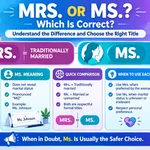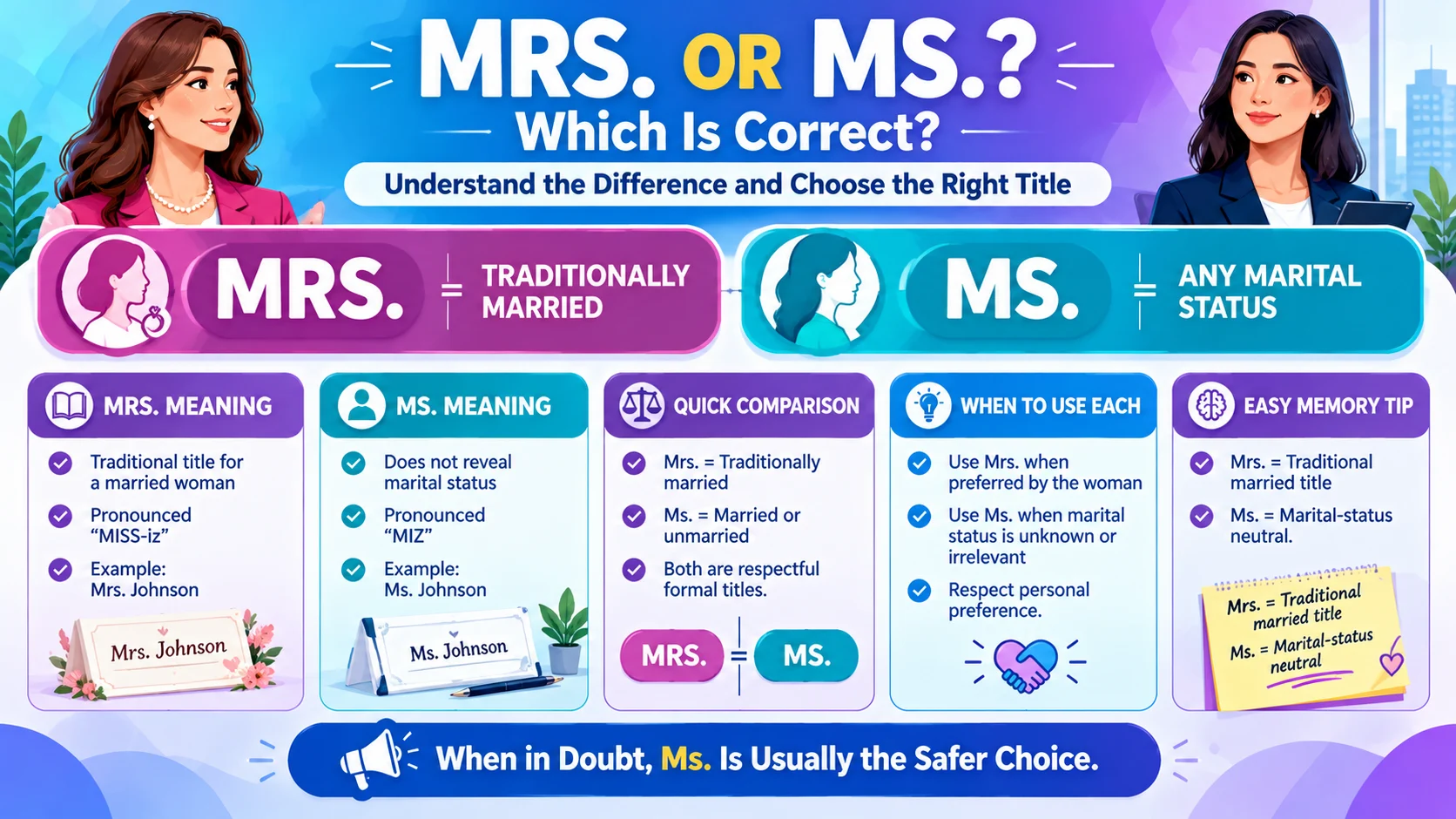
Ms. is a neutral title for a woman, regardless of whether she is married or unmarried. Mrs. traditionally identifies a married woman. Therefore, use Ms. when you do not know someone’s marital status or when that information is irrelevant. However, always respect the person’s preferred title.
Choosing between Mrs. or Ms. can feel confusing, especially when writing a formal email, addressing a letter, or preparing an invitation. Although both titles show respect, they do not communicate exactly the same thing.
The main difference is marital status. Traditionally, Mrs. refers to a married woman, while Ms. does not reveal whether a woman is married or single. As a result, Ms. works in more situations and has become a common choice in professional communication.
However, the correct title also depends on personal preference. Some women prefer Mrs., while others choose Ms. regardless of their relationship status. In this guide, you will learn their meanings, pronunciations, differences, examples, and the best situations for using each title.
What Does Mrs. Mean?
Mrs. is a traditional courtesy title used before the name of a married woman. It is commonly placed before her surname or full name.
For example:
- Mrs. Johnson
- Mrs. Sarah Johnson
- Mrs. Emily Carter
Traditionally, the title indicates that a woman is married. However, a woman may continue using Mrs. after becoming widowed or divorced if she prefers that form of address.
The title does not have to match a husband’s surname. For instance, a married woman who keeps her original last name may still choose to use Mrs.
In American English, Mrs. usually includes a period because it is written as an abbreviation. By contrast, British English often omits the period and writes it as Mrs.
Examples in sentences:
- Mrs. Johnson teaches English at our school.
- I sent the invitation to Mrs. Carter.
- Mrs. Davis will attend the meeting tomorrow.
- Please ask Mrs. Wilson to review the document.
Therefore, Mrs. is appropriate when a woman uses that title or has indicated that she prefers it.
What Does Ms. Mean?
Ms. is a courtesy title used before a woman’s name without indicating her marital status. In other words, it can refer to a married woman, an unmarried woman, or someone whose relationship status is unknown.
For example:
- Ms. Johnson
- Ms. Sarah Johnson
- Ms. Emily Carter
Unlike Mrs., Ms. does not tell the reader whether the woman is married. Because of this, it is a practical and widely accepted choice in workplaces, schools, business letters, and other formal settings.
In addition, many women prefer Ms. because it focuses on their name rather than their marital status.
Examples in sentences:
- Ms. Johnson will lead the meeting.
- Please contact Ms. Carter for more information.
- Ms. Davis is our new department manager.
- I received an email from Ms. Wilson.
Therefore, Ms. is usually the safest choice when you do not know which title a woman prefers.
Mrs. vs. Ms.: What Is the Difference?
The biggest difference between Mrs. and Ms. is whether the title communicates marital status.
Mrs. traditionally indicates that a woman is married, whereas Ms. does not identify her relationship status. Both titles are respectful, but they serve different purposes.
| Feature | Mrs. | Ms. |
|---|---|---|
| Meaning | Traditional title for a married woman | Title that does not indicate marital status |
| Marital status | Traditionally married | Married or unmarried |
| Pronunciation | MISS-iz | MIZ |
| Formal usage | Yes | Yes |
| Professional emails | When preferred | Common default |
| Period in US English | Mrs. | Ms. |
| Period in British English | Usually omitted | Usually omitted |
For example, if you know that a woman prefers Mrs., you can use that title. However, if you are unsure about her preference, Ms. is generally more appropriate.
Mrs. vs. Ms. Pronunciation
Although these titles look similar, they sound different when spoken.
Mrs. is pronounced MISS-iz. It has two syllables and sounds similar to “miss-iz.”
Ms. is pronounced MIZ. It has one syllable and sounds like the word “miz.”
Here is a simple pronunciation comparison:
| Title | Pronunciation | Sound |
|---|---|---|
| Mrs. | MISS-iz | Miss-iz |
| Ms. | MIZ | Miz |
| Miss | MISS | Miss |
The difference becomes easier to remember when you say the words aloud. Mrs. has an extra syllable, while Ms. has a short, single-syllable pronunciation.
When Should You Use Mrs.?
Use Mrs. when a woman prefers this title or has specifically asked you to address her that way.
Traditionally, it is used for married women. Nevertheless, personal preference matters more than assumptions about someone’s relationship status.
Consider these situations:
When addressing a married woman who prefers Mrs.
Example: Dear Mrs. Johnson,
When writing a formal invitation
Example: Mrs. Emily Carter requests the pleasure of your company.
When addressing someone who has introduced herself as Mrs.
Example: Thank you for your message, Mrs. Davis.
However, do not automatically use Mrs. simply because you believe someone is married. A married woman may prefer Ms. instead.
When Should You Use Ms.?
Use Ms. when a woman’s marital status is unknown, irrelevant, or when she prefers this title.
In modern professional communication, Ms. is often the most practical option. It also avoids making assumptions about someone’s personal life.
Here are some common situations:
When writing a business email
Example: Dear Ms. Anderson,
When contacting a customer
Example: We appreciate your feedback, Ms. Wilson.
When addressing a woman whose marital status is unknown
Example: Please forward the documents to Ms. Taylor.
When preparing a formal letter
Example: Dear Ms. Brown,
In addition, Ms. is suitable for married and unmarried women alike. Therefore, you do not need to know someone’s relationship status before using it.
Mrs. or Ms. in Professional Emails
When writing a professional email, Ms. is generally a safe choice if you do not know the recipient’s preferred title.
For example, you might begin with:
- Dear Ms. Johnson,
- Dear Ms. Carter,
- Dear Ms. Williams,
However, if the recipient signs her previous emails as Mrs. Johnson, follow that preference.
Similarly, if she specifically requests Ms., use Ms. even if you know she is married.
When the recipient’s name or title is uncertain, you can avoid guessing altogether. Instead, use a greeting such as:
- Dear Sarah Johnson,
- Hello Sarah,
- Dear Customer,
- Dear Hiring Manager,
This approach keeps your message respectful without making assumptions.
Mrs. vs. Ms. vs. Miss: Understanding All Three
Many people confuse Mrs., Ms., and Miss because all three are traditional titles used before women’s names. However, their meanings and pronunciations are different.
| Title | Meaning | Pronunciation |
|---|---|---|
| Mrs. | Traditionally a married woman | MISS-iz |
| Ms. | Does not indicate marital status | MIZ |
| Miss | Traditionally an unmarried woman or girl | MISS |
Miss is different from both Mrs. and Ms. because it traditionally identifies an unmarried woman or girl.
For example:
- Miss Taylor is joining our class.
- Mrs. Taylor is attending the event.
- Ms. Taylor will lead the presentation.
Nevertheless, Ms. is often preferred for adult women because it does not emphasize marital status.
Can a Married Woman Use Ms.?
Yes. A married woman can absolutely use Ms. The title does not mean that someone is unmarried.
For example, a woman named Sarah Johnson may be married and still prefer to be addressed as Ms. Johnson.
In fact, many women choose Ms. because they do not want their marital status included in formal communication.
The choice is personal. Therefore, you should not assume that Mrs. is automatically correct for every married woman.
Similarly, a woman who is unmarried can use Ms. rather than Miss. The title works regardless of relationship status.
Can an Unmarried Woman Use Mrs.?
Traditionally, Mrs. identifies a married woman. However, titles are also a matter of personal preference and individual circumstances.
An unmarried woman would generally use Ms. or Miss instead. Nevertheless, the most respectful approach is to use the title she has chosen for herself.
For example, if someone introduces herself as Mrs. Smith, follow her preference rather than questioning her marital status.
In formal communication, avoid making assumptions based on someone’s age, appearance, or surname.
Is Ms. More Professional Than Mrs.?
Neither title is automatically more professional than the other. Both are accepted forms of formal address.
However, Ms. is often more convenient in professional settings because it does not require knowledge of a woman’s marital status.
For example, businesses frequently use Ms. when communicating with customers, employees, clients, and job applicants.
On the other hand, Mrs. is perfectly appropriate when a woman prefers that title.
Therefore, professionalism depends on using the correct name and respecting personal preference, not simply choosing one title over the other.
Common Mistakes When Using Mrs. and Ms.
Although the difference is straightforward, people sometimes use these titles incorrectly.
Assuming Every Married Woman Uses Mrs.
Marriage does not automatically determine someone’s preferred title. A married woman may choose Ms. for personal or professional reasons.
Thinking Ms. Means Unmarried
This is incorrect. Ms. works for both married and unmarried women, so it does not reveal relationship status.
Confusing Ms. With Miss
These are two different titles with different pronunciations. Ms. sounds like “miz,” while Miss sounds like “miss.”
Using Mrs. Without Knowing Someone’s Preference
Avoid assuming that someone wants to be called Mrs. simply because she is married. Instead, use her preferred title or choose Ms. when appropriate.
Forgetting the Period in American English
In standard American English, Mrs. and Ms. generally include periods. However, British English usually omits them.
Mrs. or Ms. in American and British English
The meanings of Mrs. and Ms. are generally the same in American and British English. However, punctuation conventions differ.
| English Variety | American English | British English |
|---|---|---|
| Married title | Mrs. | Mrs |
| Neutral title | Ms. | Ms |
| Unmarried title | Miss | Miss |
In the United States, the periods after Mrs. and Ms. are standard in many writing styles.
By contrast, British English commonly uses Mrs and Ms without periods.
However, both styles communicate the same basic meanings. Therefore, follow the style guide used by your publication, workplace, or school.
What Is the Best Alternative When You Are Unsure?
If you do not know whether someone prefers Mrs. or Ms., Ms. is usually the safest traditional courtesy title.
It avoids assumptions about marriage and works in most formal situations. Nevertheless, you can also use the person’s full name without any title.
For example:
- Dear Sarah Johnson,
- Hello Emily Carter,
- Dear Taylor Williams,
This option is particularly useful in modern workplaces where titles may not be necessary.
Ultimately, the person’s preference should guide your choice. Respectful communication matters more than following an outdated assumption.
Frequently Asked Questions
Is Mrs. or Ms. correct?
Both are correct, but they have different meanings. Mrs. traditionally refers to a married woman, while Ms. does not indicate marital status. Therefore, the best choice depends on the woman’s preference and the situation.
Should I use Mrs. or Ms. for a married woman?
You can use either title if a married woman accepts it. Traditionally, Mrs. indicates marriage. However, many married women prefer Ms. because it does not reveal their relationship status.
Does Ms. mean unmarried?
No. Ms. does not mean unmarried. Instead, it is a neutral courtesy title that works for married and unmarried women. As a result, it is commonly used when someone’s marital status is unknown or irrelevant.
Can a married woman use Ms.?
Yes. A married woman can use Ms. regardless of her relationship status. The title is not restricted to unmarried women. In fact, many women prefer it for professional communication and everyday formal situations.
What is the difference between Mrs. and Miss?
Mrs. traditionally refers to a married woman, while Miss traditionally refers to an unmarried woman or girl. In contrast, Ms. does not indicate marital status and can be used for either married or unmarried women.
How do you pronounce Mrs. and Ms.?
Mrs. is pronounced “MISS-iz,” with two syllables. Meanwhile, Ms. is pronounced “MIZ,” with one syllable. Although the spellings look similar, their spoken forms are noticeably different.
Is Ms. more professional than Mrs.?
Neither title is automatically more professional. However, Ms. is often a practical choice in business communication because it does not reveal marital status. Still, you should always respect the recipient’s preferred title.
Should I use Ms. in a formal email?
Yes. Ms. is widely accepted in formal emails, especially when you do not know the recipient’s marital status or preferred title. If the person has requested Mrs., however, use that title instead.
Does Mrs. always mean a married woman?
Traditionally, Mrs. identifies a married woman. However, some women continue using it after becoming widowed or divorced. Therefore, the title should reflect personal preference rather than assumptions about someone’s current relationship.
Can I use Ms. without knowing someone’s marital status?
Yes. That is one of the main reasons Ms. is useful. It provides a respectful form of address without requiring you to know whether someone is married or unmarried.
Conclusion
Choosing between Mrs. or Ms. becomes easier when you understand their meanings. Traditionally, Mrs. identifies a married woman, while Ms. works regardless of marital status. Therefore, Ms. is often the safer choice when you do not know someone’s preference. However, both titles are respectful and appropriate when used correctly. In professional emails, formal letters, and everyday communication, personal preference should always guide your decision. Remember that a woman’s marital status does not determine which title she must use. Ultimately, using the title someone prefers is the simplest way to communicate politely and confidently.