Democrats in the United States are generally considered left-wing or center-left on the political spectrum. They tend to support a more active government role in areas such as healthcare, social programs, and economic regulation. However, the party includes both moderate and progressive members.
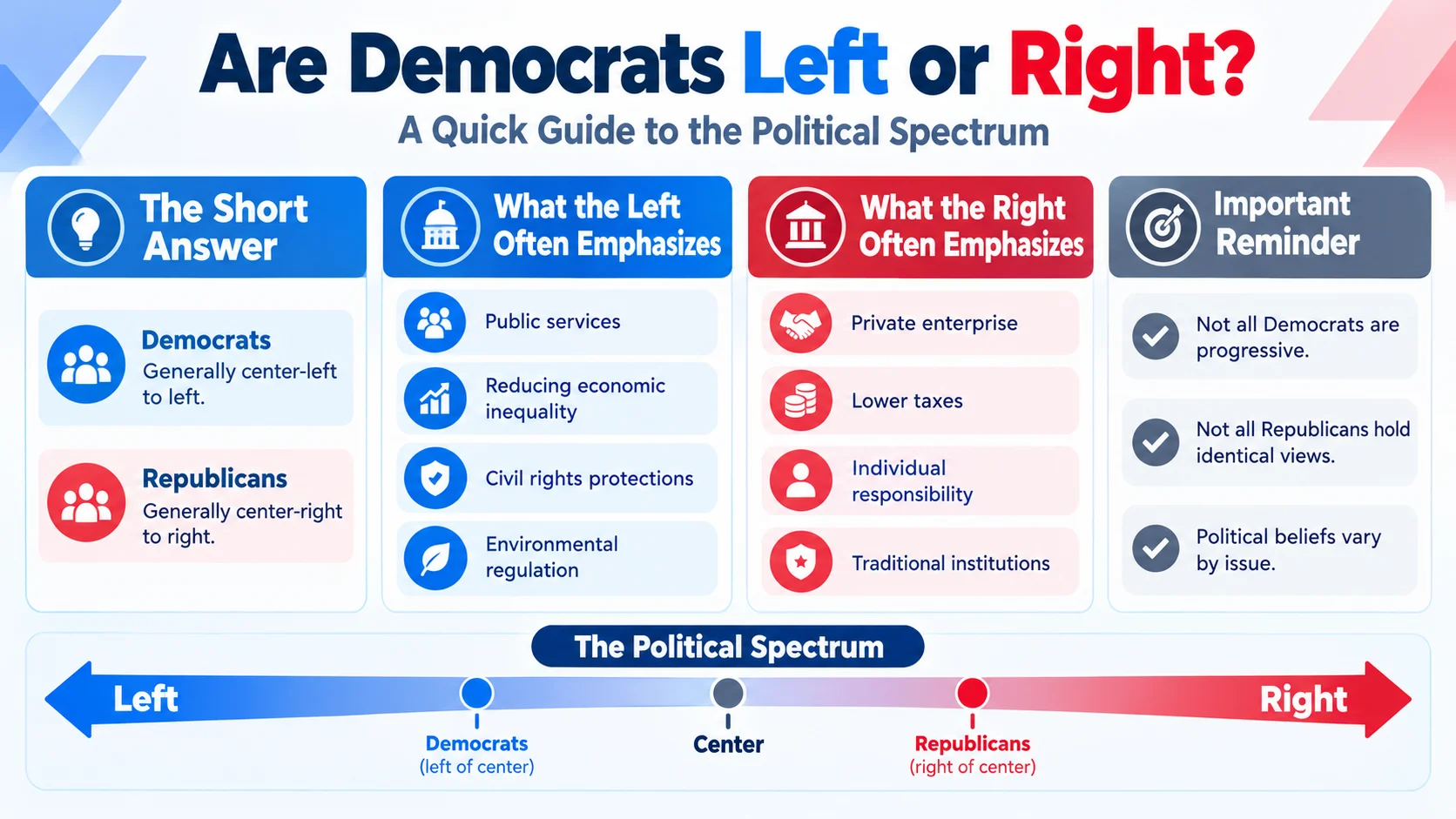
Are Democrats left or right? In the United States, Democrats are generally considered left-wing or center-left, while Republicans are generally considered right-wing or center-right. This difference reflects their typical views on government, taxes, healthcare, social issues, and economic policy.
However, not every Democrat holds the same beliefs. The Democratic Party includes moderates, liberals, and progressives, each with different priorities. Similarly, Republicans range from traditional conservatives to more populist and libertarian-leaning members.
Understanding the political spectrum makes it easier to compare these groups. It also helps explain why two people in the same party can disagree about important issues.
What Does Left-Wing Mean in Politics?
Left-wing politics generally emphasizes reducing economic inequality, expanding access to public services, and using government policies to address social and economic problems.
In the United States, left-leaning political positions often include support for affordable healthcare, stronger worker protections, environmental regulations, and civil rights protections.
For example, a left-leaning politician might support raising taxes on high-income earners to fund public programs. Another might advocate for expanding access to affordable college education.
However, left-wing does not mean every person supports the same policies. Some favor gradual reforms within the existing economic system, while others advocate for more substantial changes.
The meaning can also vary between countries. A policy considered left-wing in the United States might be supported by mainstream parties in another democracy.
What Does Right-Wing Mean in Politics?
Right-wing politics generally places greater emphasis on individual responsibility, private enterprise, traditional institutions, or limiting government involvement in certain areas.
In the United States, right-leaning positions often include lower taxes, fewer business regulations, stronger emphasis on personal responsibility, and more conservative approaches to some social issues.
For instance, a right-leaning politician might argue that businesses can create jobs more effectively when they face fewer regulatory restrictions. Another might favor giving states greater authority over certain policy decisions.
Nevertheless, right-wing politics includes several different traditions. Fiscal conservatives, religious conservatives, libertarians, and populists may disagree on trade, immigration, government spending, and other issues.
Therefore, right-wing does not describe one fixed set of beliefs.
Where Do Democrats Fall on the Political Spectrum?
The Democratic Party generally falls on the center-left to left of the American political spectrum. Its members commonly support civil rights protections, access to healthcare, environmental action, and government programs designed to address economic hardship.
However, the party contains several ideological groups.
| Political Group | General Position | Common Priorities |
|---|---|---|
| Progressive Democrats | Left-wing | Structural reforms, economic equality, expanded public programs |
| Liberal Democrats | Center-left to left | Civil rights, social programs, environmental protections |
| Moderate Democrats | Center to center-left | Incremental reforms, compromise, practical policy changes |
| Conservative Democrats | Center to right on some issues | More traditional or fiscally conservative positions |
These labels are broad descriptions, not official categories. Individual politicians may hold different views depending on the issue.
A Democrat might support government-funded healthcare programs while favoring moderate tax policies. Another might advocate more extensive economic reforms.
According to Pew Research Center’s 2026 survey, 60% of Democrats and Democratic-leaning independents placed their own political views to the left of center. The findings also show that the Democratic coalition includes people with different ideological positions.
Are Democrats Liberal or Conservative?
Democrats are generally associated with liberal politics in the United States. However, liberal and Democrat do not mean exactly the same thing.
A Democrat is someone who identifies with or supports the Democratic Party. A liberal is someone whose political beliefs generally align with liberal principles, although the precise meaning varies by country and context.
For example, a person may vote for Democratic candidates because they support certain healthcare or education policies while holding moderate views on taxes or public spending.
Similarly, some Democrats describe themselves as centrists rather than liberals. Others identify as progressive and favor broader changes to economic or social policies.
Therefore, it is more accurate to say that the Democratic Party leans left than to assume every Democrat is liberal on every issue.
Democrats vs. Republicans: What’s the Difference?
The Democratic and Republican parties are the two major political parties in the United States. Democrats are generally positioned left of center, while Republicans are generally positioned right of center.
Their typical policy approaches differ, although both parties contain internal disagreements.
| Issue | Democrats: Common Tendencies | Republicans: Common Tendencies |
|---|---|---|
| Taxes | More likely to support higher taxes on high earners to fund public programs | More likely to favor tax cuts and lower tax burdens |
| Healthcare | More likely to support expanding public healthcare access | More likely to emphasize private markets and consumer choice |
| Government regulation | More likely to support regulation in areas such as labor and the environment | More likely to favor reducing some business regulations |
| Climate policy | Generally favor stronger government action on climate change | More divided, with many emphasizing energy production and regulatory limits |
| Social issues | Generally more supportive of abortion rights and LGBTQ+ protections | Generally more supportive of restrictions on abortion and traditional social positions |
| Economic inequality | More likely to support policies intended to reduce inequality | More likely to emphasize growth, markets, and individual opportunity |
These are general patterns rather than universal rules. Party platforms, individual candidates, and state-level politics can differ.
Furthermore, a voter may agree with Democrats on healthcare but agree with Republicans on taxes. Political beliefs do not always fit neatly into a single party.
What Is the Difference Between Left, Center, and Right?
The political spectrum is a simplified way to describe ideological differences.
Left-Wing
Left-wing views often emphasize economic equality, social welfare programs, and government action to address certain social problems.
For example, someone on the left might support expanding public healthcare or increasing protections for workers.
Center or Moderate
Centrists generally hold a mixture of left-leaning and right-leaning views. They may favor public programs in some areas while supporting market-based solutions in others.
For instance, a moderate might support affordable healthcare programs but prefer gradual changes rather than a complete overhaul.
Right-Wing
Right-wing views often emphasize private enterprise, individual responsibility, lower taxes, or traditional social institutions.
For example, someone on the right might favor reducing business regulations or limiting government involvement in certain markets.
These categories are not exact measurements of a person’s beliefs. In addition, economic views and social views can place the same person in different positions on the spectrum.
Are All Democrats Far-Left?
No. Most Democrats should not automatically be described as far-left.
The terms left-wing, liberal, progressive, and far-left refer to different positions or traditions within politics.
A moderate Democrat may favor incremental changes and compromise with Republicans. A progressive Democrat may support more extensive changes to healthcare, taxation, or economic policy.
The distinction matters because political parties are broad coalitions. They bring together voters and politicians who agree on some priorities but disagree on others.
For example, two Democratic lawmakers might both support expanding healthcare access while disagreeing over whether the government should operate a larger public insurance program.
Therefore, describing every Democrat as far-left overlooks the range of beliefs within the party.
Are Democrats Left-Wing in Every Country?
No. Political labels depend on the country and its political system.
In the United States, the Democratic Party is generally classified as center-left to left. However, the word Democrat can also refer to members of political parties in other countries that have different histories and policy positions.
Even the terms liberal and conservative can change meaning across national contexts. In some countries, liberal politics places a stronger emphasis on free markets, while in American political discussions, liberalism often also refers to progressive social policies and a larger government role in providing public services.
As a result, comparing parties across countries requires examining their actual policies rather than relying only on their names.
Why Are Democrats Called the Left?
The terms left and right have historical roots in the French Revolution. During debates in the French National Assembly, supporters of revolutionary change and greater equality tended to sit on the left, while defenders of the established order tended to sit on the right.
Over time, these seating positions became political labels.
Today, left-wing politics is commonly associated with equality and reform, while right-wing politics is often associated with tradition, hierarchy, or market-oriented policies. The exact meaning depends on the historical and national context.
In the United States, the Democratic Party became associated with the left through its coalition of voters and its positions on economic, social, and government policies.
However, these labels have changed over time. The modern Democratic Party is not identical to earlier versions of the party, and its internal ideological balance continues to evolve.
How Does the Political Spectrum Help Explain Elections?
The political spectrum helps voters understand differences between candidates and parties. It can also clarify why politicians within the same party sometimes disagree.
For example, a progressive Democrat and a moderate Democrat may share priorities involving healthcare access but propose different methods to achieve them.
Likewise, a traditional conservative Republican and a populist Republican may disagree about trade, government spending, or foreign policy.
Political labels provide a starting point, but they do not tell the entire story. A candidate’s voting record, public statements, policy proposals, and actions offer more specific information about their positions.
Therefore, voters can use ideological labels as a guide while examining individual issues before reaching conclusions.
Frequently Asked Questions
Are Democrats left or right?
Democrats in the United States are generally considered center-left to left-wing. They commonly support civil rights protections, public programs, and government action in certain economic and social areas. However, the party includes moderates, liberals, and progressives.
Are Democrats liberal or conservative?
Democrats are generally associated with liberal politics in the United States. However, the party also includes moderates and some members with conservative views on particular issues. Party affiliation does not determine every aspect of a person’s ideology.
Are Republicans left or right?
Republicans are generally considered right-wing or center-right in the United States. Their common priorities include lower taxes, private enterprise, and conservative approaches to some social issues. However, the Republican Party also contains different ideological groups.
What is the difference between left-wing and right-wing?
Left-wing politics generally emphasizes reducing inequality and using public policy to address social problems. Right-wing politics often emphasizes private enterprise, individual responsibility, and traditional institutions. These are broad tendencies, and individual beliefs can vary.
Are all Democrats progressive?
No. The Democratic Party includes progressives, liberals, moderates, and centrists. Progressives generally support broader policy changes, while moderate Democrats may prefer gradual reforms or compromise. Members can also hold different positions on economic and social issues.
Does left-wing mean socialist?
Not necessarily. Left-wing politics includes liberal, social democratic, progressive, and socialist traditions. Some left-leaning people support regulated capitalism and public programs, while others favor more extensive public or collective ownership of economic resources.
Is the Democratic Party farther left than the Republican Party?
In the contemporary United States, the Democratic Party is generally positioned to the left of the Republican Party. However, the parties contain internal ideological differences, and their policy positions vary across issues and over time.
Can someone be liberal on social issues but conservative on economic issues?
Yes. Political beliefs do not always fit into a single category. Someone might support LGBTQ+ rights and abortion rights while favoring lower taxes or limited economic regulation. Such combinations are one reason political ideology is more complex than a simple left-right scale.
Conclusion
Democrats in the United States are generally considered center-left to left-wing, while Republicans are generally considered center-right to right-wing. This distinction reflects common differences in their approaches to government, economic policy, social issues, and public services. However, neither party has a single set of beliefs shared by every member. Democrats include moderates, liberals, and progressives, while Republicans also represent several conservative traditions. Political labels are useful starting points, but individual positions matter too. To understand a politician’s ideology, examine their policies, statements, and voting record rather than relying on a party label alone.