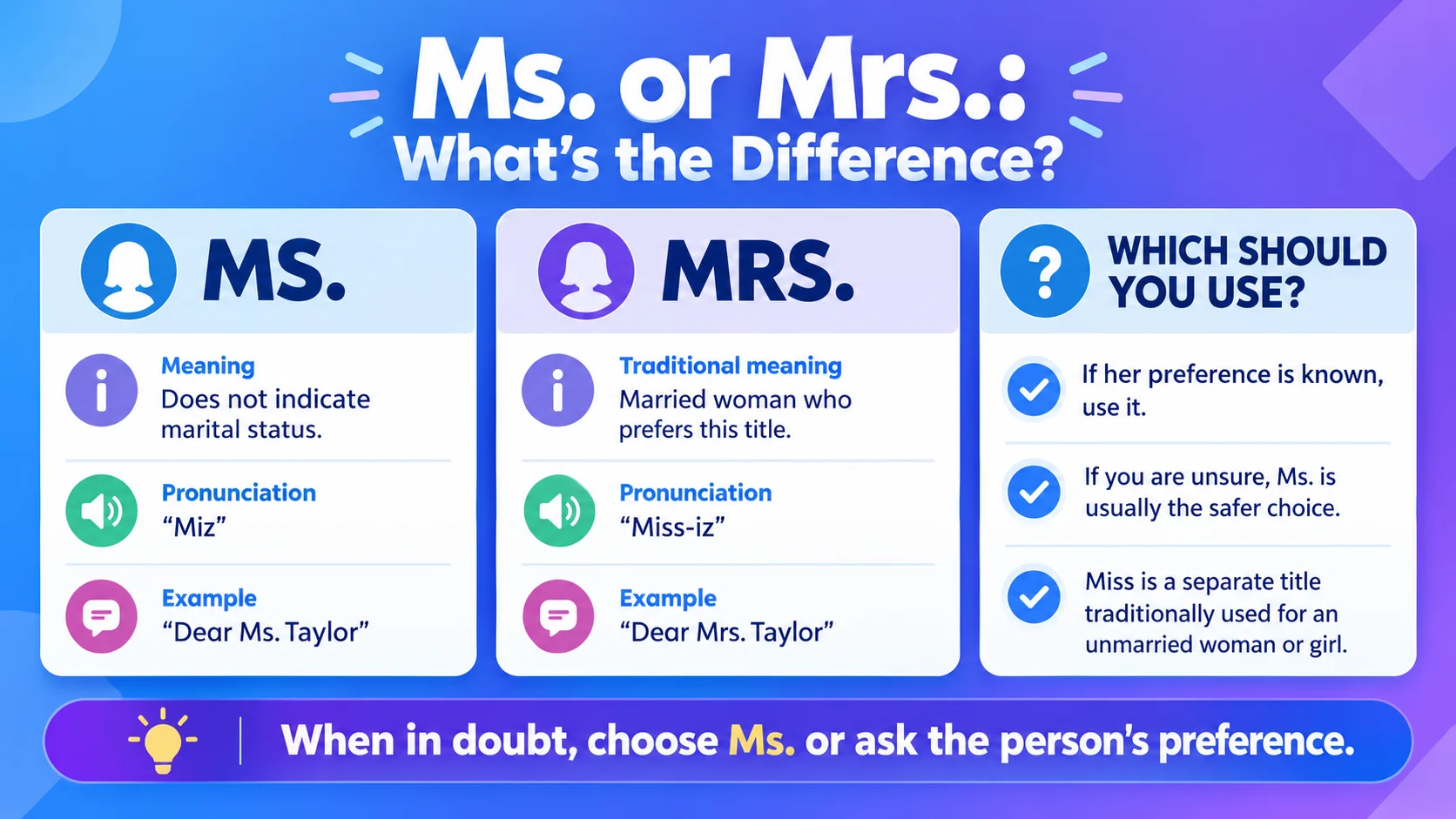
Use Mrs. when a woman is married and prefers that title. Use Ms. when her marital status is unknown, irrelevant, or when she prefers a title that does not indicate whether she is married. When in doubt, Ms. is usually the safer choice.
Ms. or Mrs. is a common question when writing emails, addressing letters, or speaking politely to a woman. Both are respectful titles, but they have different traditional meanings. Mrs. traditionally identifies a married woman, while Ms. can refer to a woman regardless of whether she is married.
However, marital status is not the only consideration. A woman’s personal preference matters, too. In professional settings, Ms. is often the safest choice when you do not know which title someone prefers. By understanding the difference between Ms. and Mrs., you can address people correctly and communicate with confidence.
Ms. vs. Mrs.
| Feature | Ms. | Mrs. |
|---|---|---|
| Traditional meaning | Does not indicate marital status | Traditionally indicates a married woman |
| Pronunciation | “Miz” | “Miss-iz” |
| Can be used for a married woman? | Yes | Yes |
| Can be used for an unmarried woman? | Yes | Not under the traditional convention |
| Professional use | Common and widely accepted | Appropriate when preferred |
| Best choice when unsure | Usually yes | Only when you know she prefers it |
The main difference is simple: Ms. does not reveal marital status, while Mrs. traditionally does. Both titles show respect, so the best choice depends on the person’s preference and the situation.
What Does Ms. Mean?
Ms. is a title used before a woman’s name without indicating whether she is married. It is pronounced “miz,” which sounds different from “miss.”
For example:
- Ms. Taylor
- Ms. Jennifer Taylor
- Dear Ms. Taylor,
Ms. is especially common in professional communication because it keeps marital status separate from a person’s identity. Therefore, it works well in business emails, job applications, school correspondence, and formal letters.
A married woman can use Ms. just as an unmarried woman can. In addition, a woman who is divorced or widowed may prefer Ms. because it does not define her by her past or current marital status.
The title is not short for “Miss.” Instead, it developed as a separate form of address. Today, many women prefer it because it offers a respectful option without making assumptions about their personal lives.
What Does Mrs. Mean?
Mrs. is a traditional title used for a married woman who prefers that form of address. It is pronounced “miss-iz.”
Examples include:
- Mrs. Taylor
- Mrs. Jennifer Taylor
- Dear Mrs. Taylor,
Traditionally, Mrs. was often associated with a woman’s married surname. However, naming practices vary, and a woman may keep her original surname after marriage while continuing to use Mrs.
For example, Jennifer Taylor might use Mrs. Taylor if she prefers that title, even if Taylor is the surname she had before marriage.
It is important to remember that marriage does not automatically mean a woman wants to be called Mrs. Some married women prefer Ms. instead. Therefore, use Mrs. when you know it matches her preference.
Ms. or Mrs. in Professional Emails
When writing a professional email, Ms. is usually the safer option if you do not know the recipient’s preferred title.
For example, if you are contacting a recruiter named Jennifer Taylor and do not know her preference, you can begin with:
Dear Ms. Taylor,
If you know that she prefers Mrs., you can write:
Dear Mrs. Taylor,
However, you do not always need to use a courtesy title. If the recipient signs previous emails with her first name or uses a first-name greeting, following that style may be appropriate.
Here are a few practical guidelines:
- You do not know her preference: Use Ms. if a title is necessary.
- She has asked to be called Mrs.: Use Mrs.
- She uses her first name in correspondence: A first-name greeting may be suitable.
- You are unsure whether a title is necessary: Use the greeting style common in your workplace.
Above all, follow the person’s stated preference rather than guessing based on age, appearance, or marital status.
Ms. vs. Mrs. vs. Miss
Although Ms. and Mrs. are often compared, Miss is another title worth understanding.
| Title | Traditional Usage | Pronunciation |
|---|---|---|
| Ms. | Any adult woman, regardless of marital status | Miz |
| Mrs. | A married woman who prefers this title | Miss-iz |
| Miss | Traditionally an unmarried woman or girl | Miss |
For example, an adult woman named Sarah Johnson might use Ms. Johnson whether she is married or single. If she prefers Mrs. Johnson and is married, that title is also appropriate.
Miss traditionally refers to an unmarried woman or girl. However, for adult women, Ms. is often more practical because it does not make marital status part of the introduction.
Consequently, when you are uncertain, Ms. is usually the most flexible option.
How to Pronounce Ms. and Mrs.
The two titles look similar, but they sound different.
Ms. is pronounced “miz,” rhyming with “quiz.” It has a short, voiced ending and does not sound like “miss.”
Mrs. is pronounced “miss-iz.” It has an extra syllable compared with Ms.
Here are examples:
- Ms. Taylor: “Miz Taylor”
- Mrs. Taylor: “Miss-iz Taylor”
- Miss Taylor: “Miss Taylor”
The pronunciation matters because the titles are not interchangeable in every context. If you are unsure how someone says her title, listen to how she introduces herself or politely ask.
Should You Use Ms. for a Married Woman?
Yes. Ms. is appropriate for a married woman because it does not communicate marital status.
For example, a woman named Jennifer Taylor may be married but still prefer Ms. Taylor at work. Another woman with the same marital status may prefer Mrs. Taylor.
Neither preference is inherently more correct. Instead, the appropriate title is the one the person chooses.
Ms. can be particularly useful in business, education, healthcare administration, and other settings where marital status has no bearing on the conversation.
Therefore, do not assume that a married woman must use Mrs. If she uses Ms. in her email signature or professional profile, follow that choice.
Common Mistakes When Choosing Ms. or Mrs.
Even though the difference is straightforward, several common mistakes can lead to awkward introductions.
Mistake 1: Assuming Every Married Woman Uses Mrs.
Marriage does not determine someone’s preferred title. A married woman may choose Ms. for personal or professional reasons.
Mistake 2: Assuming Ms. Means Unmarried
Ms. does not tell you whether someone is married. It is appropriate for married and unmarried adult women alike.
Mistake 3: Using Mrs. Without Knowing Her Preference
Although Mrs. traditionally indicates marriage, not every married woman uses it. If you are unsure, Ms. is usually a safer option.
Mistake 4: Confusing Ms. With Miss
Ms. is pronounced “miz,” while Miss is pronounced “miss.” They are different titles, not alternative spellings of the same word.
Mistake 5: Forgetting the Period in American English
In American English, Ms. and Mrs. normally take periods. By contrast, Miss is not an abbreviation and does not take a period.
Examples of Ms. and Mrs. in Sentences
These examples show how each title works in everyday and professional writing.
Using Ms.:
- Ms. Taylor will lead the meeting this afternoon.
- I sent the report to Ms. Johnson.
- Dear Ms. Davis, thank you for your response.
- Please ask Ms. Brown to contact me.
Using Mrs.:
- Mrs. Taylor will attend the school meeting.
- I spoke with Mrs. Johnson yesterday.
- Dear Mrs. Davis, thank you for your time.
- Mrs. Brown requested a copy of the report.
Notice that both titles appear before a surname or full name. The choice depends on the person’s preferred title and the context, not on a rule that requires every woman to use one specific form.
Which Title Should You Use When You Don’t Know?
If you need to address a woman formally but do not know her marital status or preferred title, use Ms. This avoids making assumptions and is widely accepted in professional settings.
For instance, if you are writing to a hiring manager named Alex Morgan, “Dear Ms. Morgan” is a reasonable choice if you know she uses that title.
However, if you do not know the person’s title or how they prefer to be addressed, you can also use a neutral greeting such as:
- Dear Alex Morgan,
- Hello Alex,
- Good morning,
A neutral greeting can be especially useful when you are unsure whether a courtesy title is appropriate.
Ultimately, the most respectful approach is to follow the recipient’s own preference whenever it is known.
Frequently Asked Questions
Is Ms. or Mrs. more professional?
Both titles are professional. However, Ms. is often the safer choice when you do not know a woman’s preference because it does not indicate marital status. If she prefers Mrs., use that title instead.
Can a married woman use Ms.?
Yes. A married woman can use Ms. regardless of whether she changed her surname after marriage. The title does not indicate marital status, so it is appropriate in professional and personal settings.
Does Ms. mean Miss?
No. Ms. and Miss are different titles with different pronunciations. Ms. is pronounced “miz” and does not indicate marital status, while Miss is traditionally used for an unmarried woman or girl.
Is Mrs. only for women who use their husband’s surname?
No. A woman may use Mrs. while keeping her original surname. Naming customs vary, so the most important consideration is whether she prefers that title and how she uses her name.
How do you address a woman whose marital status is unknown?
Use Ms. if you need a formal title and do not know her preference. Alternatively, use her full name or a neutral greeting. These options avoid making assumptions about her personal life.
Should I use Ms. or Mrs. in a job application?
If you are addressing a woman in a professional application or email and do not know her preference, Ms. is usually suitable. You can also use her full name without a title if that fits the context.
Does Ms. have a period after it?
In American English, Ms. usually takes a period. In British English, the period is often omitted. Follow the spelling and punctuation conventions used by your organization or publication.
Can I ask someone whether she prefers Ms. or Mrs.?
Yes. If the title matters to the situation, you can politely ask how she prefers to be addressed. Otherwise, using Ms. or a neutral greeting is often enough until you learn her preference.
Conclusion
Choosing Ms. or Mrs. becomes easy once you understand their traditional meanings. Mrs. traditionally identifies a married woman who prefers that title, while Ms. works for women regardless of marital status. Therefore, Ms. is often the safest choice in professional emails or formal letters when you do not know someone’s preference. However, neither title is automatically better than the other. A person’s own choice matters most, so follow the title she uses whenever possible. By understanding the difference between Ms., Mrs., and Miss, you can address people respectfully and write with greater confidence in both personal and professional settings.