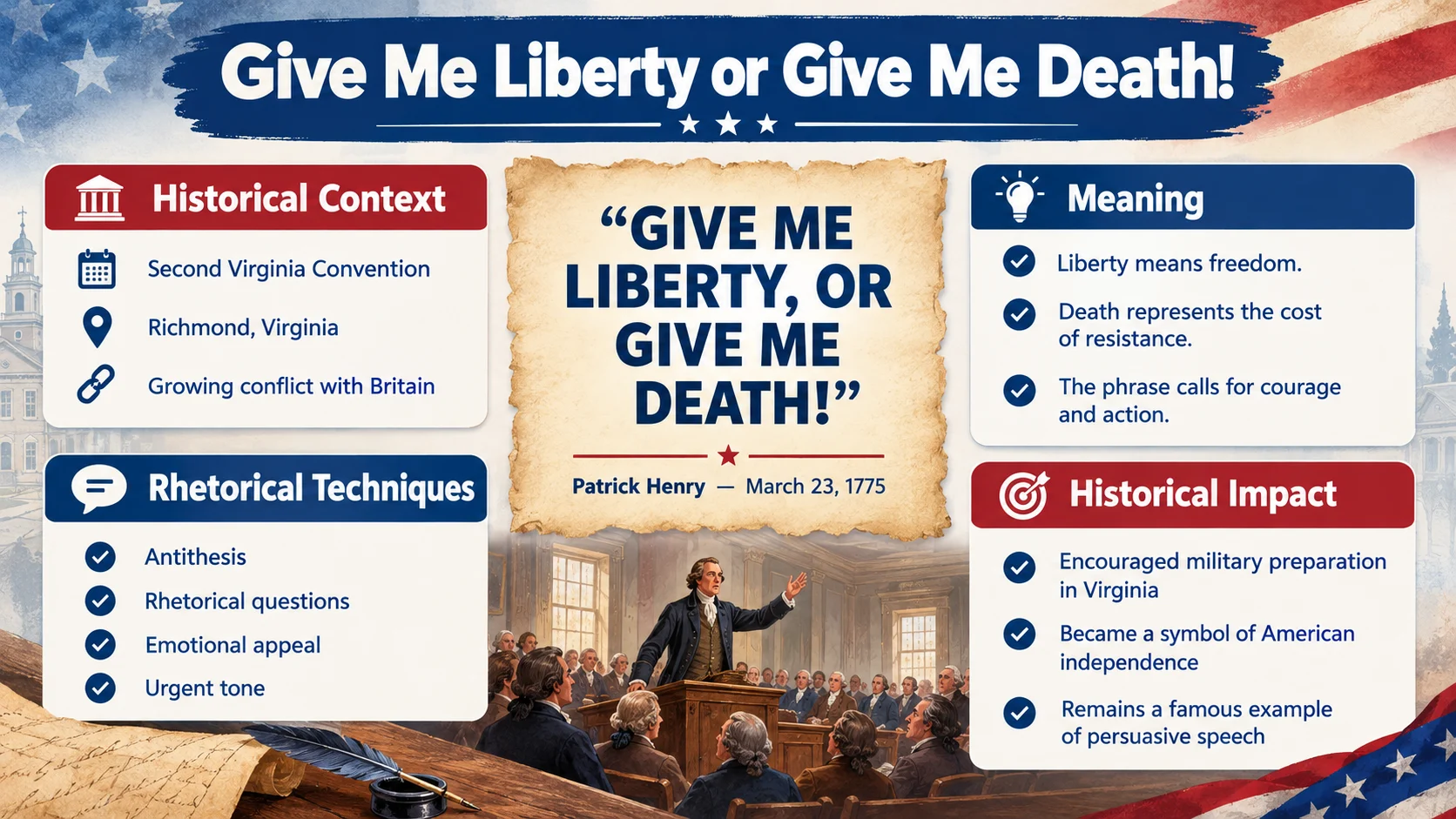
“Give me liberty, or give me death!” means that freedom is so valuable that living without it is worse than dying while resisting oppression. Patrick Henry used this famous statement to urge Virginia’s colonial leaders to prepare to defend their rights against British rule.
The speech became a symbol of freedom, courage, and resistance to oppression. Moreover, its central “Give me liberty, or give me death!” is one of the most famous statements in American history. Patrick Henry is credited with delivering these powerful words on March 23, 1775, during the Second Virginia Convention in Richmond, Virginia. Through this speech, Henry urged colonial leaders to prepare for war against British rule rather than continue waiting for peaceful solutions.
message remains relevant in discussions about individual rights, political independence, and the price of liberty. Understanding its historical background, meaning, and rhetorical techniques helps explain why these words continue to appear in classrooms, political debates, and American historical discussions.
Who Said Give Me Liberty or Give Me Death?
The famous statement is attributed to Patrick Henry, an American lawyer, political leader, and passionate opponent of British policies in the American colonies.
Henry delivered the speech on March 23, 1775, during the Second Virginia Convention at St. John’s Church in Richmond, Virginia. At that meeting, colonial leaders debated how Virginia should respond to growing tensions with Great Britain.
Some delegates hoped that negotiation might prevent a war. Henry, however, argued that continued patience would not protect the colonists’ freedoms. Instead, he believed Virginia needed to prepare for armed resistance.
His speech concluded with the declaration that became his most recognizable quotation: “Give me liberty, or give me death!”
Although the statement is often remembered as a simple demand for freedom, it served a specific political purpose. Henry wanted the delegates to support military preparations before British forces could further restrict colonial independence.
When Was the Give Me Liberty or Give Me Death Speech Delivered?
Patrick Henry delivered the speech on March 23, 1775, just weeks before the first battles of the American Revolutionary War.
The meeting took place at St. John’s Church in Richmond, Virginia. Delegates had gathered for the Second Virginia Convention to discuss the colony’s response to the growing conflict with Britain.
By this point, relations between Britain and its American colonies had deteriorated sharply. British taxation policies, restrictions on colonial self-government, and the use of military force had increased tensions.
Henry believed the colonies could no longer rely on petitions and negotiations alone. Therefore, he urged Virginia to organize local militia forces and prepare to defend its rights.
The first major battles at Lexington and Concord followed on April 19, 1775. As a result, Henry’s speech is often remembered as an important moment in the movement toward American independence.
What Was the Historical Background of the Speech?
To understand Henry’s message, it helps to examine the conflict between Britain and its American colonies.
British Policies Increased Colonial Tensions
During the 1760s and early 1770s, the British government introduced measures that many colonists considered unfair. These included taxation policies and restrictions that challenged colonial ideas about representation and self-government.
Colonists increasingly argued that they should not face taxation without representation in the British Parliament. In addition, many objected to what they viewed as Britain’s growing interference in local affairs.
The Intolerable Acts Deepened the Crisis
In 1774, Britain passed a series of punitive measures commonly known in the colonies as the Intolerable Acts. These followed the Boston Tea Party and included the closure of Boston’s port and changes to Massachusetts’s government.
The measures increased fears that Britain might restrict the political freedoms of other colonies as well.
Consequently, colonial leaders began considering stronger forms of resistance. Some still favored peaceful negotiations, while others believed military preparation had become necessary.
Virginia Debated Military Resistance
During the Second Virginia Convention, Henry argued that Virginia should prepare for possible conflict. His proposal called for organizing local militia companies.
However, not every delegate agreed that military action was the best next step. Henry’s speech aimed to persuade hesitant leaders that delay could leave the colony vulnerable.
His famous closing line expressed the choice as he saw it: freedom required action, even if that action carried the risk of death.
What Does Give Me Liberty or Give Me Death Mean?
The phrase expresses the belief that freedom is worth defending, even when the cost may be life itself.
Henry presented liberty and death as two opposing outcomes. On one side stood freedom and the ability to govern oneself. On the other stood submission to a government that he believed threatened colonial rights.
The statement was not simply an expression of personal bravery. Instead, it was a political argument intended to persuade other leaders to take action.
Liberty Means Freedom From Oppression
In Henry’s speech, liberty referred mainly to political freedom and the right of the colonies to defend their interests against British authority.
He believed the colonists had already tried peaceful approaches without achieving the changes they wanted. Therefore, he argued that they needed to prepare for resistance.
Death Represents the Cost of Resistance
The word “death” makes the statement dramatic and urgent. Henry wanted his audience to consider what might happen if the colonies refused to defend their rights.
He presented resistance as a serious choice rather than an easy path. Nevertheless, he argued that accepting oppression could be worse than risking one’s life for freedom.
The Phrase Creates a Powerful Contrast
The statement places liberty and death at opposite ends of a stark choice. This contrast makes the message easy to remember.
Moreover, the short, direct wording gives the quotation emotional force. It turns a complicated political debate into a simple declaration of principle.
Key Ideas in Patrick Henry’s Speech
Henry’s argument included several connected ideas. Together, they explain why he believed Virginia needed to prepare for war.
| Key Idea | Explanation |
|---|---|
| Liberty | Colonists should protect their political rights and freedom. |
| Resistance | Peaceful efforts had not resolved the conflict with Britain. |
| Urgency | Waiting longer could leave the colonies less prepared. |
| Courage | Defending freedom might require personal sacrifice. |
| Unity | Colonial leaders needed to act together against a common threat. |
First, Henry challenged the belief that peace remained the safest option. He argued that British actions showed the conflict was already moving toward war.
Next, he called for practical preparation rather than continued debate. In his view, military readiness would give Virginia a better chance of defending itself.
Finally, he used the idea of liberty to connect the political decision with a deeply held value. This approach made his argument both logical and emotional.
Famous Lines and Their Meaning
The speech is remembered for its dramatic language and memorable statements. The best-known passage is its closing declaration.
“Give Me Liberty, or Give Me Death!”
This line summarizes Henry’s argument. He believed that freedom was essential and that accepting political subordination was not an acceptable alternative.
The phrase also places responsibility on the people hearing it. Rather than allowing them to remain undecided, Henry challenges them to consider what they are willing to sacrifice for liberty.
“Is Life So Dear, or Peace So Sweet, as to Be Purchased at the Price of Chains and Slavery?”
In the traditionally published version of the speech, Henry questions whether personal safety and peace are worth surrendering freedom.
Here, “chains and slavery” functions as a metaphor for political subordination. The wording appeals to the audience’s fear of losing its rights.
However, the historical context matters. Henry was speaking about colonial political freedom in a society where slavery also existed. He himself enslaved people, creating a serious contradiction between his rhetoric about liberty and his personal actions.
“The War Is Actually Begun!”
This statement reflects Henry’s argument that the conflict had already advanced beyond ordinary political disagreement.
He believed British military actions and colonial tensions made armed conflict increasingly likely. Therefore, he urged the delegates to prepare rather than wait for further evidence.
Rhetorical Devices Used in the Speech
Patrick Henry’s speech is frequently studied because it combines emotional language, direct challenges, and persuasive reasoning.
1. Antithesis
Antithesis places contrasting ideas close together.
The phrase “liberty” versus “death” creates a sharp contrast between freedom and the ultimate cost of resisting oppression. As a result, the audience can quickly grasp the urgency of Henry’s argument.
2. Rhetorical Questions
Henry asks questions that challenge the audience to reconsider its assumptions.
For example, his question about whether peace is worth the price of chains encourages listeners to think about the consequences of surrendering their rights.
Rather than asking for simple answers, these questions guide the audience toward his position.
3. Emotional Appeal
Henry uses language associated with freedom, danger, courage, and oppression. These ideas encourage his listeners to feel that the political crisis demands immediate attention.
Consequently, the speech appeals not only to reason but also to the audience’s emotions and sense of duty.
4. Repetition and Contrast
The traditional version of the speech uses repeated ideas and contrasting images to reinforce its message.
By returning to themes of liberty, resistance, and danger, Henry builds momentum toward the final declaration.
5. Urgent Tone
Henry presents the situation as a crisis that requires action. His urgent tone challenges delegates who hoped that further discussion might prevent conflict.
Therefore, the speech functions as both a political argument and a call to action.
How Did the Speech Influence the American Revolution?
Henry’s speech became an important symbol of the growing movement for independence. Its immediate purpose was to persuade Virginia’s leaders to prepare for military resistance.
The convention subsequently supported plans to organize militia forces. Although the speech was not the sole cause of the Revolution, it reflected the growing belief among some colonial leaders that armed conflict might be unavoidable.
Within a month, fighting began at Lexington and Concord in Massachusetts. These battles marked the beginning of the Revolutionary War.
Over time, Henry’s closing declaration became associated with the broader struggle for American independence. Its message of defending freedom helped make it a lasting part of American historical memory.
Nevertheless, the speech should be understood within its specific context. Henry was arguing for Virginia’s resistance to British authority, not presenting a modern, universal definition of freedom that included everyone equally.
Did Patrick Henry Really Say Give Me Liberty or Give Me Death?
The quotation is widely attributed to Patrick Henry, but historians have raised questions about the exact wording of the speech.
No complete transcript made at the time of delivery is known to survive. Henry reportedly spoke without reading from a prepared manuscript, and no contemporary record preserves every word.
The version most commonly studied today appeared in William Wirt’s 1817 biography of Henry, published more than four decades after the speech. Wirt reconstructed the address using recollections and accounts from people who had been present.
As a result, historians generally distinguish between the historical event and the exact wording of the surviving text. Henry did speak in favor of preparing Virginia for resistance, and his speech had a strong impact on the convention. However, scholars cannot verify every sentence as a verbatim record.
The famous final declaration is widely associated with Henry, although debate continues over the precise language he used.
The Contradiction Between Liberty and Slavery
Henry’s speech has a powerful message about freedom, but his personal history reveals an important contradiction.
Like many prominent Virginia leaders of his time, Henry enslaved people. He acknowledged that slavery was a moral evil, yet he continued to hold enslaved people during his lifetime.
This contradiction matters because the liberty he defended in 1775 did not extend equally to everyone living in the colonies.
His words helped express the colonists’ opposition to British political control. However, enslaved people did not enjoy the same freedom or legal rights that many white colonists sought to protect.
Understanding this history does not erase the speech’s influence. Instead, it provides a fuller picture of the period and encourages readers to examine both the ideals expressed by historical figures and the limits of their actions.
Why Is Give Me Liberty or Give Me Death Still Important Today?
The quotation remains influential because it expresses a powerful belief: freedom should not be surrendered without serious consideration of its value.
People continue to use the phrase in discussions about human rights, political independence, civic responsibility, and resistance to oppression.
In education, the speech helps students understand the tensions that led to the American Revolution. It also provides a clear example of persuasive rhetoric, especially the use of contrast, rhetorical questions, and emotional appeals.
At the same time, the speech encourages critical thinking about history. Its message can inspire discussions about who receives liberty, who is excluded, and how political ideals compare with real-world actions.
Ultimately, the quotation endures because it raises a fundamental question: What is freedom worth, and what responsibilities come with defending it?
Frequently Asked Questions
Who said “Give me liberty, or give me death”?
Patrick Henry is credited with saying “Give me liberty, or give me death!” during a speech to the Second Virginia Convention on March 23, 1775. He urged Virginia’s leaders to prepare for resistance against British rule.
When did Patrick Henry deliver the speech?
Patrick Henry delivered the speech on March 23, 1775, at St. John’s Church in Richmond, Virginia. The address came less than a month before the battles of Lexington and Concord began the American Revolutionary War.
What does “Give me liberty or give me death” mean?
The phrase means that freedom is so valuable that a person should be willing to risk death rather than accept oppression. Henry used it to argue that Virginia should defend its political rights against British authority.
Why did Patrick Henry give his famous speech?
Henry wanted Virginia’s colonial leaders to support military preparations against Britain. He believed peaceful appeals had failed to resolve the conflict and that delaying action could leave the colony unprepared for war.
What rhetorical devices appear in the speech?
The speech uses antithesis, rhetorical questions, emotional appeals, repetition, and urgent language. These techniques strengthen Henry’s argument by contrasting freedom with oppression and encouraging his audience to support immediate action.
Did Patrick Henry’s speech start the American Revolution?
No single speech started the American Revolution. However, Henry’s address helped build support for military preparation in Virginia. The first major battles began at Lexington and Concord on April 19, 1775.
Is the full speech historically accurate?
The commonly published version comes from William Wirt’s 1817 biography, not a surviving transcript made during the speech. Therefore, the broad argument is historically important, but the exact wording cannot be fully verified.
Why is the speech still taught in schools?
The speech is studied for its role in the American independence movement and its effective persuasive techniques. It also encourages discussion about liberty, political resistance, historical context, and the contradictions between American ideals and slavery.
Conclusion
“Give me liberty, or give me death!” remains one of the most memorable declarations in American history. Attributed to Patrick Henry’s March 23, 1775, speech, the phrase expressed his belief that freedom was worth defending despite the risk of death. His passionate argument encouraged Virginia’s leaders to prepare for resistance against British rule as tensions moved toward revolution. Moreover, the speech demonstrates how powerful rhetoric can influence political decisions and shape national memory. Its legacy also invites critical reflection on the limits of liberty in colonial society, especially the contradiction between the freedom Henry defended and the slavery he upheld.