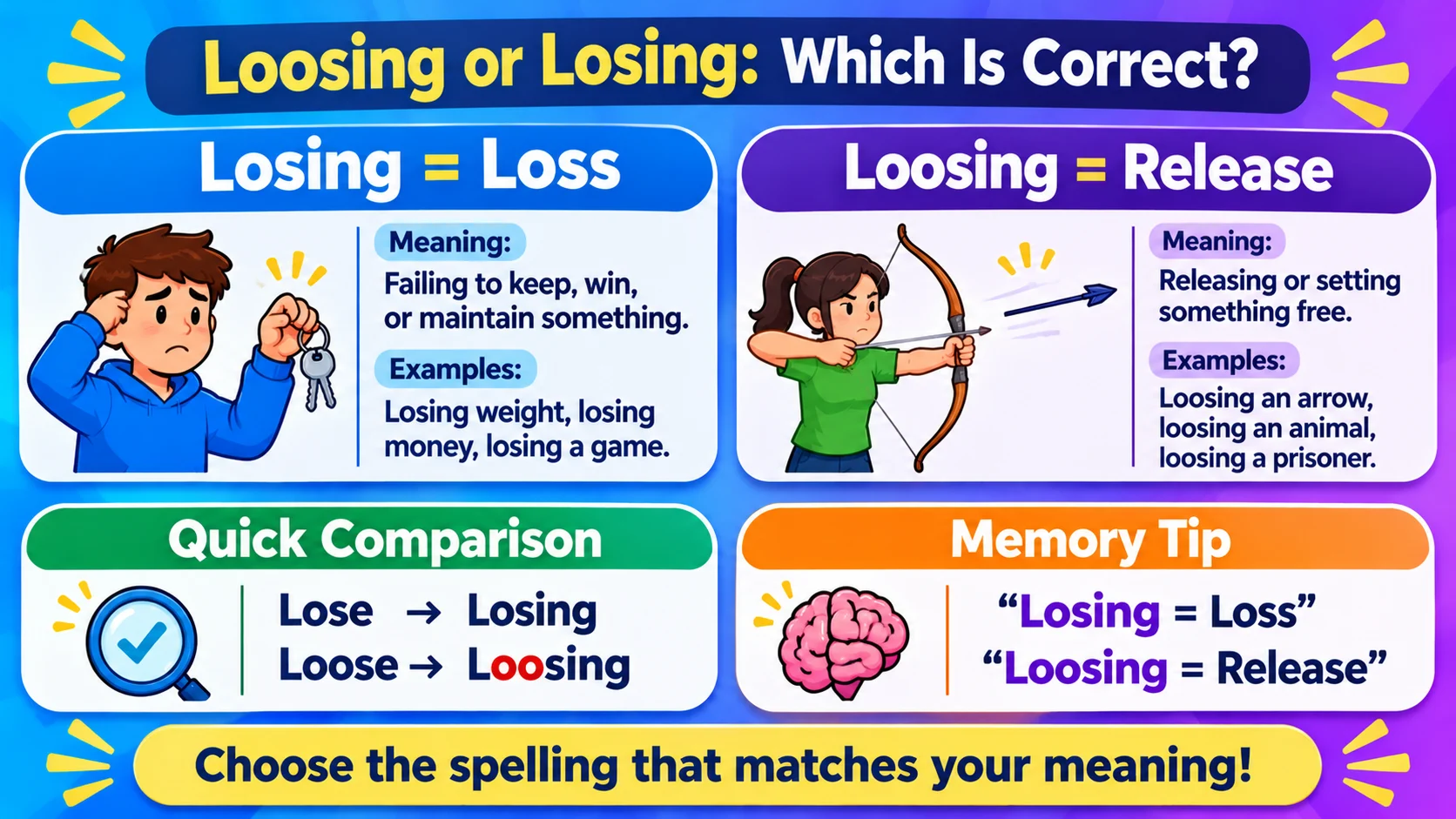
Losing is the correct spelling when you mean failing to win, misplacing something, or no longer having something. However, loosing is also a real English word. It means releasing, freeing, or setting something loose.
Although these words look almost identical, they come from different verbs and have different meanings. For example, you are losing weight, but an archer is loosing an arrow. Therefore, choosing the right spelling depends on what you want to express. This guide explains the difference between loosing and losing, with simple rules, practical examples, common mistakes, and helpful tips.
Loosing or Losing?
Both loosing and losing are correctly spelled words. However, they have different meanings.
| Word | Comes From | Meaning | Example |
|---|---|---|---|
| Losing | Lose | Failing to keep, win, or maintain something | “We are losing the game.” |
| Loosing | Loose | Releasing or setting something free | “The archer is loosing an arrow.” |
Remember: Use losing for loss or defeat. Use loosing when you mean releasing or freeing something.
What Is the Difference Between Loosing and Losing?
The main difference comes from their base verbs: lose and loose.
Losing is the present participle of lose. It describes losing something, experiencing a defeat, or no longer maintaining something.
For example:
- Losing a game
- Losing money
- Losing your keys
- Losing weight
- Losing patience
- Losing confidence
On the other hand, loosing is the present participle of loose when used as a verb. It means releasing, freeing, or letting something go.
For example:
- Loosing an arrow
- Loosing a prisoner
- Loosing an animal
- Loosing a rope
Although both words look similar, they are not interchangeable. Therefore, check the intended meaning before choosing one.
What Does Losing Mean?
Losing means failing to keep, win, find, or maintain something. It can describe a physical loss, a competition, a decrease, or an emotional change.
The word comes from the verb lose. When you add the suffix “-ing,” the final letter e disappears.
The spelling pattern is:
Lose + ing = Losing
Here are common situations where you should use losing.
Losing Something You Cannot Find
Use losing when you misplace something or cannot locate it.
Examples:
- “I’m losing my phone again.”
- “She keeps losing her keys.”
- “He is losing his wallet.”
- “We are losing important documents.”
In each sentence, someone has difficulty keeping track of an item.
Losing a Game or Competition
Use losing when a person or team is not winning a competition.
Examples:
- “Our team is losing the match.”
- “They are losing the championship.”
- “I hate losing at chess.”
- “The player is losing the final round.”
In this context, losing describes defeat or failure to win.
Losing Weight
The correct expression is losing weight, not loosing weight.
Examples:
- “She is losing weight through regular exercise.”
- “I’m losing weight slowly.”
- “He started losing weight last month.”
Here, losing describes a reduction in body weight.
Losing Feelings, Interest, or Confidence
You can also use losing for emotional or mental changes.
Examples:
- “I’m losing interest in this show.”
- “She is losing confidence.”
- “He is losing patience.”
- “They are losing hope.”
Similarly, the word appears in expressions such as losing control, losing focus, and losing touch.
What Does Loosing Mean?
Loosing means releasing, freeing, or setting something loose. It comes from the verb loose, which can function as an adjective or a verb.
As an adjective, loose means not tight or not firmly attached. However, when used as a verb, loose can mean to release something.
The spelling pattern is:
Loose + ing = Loosing
Although loosing is grammatically correct, it is much less common than losing in everyday English.
Loosing an Arrow
One traditional example is an archer releasing an arrow from a bow.
Example:
“The archer is loosing an arrow toward the target.”
Here, loosing means releasing or firing the arrow.
Loosing an Animal
You can also use loosing when someone releases an animal.
Examples:
- “The farmer is loosing the horses into the field.”
- “They are loosing the dogs from their cages.”
- “The handler was loosing the birds.”
In these examples, someone deliberately sets an animal free.
Loosing a Person
Loosing can also describe releasing someone from restraint or confinement.
Example:
“The guards are loosing the prisoners.”
This means the guards are setting the prisoners free.
However, modern writers often prefer words such as releasing or freeing because they sound more natural.
Why Do People Confuse Loosing and Losing?
The confusion happens because the words look almost identical. The only spelling difference is an extra letter o in loosing.
Moreover, both words come from similar-looking base verbs:
- Lose means to fail to keep something.
- Loose means not tight or, as a verb, to release something.
Because loose has two consecutive o’s, some writers mistakenly add another o when writing losing.
For example:
Incorrect: “I’m loosing weight.”
Correct: “I’m losing weight.”
The mistake comes from choosing the wrong base verb. Weight loss relates to lose, not loose.
Similarly, the sentence “Our team is loosing the game” should be “Our team is losing the game.”
Therefore, understanding the original verb makes the spelling much easier.
Why Is Losing Spelled With One O?
The spelling becomes simple when you understand how the word is formed.
The base verb is lose, which contains one o. To create its present participle, remove the final e and add “-ing.”
Lose + ing = Losing
This follows a common English spelling pattern.
Consider these examples:
| Base Verb | Present Participle |
|---|---|
| Lose | Losing |
| Make | Making |
| Write | Writing |
| Hope | Hoping |
| Use | Using |
| Move | Moving |
Notice that the final e disappears before the suffix “-ing.”
However, loose already ends with two o’s and an e. Therefore, its present participle becomes loosing.
Loose + ing = Loosing
As a result, the base word determines the correct spelling.
Loosing vs. Losing Examples in Sentences
The following examples show how both words work in everyday English.
| Sentence | Correct Word | Explanation |
|---|---|---|
| “I’m ___ weight.” | Losing | Describes a reduction in weight. |
| “Our team is ___ the game.” | Losing | Describes a defeat. |
| “She keeps ___ her keys.” | Losing | Describes misplacing something. |
| “The archer is ___ an arrow.” | Loosing | Describes releasing an arrow. |
| “The guards are ___ the prisoners.” | Loosing | Describes setting people free. |
| “He is ___ patience.” | Losing | Describes running out of patience. |
| “They are ___ the horses.” | Loosing | Describes releasing animals. |
| “I’m ___ interest in the project.” | Losing | Describes a decline in interest. |
For another way to understand the distinction, compare these complete sentences.
Correct:
- “I am losing my mind.”
- “She is losing her job.”
- “We are losing time.”
- “The hunter is loosing an arrow.”
- “The workers are loosing the animals.”
Incorrect in the intended context:
- “I am loosing my mind.”
- “She is loosing her job.”
- “We are loosing time.”
The first three sentences describe loss, not release. Therefore, losing is the correct choice.
Common Mistakes With Loosing and Losing
Even confident writers sometimes confuse these words. Fortunately, a few simple corrections can prevent most mistakes.
“Loosing Weight” vs. “Losing Weight”
Incorrect: “I’m loosing weight through exercise.”
Correct: “I’m losing weight through exercise.”
The sentence describes a reduction in body weight. Therefore, it needs the verb lose.
“Loosing the Game” vs. “Losing the Game”
Incorrect: “Our team is loosing the game.”
Correct: “Our team is losing the game.”
A team loses when it fails to win. As a result, losing is the appropriate spelling.
“Loosing My Keys” vs. “Losing My Keys”
Incorrect: “I’m loosing my keys every week.”
Correct: “I’m losing my keys every week.”
Here, the speaker means they repeatedly misplace their keys. Consequently, the sentence needs losing.
“Loosing Patience” vs. “Losing Patience”
Incorrect: “She is loosing patience with him.”
Correct: “She is losing patience with him.”
The expression describes becoming less patient. Therefore, use losing.
“Loosing an Arrow” vs. “Losing an Arrow”
Both spellings can form correct sentences, but their meanings differ.
- “The archer is loosing an arrow.” means releasing it.
- “The archer is losing an arrow.” means misplacing it or no longer having it.
This example shows why context matters.
Is Loosing a Real Word?
Yes. Loosing is a real English word, not simply a misspelling of losing.
It is the present participle of the verb loose. When loose functions as a verb, it can mean releasing, freeing, or setting something free.
For example:
“The soldiers were loosing the prisoners.”
The sentence means that the soldiers were releasing the prisoners.
However, loosing is relatively uncommon in modern everyday English. Writers often choose more familiar alternatives, including:
- Releasing
- Freeing
- Letting go
- Setting free
- Unfastening
For example, “The guard is releasing the prisoner” sounds more natural in many modern contexts than “The guard is loosing the prisoner.”
Nevertheless, loosing remains a valid word when its meaning fits the sentence.
Loosing vs. Loosening: What Is the Difference?
Another word that causes confusion is loosening. Although loosing and loosening look similar, they do not mean exactly the same thing.
Loosing means releasing or setting something free.
Loosening means making something less tight or less firmly fixed.
Compare these examples:
| Word | Meaning | Example |
|---|---|---|
| Loosing | Releasing something | “The guard is loosing the prisoner.” |
| Loosening | Making something less tight | “She is loosening the knot.” |
| Loose | Not tight | “My shoes are loose.” |
For example, if you turn a screw to make it less tight, you are loosening it.
However, if you release something from a restraint, you may describe the action as loosing it.
Therefore, choose loosening when you mean making something less tight.
How to Remember the Difference Between Loosing and Losing
A simple memory trick can help you choose the correct word.
Losing = Loss
Both words begin with the same letters. Therefore, remember that losing relates to losing something, failing to win, or experiencing a reduction.
Examples:
- Losing money
- Losing weight
- Losing a game
- Losing interest
Loosing = Loose or Release
Loosing comes from loose. Think of releasing something or setting it free.
Examples:
- Loosing an arrow
- Loosing an animal
- Loosing a prisoner
You can also use a quick substitution test.
Ask yourself: Does the sentence mean losing something or releasing something?
If it means losing, choose losing. If it means releasing, loosing may be correct.
Frequently Asked Questions
Is it losing or loosing weight?
The correct expression is losing weight. It describes a reduction in body weight. The word comes from the verb lose, so it keeps one o when you add “-ing.”
Is loosing a real English word?
Yes. Loosing is the present participle of loose when used as a verb. It means releasing, freeing, or setting something loose. However, it is much less common than losing in everyday writing.
Why is losing spelled with one O?
Losing comes from the base verb lose, which contains one o. When you add “-ing,” the final e disappears. Therefore, the correct spelling is losing, not loosing.
Is losing the same as loose?
No. Losing comes from lose and means failing to keep or maintain something. Loose usually describes something that is not tight. However, loose can also function as a verb meaning to release something.
Is “loosing the arrow” correct?
Yes. “Loosing an arrow” is grammatically correct because loosing can mean releasing or firing an arrow from a bow. It is a traditional use of the verb loose.
What is the difference between loosing and loosening?
Loosing means releasing or setting something free. In contrast, loosening means making something less tight. For example, you may be loosing an arrow but loosening a knot.
Is “I’m loosing my mind” correct?
No, not when you mean that you are feeling overwhelmed or struggling emotionally. The correct expression is “I’m losing my mind.” It comes from the verb lose, not loose.
Which word is more common, losing or loosing?
Losing is much more common in everyday English. People use it when discussing games, money, weight, possessions, time, and emotions. Loosing appears less often because it has a narrower meaning related to releasing something.
Conclusion
Losing is the correct choice when you mean experiencing a loss, failing to win, or misplacing something. However, loosing is also a real word that means releasing or setting something free. The easiest way to remember the difference is to connect losing with loss and loosing with loose. For example, you are losing weight, but an archer is loosing an arrow. Although the spellings look similar, their meanings are different. Therefore, always check the base verb before choosing. Once you understand this simple rule, you can use both words correctly and avoid common spelling mistakes.