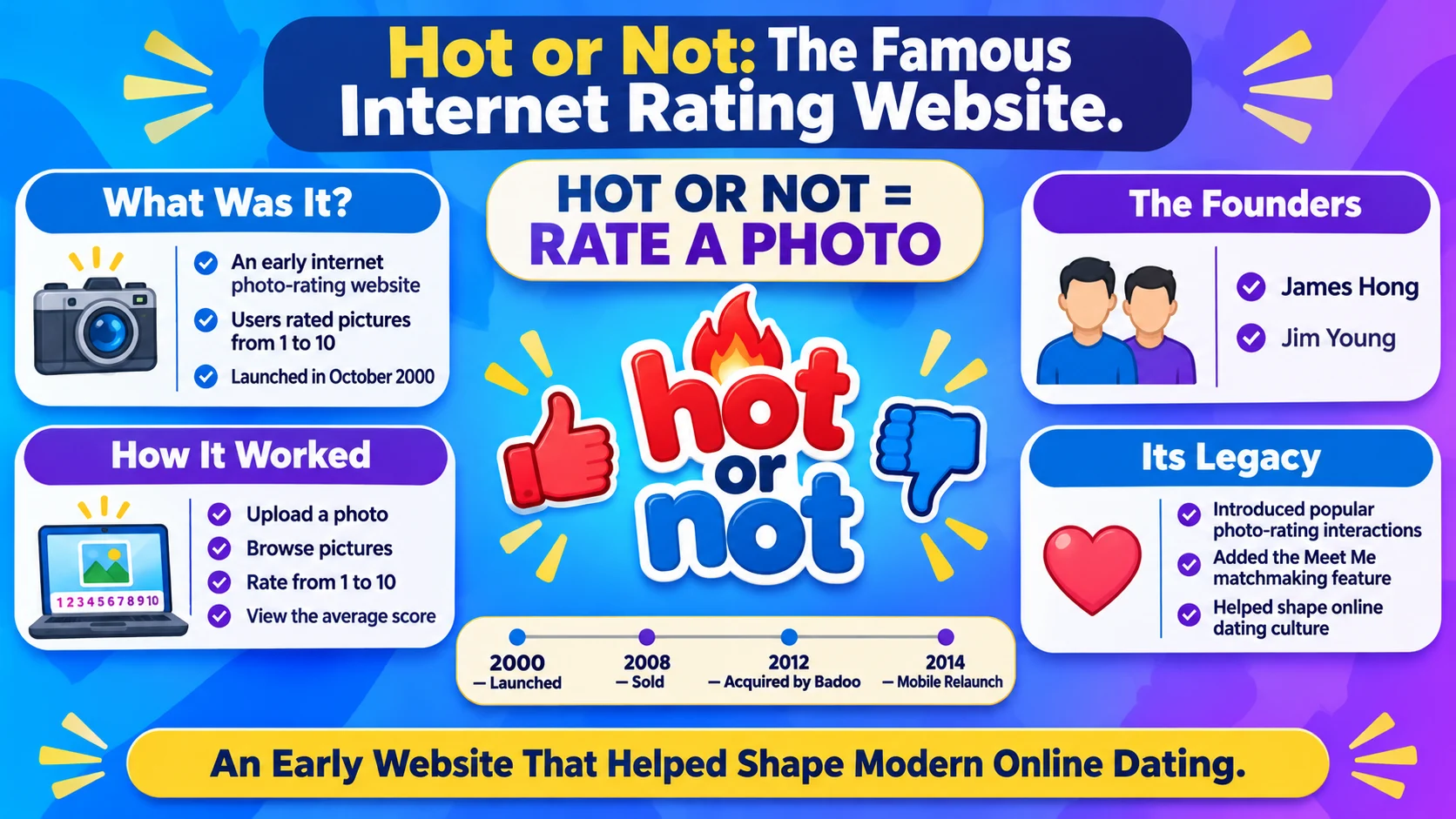
Hot or Not was a popular internet rating website that allowed people to upload photos and let other users judge their appearance. Launched in October 2000, the platform became famous for its simple question: Was someone “hot” or “not”? Visitors could rate photos, view popularity scores, and eventually connect with other users through its matchmaking features.
At first, the idea seemed like a simple online game. However, it quickly became an important part of early internet culture. The website helped popularize photo-based ratings, online matchmaking, and the social features that later became common in dating apps. Today, Hot or Not is remembered as one of the early platforms that influenced how people interact online.
What Was Hot or Not?
Hot or Not was an early internet website where users submitted photos and received attractiveness ratings from other visitors. People could rate pictures on a scale from 1 to 10, with higher scores indicating that a photo was considered more attractive.
The concept was simple. A visitor viewed someone’s picture, selected a rating, and submitted a vote. The website then calculated an average score based on the ratings received.
Unlike many social networking platforms today, the original Hot or Not focused mainly on appearance. It did not require users to create long posts or maintain complicated profiles.
Instead, the central experience revolved around looking at photos and voting. As a result, the website became a recognizable part of early-2000s internet culture.
Who Created Hot or Not?
Hot or Not was created by James Hong and Jim Young, two engineers and former roommates who studied at the University of California, Berkeley.
The idea reportedly began with a disagreement about whether a woman they had seen was particularly attractive. Rather than settle the debate themselves, they developed a website that allowed other people to vote.
They launched the original site in October 2000 under the name Am I Hot or Not?
The concept quickly attracted attention. In fact, the website reportedly reached around two million page views per day within its first week.
The founders had created something easy to understand and even easier to use. Consequently, visitors could participate without needing advanced computer skills or extensive online experience.
How Did the Hot or Not Website Work?
The original Hot or Not experience centered on photo submissions and public ratings. Users could upload pictures, browse photographs submitted by other people, and assign scores.
Here is how the basic process worked:
- Upload a photo: A user submitted a picture of themselves.
- Browse photographs: Other visitors viewed photos on the platform.
- Give a rating: Visitors selected a score, usually from 1 to 10.
- Calculate the average: The website combined votes into an overall rating.
- View popularity: Users could see how their photos performed.
For example, if a photograph received ratings of 6, 8, 9, and 7, its average score would be 7.5.
The scoring system turned personal opinions into a visible number. Therefore, users could compare ratings and see how strangers responded to their photographs.
However, the system also encouraged people to judge appearance quickly, often without knowing anything about the person in the picture.
What Did Hot and Not Mean?
The words hot and not represented two simple judgments about someone’s appearance.
| Choice | Meaning |
|---|---|
| Hot | The viewer considers the person attractive |
| Not | The viewer does not consider the person attractive |
The original website used a numerical rating system. However, later versions also adopted a simpler hot-or-not choice.
The phrase eventually became part of everyday internet language. People could use “hot or not” to ask whether someone, something, or an idea was appealing.
For example:
- “That outfit: hot or not?”
- “New hairstyle: hot or not?”
- “Is this fashion trend hot or not?”
Although the phrase often refers to physical appearance, it can also describe opinions about products, trends, entertainment, and personal style.
When Did Hot or Not Launch?
Hot or Not launched in October 2000. It arrived during a period when the internet was becoming more accessible to ordinary users.
At the time, social networking was still developing. Many people used personal websites, online forums, chat rooms, and early dating platforms to communicate.
Hot or Not offered a different kind of experience. Instead of focusing on written conversations, it encouraged visitors to interact through photographs and ratings.
The website gained attention quickly because its concept was easy to understand. Moreover, the rating process encouraged users to keep browsing and voting.
Its popularity helped establish photo-based interaction as a recognizable part of online culture.
How Did Hot or Not Become a Dating Website?
Although Hot or Not started as a photo-rating platform, its creators eventually introduced matchmaking features.
One important addition was Meet Me, which allowed users to connect with other members who showed mutual interest.
This feature changed the website’s purpose. Rather than simply rating photographs, people could use the platform to discover potential dates and communicate with others.
The combination of photo ratings and matchmaking helped Hot or Not move beyond its original concept.
However, the platform still placed considerable emphasis on appearance. Users could receive attention through their photographs and popularity scores, which made the experience different from dating services built around detailed profiles or compatibility questions.
What Happened to Hot or Not?
Hot or Not went through several ownership changes as online dating and social networking evolved.
The 2008 Sale
In February 2008, Hot or Not was sold to Avid Life Media, the company associated with Ashley Madison. The reported sale price was approximately $20 million.
The acquisition marked an important change in the platform’s ownership and business direction.
The Badoo Acquisition
In April 2012, Badoo acquired Hot or Not. Badoo was already an established online dating and social networking company.
The acquisition connected Hot or Not to a larger dating platform. As a result, the original rating website gradually moved toward a more modern matchmaking experience.
The 2014 Relaunch
In June 2014, Hot or Not returned in a redesigned mobile-focused form.
The updated experience replaced much of the original numerical rating approach with simple Hot and Not choices. It also included features that allowed mutually interested users to connect and chat.
This version looked more like modern swipe-based dating apps. Nevertheless, it retained the central idea of making quick judgments based on profile photographs.
Is Hot or Not Still Available?
Hot or Not has changed considerably since its original launch. The original early-2000s rating website is no longer the same service people remember from its peak popularity.
After Badoo acquired the platform, its identity and features shifted toward a mobile dating experience.
Therefore, people searching for the original Hot or Not website should understand that its historical version and later app-based versions were different experiences.
The name remains recognizable because of its influence on internet culture. However, users should check current service availability and ownership information before assuming that an old version or feature still operates.
How Did Hot or Not Influence Modern Dating Apps?
Hot or Not helped popularize several ideas that later became familiar in online dating.
1. Photo-Based Profiles
The website placed photographs at the center of online interaction. Similarly, many modern dating apps use profile pictures as a major part of the discovery process.
2. Quick Decisions
Hot or Not encouraged users to make fast judgments. Later dating platforms adopted similarly simple interactions, allowing people to respond to profiles with a tap or swipe.
3. Mutual Matching
The Meet Me feature introduced a matchmaking element based on mutual interest. This approach became a familiar feature in later dating services.
4. Gamification
The rating system made appearance into something users could measure and compare. Consequently, the platform helped popularize a style of online interaction built around scores, rankings, and repeated participation.
5. Social Discovery
Hot or Not demonstrated that people could use photographs to discover strangers online. Modern dating and social discovery platforms developed this concept in different ways.
However, the influence of Hot or Not should not be confused with being the only origin of modern dating apps. Other websites and services also contributed to the development of online matchmaking.
Hot or Not vs. Modern Dating Apps
Hot or Not shared some features with today’s dating platforms. Nevertheless, its original experience was much simpler.
| Feature | Original Hot or Not | Modern Dating Apps |
|---|---|---|
| Main purpose | Rate photographs | Dating and social discovery |
| User interaction | Numerical ratings | Likes, matches, and messages |
| Main focus | Appearance | Photos, profiles, and preferences |
| Matching | Added through Meet Me | Often built into the main service |
| Communication | Limited in the original format | Messaging and other communication tools |
| Experience | Photo-rating game | Broader dating experience |
The biggest difference is the overall purpose. Hot or Not originally encouraged people to rate photographs, while modern dating apps generally aim to help users form connections.
Why Was Hot or Not So Popular?
Several factors contributed to the website’s popularity.
First, it was simple. Visitors did not need to understand complicated features. They could look at a photograph and submit a rating.
Second, it encouraged curiosity. People wanted to see how strangers rated their photographs. Meanwhile, browsing other people’s pictures created a continuous cycle of interaction.
Third, it offered instant feedback. Users could receive a score instead of waiting for someone to respond to a message.
Finally, it arrived at the right time. The early 2000s were a period of rapid growth for internet communities and online social experiences.
Together, these factors helped Hot or Not become one of the recognizable websites of its era.
What Were the Problems With Hot or Not?
Despite its popularity, Hot or Not also raised concerns about online behavior and appearance-based judgment.
Appearance-Based Judgments
The rating system encouraged users to judge people primarily by their photographs. Consequently, personality, character, and other qualities received less attention.
Public Ratings
Receiving a low score could feel discouraging. In addition, public ratings could affect how users viewed their own appearance.
Privacy Concerns
Uploading personal photographs to a public website involved sharing images with strangers. Therefore, users needed to consider how their pictures might be viewed or used.
Social Pressure
The popularity score could encourage people to compare themselves with others. Over time, this type of comparison could contribute to insecurity or unhealthy attention-seeking.
These concerns remain relevant when discussing online rating systems and social media today.
Frequently Asked Questions
What was Hot or Not?
Hot or Not was an early internet website where users uploaded photographs and received ratings from other visitors. People could score pictures from 1 to 10, making it a popular photo-rating platform in the early 2000s.
Who founded Hot or Not?
James Hong and Jim Young founded Hot or Not. The two engineers developed the idea after a disagreement about someone’s appearance and launched the website in October 2000.
When did Hot or Not start?
Hot or Not launched in October 2000. It quickly attracted attention because visitors could easily submit photographs, rate other users, and see average scores.
Was Hot or Not a dating website?
Hot or Not originally focused on rating photographs. However, it later introduced Meet Me, a matchmaking feature that allowed interested users to connect and communicate.
Is Hot or Not still around?
The original Hot or Not rating website is no longer the same service people used in the early 2000s. Its ownership and features changed, and later versions moved toward mobile dating and matchmaking.
What happened to the Hot or Not website?
Hot or Not was sold to Avid Life Media in 2008 and acquired by Badoo in 2012. It later returned as a redesigned mobile experience with simpler rating and matchmaking features.
Did Hot or Not influence Tinder?
Hot or Not helped popularize photo-based judgments and mutual-interest matchmaking. These ideas resemble features found in modern dating apps, although Tinder and other services developed their own systems.
What does hot or not mean?
Hot or not is a phrase used to judge whether someone or something is attractive, appealing, or fashionable. It can refer to appearance, clothing, trends, products, entertainment, and personal preferences.
Conclusion
Hot or Not was more than an early internet rating game. Launched in October 2000, it introduced a simple way for people to share photographs, receive ratings, and discover others online. Its founders, James Hong and Jim Young, helped popularize photo-based interaction long before swipe-based dating apps became common. Moreover, features such as Meet Me expanded the platform into online matchmaking. Although the original website changed through several ownership transitions, its influence remains part of internet history. Today, Hot or Not represents an important chapter in the evolution of online dating, social discovery, and digital culture.